
{
“@context”: “https://schema.org”,
“@graph”: [
{
“@type”: “FAQPage”,
“mainEntity”: [
{
“@type”: “Question”,
“name”: “Warum ist das Thema für deinen Betrieb so wichtig?”,
“acceptedAnswer”: {
“@type”: “Answer”,
“text”: “Die Gastronomie lebt von ihrer Dynamik – und von oft unregelmässigen Arbeitszeiten. Genau deshalb ist ein solides Verständnis der L-GAV-Vorgaben unerlässlich. Eine fehlerhafte Planung oder eine lückenhafte Dokumentation kann schnell zu Konflikten im Team führen und bei Kontrollen richtig teuer werde”
}
},
{
“@type”: “Question”,
“name”: “Die zentralen Bausteine des L-GAV”,
“acceptedAnswer”: {
“@type”: “Answer”,
“text”: “Um die Regeln zu meistern, ist es hilfreich, die wichtigsten Begriffe zu kennen. Sie sind das Fundament für eine korrekte Einsatzplanung und Zeitwirtschaft in deinem Betrieb:”
}
},
{
“@type”: “Question”,
“name”: “Was gehört zur Arbeitszeit und was nicht?”,
“acceptedAnswer”: {
“@type”: “Answer”,
“text”: “Um hier Klarheit zu schaffen, brauchst du eine unmissverständliche Abgrenzung. Gerade im Gastgewerbe gibt es oft Grauzonen, die du mit einer klaren internen Regelung für dein Team von Anfang an auflösen solltest.”
}
},
{
“@type”: “Question”,
“name”: “Wöchentliche Höchstarbeitszeit im Gastgewerbe”,
“acceptedAnswer”: {
“@type”: “Answer”,
“text”: “Der L-GAV legt die durchschnittliche wöchentliche Arbeitszeit auf”
}
},
{
“@type”: “Question”,
“name”: “Die Pflicht zur Zeiterfassung”,
“acceptedAnswer”: {
“@type”: “Answer”,
“text”: “Machen wir es kurz: Die Zeiterfassung ist keine nette Geste, sondern eine gesetzliche Pflicht. Sie dient dem Schutz deiner Mitarbeitenden und gibt dir als Arbeitgeber die nötige Rechtssicherheit. Ohne eine lückenlose Dokumentation kannst du bei einer Kontrolle nicht nachweisen, dass du die komplexen”
}
}
]
},
{
“@type”: “BreadcrumbList”,
“itemListElement”: [
{
“@type”: “ListItem”,
“position”: 1,
“name”: “Home”,
“item”: “https://job.rocks”
},
{
“@type”: “ListItem”,
“position”: 2,
“name”: “Einsatzplanung”,
“item”: “https://job.rocks/category/einsatzplanung/”
},
{
“@type”: “ListItem”,
“position”: 3,
“name”: “L-GAV Arbeitszeit und Pausen: Dein kompletter Guide für das Gastgewerbe”
}
]
}
]
}
Bist du unsicher, wie du die Arbeitszeiten deiner Mitarbeitenden im Gastgewerbe korrekt planst und dabei alle Regeln des Landes-Gesamtarbeitsvertrags (L-GAV) einhältst? Die richtige Handhabung vonL-GAV Arbeitszeit und Pausenist mehr als nur eine lästige Pflicht. Sie ist das Fundament für ein faires, produktives und erfolgreiches Arbeitsumfeld.
Was du über Arbeitszeit und Pausen im L-GAV wissen musst
Der Landes-Gesamtarbeitsvertrag (L-GAV) für das Gastgewerbe ist das zentrale Regelwerk, das die Spielregeln in der Branche festlegt. Er schafft einen verbindlichen Rahmen, um Fairness und Transparenz für dich und dein Team zu garantieren. Die Bestimmungen zur Arbeitszeit und zu den Pausen sind dabei das Herzstück.

Wenn du die L-GAV-Regeln im Griff hast, vermeidest du nicht nur rechtliche Scherereien und empfindliche Bussen. Du zeigst deinem Team echte Wertschätzung und baust eine positive Arbeitsatmosphäre auf. Klare Strukturen bei der Schichtplanung, bei den Pausen und der Vergütung von Überstunden sind die Basis für motivierte und loyale Mitarbeitende, die gerne bei dir arbeiten.
Warum ist das Thema für deinen Betrieb so wichtig?
Die Gastronomie lebt von ihrer Dynamik – und von oft unregelmässigen Arbeitszeiten. Genau deshalb ist ein solides Verständnis der L-GAV-Vorgaben unerlässlich. Eine fehlerhafte Planung oder eine lückenhafte Dokumentation kann schnell zu Konflikten im Team führen und bei Kontrollen richtig teuer werden.
Stell dir ein typisches Szenario vor: Ein grosses Event steht an, der Betrieb brummt und dein Team muss länger arbeiten als geplant. Ohne ein klares System zur Erfassung und Kompensation dieser Mehrarbeit riskierst du nicht nur Unzufriedenheit, sondern auch handfeste rechtliche Konsequenzen.
Eine genaue und L-GAV-konforme Zeiterfassung ist kein bürokratischer Mehraufwand. Sie ist ein Zeichen von Professionalität und Respekt gegenüber deinen Mitarbeitenden. Sie schafft Vertrauen und ist die einzige Grundlage für eine faire Lohnabrechnung.
Um dir den Einstieg zu erleichtern, haben wir die wichtigsten Regeln in einer Übersichtstabelle zusammengefasst.
L-GAV Regeln für Arbeitszeit und Pausen im Überblick
Eine Zusammenfassung der wichtigsten Vorgaben aus dem L-GAV, damit du die zentralen Punkte schnell erfassen kannst.
| Thema | Regelung laut L-GAV | Praktischer Hinweis |
|---|---|---|
| Wöchentliche Arbeitszeit | 42 Stundenim Durchschnitt (bei einer 5-Tage-Woche). Je nach Saison und Betriebstyp sind Abweichungen möglich. | Plane vorausschauend, um saisonale Spitzen abzufedern und die durchschnittliche Arbeitszeit im Auge zu behalten. |
| Tägliche Höchstarbeitszeit | Maximal14 Stundeninklusive Pausen. Die reine Arbeitszeit sollte9 Stundennicht überschreiten. | Achte bei langen Schichten darauf, dass die Pausen korrekt eingeplant und auch wirklich genommen werden. |
| Pausenregelung | Ab5.5 StundenArbeit:15 MinutenPause. Ab7 StundenArbeit:30 MinutenPause. Ab9 StundenArbeit:60 MinutenPause. |
Pausen müssen effektiv frei sein. Ein schnelles Sandwich am Arbeitsplatz zählt nicht als Pause. |
| Tägliche Ruhezeit | Mindestens11 Stundenununterbrochene Ruhezeit zwischen zwei Arbeitseinsätzen. | Vermeide “Clopening”-Schichten (Spätdienst gefolgt von Frühdienst), wenn die 11-Stunden-Ruhezeit nicht garantiert ist. |
| Wöchentliche Ruhezeit | 2 Ruhetagepro Woche, davon müssen mindestens1.5 Tage(36 Stunden) zusammenhängen. | In Ausnahmefällen können Ruhetage verschoben werden, müssen aber innerhalb eines festgelegten Zeitraums kompensiert werden. |
| Nachtarbeit | Zwischen23:00 und 06:00 Uhr. Erfordert eine Bewilligung und ist mit Lohn- oder Zeitzuschlägen verbunden. | Dokumentiere Nachtarbeit penibel. Der Zuschlag von10%(Zeit) oder Lohn ist obligatorisch. |
Diese Tabelle dient als schneller Spickzettel. Die Details sind aber entscheidend, und genau die schauen wir uns jetzt an.
Die zentralen Bausteine des L-GAV
Um die Regeln zu meistern, ist es hilfreich, die wichtigsten Begriffe zu kennen. Sie sind das Fundament für eine korrekte Einsatzplanung und Zeitwirtschaft in deinem Betrieb:
- Höchstarbeitszeit:Sie legt die maximal zulässige wöchentliche Arbeitszeit fest, die im Durchschnitt nicht überschritten werden darf. Im Gastgewerbe sind das normalerweise42 Stunden
- Ruhezeiten:Das sind die ununterbrochenen Freizeitperioden, die deinen Mitarbeitenden zwischen zwei Arbeitseinsätzen zustehen. Die11 Stundensind hier die magische Zahl.
- Pausenregelung:Der L-GAV definiert klar, ab welcher Arbeitsdauer Pausen gewährt werden müssen und wie lange diese zu sein haben.
- Überstunden und Überzeit:Es ist extrem wichtig, diesen Unterschied zu kennen. Für beide gelten nämlich unterschiedliche Regeln, was den Ausgleich und die Vergütung angeht.
In den folgenden Abschnitten nehmen wir diese Punkte genau unter die Lupe. Du bekommst praktische Beispiele und klare Anleitungen, wie du die L-GAV-Regeln zu Arbeitszeit und Pausen in deinem Alltag sicher umsetzt und deine Personalplanung verbesserst.
Die Arbeitszeiterfassung im L-GAV richtig umsetzen
Eine lückenlose und korrekte Arbeitszeiterfassung ist das A und O, um die Regeln des L-GAV überhaupt einhalten zu können. Erst wenn du klar weisst, was als Arbeitszeit gilt und was nicht, kannst du Pausen, Überstunden und Ruhezeiten sauber planen und abrechnen. Das ist die absolute Grundlage.
Zur Arbeitszeit zählt dabei jede Minute, in der sich deine Mitarbeitenden für dich bereithalten müssen. Das fängt nicht erst am Herd oder an der Bar an. Schon das Umziehen in die Arbeitskleidung vor Schichtbeginn oder das kurze Team-Briefing gehören dazu und müssen erfasst werden.
Der Weg zur Arbeit hingegen ist Privatsache und zählt nicht zur Arbeitszeit. Beginnt die Schicht um14:00 Uhr, startet die Zeiterfassung auch genau dann – selbst wenn dein Mitarbeiter schon um13:45 Uhrim Betrieb ist und noch gemütlich einen Kaffee trinkt.
Was gehört zur Arbeitszeit und was nicht?
Um hier Klarheit zu schaffen, brauchst du eine unmissverständliche Abgrenzung. Gerade im Gastgewerbe gibt es oft Grauzonen, die du mit einer klaren internen Regelung für dein Team von Anfang an auflösen solltest.
-
Zur Arbeitszeit gehört:
- Die eigentliche Tätigkeit (Kochen, Servieren, Abräumen).
- Vorbereitungs- und Abschlussarbeiten, wie das Hochfahren der Kasse oder das Aufräumen nach Betriebsschluss.
- Obligatorische Team-Meetings oder kurze Einweisungen.
- Die Zeit für das An- und Ausziehen der Berufskleidung im Betrieb.
-
Nicht zur Arbeitszeit gehört:
- Der Arbeitsweg von und zum Betrieb.
- Freiwillige Pausen, die über das gesetzliche Minimum hinausgehen.
- Private Erledigungen während der Arbeitszeit, auch wenn sie im Betrieb stattfinden.
Ein klassischer Fehler: Das tägliche Briefing vor der Schichtöffnung wird als selbstverständlich angesehen und einfach nicht erfasst. Diese10 bis 15 Minutenpro Tag summieren sich aber über das Jahr zu einer beachtlichen Anzahl an Arbeitsstunden, die bezahlt werden müssen.
Wöchentliche Höchstarbeitszeit im Gastgewerbe
Der L-GAV legt die durchschnittliche wöchentliche Arbeitszeit auf42 Stundenfest, basierend auf einer 5-Tage-Woche. Die gesetzliche Höchstarbeitszeit liegt für die meisten Betriebe im Gastgewerbe bei45 Stunden pro Woche. Diese Obergrenze darf nur in Ausnahmefällen und mit entsprechender Kompensation überschritten werden.
Je nach Betriebsart gibt es jedoch feine Unterschiede:
- Ganzjahresbetriebe:Hier gilt die durchschnittliche Wochenarbeitszeit von42 Stunden. Deine Planung muss so ausgerichtet sein, dass dieser Schnitt über einen längeren Zeitraum auch erreicht wird.
- Saisonbetriebe:In der Hochsaison kann die wöchentliche Arbeitszeit vorübergehend auf bis zu45 Stundenerhöht werden, sofern das vertraglich so vereinbart ist. Wichtig: Diese Mehrstunden müssen in der Nebensaison zwingend durch Freizeit ausgeglichen werden.
Ein Beispiel aus der Event-Gastronomie: Du organisierst ein dreitägiges Festival und deine Crew arbeitet an diesen Tagen jeweils 12 Stunden am Stück. Diese massive Mehrarbeit musst du exakt dokumentieren. In den folgenden, ruhigeren Wochen muss diese Zeit durch zusätzliche freie Tage oder deutlich kürzere Schichten kompensiert werden, um den Durchschnitt von 42 Stunden wiederherzustellen.
Die hohe Arbeitsbelastung in der Schweiz, wo Beschäftigte im EU-Vergleich länger arbeiten, macht eine genaue Erfassung unverzichtbar. Im Jahr 2024 wurden in der Schweiz insgesamt8,117 Milliarden Arbeitsstundengeleistet. Die durchschnittliche Wochenarbeitszeit bei Vollzeitbeschäftigten sank zwar leicht auf40 Stunden und 4 Minuten, was aber vor allem auf weniger Überstunden und mehr Absenzen zurückzuführen ist.
Die Pflicht zur Zeiterfassung
Machen wir es kurz: Die Zeiterfassung ist keine nette Geste, sondern eine gesetzliche Pflicht. Sie dient dem Schutz deiner Mitarbeitenden und gibt dir als Arbeitgeber die nötige Rechtssicherheit. Ohne eine lückenlose Dokumentation kannst du bei einer Kontrolle nicht nachweisen, dass du die komplexen Regeln zuL-GAV Arbeitszeit und Pauseneinhältst.
Moderne Systeme machen die Erfassung heute einfach und transparent:
- Stationäre Terminals (Stempeluhr):Der Klassiker. Mitarbeitende stempeln sich beim Kommen und Gehen mit einem Badge oder PIN-Code ein. Ideal für Betriebe mit einem festen Standort.
- Mobile Apps:Dein Team erfasst die Arbeitszeiten direkt über das Smartphone. Das ist perfekt für Catering-Einsätze oder Mitarbeitende, die an verschiedenen Standorten arbeiten.
- Digitale Web-Terminals:Eine schlanke und kostengünstige Lösung, bei der die Erfassung über einen Computer oder ein Tablet im Betrieb erfolgt.
Die Zeiten von unleserlichen Stundenzetteln und mühsamen Excel-Listen sind vorbei. Eine digitale Lösung hilft dir nicht nur, gesetzeskonform zu bleiben, sondern vereinfacht auch die gesamte Lohnabrechnung. Wenn du tiefer in die Vorteile und Methoden moderner Systeme einsteigen möchtest, findest du in unserem Artikel zurArbeitszeiterfassung im L-GAValle wichtigen Infos.
Pausen und Ruhezeiten im Betriebsalltag clever planen
Pausen sind mehr als eine willkommene Unterbrechung. Sie sind eine gesetzliche Notwendigkeit und der Schlüssel zur Gesundheit und Leistungsfähigkeit deines Teams. Eine bewusste Gestaltung von Pausen und Ruhezeiten ist entscheidend, um aktivMüdigkeit zu bekämpfenund die Konzentration hochzuhalten – gerade dann, wenn es im Betrieb mal wieder hektisch wird.
Die Regeln fürL-GAV Arbeitszeit und Pausensind klar definiert, um genau das sicherzustellen. Sie geben dir einen verlässlichen Rahmen an die Hand, mit dem du die Erholung deiner Mitarbeitenden systematisch in den Betriebsablauf einbauen kannst. Schauen wir uns die Details genauer an.
Die goldene Regel der Kurzpausen
Jeder, der lange am Stück arbeitet, braucht eine Unterbrechung. Das ist keine Meinung, sondern eine gesetzliche Vorgabe. Der L-GAV legt genau fest, wann eine Pause fällig ist.
Die wichtigste Marke sind hier5,5 Stunden ununterbrochene Arbeit. Sobald diese erreicht sind, hat dein Mitarbeiter Anspruch auf eine Kurzpause von mindestens15 Minuten. Diese Regel ist nicht verhandelbar und dient dem Schutz vor Überlastung im anspruchsvollen Arbeitsalltag.
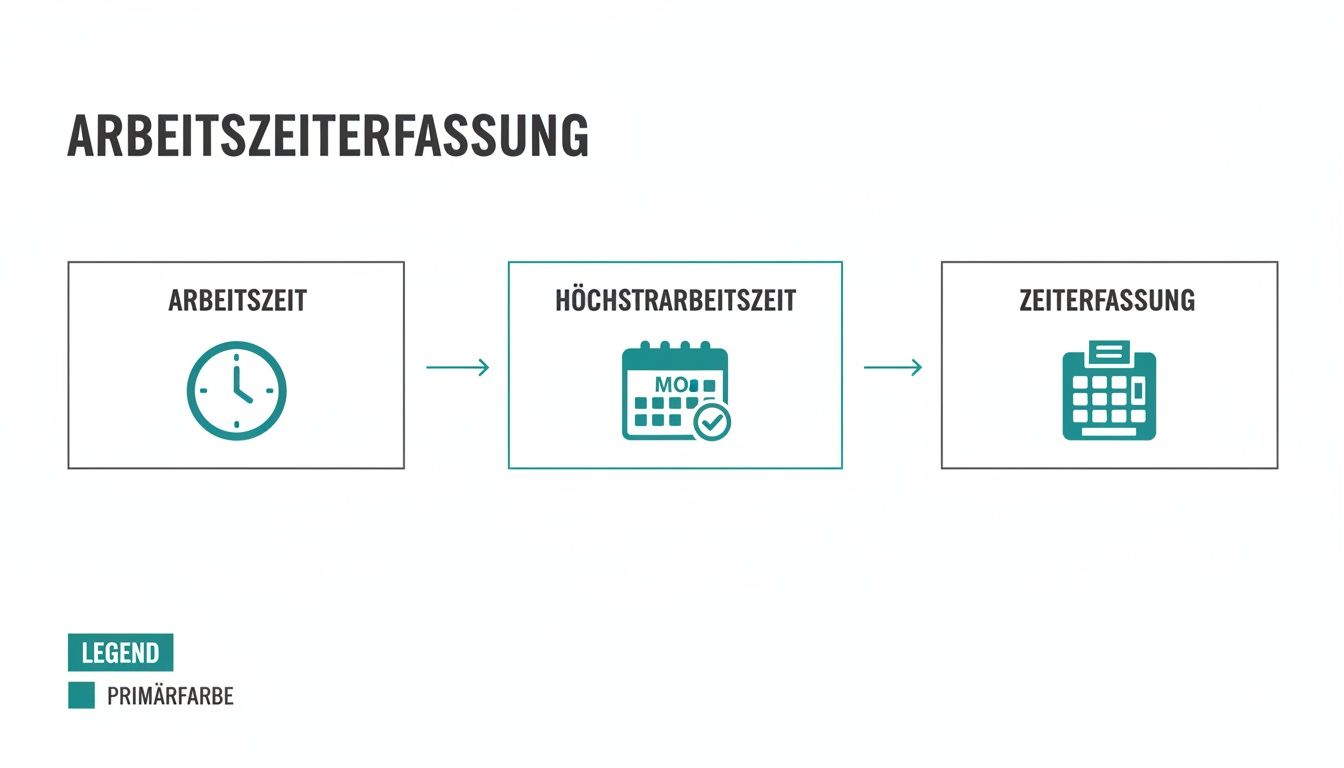
Die Grafik macht deutlich: Ohne eine exakte Erfassung der Arbeitsstunden ist die Einhaltung von Pausen und Höchstgrenzen kaum nachweisbar und kann schnell zu Problemen führen.
Bezahlte vs. unbezahlte Pausen: Wer zahlt?
Eine der häufigsten Fragen ist, ob Pausen zur Arbeitszeit zählen und somit bezahlt werden müssen. Die Antwort hängt von einer einfachen Bedingung ab: Kann die Person ihren Arbeitsplatz verlassen oder nicht?
-
Unbezahlte Pausen:Wenn deine Mitarbeitenden während ihrer Pause den Betrieb verlassen oder sich in einem separaten Pausenraum aufhalten können, gilt die Pause nicht als Arbeitszeit. Das ist der Standardfall.
-
Bezahlte Pausen (Pausen am Arbeitsplatz):If an employee must remain at the workplace for operational reasons – for example, to answer the phone or respond to guests – this “break” counts fully as working time.
Imagine a restaurant: Your chef takes a half-hour break during the quieter afternoon shift. He can go to the break room or step outside for some fresh air. This break isunpaid. However, your receptionist must remain reachable during her break in case the phone rings. Therefore, her break counts aspaid working time
. The distinction is simple but crucial. A real break means that one does not have to be available. As soon as on-call duty is required, it counts as working time.
Daily rest period: The battery needs to be recharged
After a long workday, the body needs time to recover. The L-GAV therefore mandates an uninterrupted daily rest period of at least11 hoursbetween the end of one shift and the beginning of the next.
This rule is particularly important to avoid the dreaded “clopening” shifts, where an employee closes the store late at night and opens it again the next morning. Such shift changes are only permissible if the 11-hour rest period is fully adhered to.
Weekly rest period and days off
In addition to daily recovery, your employees are also entitled to longer, continuous time off. The L-GAV regulates the weekly rest days as follows:
- Two days off per week:In principle, every employee is entitled to two rest days per week.
- 36 continuous hours:At least once a week, a continuous rest period of36 hours(i.e., 1.5 days in a row) must be guaranteed.
- Eight days off per month:Over the course of the month, at least eight days off must be granted.
It is no secret: Switzerland is the European champion in working life. Men work over72,000 hoursin their lifetime, significantly more than in our neighboring countries. This high figure, combined with often long weekly working hours, increases the pressure for a functioning break and recovery regulation. The legal requirement of a 15-minute break after 5.5 hours of work is just the absolute minimum.
Understanding and correctly billing overtime and excess hours
In the hospitality industry, things rarely go exactly according to plan. An unexpected surge of guests, a spontaneous large-scale catering event – and it becomes clear: The team has to work longer. But how do you handle this extra work correctly? The key lies in the distinction betweenovertimeandexcess hours.This is not a play on words, but a legally fundamental difference that determines compensation and compensation.
Those who know and correctly apply these two terms not only create legal certainty for the business but also ensure fairness and transparency within the team. Let’s tackle this topic so that you know exactly what to expect during the next payroll.
The fine but crucial difference
At first glance, the terms sound almost identical, but legally there are worlds between them. This distinction is the basis for every correct billing.
-
Overtimerefers to working hours that exceed the contractually agreed time but are still below the legal maximum limit. If your employee’s contract states42 hours per week, but he works44 hours, then that is2 hours of overtime
-
.Excess hoursonly begin when the legal maximum working time is exceeded. For most businesses in the hospitality sector, this limit is45 hours per week.So if your employee works47 hours, he has3 hours of overtime(from 42 to 45 hours) and2 hours of excess hours
(everything beyond 45 hours).
Why this separation is so important becomes immediately clear when it comes to compensation.
How overtime is compensated or balanced
How you must compensate overtime largely depends on what is stated in the employment contract. The L-GAV provides a clear framework here but also allows for some flexibility.
- In principle, there are two ways to compensate for overtime:Compensation through time off:
- If your employee agrees, overtime can be compensated in the same ratio (i.e., 1:1) with time off. This should, of course, happen within a reasonable timeframe.Payment with a surcharge:If a time-off compensation is not possible or not desired, the overtime must be paid out. Here, the wage surcharge of25%
comes into play.
The 25% surcharge is not set in stone. If something different is agreed in writing in the employment contract (for example, a flat-rate compensation or a waiver of the surcharge) or if compensation is made through time off, it can be waived. A clear regulation in the contract protects both parties from misunderstandings.
The stricter rules for excess hours
Excess hours are about the health protection of your employees, which is why the rules are significantly stricter and non-negotiable. Contractual agreements that disadvantage the employee are invalid here.For every hour of excess work, awage surcharge of 25% is mandatory.Alternatively, compensation through time off is also possible here, but again only with a surcharge. This means: For one hour of excess work,1 hour and 15 minutes
of time off must be granted.There is a small exception for the first60 hours of excess work per calendar year
for office or commercial employees – here the surcharge is waived. However, for your operational staff on the front line, this regulation is hardly relevant in practice.
A practical case study from event cateringImagine you are managing a large music festival with your agency. Your employee Luca has a contract for42 hours per week.The festival week is intense, and he works a total of
50 hours.
- Here’s how to bill this correctly:Contractual working time:
- 42 hoursLegal maximum working time:
- 45 hoursActual hours worked:
50 hours
- The calculation is simple: Overtime:3 hours
- (the difference from 42 to 45 hours) Excess hours:5 hours
(everything that exceeds 45 hours)
- TheFor payroll, this means:3 hours of overtime
- Thecan either be compensated 1:1 with time off or paid out with a wage surcharge of 25% – depending on what the contract stipulates.5 hours of excess work
must be compensated with a surcharge of 25%, either as pay or as time credit.You see: A clean, gapless documentation of each individual hour is essential here. A digital time tracking system is invaluable for keeping track and billing such cases accurately. This ensures that theL-GAV working time and break
regulations are always adhered to.
Handling special cases like night work and holidays safelyWorking in the hospitality industry has little in common with a classic office routine. Night shifts, work on holidays, or complex shift models are not the exception but the rule. Yet these special situations also bring specific rules that you must keep in mind when planningL-GAV working time and breaks.
Those who master these special cases confidently not only protect their team from overwork but also avoid significant legal pitfalls. It’s about guaranteeing fairness – even when the working hours are anything but ordinary.
What counts as night work and how it is compensated
Not every shift that goes late into the evening is automatically considered night work. The L-GAV draws a clear line here: The official period for night work begins at11:00 PM and ends at 06:00 AM.If an employee’s working hours fall within this window, special protection provisions and compensation rules apply.
The most important rule concerns compensation for this special burden. For night work performed, your employee is entitled to a time surcharge of10%.This means: For every hour of night work, he receives six minutes of time credited.
An example from hotel practice: Your night porter works from 11:00 PM to 07:00 AM. Of this, seven hours fall exactly within the defined night period (from 11:00 PM to 06:00 AM). For these seven hours, he receives a time compensation of10%, which amounts to an additional42 minutesper shift. This time must be granted to him as time off.
This time compensation is the standard and must be compensated within one year. A cash payment is only possible in exceptional cases and after mutual agreement. Do you want to dive deeper into the details? Our article on thenight surcharge in Switzerlandexplains everything you need to know.
Correctly planning and billing holidays
For most, holidays are a welcome break – in the hospitality industry, they often belong to the busiest days of the year. Therefore, it is all the more important to regulate work on these days fairly and to compensate correctly so that no one in the team feels disadvantaged.
The L-GAV stipulates that employees are entitled tosix paid holidays per year, including the national holiday on August 1st. Which the remaining five days are can vary from canton to canton.
Here are the key points you should consider when planning:
- Off on the holiday:If a holiday falls on a regular workday and your employee has the day off, he will be paid for that day as if he had worked.
- Working on the holiday:If someone must work on one of their designated holidays, they are entitled to a full replacement rest day. This must be granted within a clearly defined timeframe.
- Holiday on a day off:If a holiday falls on a day when your employee would have had off anyway (for example, their fixed rest day), this does not create a claim for an additional day off.
Open communication about which holidays apply in the business and how compensation is regulated creates clarity and prevents misunderstandings.
Mastering shift work and minimizing strain
Especially in 24/7 operations like hotels or large events, shift work is unavoidable. This places high demands on planning, as you must not only ensure seamless coverage but also keep the health of your team in mind. The irregular rhythm can take a toll over time.
A cleverly thought-out shift plan is essential here. It must not only secure operational processes but also meticulously adhere to the legal rest periods. The11 hours of uninterrupted rest timebetween two shifts is the absolute minimum – this must never be undercut.
To keep the strain on your team as low as possible, there are a few simple but effective levers:
- Plan ahead:Publish the shift schedules as early as possible. This gives your people the chance to organize their private lives.
- Rotate fairly:Ensure a fair distribution of popular and unpopular shifts. No one should be assigned only to night or weekend shifts permanently.
- Consider requests:Give your team the opportunity to express preferences for shifts or days off. Software that queries availability can greatly facilitate this process.
A shift planning that not only follows the L-GAV rules on working time and breaks but also addresses the needs of the employees is a strong sign of appreciation. It contributes to a good working atmosphere and lower turnover.
Your checklist for L-GAV-compliant deployment planning
Now it’s time to get down to business. We’re packing all the theory into a practical checklist that allows you to go through your deployment planning step by step and check for L-GAV compliance. Consider it your personal guide – this way you can immediately see where you’re doing everything right and where there might still be a need for action.
Working time recording and documentation
A seamless documentation is the absolute basis for everything else. Without clean data, you can never prove compliance with the rules regardingL-GAV working hours and breaksin case of an emergency.
- Systematic recording:Do you clock in the working hours for each employee from the start of the shift to the end cleanly and without gaps?
- Definition of working hours:Is everyone in the team clear about what counts as paid working time (e.g., changing clothes on-site, mandatory briefings) and what does not (e.g., the normal commute)?
- Accessibility:Can your people easily view their recorded hours at any time? Transparency builds trust.
- Archiving:Do you securely store all time data so that you can still trace it infive years?
A digital time recording system is not a nice extra here, but a necessity. It prevents careless mistakes, gives you legal certainty, and saves an incredible amount of time at the end of the month during payroll processing.
Breaks and rest periods
Breaks and rest periods are not a “nice-to-have”, but a legal obligation. They protect your team from overwork and are non-negotiable.
- Break regulation:Does everyone receive their well-deserved break after a maximum of5.5 hoursof work? Do the lengths of breaks correspond to the duration of the shift (i.e., 15, 30, or 60 minutes)?
- Unpaid breaks:Is it ensured that employees can leave the workplace during unpaid breaks and freely manage their time? They must not be on call during this time.
- Daily rest period:Is there always a minimum of11 hoursof uninterrupted free time between the end of the shift and the start of the next shift?
- Weekly rest days:Do you guarantee two days off per week, of which at least36 hoursare consecutive?
Overtime, extra time, and special cases
When it takes longer again, it must be handled fairly and correctly. This not only prevents legal problems but is also a matter of respect towards your team.
- Distinction:Do you clearly separate in your recording between overtime (everything above the contractual requirement) and extra time (everything above the legal maximum)?
- Compensation for extra time:Is extra time consistently compensated with a surcharge of25%either as pay or as time off?
- Contractual regulation:Is it clearly and unambiguously stated in the employment contract how overtime is handled – i.e., compensation or payment?
- Night work:Do you record shifts between 11:00 PM and 6:00 AM separately and grant the required time surcharge of10%?
- Public holidays:Is the compensation for work on public holidays clearly regulated and is it consistently implemented?
This checklist helps you keep an eye on the most important levers. Do you want to improve your time recording? Then take a look at ourtemplate for time recording– it’s the perfect starting point.
Frequently asked questions about L-GAV working hours and breaks
In everyday work, the same questions keep coming up. Here we provide you with clear and practical answers to the most common uncertainties regardingL-GAV working hours and breaks, so you can quickly regain clarity.
Does changing clothes count as working time?
Yes. If wearing specific work clothing is mandatory and changing must take place on-site, then this time also counts as working time. It may only be a few minutes per day, but it must be recorded and paid.
Do I have to pay for breaks?
It depends. The crucial question is: Can your employee leave the workplace during the break? If so, the break is considered unpaid. However, if they must remain at their place for operational reasons – for example, for telephone service – then the break counts as working time and must be compensated.
How many breaks are mandatory?
The duration of the break directly depends on the length of the shift. The breakdown is simple:
- For more than5.5 hoursof work: at least15 minutesof break.
- For more than7 hoursof work: at least30 minutesof break.
- For more than9 hoursof work: at least60 minutesof break.
These breaks do not have to be taken all at once. They can be split up as long as the total duration is correct at the end of the day.
What happens if the 11-hour rest period is not adhered to?
The daily rest period of11 hoursis not a guideline but a mandatory protective regulation. It cannot be ignored. A shortfall is only permitted in absolute, legally clearly defined exceptional cases and must then also be compensated. In normal operations, compliance is mandatory.
Can employees waive the 25% surcharge for overtime?
Yes, that is possible, but only under strict conditions. A waiver of the surcharge or a deviating regulation must be documented in writing in the individual employment contract. But beware: This only applies to overtime. For extra time, the surcharge of25%is always mandatory and cannot be contractually excluded.
Do you want to finally simplify your deployment planning, time recording, and payroll processing while working in compliance with L-GAV?job.rocksoffers you the perfect digital solution to minimize administrative effort and manage your team fairly and transparently. Learn more athttps://job.rocks