
The Onboarding process of new employees is the all-important phase. This determines how quickly and successfully new team members really integrate into your company. A clearly structured process leads to high employee loyalty and rapid productivity. A chaotic start? Unfortunately, this often ends in early termination.
Why a good start changes everything

Hand on heart: The time between signing the contract and the first day of work is a delicate phase. This is where it is decided whether your new employee's initial enthusiasm remains or turns into uncertainty. A well thought out one Onboarding process of new employees is much more than just an administrative exercise. It is your most powerful tool for retaining talent long-term and building a positive, productive relationship from day one.
Especially in industries with a high need for personnel and a lot of flexible workers - imagine events, catering or healthcare - a smooth start is worth its weight in gold. The aim here is to get people up and running quickly without sacrificing a personal greeting.
The importance of preboarding
The actual training begins before the first coffee is drunk in the office. This phase, known as preboarding, is your best chance to make a professional and appreciative first impression. Instead of leaving new team members guessing, you can actively organize this time. Imagine sending a friendly email a week before the start that clarifies all the important questions.
- Reduce uncertainty: A friendly email a week before the start with the most important information works wonders. Where to go on the first day? Who is the first point of contact? Is there a dress code?
- Increase anticipation: A small welcome package that arrives in the mail in advance or a digital greeting from the future team - these are small gestures with a big impact.
- Overcome administrative hurdles: Complete as many formalities as possible in advance and digitally. Sending and signing contracts or collecting personnel data can now be easily done online.
A structured start makes the difference. Studies show that employees who experience positive onboarding are significantly more likely to stay with the company for longer than three years.
Practical example from the event industry
Imagine an event agency that has to coordinate dozens of helpers at short notice for a large festival. Instead of calling each individual and manually sending documents via email, the agency relies on a platform like job.rocks.
As soon as a helper agrees, the system automatically sends a digital welcome package. This contains the contract for the digital signature, a link to the employee app and initial information about the location. The new employee can immediately enter their availability and upload the necessary documents. This automated process not only saves a huge amount of time - it conveys professionalism right from the start and inspires the new team member.
Especially in Switzerland, where around 56% of companies are struggling with the shortage of skilled workers, such a process becomes a clear competitive advantage. It helps to fill vacancies more quickly and reduce fluctuation. You can find more background information on this in the current employer branding study. In order to ensure the long-term success of your company, it is crucial advanced onboarding strategies like Ultra Onboarding to invest that goes far beyond the basics.
Your preboarding checklist for the phase before day one
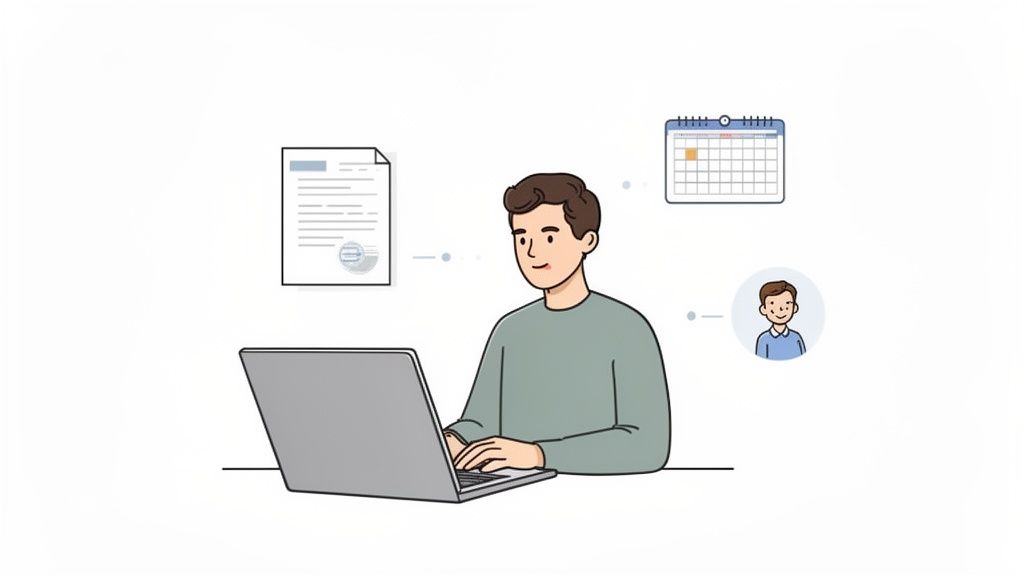
The time between signing the contract and the first day of work is a golden but often wasted opportunity. A really strong one Onboarding process of new employees starts right here, in preboarding. It's your opportunity to eliminate uncertainty, overcome administrative hurdles digitally and build positive relationships before your new team member even sets foot in the office.
Good preparation is more than just organization – it is a sign of appreciation. Instead of spreading hectic and chaos on the first day, you convey professionalism and structure. This is crucial because it is frightening 36% of the companies surveyed have already experienced layoffs before the first day of work has even begun. The reason? Mostly false expectations or lack of communication in this critical phase.
Complete administrative tasks digitally
Let’s be honest: Nobody wants to start their first day at work with a pile of paperwork. You can now handle many administrative tasks digitally in advance and in compliance with GDPR. This not only relieves you, but also your new team member.
Imagine you’re hiring a new security guard. Instead of handing them forms on the first day, you send them via a platform like job.rocks automatically a link to the employee app. There he uploads all the necessary documents safely and conveniently from home.
The following tasks can be easily digitized:
- Collect personnel data: Master data, bank details and social security number can be obtained using a secure online form.
- Sign contracts digitally: Qualified electronic signature tools eliminate the need for postal mail and speed up the entire process.
- Collect qualifications and certificates: This is a must, especially in regulated industries such as security or healthcare. Employees can upload their evidence directly into the app.
Ein durchdachtes Preboarding sendet eine klare Botschaft: "Wir sind vorbereitet und wir freuen uns auf dich." Diese Geste ist unbezahlbar und legt den Grundstein für eine langfristige, loyale Zusammenarbeit.
Prepare technology and work equipment
Nothing is more demotivating than a first day at work when your laptop is missing or the access doesn't work. Complete organization of the technical equipment is a clear sign of professionalism. Make sure everything is ready from the start.
Your technology checklist
| Task | Responsible (example) | status |
|---|---|---|
| Order and set up a laptop/PC | IT department | Completed |
| Create an email account | IT department | Completed |
| Apply for access to software (e.g. CRM, project tools). | Team leadership | Completed |
| Provide phone and other hardware | Office management | Completed |
This preparation ensures that new employees can be productive from the very first moment and do not have to deal with technical glitches.
Promote social integration right from the start
Preboarding is much more than just administration. It is the first, crucial opportunity to socially integrate your new team member into the team. Because the feeling of belonging doesn't just arise on the first day of work.
A simple but extremely powerful step is to assign one Buddies. This colleague serves as an informal contact person for all the small questions that you might not dare ask your superior directly. The buddy can introduce himself before the first day via email or via the team chat.
More ideas for early social inclusion:
- A welcome email from the team: A short, personal message from future colleagues sharing their excitement.
- Invitation to an informal virtual coffee: A casual 15-minute video call with the buddy or a few team members a week before launch.
- Providing an organizational chart: An overview of the team and important contacts helps enormously with orientation.
These small gestures make your new team member feel like a part of the whole rather than a stranger. This proactive approach in Onboarding process of new employees pays off through higher motivation and significantly faster integration.
The plan for the first day and the first week
The first impression counts – and the first day at work especially. These first few hours are absolutely crucial for the whole thing Onboarding process of new employees. An honest, warm welcome and a clear structure ensure that new team members feel valued and in good hands from the very first moment.
Eine durchdachte Begrüßung ist so viel mehr als eine schnelle Vorstellungsrunde im Flur. Es geht darum, eine Atmosphäre zu schaffen, die signalisiert: "Wir haben auf dich gewartet und freuen uns, dass du da bist." Ein fertig eingerichteter Arbeitsplatz, ein kleines Willkommensgeschenk oder ein persönliches Gespräch mit The direkten Führungskraft sind kleine Gesten mit riesiger Wirkung. Überleg doch mal, statt The üblichen Büroartikel creative employee gifts to provide solutions that really fit your company culture.
The timetable for the first day
The first day should be a good mix of important information, social contacts and initial small insights into future tasks. The goal is to provide orientation without overwhelming the new person.
Imagine a new waitress in a hotel. Your first day might go something like this:
- Personal Greeting: The hotel manager consciously takes time for a short conversation, explains the vision of the hotel and hands over a personalized induction plan.
- Team introduction: An assigned buddy leads you through the house and introduces you not only to the service team, but also to the kitchen crew and reception - because everyone works hand in hand here.
- Practical organization: She receives her work clothes, the locker key and a short introduction to the mobile app for shift planning, in which her first assignments are already visible.
- Lunch together: The entire team eats together to get to know the new member in a casual, relaxed atmosphere.
A well-structured first day reduces nervousness and immediately creates trust. It shows the new employee that their arrival was expected and that the company really wants to invest in their success.
In order not to lose sight of the most important tasks on the first day, a simple checklist has proven useful. It provides clarity and ensures that everyone involved knows what needs to be done.
Checklist for the first day of work
Here is a simple template that you can easily adapt to your needs to ensure a smooth process.
| Task | Responsible (example) | status |
|---|---|---|
| Personal welcome & handover of the plan | Sarah (team leader) | ☐ |
| Setting up a workplace (laptop, access points) | IT department / Jonas | ☐ |
| Team introduction & tour | Alex (buddy) | ☐ |
| Handing out keys & work clothes | HR / Maria | ☐ |
| Explanation of time recording & break rules | Sarah (team leader) | ☐ |
| Organize lunch together | Alex (buddy) | ☐ |
| First check-in at the end of the day | Sarah (team leader) | ☐ |
With a list like this you can ensure that the administrative and social points are covered evenly and that your new team member feels professionally looked after from the start.
Structure the first week
The first week is about deepening the impressions of the first day. The focus now is on really experiencing the corporate culture, understanding the core processes and taking on initial, manageable tasks independently. A rough weekly plan helps to clearly define the learning goals and avoid being overwhelmed.
Well-prepared documents are worth their weight in gold for effective knowledge transfer. It's worth investing time to summarize the most important information in a clear and understandable way. Here you will find valuable tips on how to perfect handouts for studies and work design – the principle can be transferred 1:1 to onboarding.
The importance of social and cultural integration is often massively underestimated. A study shows that 86% of Swiss companies see a significant need for action in their onboarding process. Social and value-oriented integration is often neglected, even though it is absolutely crucial for long-term employee loyalty.
Schedule regular check-ins
Questions constantly arise, especially in the beginning. Short, daily check-ins with the manager or buddy are therefore essential. These 10-minute conversations in the morning or at the end of the day are perfect for immediately clearing up any confusion and sharing feedback.
Example questions for a check-in:
- How has your day been going so far?
- Was there anything that surprised you – positively or negatively?
- Where do you still need support or more information?
- Have you already met all the colleagues who are important for your current tasks?
These regular conversations not only show genuine interest, but also help to identify potential hurdles at an early stage Onboarding process of new employees to continually improve. This way you can ensure that the training stays on track and that your new talent can fully concentrate on the new tasks.
The 30-60-90 day plan for sustainable success
A good one Onboarding process of new employees is not a sprint that ends abruptly after the first week. The truly deep and sustainable integration happens in the first three months. This is exactly where the 30-60-90 day plan comes into play - it is your roadmap that provides orientation, clarifies expectations right from the start and creates a clear, motivating structure for onboarding.
This plan breaks down what can often be an initially overwhelming phase into three manageable sections. This way you avoid new employees being flooded with information and instead ensure a realistic and motivating learning curve. For you as a manager, it is the perfect tool to accompany progress and offer support exactly when it is needed.
The first 30 days: learning and observing
The first 30 days are all about arriving, listening and understanding. Your new team member should absorb the basics of the job, the most important processes and the company culture - without the pressure of having to deliver top performance immediately.
The focus is clearly on building knowledge. This is the phase in which countless questions are asked and the assigned buddy or mentor plays a central role. The goal is not perfection, but rather a solid foundation on which everything else can be built.
Specific goals for this phase could be:
- Understand core tasks: What are the day-to-day responsibilities and how do they fit into the bigger picture?
- Get to know important contacts: Who are the key people in your own team and in related departments?
- Master systems and tools: A secure application of the basic software and tools necessary for daily work.
- Absorb corporate culture: Experience the unwritten rules, communication channels and shared values in everyday life.
At the end of these 30 days there will be a first formal feedback discussion. Here you compare expectations, clarify open questions and set the goals for the next stage together.
Day 31 to 60: Active participation and initial responsibility
Once the basics are in place, the phase of active participation now begins. Your new team member should now start taking on their first smaller projects or tasks independently. It's about putting what you've learned into practice and taking on more responsibility step by step.
During this time, self-confidence grows and your new employee becomes increasingly a productive part of the team. He or she should now be able to get by with less direct guidance and actively participate in team meetings.
A structured plan shows new employees a clear path to success. It transforms initial uncertainty into targeted action and promotes the feeling of being able to quickly make a valuable contribution.
The following infographic shows important milestones that lay the foundation for a successful 30-60-90 day plan in the first few days.
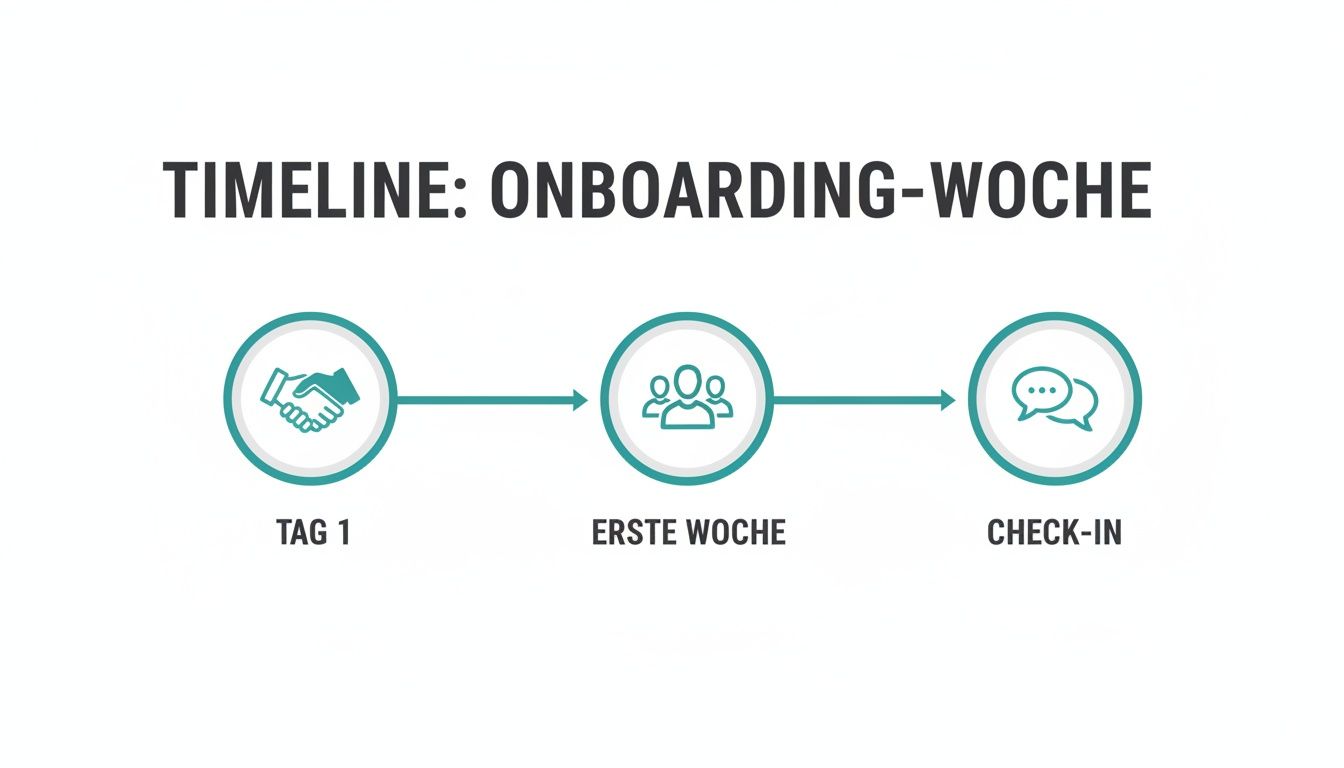
This visualization makes it clear how important a well-thought-out sequence of greetings, team integration and regular conversations is in the very first week.
Example logistics employee (days 31-60)
| Goal | Specific task |
|---|---|
| Support tour planning | Plan a simple delivery route independently with guidance. |
| Apply warehouse processes | Process and document a complete goods receipt independently. |
| Communication with drivers | Act as the first point of contact for drivers in the event of minor problems. |
The feedback discussion after 60 days focuses on previous performance, teamwork and where there may still be a need for training.
Day 61 to 90: Independence and initiative
The final phase of the plan aims to fully integrate the new employee into their role. He or she should now be able to carry out tasks largely independently and proactively contribute their own ideas or suggestions for improvement.
Now the true success of the training becomes apparent. Your team member not only understands their own tasks, but also how their own work contributes to the success of the entire company.
Example Healthcare Nurse (Days 61-90)
- Assuming full patient responsibility: Independent care of an assigned group of patients, including documentation and communication with physicians.
- Training new interns: Take on initial instructional tasks and pass on knowledge to new, inexperienced colleagues.
- Suggest process improvement: Develop an idea to improve the morning handover and present it to the team.
The final interview after 90 days serves as a review of the entire induction phase and an outlook on future developments in the company. It's also the perfect time to provide feedback Onboarding process of new employees to catch up yourself. In order to have such conversations constructively, it can help to use methods Evaluating superiors and giving feedback to familiarize.
In the end, such a plan is not a rigid corset, but a flexible framework that you should always adapt to the respective role and person. It ensures transparency, promotes motivation and lays the foundation for long-term and successful collaboration.
How to digitize and automate your onboarding
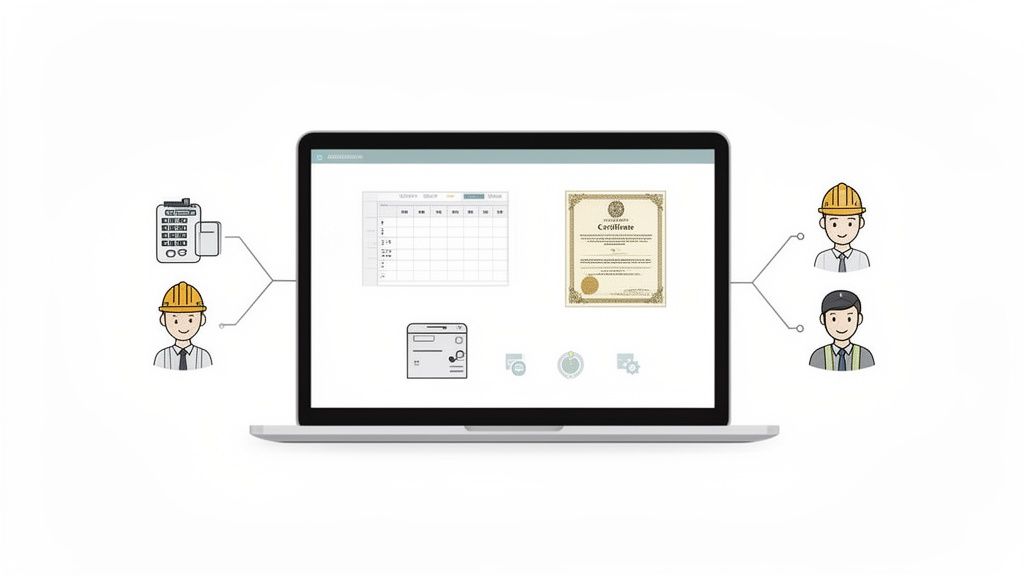
Hand on heart: Manual processes in Onboarding process of new employees are not only tedious, they are also a huge source of errors. Paperwork, endless email chains and forgotten tasks cost you valuable time and nerves. Worse, they leave new team members with a messy first impression. The good news is: With the right digitalization and automation, you can take the whole process to a new level.
Automation takes the repetitive, administrative tasks off your hands. This creates freedom so that you can concentrate on what really counts: personal support and building a real relationship with your new employee. A digital platform bundles all information in a central and secure location.
Which steps are suitable for automation?
Of course, not every part of onboarding should be automated - a personal greeting on the first day is and remains irreplaceable. But many administrative hurdles can be perfectly digitized, which provides you with enormous relief in your everyday life.
Here are a few typical tasks you can automate right away:
- Digital contract signing: No more paperwork. Simply send contracts via link and have them signed with a qualified electronic signature. This is quick, legally secure and protects the environment.
- Automatic data collection: Instead of laboriously filling out personnel forms, new employees enter their master data, bank details or social security number directly into a secure online portal. Error-free and immediately available.
- Provision of information: Once a contract is signed, the system can automatically send a welcome email with all the important information for the first day. Without any action on your part.
- Qualifications and availability query: A big advantage, especially with flexible workers. Record qualifications and availability digitally and use this data directly for deployment planning.
A digitalized onboarding process not only reduces administrative effort. It also ensures that all steps are GDPR-compliant by managing personnel data centrally and securely.
A practical example from personnel placement
Imagine you have an agency that provides short-term staff for events or catering. A customer calls: He urgently needs ten service staff with catering experience for tomorrow evening.
Without automation, the stress begins: You dig through Excel lists, write countless emails and make dozens of phone calls. A slow, inefficient and extremely error-prone process.
Mit einer Plattform wie job.rocks sieht die Welt ganz anders aus. Du erstellst den Einsatz, und das System filtert sofort alle Mitarbeitenden in deinem Pool, die die Qualifikation "Catering-Erfahrung" besitzen und sich für morgen Abend als verfügbar gemeldet haben. Diese Kandidaten erhalten umgehend eine automatisierte Einladung per App oder E-Mail. Die ersten zehn, die zusagen, werden automatisch für den Job gebucht. The ganze Vorgang? Dauert oft nur wenige Minuten.
More than just efficiency: compliance and data security
A digital one Onboarding process of new employees goes far beyond just saving time. It is a central building block for your compliance, especially with regard to the strict General Data Protection Regulation (GDPR).
Advantages for data security at a glance:
| aspect | Manual process | Digital process |
|---|---|---|
| Data storage | Documents are scattered in email inboxes, on local drives or in paper files. | All personnel data is stored centrally in a secure database. |
| Access control | Who is allowed to access which data is often unclear and difficult to control. | Role and rights concepts precisely control who can see and edit which information. |
| Extinguishing concepts | Legal retention periods and the punctual deletion of data are quickly overlooked. | Automated routines help to securely and verifiably delete data after the deadlines have expired. |
If you would like to delve deeper into this topic, see our article about it Digitalization in the human resources area further valuable insights.
By centralizing and automating, you not only create a faster and more professional onboarding process, but also actively minimize legal risks. You ensure that the entire life cycle of employee data - from hiring to leaving - is documented cleanly and completely.
The most frequently asked questions about the onboarding process
A well-planned onboarding often raises very specific questions in practice. Here I have collected the most common ones for you and will give you clear, tried-and-tested answers. This way you avoid the typical cliffs right from the start.
How long should an onboarding process actually take?
Of course, it's difficult to say in general terms, but there is a good rule of thumb: a truly comprehensive induction process should extend over the entire probationary period. These are usually three to six months.
Of course, the most intense phase takes place in the first few weeks. This is about creating the basics. But sustainable integration, where new team members really feel like they belong and are productive – that takes time. Structured concepts like that 30-60-90 day plan are the perfect tool for this.
For short-term or flexible employees, such as those you know from the event industry or catering industry, the process obviously needs to be streamlined. Nevertheless, you should never do without the essential building blocks:
- A crystal-clear introduction to the tasks and expectations.
- The introduction of the most important contact persons.
- The social connection to the direct team.
This is where digital tools can work wonders by making the most important information accessible quickly and at any time.
What are the biggest onboarding mistakes?
Many companies keep stumbling over the same hurdles that could actually be easily avoided. The most common mistake is one lack of preparation. Imagine that on the first day the laptop is missing, the access doesn't work or no one really has time - that's pure poison for motivation.
Another classic is purely technical training. New employees are overwhelmed with processes and to-dos, but social integration and the communication of corporate culture fall by the wayside. Studies show that positive induction massively increases the likelihood that employees longer than three years stay in the company.
The biggest mistake is to mark the process as “done” after the first week. True integration is a marathon, not a sprint. Regular feedback and clear development goals are crucial for long-term success.
And lastly: off-the-shelf onboarding doesn't work. The process for a festival helper who is only on duty for a weekend must be more agile and focused than that for a permanent office worker.
How do I measure whether my onboarding process is achieving anything?
The success of your onboarding can be measured in hard numbers. In this way, you can finally make the value of your efforts visible and see where there is still room for improvement. Don't just rely on your gut feeling, use clear metrics.
Important key figures for measuring success:
- Fluctuation rate during the probationary period: How many new employees quit in the first six months? A high rate is a clear red flag for your onboarding.
- Time to full productivity: How long does it take for a new team member to actually complete their tasks independently and efficiently? Digital tools help track this progress.
- Satisfaction of new employees: Regular, short surveys (for example after 30, 60 and 90 days) provide you with direct and unvarnished feedback on the quality of your process.
- Feedback from superiors and colleagues: How do the direct contacts assess the integration and progress? This qualitative assessment is the perfect complement to the hard numbers.
Modern, digital platforms help you to automatically collect and evaluate much of this data. This way you can see at a glance whether your Onboarding process of new employees delivers the desired results or whether you need to readjust.
Are you ready to digitize and finally automate your onboarding process? job.rocks offers you the perfect platform to train new employees more quickly, efficiently and professionally. Schedule your free demo on job.rocks today and discover how you can reduce administrative hurdles and gain more time for what matters.