
Your net wage is the money that after all deductions actually ends up in your bank account. It is the amount you use to pay for your rent, groceries and leisure time. While the gross wage is your contractually agreed salary before deductions, the net wage represents your actually disposable income.
What your net salary really means
Have you ever wondered why there is a much nicer number on your employment contract than on your bank statement at the end of the month? The answer lies precisely in the difference between gross and net wages - and this detail is crucial for your entire financial planning.
It's best to imagine your gross salary like a freshly baked cake. Before you get your piece, several parts of it are diverted for important purposes. These parts are statutory contributions and taxes. What's left for you in the end is the net salary - the piece of cake that you can actually enjoy.
The most important deductions at a glance
Every single deduction from your gross wages serves a clear purpose and protects you for various situations in life. The biggest chunks are social security contributions. They form the foundation of the social network in Switzerland.
These contributions flow into different pots that support you exactly when you need it most:
- Retirement provision: Protects your income when you retire.
- Disability protection: Offers financial help should you become unable to work.
- Income replacement: Steps in if you do military service or go on maternity leave.
- Unemployment: Covers you financially if you lose your job.
The net wage is much more than just a number on your payslip. It is the result of a clever system that gives you security and stability while shaping your financial present.
The exact amount of deductions depends on your income, of course, but the contribution rates are clearly regulated by law. So that you can keep track of things, we have broken down the most important items for you.
The most important wage deductions at a glance
This table shows you which contributions are deducted from your gross salary and what they are used for.
| Deduction | Purpose | Typical contribution rate in % |
|---|---|---|
| AHV/IV/EO | Old age and survivors' insurance, disability insurance, income compensation scheme | 5,300% |
| ALV | Unemployment insurance | 1,100% |
| Pension fund (BVG) | Occupational pension provision for old age | Varies (approx. 7-18%) |
| NBU | Non-occupational accident insurance | Varies (approx. 1-3%) |
| Withholding tax | Direct tax for foreign employees without a C permit | Varies depending on canton and municipality |
This way you can see exactly where part of your salary goes and what direct benefit you will ultimately get from it.
The journey from gross to net – your deductions in detail
The path from your agreed gross salary to the amount that actually ends up in your account is a short journey. Every single deduction on your payslip plays an important role and finances a social safety net that protects you in different phases of your life.
You can best imagine the whole thing as a hierarchy: at the top is the full gross amount, in the middle the various deductions branch off, and at the bottom is the net wage that will be paid to you.
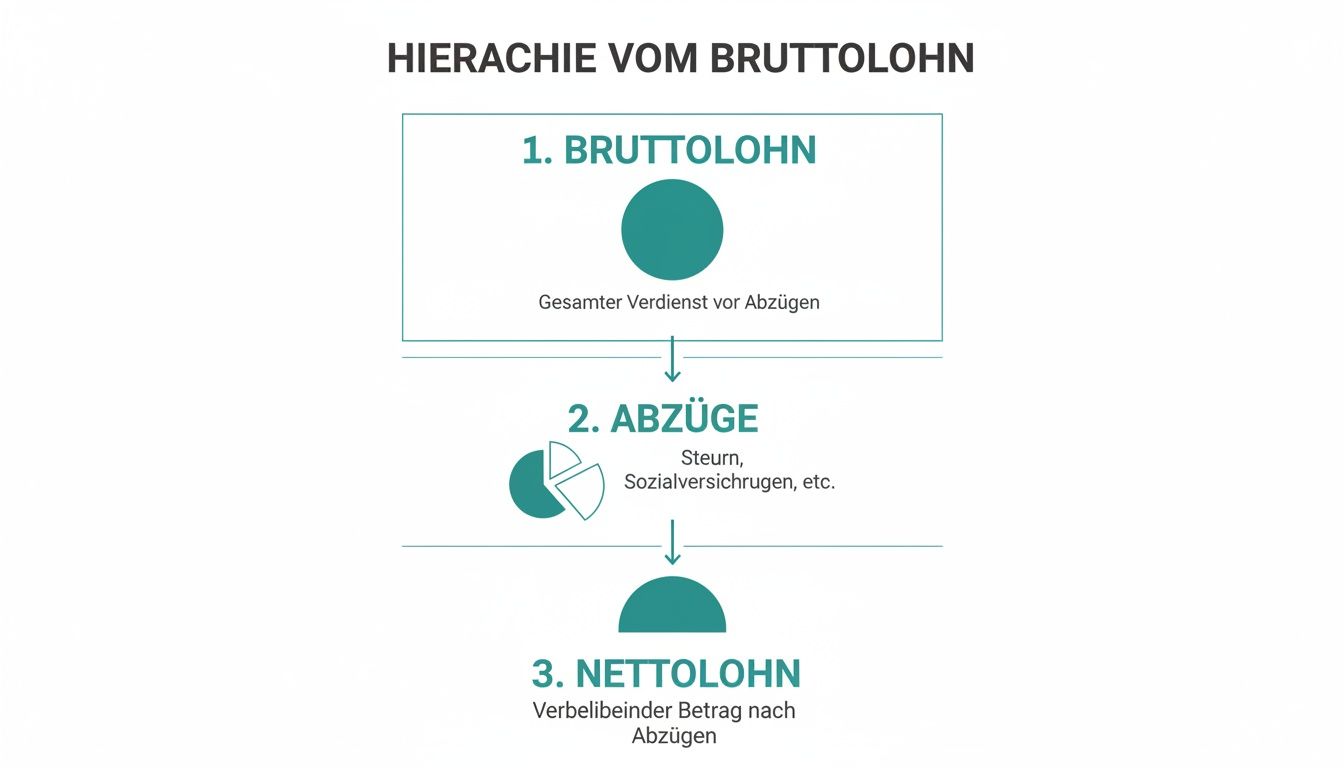
The graphic makes it clear: Your net salary is the direct result of the contributions deducted - money that works for your future and your security. Now let's take a closer look at these deductions.
The pillars of your social security
The largest items are social security contributions. They are required by law in Switzerland and protect you and your family against the basic risks of life.
- AHV/IV/EO: These three insurance policies are always billed as a package. Old-age and survivors' insurance (AHV) is the basis of your pension. Disability insurance (IV) kicks in if you become unable to work. And the income replacement scheme (EO) secures your income if you do military service or become a mother.
- ALV (unemployment insurance): This article will help you if you lose your job through no fault of your own. It provides you with a replacement income for a certain period of time while you reorient yourself.
The great thing about it: These contributions are financed equally. This means that your employer will pay exactly the same amount on top of that for you. So you only pay half.
Prevention and protection in everyday working life
In addition to these basic social security benefits, there are two other important deductions that are directly related to your employment.
Your payslip is more than just a statement. It is proof of the protection that you build up month after month - from the pension fund to accident protection.
On the one hand there is this Occupational pension provision (BVG), better known as pension fund. It forms the second pillar of your retirement provision and is mandatory above a certain annual income. Their goal is to ensure that you can maintain your usual standard of living as you age.
On the other hand, there is that Non-occupational accident insurance (NBU). It protects you from the financial consequences of an accident that happens in your free time. Accidents at work are insured through your employer, but only the NBU gives you all-round protection.
If you understand your deductions, you can also identify savings potential. For example, there are ways like you Deduct travel expenses from taxes and thus reduce your tax burden.
Don’t forget regional wage differences
Where in Switzerland you work has a major influence on your gross wages and therefore on the basis for all these deductions. The regional wage differences are significant and have a direct impact on personnel costs in the cantons.
The gross median wage varies greatly: While the national average was 7,024 francs, the median wage in the Zurich region was 7,502 francs, while in Ticino it was only 5,708 francs. That's a difference of almost 1,800 francs or around 31 percent between the highest and lowest regions.
Theory is one thing - but it's only when you see the numbers in black and white that things really become tangible. So let’s take a look at what the journey from gross to net pay looks like in practice. We start simple and then increase step by step.
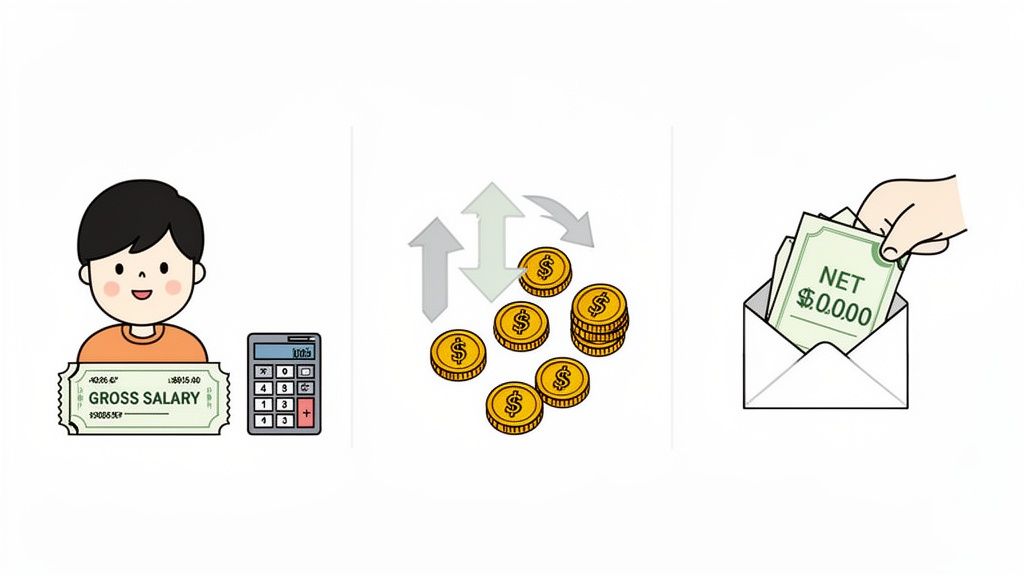
Example 1: Young employee, single, without children
Marco is 22, single and works full time in the logistics industry. His gross monthly salary is 4,500 CHF. Since he is still young and has no children, his deductions remain fairly manageable.
This is what his payslip looks like:
- Gross wage: 4,500.00 CHF
- AHV/IV/EO (5.3%): -238.50 CHF
- ALV (1.1%): -49.50 CHF
- Pension fund (BVG, approx. 7%): -315.00 CHF
- NBU (approx. 1%): -45.00 CHF
- Total deductions: -648.00 CHF
Marco's net salary: 3,852.00 CHF
This exact amount ends up in his account at the end of the month. It is the basis for his monthly budget. Speaking of budget: If you plan your expenses, you should know all the big items. A decisive factor is this Difference between cold and warm rent, which can quickly amount to a few hundred francs.
Example 2: Part-time in the event industry with withholding tax
Elena, 30 years old, actually lives in Germany, but is temporarily working for an event agency in Zurich. This means: It is subject to withholding tax. It comes up in a month with many missions 100 working hours with a gross hourly wage of 35 CHF.
Your billing is a bit more complex:
- Calculate gross wages: 100 hours × 35 CHF/hour = 3,500.00 CHF.
- Calculate social deductions:
- AHV/IV/EO (5.3%): -185.50 CHF
- ALV (1.1%): -38.50 CHF
- There is no BVG deduction for her because, as a temporary employee, she is below the entry threshold.
- NBU (approx. 1.5%): -52.50 CHF
- Deduct withholding tax: The rate depends heavily on the canton, marital status and income. Let's take a fictitious sentence here 8% to.
- Withholding tax (8% of 3,500 CHF): -280.00 CHF
- Total deductions: -556.50 CHF
Elena's net salary: 2,943.50 CHF
Especially with hourly wages, it is absolutely crucial to accurately record working hours. Would you like to know more about it? Check out our post on how to calculate the working hours per month to.
Example 3: Employees with children and higher wages
Sarah is 42, married and mother of one child. She has a permanent job in the hospitality industry and earns gross 6,800 CHF. Both their age and marital status affect the deductions.
Your billing in detail:
- Gross wage: 6,800.00 CHF
- AHV/IV/EO (5.3%): -360.40 CHF
- ALV (1.1%): -74.80 CHF
- Pension fund (BVG): Your contribution is higher due to your age. Let's assume it's included 9%, what -612.00 CHF corresponds.
- NBU (approx. 1.2%): -81.60 CHF
- Total deductions: -1,128.80 CHF
Sarah's net salary: 5,671.20 CHF
An interesting fact on the side: Unfortunately, gender still influences wage levels in Switzerland. The gross monthly median wage for men was recently 7,276 francs, while women have a median wage of 6,666 francs earned - that's a difference of 8.4 percent. You can find out more about the current wage statistics directly on the Website of the Federal Statistical Office.
Why the net wage is so important for employers
So far we have looked at net wages primarily from the employee perspective. But what does it actually mean for companies, event agencies or recruiters? Here, a deep understanding is at least as crucial, because it is about much more than a punctual transfer.
For employers, correct payroll accounting is one of the absolute core tasks. Mistakes not only cause dissatisfied employees, but can also quickly lead to legal consequences. Proper wage preparation is therefore the foundation for trusting cooperation and a stable team.
Keep an eye on the total costs
A common mistake is to only view gross wages as a cost factor. The true personnel costs, often also as Employer gross referred to as, are significantly higher. In addition to your employee's gross wage, there are also the employer's social security contributions, which the company must also pay.
This total burden is the key to realistic budget planning. Regardless of whether you are calculating a large event, have to staff a temporary project or are planning for the long term - only those who know all the additional wage costs can really set up their prices and budgets precisely.
Transparent and error-free payroll is not a luxury, but a sign of professionalism and appreciation. It creates trust and is the foundation for a long-term bond between you and your team.
Transparency creates trust and security
Particularly in the flexible working world, be it for temporary assignments or in the gig economy, traceable payroll is worth its weight in gold. Employees who understand how their net salary is made up feel that they are being treated fairly. This avoids unnecessary misunderstandings and massively strengthens trust in you as an employer.
Automated processes, such as those offered by modern workforce management systems, play a crucial role here. They significantly minimize the error rate when recording time and preparing wages - a blessing, especially when it comes to complex billing with variable hours and surcharges.
The wage development in Switzerland underlines how important precise calculation has become. The gross monthly median wage for a full-time position recently climbed 7,024 Swiss francs, an increase of 3.5 percent compared to the previous year. This shows how crucial precise planning of labor costs is in order to remain competitive. You can find more details about this in this article current wage developments in Switzerland on srf.ch.
Ultimately, a clear understanding of the net salary on both sides ensures smooth cooperation. For your employees it means financial clarity, for you as an employer it is a central building block for economic success and a satisfied team.
Avoid typical mistakes in payroll accounting
Mistakes in payroll accounting are more than just annoying - they can be expensive and permanently undermine team trust. Even small inattentions quickly add up to a major problem. That's exactly why it's so important to know the most common pitfalls and how to avoid them gracefully.
One wrong click, one piece of outdated information, and it's done. The classics include incorrectly applied social security contribution rates or incorrect calculation of withholding tax. Overlooking allowances or incorrectly billed allowances are also typical sources of error that directly reduce your net salary.

The consequences range from annoying back payments to serious legal consequences for the employer. For you as an employee, such mistakes primarily mean uncertainty and the tedious effort of initiating corrections.
Common stumbling blocks in practice
Let's take a look at some of the typical mistakes that happen again and again and that you should check on your own payslip. It's often the little details that make the difference.
- Incorrect withholding tax rates: The withholding tax rate is a complex structure that depends on the canton, municipality, marital status and even denomination. An incorrect assignment leads directly to an incorrect net wage.
- Child allowances not taken into account: If child allowances are forgotten or calculated incorrectly, you will be short of cash at the end of the month. This happens faster than you think.
- Incorrect BVG deductions: Especially when changing jobs or adjusting the level of employment, it can happen that the contribution to the pension fund is calculated incorrectly.
- Forgotten expenses or surcharges: Have all expenses been recorded correctly? Are the surcharges for special working hours calculated correctly? Such details are crucial. Find out more about when you can get one here Entitlement to a night supplement in Switzerland have.
Correct payroll is not a product of chance. It is the result of careful processes and the right tools that reduce human errors to a minimum.
This is how you protect yourself from mistakes
The good news is that most of these mistakes can be avoided. The first and most important step is always to take a close look at your payslip every month. Compare it with the previous month and if anything is unclear, contact the HR department immediately.
Modern software solutions for time recording and wage preparation are a real game changer here. They automate the collection and transfer of data to payroll accounting. Instead of laboriously transferring timesheets by hand, the data flows digitally and error-free directly into the system.
Such tools ensure that all relevant information – from hours worked to bonuses and expenses – is accurately recorded and taken into account when calculating net wages. This not only minimizes the administrative effort, but also eliminates one of the biggest sources of errors right from the start. This creates a clean and transparent basis for punctual and, above all, correct payment of your net wages.
What else you should know about the net salary
Finally, we clear up the typical questions that keep coming up about net wages. Think of this section as your personal cheat sheet to clear up any final ambiguities.
Is wages the same as salary?
Hand on heart: you have probably heard both terms and perhaps even used them interchangeably. This is completely normal in everyday life, but there is a subtle but important difference that you should know.
- Salary: This is payment for work actually done, usually on an hourly basis. Your earnings can look different every month - depending on how many hours you have worked. This is typical for temporary or part-time jobs.
- Salary: This is a fixed monthly amount. Regardless of whether a month has 28 or 31 days, the salary always remains the same. It is the classic compensation for employees.
But don't worry: regardless of whether you receive wages or salaries, the deductions from gross to net follow the exact same rules in Switzerland. The calculation of your net salary works identically in both cases.
Do I have to calculate my net salary myself?
In short: No, that's not your job. Your employer is legally required to give you a clean and detailed payslip every month. Everything must be listed transparently: your gross wages, every single deduction and of course the final net wages that end up in your account.
But it definitely doesn't hurt to understand the calculation yourself. If you know how your net salary is made up, you can quickly check your billing for plausibility, plan your own finances better and simply understand where your hard-earned money goes.
Solid basic knowledge also gives you the security to confidently approach the human resources department if anything is unclear.
How much does my place of residence in Switzerland influence my net salary?
Where you live has a direct and often underestimated influence on how much net remains of the gross. This is especially true if you are subject to withholding tax. The height of the Withholding tax is not a national size, but varies massively from canton to canton and sometimes even between individual municipalities. Moving to a neighboring community can noticeably change your net wage. You can find more details about this in our guide Withholding tax in temporary employment.
But for everyone else, where you live also plays a big role. Not directly with the monthly net salary, but at the end of the year. The amount of your regular tax bill depends on the tax rate in your municipality of residence. The social security deductions like AHV or ALV However, they are unaffected by this - they are regulated uniformly nationally.
What do I do if there is an error on my payslip?
If you discover an error or simply cannot understand an item on your statement - don't panic. The most important thing is to start the conversation quickly and directly.
Report promptly to the person responsible, usually in the human resources or payroll department. It's best to mark the part that seems strange to you and kindly ask for an explanation or correction. In 99% In most cases it is an oversight that is easily corrected with the next billing. Remember: You have a legal right to accurate payslips.
Would you like to simplify salary preparation in your company and minimize sources of error? job.rocks automates time recording and ensures a seamless data flow into your payroll accounting. Discover now how you can save time and ensure satisfied employees with job.rocks.