
Vergiss Excel-Tabellen und stundenlanges Herumtüfteln. A AI shift planner ist dein intelligenter Assistent, der komplexe Anforderungen blitzschnell versteht und dir eigenständig den bestmöglichen Dienstplan vorschlägt. Das ist weit mehr als nur A digitaler Kalender – es ist A strategisches Werkzeug, das dir hilft, dein Personal fair und absolut gesetzeskonform einzuplanen.
Mehr als nur A digitaler Kalender

Stell dir den Alltag in einem gut besuchten Restaurant vor. Bisher hast du wahrscheinlich jeden Sonntagabend damit verbracht, Verfügbarkeiten per WhatsApp abzufragen und alles mühsam in eine Tabelle zu klopfen. Dabei musstest du darauf achten, dass die Köche die richtigen Qualifikationen für die anspruchsvollen Abendgerichte haben, der Service während der Stosszeiten ausreicht und niemand zu viele oder zu wenige Stunden macht. A echter Kraftakt.
How an AI shift planner takes the work off your hands
A AI shift planner approaches the whole thing completely differently. You feed the system once with the basic rules of your operation and the master data of your employees.
- Availabilities: Your team simply enters their desired times and absences themselves in an app. No more back and forth.
- Qualifications: You record who can be used as a cook, bartender, or service staff – or who has which certificates.
- Legal requirements: Working and rest time laws are already stored in the system and are automatically taken into account in every planning.
- Fairness: You can set rules so that unpopular shifts – like the late shift on Saturday – are fairly distributed among everyone.
If you want to create the plan for the next week now, you simply click a button. The AI analyzes thousands of possible combinations in the background in seconds. It not only checks who is available, but also who has the appropriate skills and whether every single legal framework condition is met.
An AI shift planner does not replace your decision but provides you with a perfectly prepared template. It frees you from the administrative burden so you can focus on what really matters: your team and your guests.
Someone canceled at short notice? No problem. The system immediately suggests suitable and available replacements. The manual search and annoying phone calls are completely eliminated. This shows how such a tool goes far beyond mere shift planning and becomes a central component of your personnel management.
How artificial intelligence changes your shift planning
You may be wondering what exactly is technically behind an AI shift planner involves. It's less magic than you might think – rather, it's clever mathematics and data analysis that do the heavy lifting for you in the background. Imagine the AI as an extremely fast and meticulous assistant. One that plays through thousands of planning combinations in seconds to find the best solution for your team.
Instead of just checking who is available on a certain day, artificial intelligence relies on much more information. It links countless data points to create a plan that really fits.
Data analysis instead of gut feeling
Let's take an example from the security industry. You have to guard a large company premises. Previously, you manually checked which employees are available and who has which qualifications. With an AI-supported system, the process suddenly looks very different.
- Qualification check: The AI automatically checks whether the available person has the necessary certificate for handling the alarm system. No more manual look-up in lists.
- Compliance: The system automatically ensures that the legally required rest periods since the last shift are observed. Compliance with regulations becomes automatic.
- Fairness algorithm: The AI remembers who has frequently taken on the unpopular night shift recently and suggests a fairer distribution. This strengthens team morale.
This intelligent linking of rules and data is the core of any good AI shift planner. It's about providing you with data-based suggestions that you would otherwise have to research yourself with great effort.
An AI shift planner does not replace your human judgment. It provides you with a well-founded, compliant, and fair planning basis so that you can make faster and better decisions.
Planning ahead with forecasts
Modern systems go even further. They analyze historical data - such as previous shift patterns, seasonal fluctuations, or staff requirements at past events. Based on this, the AI can make forecasts. It warns you in advance if more staff will be needed for the upcoming Christmas season or a large summer festival.
Although the technology offers impressive possibilities, the willingness of many companies in Switzerland is still lagging behind. A recent study shows that only 9% of Swiss companies are well prepared for the use of AI, which represents only a minimal increase compared to previous years. Many companies have not yet fully recognized the need for a solid digital infrastructure. You can find out more about the study results on AI readiness in Switzerland in this comprehensive report on topsoft.ch.
So you see: Anyone who already relies on an AI shift planner today gains a real advantage.
What specific benefits you immediately feel
A AI shift planner is far more than just a modern tool. It brings tangible improvements to you and your team in everyday life that you immediately notice. Perhaps the most obvious is the enormous time savings, which is directly reflected in your daily work.
Significantly less planning effort
Imagine you lead a team of 20 employees. The weekly planning has easily cost you eight hours. You spend this time asking about availabilities, checking qualifications, and laboriously transferring everything into an Excel spreadsheet.
With an AI shift planner, this effort shrinks to a few minutes. Once all the rules and employee data are stored, the system completes the entire puzzle work at the touch of a button. From eight hours a week, you might only spend 15 minutes on the final check. That's over 30 hours per month, which you have back for your leadership tasks.
Fair plans and motivated employees
Fairness is a huge factor for team satisfaction. Nothing is more demotivating than the feeling of constantly getting the unpopular shifts. This is where an AI shift planner plays one of its greatest strengths.
Let's take an example from the healthcare sector: Night shifts on weekends are unpopular but necessary. A good system ensures that these shifts are fairly distributed among all qualified caregivers over a longer period.
An AI-based system forgets nothing. It remembers who last had a strenuous shift and automatically ensures a fair balance – without personal preferences or human error.
The result? A transparent and verifiably fair plan that noticeably strengthens motivation and trust in the team.
Automatic compliance with laws
Compliance with labor laws, collective agreements, and internal rules is complex and extremely error-prone. A wrong entry can quickly lead to expensive overtime surcharges or legal problems.
A AI shift planner acts here as your digital rule guardian. The system automatically monitors:
- Maximum working hours: It ensures that no one exceeds the legally allowed maximum limits.
- Legal rest breaks: Compliance with the prescribed breaks between shifts is automatically checked.
- Collective agreement stipulations: Specific rules from collective agreements are taken into account from the beginning in planning.
This automated protection saves you from costly mistakes and gives you the assurance that every plan is 100% compliant is. The acceptance of such tools is growing rapidly, especially among younger generations. Current data shows that in Switzerland already 70% of 15- to 19-year-olds almost naturally use AI applications like ChatGPT. You can learn more about the generation-specific use of AI in Switzerland in this report on srf.ch.
What a modern AI shift planner must be able to do
A modern AI shift planner is so much more than a digital calendar view. Think of it more like a command center that helps you manage your staff really intelligently. If you're considering such a solution, there are a few core features you should definitely look for to get the most out of it.
By far the most important feature is the automatic schedule creation. You define the rules once - qualifications, labor laws, employee requests - and the system spits out a finished schedule at the push of a button. At job.rocks, it goes a step further: the plan is not only ready in no time, but also takes into account fairness aspects such as the fair distribution of popular and unpopular shifts.
Intelligent management from A to Z
Another central element is a clever absence management. Your people can easily submit vacation requests or sick notices via a mobile app, without paperwork and long email chains.
Imagine an employee requests vacation in the middle of peak season. The system immediately checks whether the staffing needs are still covered during this period and whether enough other qualified team members are available. Only then do you approve the request.
This direct link between absences and demand planning prevents nasty surprises and gives you real planning security.
The employee app as the centerpiece
A really good software gets your team on board. A mobile app is essential for this. Your employees can:
- Enter availabilities themselves: Your team lets you know when they can or want to work. That alone simplifies your planning enormously.
- Swap shifts easily: If someone is absent at short notice, employees can swap shifts among themselves. You only need to confirm the swap.
- All information at a glance: Everyone has their current shifts, working hours, and tasks directly available on their smartphone.
These functions strengthen the team's self-responsibility and reduce your administrative effort to an absolute minimum.
An AI shift planner only reaches its full potential when it is the central platform for the entire personnel organization. Everything from planning to time tracking to payroll must seamlessly integrate.
The connection to time tracking systems and payroll is the crucial point here. Working hours recorded via the app flow directly into payroll preparation without detours. This not only eliminates annoying transmission errors but also ensures correct and timely billing.
If you want to know how different systems perform in detail, you will find it in our Comparison of personnel planning software for Swiss SMEs a detailed overview.
In the end, it's about finding a solution that not only plans but also simplifies and finally automates the entire workflow around your staff.
How to introduce an AI shift planner in the company
The decision for an AI shift planner has been made, but what happens next? Don't worry, the introduction is simpler than many think. With a clear roadmap, the transition is smooth, and you will soon benefit from the advantages.
The first step is always to clearly define your own requirements. Sit down and think about what really matters for your planning. Which legal or contractual working time rules must be strictly adhered to? Which qualifications are essential for certain shifts? Also, note which data from existing systems, such as an employee list, must be imported.
Master data as a solid foundation
Once the requirements are clear, it's time to maintain the master data. This is the basis on which the AI makes its intelligent decisions. Here you create a profile for each employee.
- Qualifications and skills: Enter who holds which certificates or can take on which tasks.
- Availabilities and preferences: Record the regular working hours and allow your team to enter preferences and absences themselves.
- Contract details: Store information about weekly hours or specific contract clauses that are relevant for planning.
This process ensures that the AI can later create precise and correct plans.
The following process shows the central elements for planning, absence management, and mobile use in an AI shift planner.
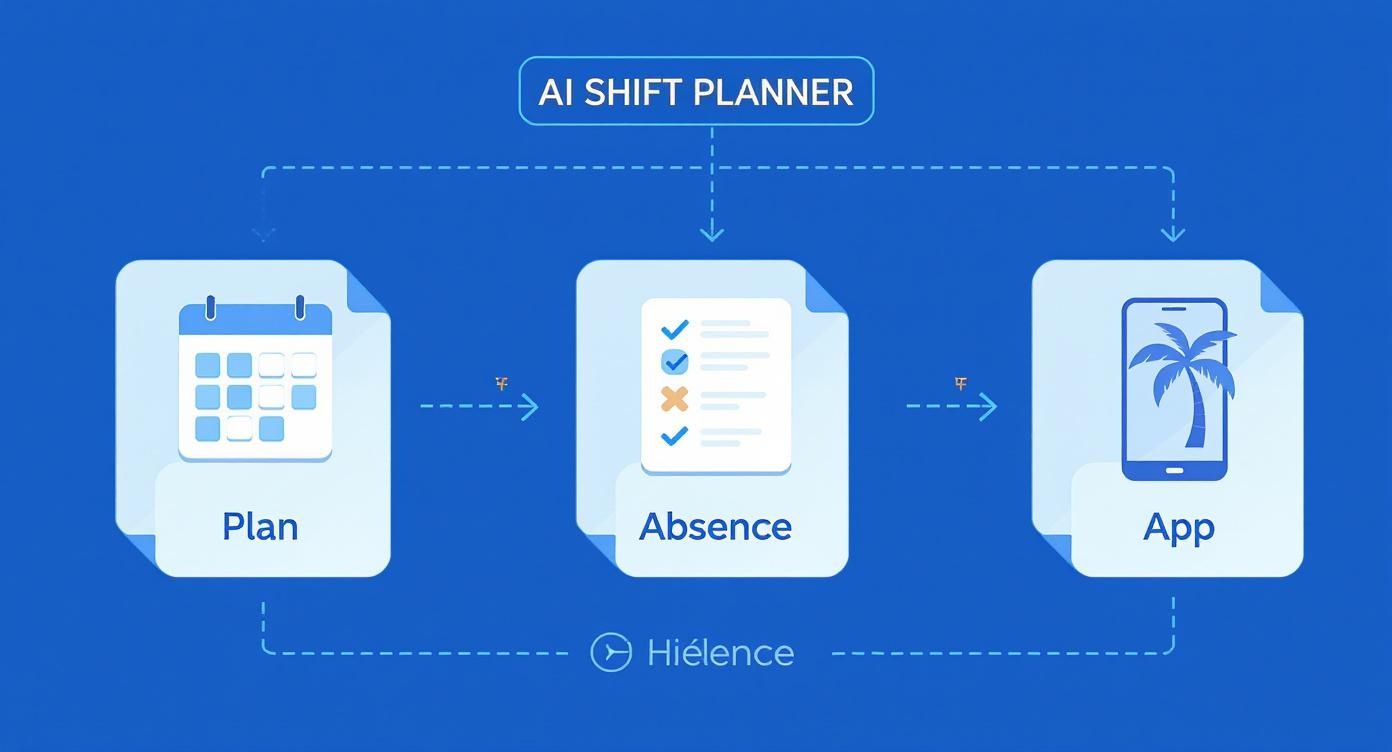
The graphic illustrates how a central platform connects calendar planning, vacation management, and the mobile app for employees into a seamless process.
Don't forget data protection and training
A very crucial point is data protection. Make sure that the provider strictly complies with the rules of the GDPR and the Swiss Data Protection Act (DSG). Ideally, the data is stored on servers in Switzerland or the EU.
Transparency with your team is worth its weight in gold: Clearly and openly explain which data is collected and why.
The best software is useless if no one can operate it. Plan time for thorough training of your team from the start. Not only show the planners the functions, but also explain the benefits of the mobile app to the employees.
If you follow these steps, the introduction will be a success. Careful preparation is the key to unlocking the full potential of a modern deployment planner software to exploit. In our guide, you will find further useful tips for the introduction of a deployment planner software, which will make it easier for you to get started.
Application examples from different industries
A AI shift planner is anything but a one-size-fits-all solution. It should be thought of more like a flexible Swiss army knife that adapts precisely to the rough edges and specific needs of each industry. And this technology is no longer reserved for large corporations.
To show you how versatile such systems are in practice, let's look at three typical scenarios in which AI plays to its strengths.
Event industry: High flexibility required
In the event industry, no day is like the other. Staffing needs fluctuate extremely, and you often have to react quickly to unforeseen changes. At a festival, a security team fails, at a company party, additional service staff with fluent French skills are suddenly needed. These are classic planning nightmares.
Here jumps in AI shift planner by filtering the entire pool of employees for the exact qualifications needed in seconds. You immediately see who is available and has the right skills. With job.rocks for example, you can send targeted shift requests to suitable groups and fill positions in record time - without the usual phone odyssey.
Hospitality: Fair planning and complex rules
In the hospitality industry, satisfied employees are essential for excellent service. A fair distribution of working hours, especially the unpopular weekend and holiday shifts, is absolutely crucial for the working atmosphere. In addition, there is a jungle of complex collective agreements and industry-specific working time laws that must be meticulously observed.
An AI system like job.rocks automatically ensures a fair distribution of shifts over longer periods. It monitors in the background that all legal requirements are met, thus preventing costly mistakes and creeping dissatisfaction within the team. This makes the planning transparent and understandable for everyone.
An intelligent planner not only solves a mathematical problem. It creates a fair foundation that positively influences the working atmosphere and significantly strengthens employee retention.
Security industry: Licenses and certificates in view
In the security industry, deployability depends on very specific licenses. An employee may only guard a specific object if they possess the necessary certificate. Keeping track of these qualifications manually is not only time-consuming but also extremely error-prone.
A AI shift planner manages these licenses centrally and intelligently. During planning, the system automatically suggests only employees for a shift who actually possess the required qualification. If a certificate is about to expire, the planner proactively receives a notification. This ensures that every deployment site is always staffed correctly and in compliance with regulations.
By the way, the demand for such intelligent solutions is growing rapidly across industries. Zurich has established itself as the AI hotspot of Switzerland and unites around 42% of all analyzed AI jobs about. If you want to know more about the hotspots for AI jobs in Switzerland, you can read about it here. which industries are driving the demand.
The most common questions about the AI shift planner
You are thinking about improving your personnel planning with AI but still have a few questions in mind? Absolutely understandable. Here I have summarized the answers to the most important points that keep coming up in practice.
Does the AI shift planner completely replace humans?
Absolutely not. Don't think of AI as a replacement, but rather as an extremely clever assistant. It takes over the tedious, time-consuming puzzle work and provides you with a prepared plan proposal based on hard data. The routine tasks are eliminated.
But the final decision, the human assessment, and the final approval – they always remain with you. You gain above all one thing: more time for what really matters – the leadership and support of your team.
What about the data security of my employees?
A central point, no question. Serious providers operating in the Swiss or European market strictly adhere to the requirements of the GDPR and the Swiss DPA. This is not an option, but an obligation.
Your data is usually stored on highly secure servers in Switzerland or the EU. My tip: Pay close attention to transparent data protection policies and consistently encrypted data transmission when choosing your tool. The provider should communicate this clearly and understandably.
Isn't setting up such software terribly complicated?
The concern is justified, but fortunately, the days of months-long IT projects are over. Modern systems are designed so that you can use them quickly and intuitively.
Most of the time, you are guided through a process where you enter the master data of the employees, working time models, and your internal rules step by step. A good provider does not leave you alone but supports you with personal support if you ever get stuck.
Does the AI also take into account the wishes of my employees?
Yes, and that is precisely one of its greatest strengths. Instead of countless emails or paperwork, your employees can directly and easily enter their availabilities, shift preferences, or leave requests via an app.
The AI then tries to find the best balance – between operational necessities and the wishes of your team. The result is not only a well-thought-out but also a significantly fairer shift plan, which noticeably increases team satisfaction.
Are you ready to finally make your personnel planning easier, fairer, and better? See how job.rocks it helps you create legally compliant shift plans in minutes instead of hours with intelligent automation.