
A Thoughtful Deployment Plan for Event Helpers is much more than just a list – it is the backbone of every successful event. It creates clear structures, prevents chaos, and ensures that each position is filled at the right time with the right person.
Why a Good Deployment Plan Saves Your Event
Every event, whether a local music festival or a large conference, stands or falls with its helpers. But without a clear and understandable plan for everyone, disorder quickly breaks out.
Imagine a city festival that you are organizing. With a simple Excel list, no one really knows who can take a break when. The helpers at the beverage stand are completely overwhelmed after three hours, while suddenly no one is at the entrance. The result? Stressed helpers, dissatisfied guests, and an organizational mess that could have been avoided.
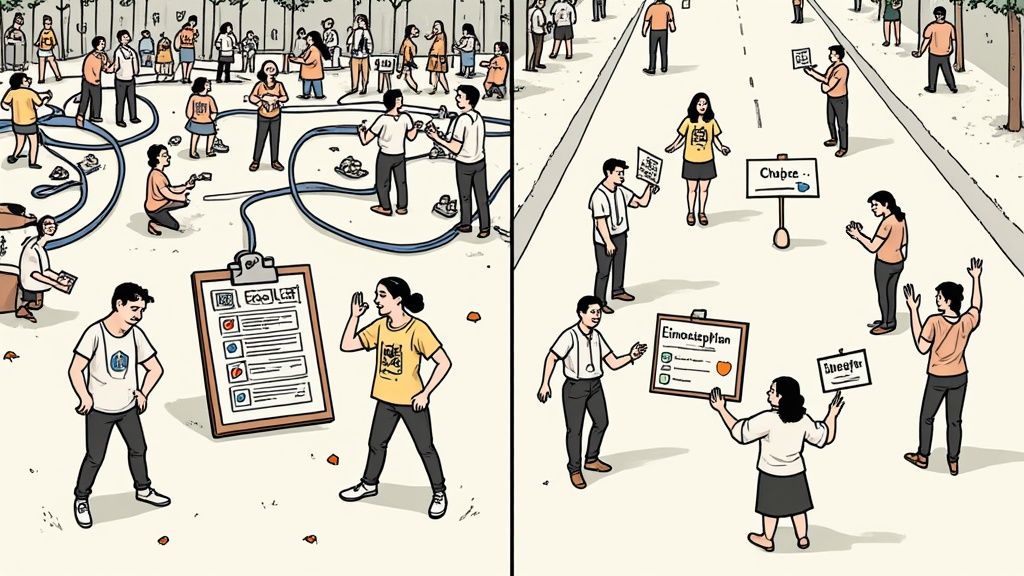
A well-thought-out deployment plan is the solution to exactly these problems. It goes far beyond a simple name list and becomes the central control instrument of your event.
The difference between chaos and control
The contrast becomes immediately clear when we look at the same city festival with a structured plan. Instead of a confusing table, you use a digital tool. Every helper knows their exact shifts, their tasks, and their direct contacts.
A solid Deployment Plan for Event Helpers lays the foundation for:
- Clear responsibilities: Everyone knows exactly what their task is. Misunderstandings do not arise at all because the roles are crystal clear.
- Regulated processes: Fixed break times and planned shift handovers ensure that your crew stays rested and motivated – from the first to the last minute.
- Reliability and motivation: When helpers see that the organization is professional and their time is valued, their readiness to help noticeably increases.
A plan is not just an administrative tool. It is a sign of respect towards your team and a guarantee for a smooth process.
Imagine you could drastically reduce administrative effort while simultaneously increasing your team's satisfaction. That's exactly what you achieve with solid planning. You prevent positions from being left unfilled or helpers from being overloaded by planning buffers and distributing the workload fairly.
The right planning of the event staff is crucial for the success and atmosphere of your event. Instead of constantly putting out fires, you maintain control and can focus on what matters: creating a great experience for all involved.
Laying the foundation: defining helper needs and roles
Before you waste a single thought on the actual deployment plan, we need to lay the foundation. The first crucial step is an honest analysis of your needs. Without this groundwork, every plan is just a well-intentioned guessing game.
Ask yourself: What areas are there at my event and how many helpers do I realistically need there? A small neighborhood festival might get by with a handful of all-rounders. A music festival with multiple stages and a camping site, on the other hand, practically screams for a detailed breakdown by zones and tasks.
Filling role profiles with life
Sobald du die Bereiche kennst, geht es ans Eingemachte: die Rollen mit Leben füllen. Ein "Helfer an der Bar" ist eine viel zu vage Beschreibung und öffnet Tür und Tor für Missverständnisse. Viel besser ist es, ganz konkrete Anforderungsprofile zu erstellen, die sowohl die Aufgaben als auch die nötigen Fähigkeiten glasklar umreissen.
Think of very specific situations that will come your way:
- Cash register/entrance: Here you need someone who can keep a cool head even in long lines, can handle money precisely, and still remains friendly. Stress resistance is very important here.
- Stage setup (stagehand): Physical fitness and a basic technical understanding are non-negotiable here. This person must be able to implement instructions quickly and handle expensive equipment safely.
- VIP care: Here, communicative, service-oriented, and absolutely discreet people are particularly in demand. A well-groomed, confident appearance is also a must.
A clear profile helps you not only with planning but also with the targeted search for the right people. You address the right candidates from the start and avoid disappointments on both sides.
From profile to helper database
With these precise role profiles, you can build a helper database. This list is pure gold for all future events. You not only collect contact details but also the specific skills, experiences, and preferred areas of deployment of your helpers.
A well-maintained database makes planning for the next event many times easier. From experience, I know: digital planning tools can reduce administrative effort by up to 70 percent reduce. Especially at events like sports tournaments or festivals in Switzerland, where hundreds of volunteers are coordinated, this has led to a significantly higher reliability. No-shows decrease through clever self-registration by up to 50 percent. You can read more about such impressive efficiency gains at Event Ready.
Exemplary role profiles for a festival
To make it more tangible, here is a simple table. It shows how you can define different roles with specific requirements and tasks for a fictional festival.
| Role | Tasks | Required skills | Number of helpers |
|---|---|---|---|
| Team lead bar | Coordination of the bar team, checking inventory, billing | Leadership experience, organizational talent, reliable | 2 |
| Logistics helper | Setup and teardown, material transport, inventory organization | Physically fit, handy skills, team player | 10 |
| Info point | Information for guests, lost and found, problem solving | Communicative, multilingual (advantageous), patient | 4 |
| Runner | Errands, springer for various tasks | Flexible, local knowledge, resilient, own driver's license | 3 |
This clear definition is not just bureaucracy, but the essential basis for a functioning and fair Deployment Plan for Event Helpers. This ensures that every task is done by someone who is truly suitable for it – and enjoys it.
Inquire about availabilities and plan shifts smartly
As soon as you know who you need for what, the real puzzle work begins. Now it's about gathering the availabilities of your helpers and creating a fair, seamless shift plan. Forget the endless back and forth via email or confusing messenger groups.
The key lies in a central, simple system. A simple online survey or – even better – a specialized tool, where everyone enters their possible deployment times, saves you hours of administrative work. You get an overview at a glance of who can when, and avoid double bookings or communication errors from the start.
This infographic outlines the fundamental process, from the first needs analysis to the finished helper database.
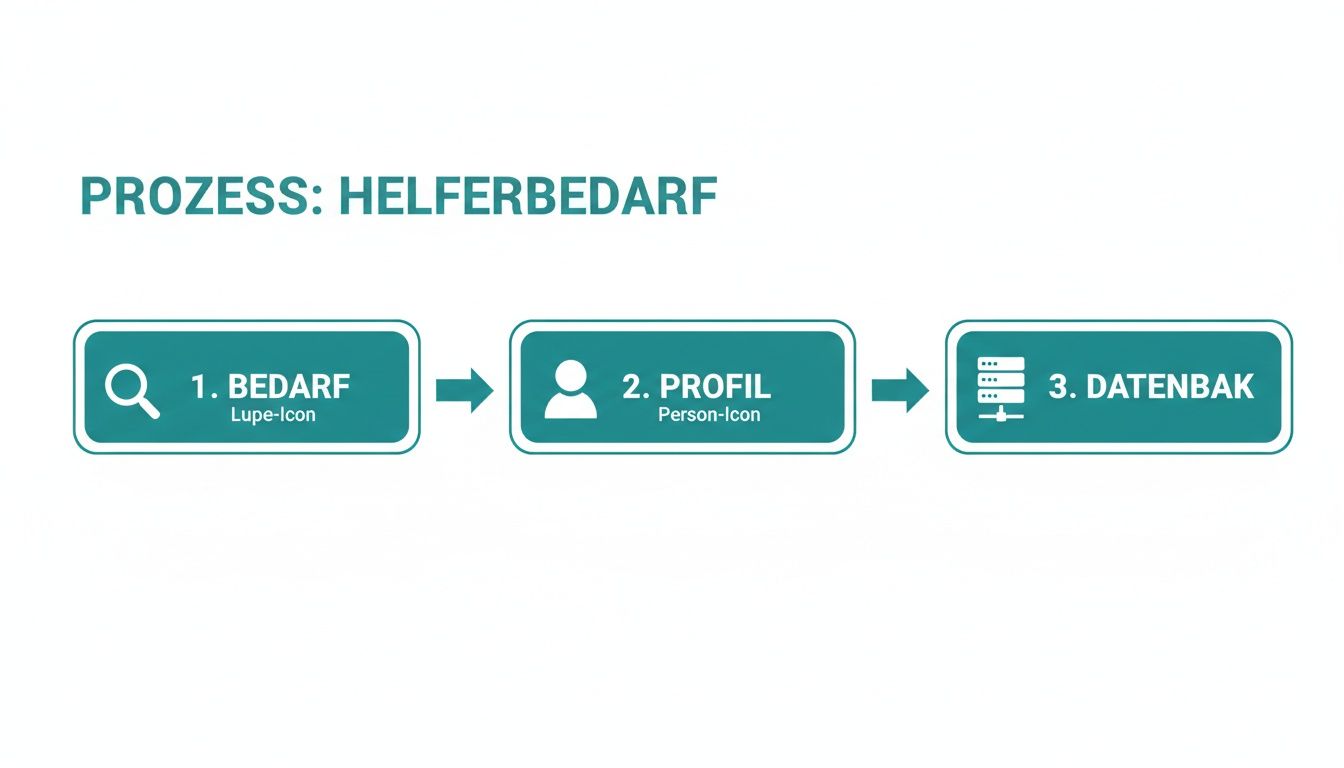
It is clear: A solid database emerges directly from a clear needs and profile definition. It is the basis for everything that follows.
Define shift blocks and handovers
A good Deployment Plan for Event Helpers is more than just a sequence of names and times. It needs a clear structure that is understandable for everyone. Work with logical shift blocks that fit the flow of your event.
Let's take a one-day sports event as a practical example. Here you could define the following blocks:
- Morning shift (08:00 – 14:00): Focus on setup, entrance control, and initial competition support.
- Afternoon shift (1:30 p.m. – 7:30 p.m.): Main phase of the event, supervision of the catering stands and award ceremony.
- Evening shift (7:00 p.m. – 1:00 a.m.): Dismantling, cleaning, and final tasks.
Have you noticed the 30-minute overlap between the shifts? This time is worth its weight in gold. It allows for a clean handover where important information is passed on without causing a rush or leaving positions briefly unfilled.
Plan shift handovers consciously. A brief, personal handover prevents misunderstandings and ensures a seamless operation. This is a small detail with a big impact on the quality of your event.
Plan for fairness and buffers
A fair plan takes into account not only the needs of the event but also those of your helpers. Make sure to adhere to break regulations and maximum working hours. No one can work concentrated for eight hours straight. Plan fixed breaks of at least 30 minutes after a maximum of four to five hours.
Zusätzlich solltest du immer einen Puffer für unvorhergesehene Ausfälle einplanen. Eine "Springer"-Role, die flexibel dort einspringt, wo Not am Mann ist, kann dir den Tag retten. Es ist auch ratsam, etwa 10-15% more helpers than you mathematically need. This way, you are prepared for short-term cancellations and your plan does not fall apart immediately.
Modern tools can assist you in efficient shift planning by automatically taking such buffers and rules into account.
If you consider the wishes of your helpers whenever possible – perhaps someone prefers to work in the evening – you significantly increase the satisfaction and reliability of your team.
Modern tools for digital deployment planning
Excel spreadsheets and chaotic messenger groups may have been the standard once, but let's be honest: They are error-prone and consume an incredible amount of time. Fortunately, today there are specialized tools that make the creation of your deployment plan for event helpers many times easier. Instead of getting lost in the minutiae, digital tools give you back the overview.
Forget manually reconciling countless availability lists. Modern platforms turn the tables: Your helpers can independently sign up for the shifts that fit their times and skills. This is not only more convenient for everyone but also increases motivation and commitment.
How digital planning tools work in practice
Platforms like Staffcloud or Helfereinsatz.ch are tailored to the needs of event organizers. Instead of contacting each individual, you simply invite your team to the platform. There, they manage their availability themselves.
Du erstellst die Schichten, die du brauchst, und hinterlegst die Anforderungen – zum Beispiel "Barpersonal mit Kassenerfahrung" oder "Aufbauhilfe mit handwerklichem Geschick". Das System ist so clever, dass es den Helfern nur die für sie relevanten Schichten anzeigt. Ein Klick zur Bewerbung genügt, und du musst die Besetzung nur noch bestätigen.
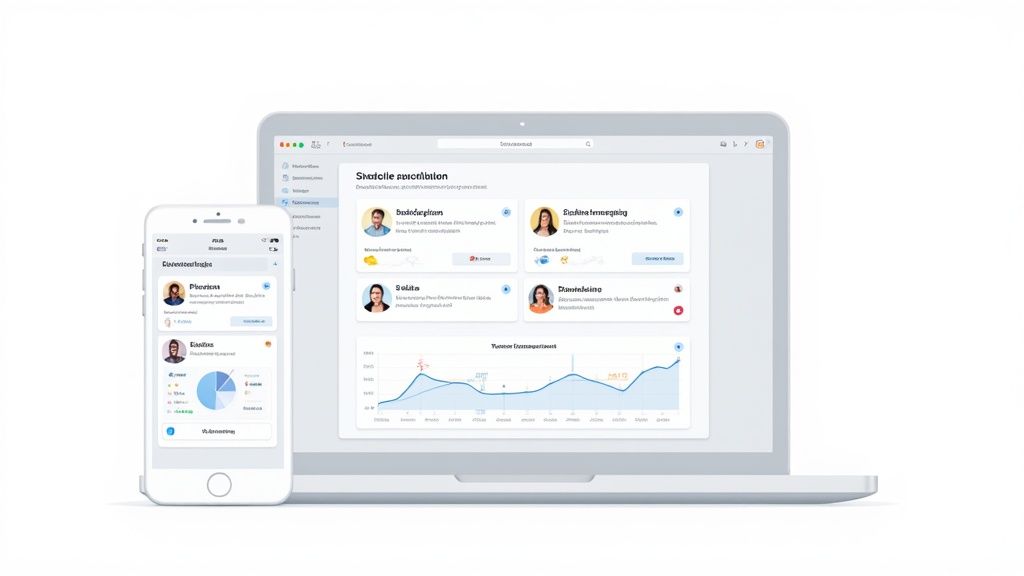
You can immediately see how a clear structure makes a difference. Profiles, shifts, and times are centrally managed. This creates transparency for everyone and reduces your administrative effort to a minimum.
Smart functions that make your life easier
These tools are much more than just a digital bulletin board. They are packed with intelligent features that simplify the entire process from the first request to the final billing.
Here are some of the biggest advantages:
- Automatic communication: The system automatically sends reminders before shifts start via app push or email. In case of last-minute changes, you can immediately reach the entire affected team with one message – no more call cascades.
- Skill management: You specify what each helper can do. The system then ensures that only people with the appropriate skills are suggested for a specific role.
- Real-time evaluations: With just a few clicks, you can see how many hours each helper has worked. This is the perfect basis for later payroll or simply to create earned certificates of appreciation.
A central system gives you back control. You can see at any time which positions are still unfilled and where you need to make targeted adjustments.
Tools like Helfereinsatz.ch go even further and allow you to measure assignments based on deployment, hours, or points – ideal for flexible compensation models. You can often easily import helper data from an existing Excel list; first name, last name, and email are usually sufficient. Experience shows: Such systems reduce dropout rates by up to 40 percent and save you up to 60 percent of planning time.
From a certain event size, such a solution almost always pays off. The time gained and the avoided mistakes quickly outweigh the license costs. If you are looking for a truly comprehensive solution that integrates even deeper into your processes, you should also inform yourself about specialized deployment planning software inform.
This is how the finished plan successfully reaches your team
The best Deployment Plan for Event Helpers is worthless if it gets lost in the chaos of the event day. A perfect plan that only exists on your laptop helps no one. Therefore, the communication of the finished plan is at least as important as its creation. It is about creating absolute clarity and security for each individual helper.
A round email to everyone is a solid start, but on the event day itself, it is completely insufficient. Last-minute changes, cancellations, or unforeseen bottlenecks are the rule, not the exception. This is exactly why you need a central, lightning-fast communication channel. This can be a simple chat group (like in WhatsApp or Signal) or - even more professional - the integrated communication feature of a planning app.
Every helper must know instinctively where to find the latest version of the plan and through which channel urgent information comes. This one point often decides between chaos or control on the event day.
The checklist for your pre-event briefing
A short, concise briefing just before the event is worth its weight in gold. The goal is not to recite the complete plan. Rather, it is about strengthening team spirit and giving everyone the necessary orientation for the starting signal.
Your briefing checklist should cover these points:
- Central point of contact: Where is the check-in for the crew? Who is the main contact person for general questions during the event? Name a person, not a title.
- Emergency contacts: Who do I contact in case of a medical emergency, a technical blackout, or a security problem? Provide clear names and mobile numbers.
- Communication channels: Erkläre unmissverständlich, wie Änderungen kommuniziert werden. Sag zum Beispiel: "Alle Updates kommen per Push-Nachricht über die Helfer-App" oder "Achtet auf Nachrichten in unserer WhatsApp-Gruppe."
- Clarify open questions: Ask actively if there are any uncertainties regarding personal assignments. Clarifying these questions now is invaluable, because it is too late in the midst of the greatest hustle.
This exchange provides your team with enormous security and signals that you, as the organizer, have everything under control.
Data protection (GDPR) - the often forgotten obligation
As soon as you collect and distribute data from your helpers – names, phone numbers, email addresses – you are operating within the scope of the General Data Protection Regulation (GDPR). This means: You are responsible for protecting this sensitive information. An unprotected Excel list with all contact details sent by email to the entire distribution list is an absolute no-go.
Specialized platforms clearly have an advantage here, as they are often specifically designed to meet the needs of Swiss major events such as sports festivals or music festivals and inherently offer GDPR-compliant environments. Such systems allow you to conduct detailed and secure evaluations without compromising the privacy of your helpers. Learn more about how professional solutions ensure the Planning securityThis not only protects your helpers' data but also shields you from severe legal consequences.
Frequently asked questions about deployment planning for event helpers
Even the most watertight plan can raise questions in practice. Especially if you are new to event organization, you often encounter the same typical hurdles. Here I have the answers to the most frequently asked questions for you - directly from practice.
What do I do in case of last-minute cancellations?
Der Anruf am Eventtag: "Du, ich kann leider doch nicht…" – ein echter Klassiker, der leider dazugehört. Die beste Strategie ist, gar nicht erst in die Bredouille zu kommen. Plane von Anfang an einen Puffer ein und bau dir einen kleinen Pool an "Springern" auf.
A good rule of thumb is to plan for about 10-15% more helpers to plan than you actually need on paper. These standby helpers are worth their weight in gold. They know they are on call and can flexibly step in wherever there is an urgent need. You can activate them immediately in case of emergency through a quick channel like a WhatsApp or Signal group. A waiting list of people who did not make it into the final plan is also a lifesaver.
How do I keep volunteers motivated?
Motivation is your most important asset, especially during long, demanding events. The magic word is appreciation, and you show that best through actions, not just words.
- Make sure you have good food: No one does good work on an empty stomach. Sufficient water, snacks, and a warm meal are the absolute minimum and show that you care.
- Plan real breaks: Ensure that people can actually take their planned breaks. A short moment to retreat and breathe works wonders for morale and concentration.
- Show your gratitude: A small, thoughtful gift at the end – an exclusive helper T-shirt, a voucher, or a joint closing party – leaves a lasting positive impression.
Be present during the event. Walk around, talk personally with your helpers, ask how things are going, and make them feel like an indispensable part of the success. This often motivates more than any material reward.
Ein ehrliches "Danke" und die sichtbare Anerkennung ihrer Leistung sind die stärksten Werkzeuge, um Freiwillige auch für deine zukünftigen Events zu begeistern.
Do I have to consider GDPR for helper data?
Yes, absolutely. As soon as you collect personal data such as names, email addresses, or phone numbers, the General Data Protection Regulation (GDPR) applies. This is not rocket science, but it means concretely:
- Only collect data that you really need for planning. Less is more.
- Inform the helpers transparently about how you use their data.
- Store the data securely and never share it with unauthorized third parties.
- Delete the data after the event unless you obtain explicit permission to store it for future events.
Professional planning tools take a lot of work off your hands. They often come with GDPR-compliant structures for data management and make your life easier.
A well-thought-out deployment plan is the foundation for any successful event. With job.rocks you automate the entire process – from availability inquiries to shift assignments to time tracking. Discover now how you can reduce your administrative effort to a minimum and optimally manage your team: https://job.rocks