
A good Staffing in Outpatient Care is much more than just distributing shifts. It is the beating heart of your care service. Everything depends on it: that the right caregiver is at the right time in the right place, truly meeting all needs – those of your clients, your employees, and of course those of your company.
What good staffing really means
Imagine staffing as a complex puzzle. Each individual piece must fit perfectly in its place so that in the end a coherent overall picture emerges. On one side, you have the personal wishes and medical needs of your clients. On the other side are the qualifications, availabilities, and also the wishes of your caregivers.
And in between? There lie all the uncertainties of everyday life: legal requirements, traffic jams during rush hour, unpredictable emergencies, and last but not least, the economic viability of your service.
A cleverly thought-out plan is the direct way to satisfied clients who feel well cared for. At the same time, it ensures motivated employees who do not work permanently at their limits. If the planning is right, the operation runs smoothly, the quality of care is high, and your team enjoys coming to work.

A practical example from everyday life
Let's take Mr. Meier. He is diabetic, has a complex wound on his leg that requires special care, and lives a bit outside. For this one assignment alone, you as a planner have to ask yourself a whole series of questions:
- Who has the right qualification? Not every caregiver can perform a special wound care. Here you need a qualified nursing professional with the appropriate training. Period.
- Who is available at this time? Your qualified specialist must be free in the desired time window and must not already be scheduled at the other end of the city.
- What does the route look like? The travel time to Mr. Meier and from there to the next client must be realistic. No one is helped if your employees rush from one appointment to the next and constantly have to watch the clock.
- What about the unexpected? What happens if the assignment with Mr. Meier takes longer than planned? Or if a traffic jam blocks further travel? Good planning always includes buffer times.
This one case already shows how many gears are interlocking here. Now multiply that by dozens or even hundreds of clients and employees, and you understand why Excel spreadsheets quickly reach their limits here.
Good deployment planning is not just an administrative act, but a strategic tool. It ensures the quality of care, increases employee satisfaction, and ensures an economically healthy operation.
The central pillars of your planning
To successfully piece together this complex puzzle, you must always keep multiple areas in view. A truly solid Staffing in Outpatient Care manages to continuously balance these four aspects:
- Client orientation: The individual needs, habits, and wishes of the people you care for always come first.
- Employee satisfaction: Fair working hours, reliable duty rosters, and consideration of personal wishes are the key to motivating and retaining your team.
- Quality assurance: The right qualifications must be precisely matched to the respective requirements. Only then is proper and safe care guaranteed.
- Economic efficiency: Routes must be planned sensibly. This means avoiding downtime and unnecessary travel costs and ensuring the utilization of your specialists.
When these four pillars are in balance, you build a stable foundation for your care service. You not only avoid daily chaos but also create real trust – with your clients and your employees.
This guide provides you with the knowledge to take your planning to the next level.
The legal frameworks of your personnel planning
A good Staffing in Outpatient Care balances on a narrow ridge. On one side are the needs of your clients and the wishes of your team, on the other the economic goals of your business. But beneath all this lies a foundation that is non-negotiable: the law. Every duty roster you create must adhere to clear legal rules.
If you ignore these rules, you risk not only hefty fines and legal disputes but also jeopardize the health and satisfaction of your employees. Let's take a closer look at the most important legal frameworks that you must always keep in mind during your planning.
Working hours law in Switzerland in focus
Your most important compass is the Swiss Labor Law (ArG). It protects employees and sets clear boundaries that must not be exceeded, even in the intensive care sector. The central points for your tour planning are quickly explained.
The Maximum working hours for most employees in care is 50 hours per week. It is important here: this is not an average value over a month, but a strict weekly upper limit. It may only be exceeded in absolute exceptional cases.
Breaks are also clearly regulated. Anyone working more than seven and a half hours in a row is entitled to at least 30 minutes break. For a working time of over nine hours, it is even 60 minutes. These breaks are not a nice gesture, but a legal obligation that serves for recovery and must be factored into the tour plan.
Another crucial factor is the daily rest period. Between two work assignments, your employees must have at least 11 hours of uninterrupted rest time available. This rule is fundamental for the body and mind to regenerate.
Correctly plan and compensate special cases
In outpatient care, there are often situations that go beyond the classic eight-hour day. It is precisely here that legal pitfalls often lurk that you should be aware of.
- On-call service: Imagine a caregiver must be reachable by phone at night and must respond immediately in case of an emergency. Once they become active, this time counts as full working time. The pure waiting time at home is compensated differently, but still compensated.
- Night work: Work between 11 PM and 6 AM is particularly demanding and is therefore specially protected. Employees who regularly work at night are entitled to a wage supplement of at least 10%.. In addition, their assignment may not last longer than nine hours.
The correct planning and compensation of these special cases is not an optional extra. It is legally required and an important sign of appreciation for the enormous flexibility of your team. If you want to delve deeper into the matter, you will find further information in our guide to create your shift planning in a legally secure manner..
Data protection in digital planning
With the transition to digital planning tools and mobile apps, another major topic comes to the forefront: data protection. The new data protection law (nDSG) in Switzerland imposes high demands on the protection of personal data – and this directly affects you.
Always remember: When your employees access their tour plans via an app, they process highly sensitive data. This includes not only names and addresses but often also very detailed health information about your clients.
You must ensure that your software securely encrypts this data and that access is strictly regulated. Imagine a caregiver is only allowed to view the information of the clients they actually care for on their tour – and not the data of all other clients of your care service.
Checklist for the legal review of your operational planning:
- Maximum working hours: Is the weekly upper limit of 50 hours per employee consistently observed?
- Break regulations: Are the breaks correctly anchored in the duty roster and are they actually taken?
- Rest times: Are there always at least 11 hours uninterrupted free time?
- Special services: Are night work and on-call services recorded properly and compensated correctly?
- Data protection: Is access to client data restricted to what is absolutely necessary and technically secured?
These points are the foundation for fair and legally compliant deployment planning. They build trust, protect you and your business from unpleasant surprises.
Master typical challenges in planning day-to-day
On paper, the deployment planning for outpatient care often looks perfect. But then Monday morning comes and with it the reality: A key employee calls in sick, a construction site paralyzes city traffic, or a client unexpectedly needs more time. It is these everyday hurdles that determine how good your planning really is.
A robust plan does not collapse like a house of cards at the first disturbance. It is flexible enough to respond to the unexpected without compromising the care of your clients or the workload of your team. It's about having not just a Plan A, but also a Plan B and C in the drawer.
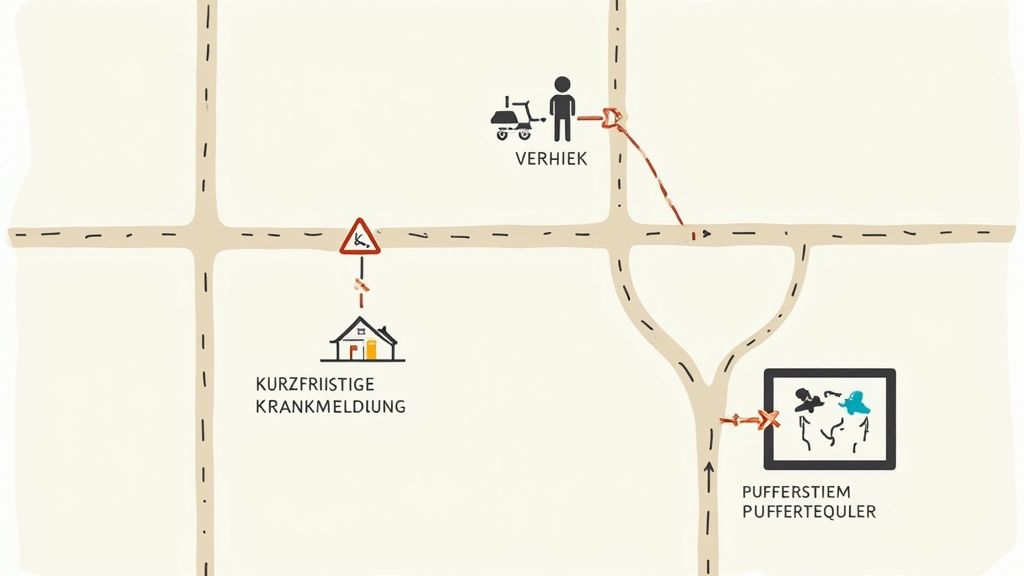
When the plan suddenly tilts
Imagine it is 7:15 AM and a nursing professional with a packed morning shift calls in sick. This is the classic stress test for any deployment planning. Now every minute counts. Who can jump in? Which appointments are the most urgent? Which clients can perhaps be served a little later?
A manual process with phone chains and confusing Excel lists can quickly lead to chaos and delays. Good preparation and the right tools are crucial.
- Define a pool of substitutes: Keep a small group of flexible employees ready who can jump in at short notice. This creates immediate relief.
- Know your priorities: Mark critical deployments in your planning, such as insulin administrations or complex wound care. These appointments must be secured first.
- Transparent communication: Proactively inform the affected clients about a possible delay. Honesty creates understanding and trust.
Traffic chaos and unforeseen delays
Another well-known problem is the time trap of the road. An unforeseen traffic jam or a road closure can disrupt the entire tour schedule. A caregiver is stuck and the following clients are waiting.
The key here lies in buffer planning. Never schedule your tours to the minute. Integrated buffer times between assignments give your team the necessary leeway to respond to delays without getting stressed.
A modern planning software can also help here by considering real-time traffic data and automatically suggesting alternative routes in case of disruptions. This turns a big problem into a manageable task.
Dealing with fluctuating demand
Demand in home care is rarely constant. Especially on weekends or after holidays, there is often a sudden increase in new clients being discharged from the hospital who need immediate care. These demand spikes present a huge challenge.
A care service must be able to respond quickly without neglecting existing care. Flexible staffing that is not solely based on fixed tours is invaluable here. Demographic developments further intensify this pressure.
In a canton like Lucerne, nearly 12,000 people utilized home care services, an increase of 6.5 percent. A typical assignment lasted 5.4 months and included 77 care hours, with almost half of the hours claimed by individuals aged 80 and over. These figures clearly show that your planning must be able to respond to an aging population and increasing demand. Learn more about the Development of Spitex services.
Example from practice:
Ein mittelgrosser Spitex-Dienst stand genau vor diesem Problem. An Wochenenden meldeten Spitäler regelmässig neue, pflegeintensive Klienten. The Lösung: Sie etablierten ein spezielles "Aufnahme-Team" für das Wochenende. Dieses Team bestand aus erfahrenen Fachkräften, The flexibel für The Erstversorgung neuer Klienten eingeplant wurden und keine feste Tour hatten.
This approach had several advantages:
- The regular tours continued uninterrupted.
- New clients received professional care from the start.
- The planning management was significantly relieved over the weekend.
By proactively developing solutions for these typical problems, you turn the daily struggle against chaos into a manageable and well-organized process.
Smart tools for better tour planning
A good Staffing in Outpatient Care depends on the right tools. The days when complex tours were painstakingly assembled in Excel spreadsheets are thankfully over. Modern technologies now give you the means to make your planning not only faster but also significantly smarter and more human.
Forget rigid plans that collapse at the slightest incident. Smart tour planning is dynamic. It doesn't just calculate the shortest routes from A to B, but simultaneously juggling a variety of factors: the urgently needed qualifications for a deployment, the personal wishes of your clients, and of course the legally mandated break times for your employees.
Qualifications as a crucial filter
A cornerstone of modern planning systems is qualification filters. Imagine you have a client who needs a special medication administered via a port. This is a task that can only be performed by a nursing professional with the appropriate additional training.
In the past, this meant sifting through long lists, manually checking availabilities, and hoping not to overlook anyone. Today, it works quite differently:
- Stored profiles: You enter all qualifications, certificates, and training for each employee in the system once.
- Automatic matching: When you plan the deployment, you specify the required qualification. The software then suggests only those employees who meet this requirement and are actually available in the desired timeframe.
- Error avoidance: The system actively prevents you from accidentally scheduling someone without the necessary competence for a complex assignment.
This filtering function is a huge safety gain. It ensures that the quality of care remains high at all times and that you comply with all professional standards without gaps.
Software is much more than a digital calendar. It is your intelligent assistant that thinks along, minimizes risks, and helps you make the best decision for your clients and your team.
From Excel to intelligent software
The leap from manual planning to a specialized software solution is enormous. Let's take a look at a typical before-and-after example of a medium-sized nursing service:
Before (Manual planning with Excel):
The planning management spent hours compiling tours. Every short-term change led to frantic phone calls. Travel times were often unnecessarily long because the routes were only roughly estimated. The mood in the team? Rather mixed.
After (use of specialized software):
After the switch, the nursing service was able to reduce the average travel times of its employees by 20%.. The software automatically optimized the routes and even took current traffic information into account. If there were any changes to the plan, the nursing staff received an immediate notification on their smartphone.
The time gained directly benefited the clients, and satisfaction in the team noticeably increased. Digital tools are a crucial lever to elevate your Staffing in Outpatient Care to a new level.
This screenshot exemplifies a modern planning interface that visually represents tours and availability.
At a glance, you can see who is on duty when and where, and where there are still gaps in the plan.
More than just route optimization
The advantages of digital solutions go far beyond mere route planning. The time required per client can vary greatly. Non-profit Spitex services in long-term care provide 47 hours per client, for-profit services, however 116 hours. This is often due to the obligation to also take on unprofitable short assignments - which requires extremely flexible and differentiated deployment planning. Learn more about the backgrounds of these numbers at SPITEX Switzerland.
Good software helps you master this complexity. Take a look at our overview to learn more about the suitable deployment planning software to learn for your needs.
In addition to digital solutions, physical aids can also promote the independence of those in need of care and thus indirectly relieve deployment planning. A comprehensive guide to stairlifts shows, for example, how technical support at the clients' home can make everyday care easier for all involved.
Step by step to your optimized deployment planning
Now it gets concrete. You know the typical stumbling blocks and the smart tools - now it's about taking your own Staffing in Outpatient Care systematically to the next level. Good preparation is the be-all and end-all. Without an honest analysis of your current processes, you risk starting at completely the wrong places.
This guide is your roadmap. It takes you from the ruthless inventory to the successful introduction of new, leaner processes. In the end, you have a tangible plan in hand that you can directly adapt for your business.
Phase 1: The honest analysis of your process
Before you change anything, you need to know exactly where you stand. Take the time to critically examine your current planning process. Often, processes have crept in over the years that no one questions anymore, but which are real time wasters.
The following checklist helps you uncover the sore points:
- Time recording: How long does it really take to create a weekly plan? Measure the time from the first draft to the final approval – without any embellishment.
- Error rate: How often do you have to throw away a finished plan due to short-term cancellations, errors, or overbookings?
- Communication: How quickly and reliably do changes to plans reach your employees? Are there regular misunderstandings?
- Employee feedback: What do your caregivers say? Where do they see the biggest friction points in the current planning?
This analysis is your unvarnished truth. It shows you in black and white where the most urgent issues lie. You may find that you are losing a lot of time with manual data entry in Excel. A detailed guide on how to create an Excel shift plan will show you not only the basics but also the clear limitations of this method.
Phase 2: Select tools and involve the team
With the results of your analysis in hand, you can now select the appropriate tools. It is not about finding the most expensive software, but the one that solves your specific problems. Consider the size of your team, the complexity of your assignments, and of course, your budget.
But even more important than the best technology is the human factor. Involve your team from the very beginning.
A new system that is decided over the heads of employees is often doomed to fail. Real acceptance only arises through participation and transparency.
Organize a small workshop. Present the results of your analysis and discuss together how better planning could look. If your team recognizes the benefits of a new system themselves, they will actively support the change.
This transition from manual to smart processes is a central step for any modern nursing service.
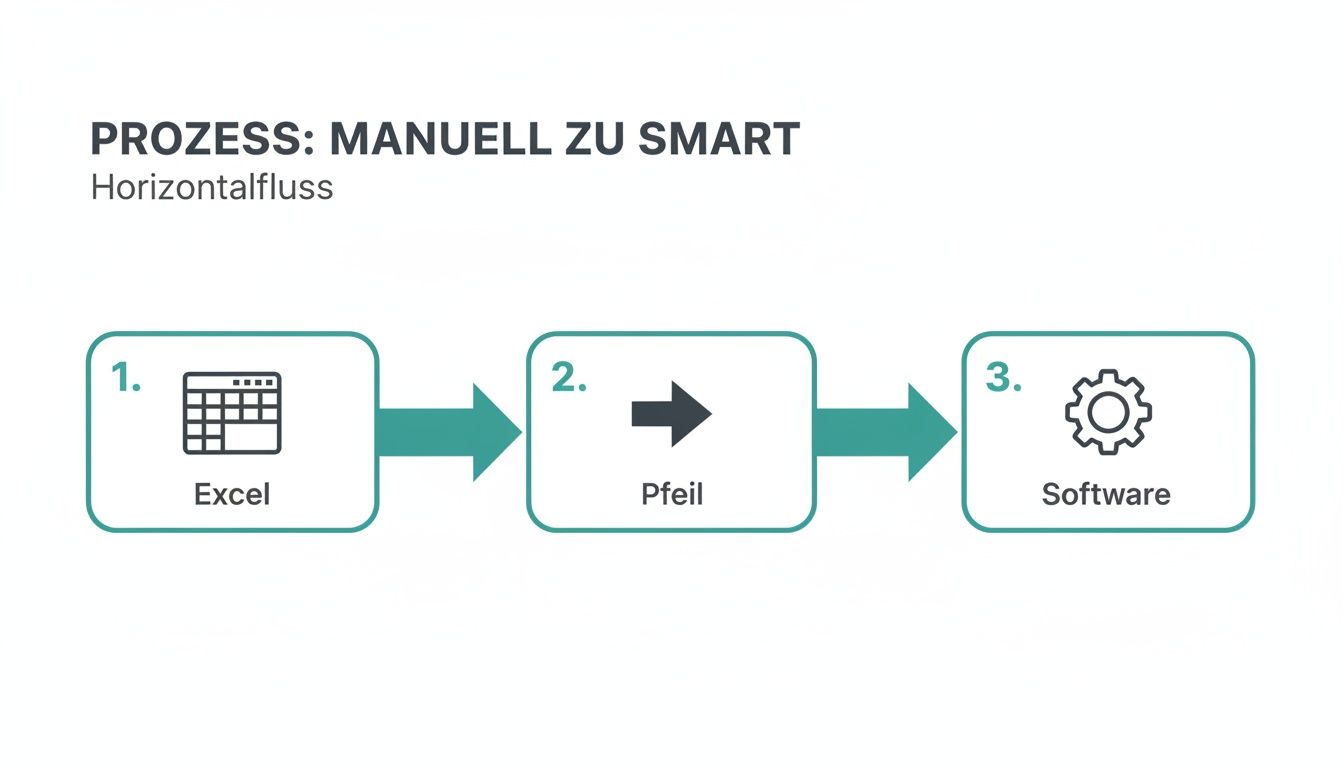
As the graphic shows, the transition from confusing tables to a specialized solution is a targeted process that ultimately releases massive efficiency gains.
Phase 3: Training and gradual introduction
No one likes to be confronted with a completely new way of working overnight. Therefore, plan the introduction in small, digestible steps and ensure proper training.
- Start pilot phase: Select a small, open-minded team and initially introduce the new software or process only there. This way, you can iron out teething problems in a protected environment without paralyzing the entire operation.
- Offer targeted training: Offer short, concise, and above all, practical training sessions. Show specifically how the new tools make daily work easier.
- Collect feedback: Listen carefully to what the pilot team has to say. Adjust the configuration and processes based on this real-world feedback before starting the rollout across the entire operation.
The growing need for care makes efficient planning increasingly important. Spitex organizations with supply obligations provided 25,637,002 care hours, an increase of a solid 10 percent. Since 29 percent of long-term care clients are of working age, your planning must be flexible enough to respond to complex cases.
Phase 4: Measure success and stay on track
After the introduction, the work is not done – now the optimization begins. Regularly check whether you have truly achieved your goals. Compare the new key figures with your original analysis from Phase 1.
- Has the planning time noticeably decreased?
- Has the error rate actually decreased?
- How has team satisfaction developed?
A practical example: A medium-sized Spitex service has consistently implemented this four-phase plan. After just three months, they were able to reduce their employees' travel times by 15% and halve the number of short-term planning changes. The key to success? The close involvement of the team and the gradual, well-supported transition.
So stay on track, continue to collect feedback, and make adjustments – this way, your deployment planning will not only improve once but will be better permanently.
Frequently asked questions about deployment planning in nursing
In deployment planning for outpatient care, the same tricky questions arise repeatedly in everyday life. Often, it is precisely these details that ultimately determine whether the process runs smoothly or descends into daily chaos. Here, I have collected the most common stumbling blocks from practice and formulated clear answers for you.
How short-term can I change the duty roster?
This is probably the most pressing question of all. The short answer: Once published, a duty roster is initially binding. You cannot simply toss it aside the day before just because it fits.
Even if Swiss labor law does not prescribe a rigid deadline, a notice period of at least four days has established itself as fair and legally secure. Imagine your employee has been given the weekend off and made private plans. A call on Friday to summon her to duty is not only demotivating but also legally tricky. Such changes must remain the absolute exception and are only meant for genuine emergencies.
The best way always leads through personal conversation. Explain the situation, be honest, and ask if someone would like to volunteer to step in or swap. This builds trust and fosters a culture of cooperation – and that is ultimately worth much more than a forced schedule change.
Are employees allowed to swap shifts with each other?
Yes, absolutely – and you should actively promote it! An uncomplicated shift swap among colleagues is a brilliant tool. It not only increases satisfaction in the team but also helps you quickly and unbureaucratically fill gaps in the schedule. Your people gain a degree of autonomy and can better balance work and private life.
But beware: As the planning responsible, you must establish clear rules. The top rule is always: Qualification before preference.. An exchange is only an option if the person stepping in meets exactly the same professional requirements for the job. A nursing assistant simply cannot step in for a qualified nurse when complex wound care is on the agenda.
Modern planning tools often have an integrated exchange platform for this purpose. Employees post a shift online, and the system automatically checks in the background whether the potential exchange partners actually have the necessary qualifications. This makes the entire process safe and transparent for all parties.
How do I handle wish services fairly?
Wish services are a double-edged sword. On one hand, they are a great motivational tool. Those who feel that their needs are taken seriously are more engaged and loyal to the company. On the other hand, the mood can quickly turn sour if the same people always get their wishes fulfilled while others are left disappointed.
The key to a fair system lies in transparency. You need clear rules that apply to everyone and are comprehensible. Everyone must know how and when wishes can be submitted and on what criteria you consider them.
A proven approach could look like this:
- Set deadlines: Set a fixed deadline each month by which wishes for the next duty roster must be submitted. Anything submitted after that cannot be guaranteed.
- Introduce a rotation principle: Ensure that everyone gets a chance on popular Fridays, for example on bridge days. A simple list can work wonders here.
- Encourage team agreements: Encourage your team to communicate with each other. Often, conflicts resolve themselves when colleagues simply talk to each other before submitting their wishes to you.
Here, too, software can support you. It captures the wishes digitally and gives you a fair overview of who has been considered how often.
Manual planning vs. software: What is better?
This question arises sooner or later for every care service. At first, an Excel spreadsheet may be sufficient, but as the team and the number of clients grow, it quickly becomes unmanageable and error-prone. Manual planning then becomes a full-time job.
Here is a direct comparison that highlights the differences:
Comparison manual vs. software-supported planning
The following table presents the key differences between planning with Excel and a specialized software solution.
| Aspect | Manual planning (e.g. Excel) | Software-supported planning |
|---|---|---|
| Flexibility | Low. Every change requires manual adjustments and carries a high risk of errors. | High. The system reacts dynamically to failures and suggests alternative solutions. |
| Qualification review | Manual and error-prone. The planning management must have all qualifications in mind. | Automated. The system only allows the scheduling of suitably qualified personnel. |
| Route optimization | Not available. Travel routes are often only roughly estimated, leading to long journeys and downtime. | Integrated. The software calculates the most efficient routes, saving time and costs. |
| Communication | Cumbersome. Schedule changes must be communicated manually by phone or message. | Immediate. All employees automatically receive a push notification on their smartphone when changes occur. |
| Legal certainty | Risky. Working time laws and rest periods must be monitored and checked manually. | Safe. The system automatically warns of violations of legal or contractual requirements. |
Ultimately, the decision depends on your company size and goals. But one thing is clear: Once you coordinate more than a handful of employees and clients, manual planning becomes an unpredictable time-waster and risk factor. Specialized software not only brings efficiency but also peace and security to daily operations.
Are you ready to leave the daily planning chaos behind and elevate your Staffing in Outpatient Care to a new level? job.rocks offers you the smart tools you need – from intelligent route planning to automatic qualification filters to the mobile app for your team. Discover now how to save time, reduce costs, and increase employee satisfaction.
Learn more at https://job.rocks