
If you type “helpers wanted at events” into the search engine, it usually starts. The biggest mistake? Place an ad quickly now. You don't build a successful event team under pressure, but rather with a plan that has been in place long beforehand. A thorough needs analysis is the foundation - it ensures that you find exactly the right people for the right tasks and that you don't experience any unpleasant surprises on the big day.
How to Properly Plan Your Helper Needs
Every great event depends on the people behind the scenes. But before you even start looking, you have to clearly define who and what you actually need. This strategy at the beginning will save you a lot of time, money and, above all, nerves later on.
The demand for good people is enormous. Alone in Switzerland, the events of SMPA members counted around 4.5 million visitors in 2022. 4.5 million visitors. This number impressively shows the enormous personnel effort behind such events. Large music festivals rely on hundreds of helpers just to keep logistics, service and security running.
Determine the exact number of helpers
The first step is an honest inventory. How many hands do you really need? To keep track, break your event down into individual areas and phases.
- Setup and teardown: Who helps with the technology, decoration, and infrastructure?
- During the event: Who runs the bar, checks the tickets, manages the wardrobe, or takes care of the artists?
- Special tasks: Do you need people with special skills, for example for first aid or technical support?
Imagine a small festival with 500 guests. Here you could start with two people for setup in the morning. Four others take care of entry and cash, three manage the bar in staggered shifts, and two flexible floaters help out wherever needed.
A solid plan also considers buffers and breaks. No one can give full throttle for eight hours straight. Calculate at least a 30-minute break for every helper for every four hours of work – this is not only fair but also ensures quality.
This infographic summarizes the three-step process: from needs analysis to specific tasks to the budget.
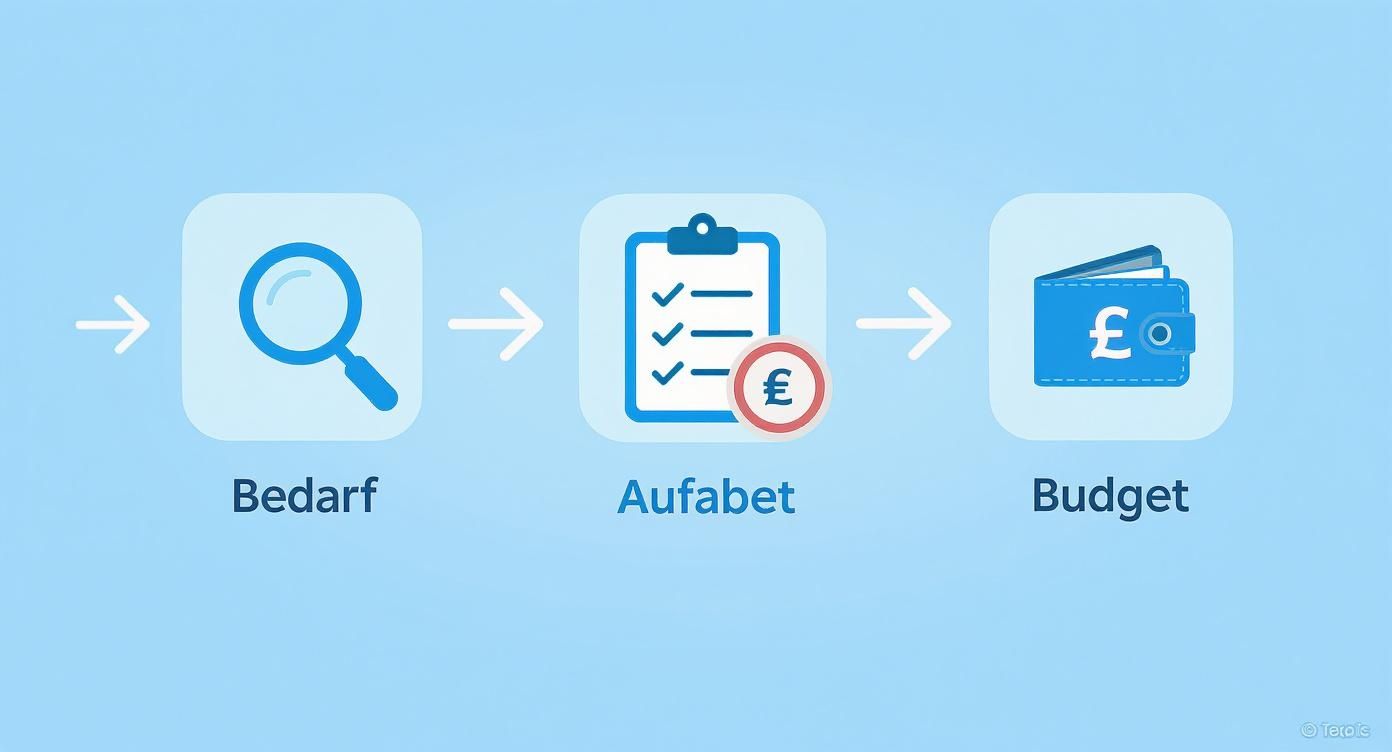
The graphic makes it clear: good helper planning is not rocket science, but a logical process where one step builds on another.
Define tasks and budget clearly
Once the number of helpers is set, it's time for the details. Create clear task profiles. What are the exact expectations for a person at the bar compared to someone helping with setup? The more precise you formulate these descriptions, the more suitable people you will find.
At the same time, you need to keep an eye on your budget. This is about much more than just a possible compensation. Be sure to consider these points:
- Catering and drinks for the entire team
- Necessary insurances (liability, accident)
- Possible subsidies for travel or small goodies as a thank you
- Costs for uniform work clothing such as t-shirts or vests
A professional Staff deployment planning for event locations is worth its weight in gold here to keep finances under control. This lays the foundation for fair, transparent cooperation and an event that runs smoothly.
This is how you write an ad that motivates
Your advertisement is the first handshake. It determines whether someone feels addressed or simply scrolls on. A really good ad is much more than a dry list of tasks – it captures the spirit of your event and shows potential helpers why it is worth being exactly at you to be part of it.
The appetite for events and thus the demand for committed helpers has noticeably grown in Switzerland in recent years. Leisure behavior has changed: The percentage of the population attending festivals rose from 38 percent in 2014 to a whopping 52 percent in 2024.
This trend means not only more events but also a huge demand for support. Often, it is young people between 18 and 35, who are motivated not only by money but by passion for the cause and the community. You can find more about these developments in the leisure behavior of the Swiss directly at SRF.
The right title immediately sparks interest
Your title is the showcase, your bait. A boring subject like 'Helpers wanted' gets completely lost in the flood of offers. Instead, formulate something that piques curiosity and captures the character of your event succinctly.
So, better not:
Helpers wanted at events
Much better like this:
Become part of our festival crew! Rock out with us behind the scenes.
This title is active, speaks to you directly and emotionally, and makes it immediately clear: This is about more than just work. This is about an experience.
Describe the event and the tasks clearly
Right after the title comes the pitch for your event. Convey the atmosphere in a few concise sentences. Is it a cozy food festival in the park or a huge open-air concert with thousands of visitors? Give people a sense of what they are getting into.
Subsequently, the task profiles must be as clear as possible. Honestly, no one will apply for a vague description like 'Help with everything'. The more precise you are, the better the applicants will know if the job really suits them.
Here are a few catchy phrases for different roles:
- Entry & Box Office: "You are the first face our guests see. You greet them with a smile, scan tickets, and manage the evening box office. Organizational talent and a friendly, open demeanor are worth their weight in gold here."
- Bar Team: "You ensure a good atmosphere and cold drinks. Experience behind the bar is a plus, but not a must. What is important to us is your pace, your reliability, and that you keep a cool head even in the biggest chaos."
- Stagehand / Runner: "You are right in the middle of the action and support our technical team with setup and teardown. You should be physically fit and eager to really pitch in so that our artists can shine on stage."
The key is not just to say, what to do is, but also, why this role is so important for the success of the event. It creates appreciation - and from the very beginning.
Show what you have to offer
Finally, perhaps the most important part to attract motivated people comes: the consideration. Make it crystal clear what you offer as thanks for the effort. It doesn't always have to be just money, as often the overall package counts.
What you could offer:
- Free entry to the event on non-working days
- Meal vouchers and free drinks
- An exclusive team T-shirt as a cool souvenir
- An invitation to the legendary volunteer closing party
- A fair flat-rate compensation for the effort
Transparency is key here. If you combine these components skillfully, you create an ad that not only informs but truly excites. You are no longer just looking for 'helpers for events', but you are forming a real team that passionately leads your event to success.
How to choose the right people
Your inbox is overflowing - great! That means your ad has worked. But now the real work begins: filtering out the truly suitable helpers from the mass of applications. With a structured yet uncomplicated process, you can quickly and fairly make the right decisions.
Efficiently pre-sort applications
First, you need to separate the wheat from the chaff. You need a simple system to quickly review applications. Base it on the core requirements you formulated in your ad.
Imagine you are looking for people for the drink stand at a street festival. Your most important criteria could be:
- Availability: Can the person work on the main days and during peak times?
- Experience: Has the person worked in hospitality before?
- Motivation: Does the application seem engaged and personal?
Assign points for each criterion from 1 to 3This way, you can quickly see who makes it to the shortlist and who receives a friendly rejection directly.
A clear point system is not only fast but also fair. It helps you avoid gut feelings and focus on the facts that really matter for the job.
If you notice that many applications do not meet your requirements, you should sharpen your requirements profile.. You can find detailed instructions here: Create a requirements profile..
Short conversations make the difference.
After the pre-selection, invite the most promising candidates for a short conversation. It doesn't have to be a lengthy interview. Often 15 to 20 minutes, also via video call, to gain a decisive impression.
Finding the right helpers is crucial for your event. Prepare for the conversations by familiarizing yourself with common questions. Good tips for the job interview help you set the right impulses.
Don't just ask about skills, but dig deeper into motivation.
- What excites you about helping at our street festival?
- How do you handle it when things get really stressful?
- What was your best experience at a previous event?
Such questions give you a much deeper insight into personality and working style than a mere inquiry about the resume.
Acceptances and rejections - professional until the end.
Communication after the conversation is just as important. Inform all applicants promptly about your decision. An acceptance should convey enthusiasm and clearly outline the next steps: location, time, and contact person.
A rejection, on the other hand, should always be appreciative and respectful. Thank them for their interest and the time invested. Someone who receives a professional rejection today may apply again next year - and will then be exactly the right person for your team.
Planning assignments and getting the team on track.
Your team is in place - now the real organization begins. A well-thought-out deployment plan is essential for a relaxed event day. Without it, pure chaos threatens when suddenly areas are understaffed or no one knows who has a break when.
A good plan creates clarity from the very first moment and prevents typical misunderstandings. It is your central tool to ensure that every task is completed at the right time by the right person.
Create a clear shift plan
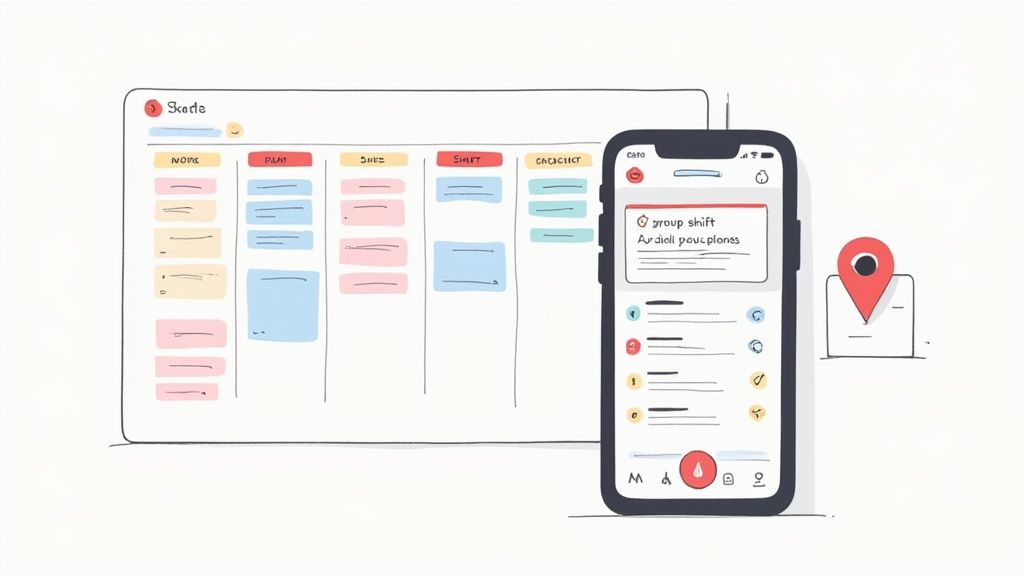
The first step is a visual shift plan. Don't worry, you don't need expensive software for this – simple tools like Excel or Google Sheets are often sufficient for a start. You create a simple table where you represent the timeline (preferably in 30-minute intervals) and the various task areas (entry, bar, technology, etc.).
Then you enter the names of your helpers into the appropriate time slots. Very important: Clearly mark buffer times and planned breaks. For a smooth process, it is crucial that the handovers between shifts are well planned. A helper should only finish their shift when the replacement has arrived and has been briefly instructed.
A good shift plan takes into account not only the tasks but also the people behind them. Ensure a variety of activities and plan so that no one is stuck for hours in the most stressful area, like the main bar. A well-thought-out rotation keeps the team fresh and the motivation high.
In more complex events with dozens of helpers and different qualifications, Excel lists quickly reach their limits. Here, specialized software can be a massive relief. Such digital tools automate the assignment, take skills into account, and automatically remind helpers of their upcoming shifts. You can find more about the benefits in our guide to digital deployment planning.
Communicate all important information
A plan is only as good as it is communicated. Therefore, send your team a compact briefing a few days before the event with all the information that really matters. Keep it short, clear, and above all mobile-friendly – most will read it on their smartphones while on the go.
This briefing is the one central source of information for your entire team. Summarize everything relevant so that no unnecessary questions arise on the big day.
We have compiled a checklist to help you think of everything.
Checklist for the helper briefing
This checklist summarizes all the information your helpers need before and during the event.
| Category | Information | Example |
|---|---|---|
| Arrival & Check-in | Exact address, transportation options (public transport, parking) and the exact meeting point for check-in. | Meeting point is at 2:00 PM at the helper tent directly to the left of the main entrance. Check in there with Sarah. |
| Schedule | Start and end of the shift, planned breaks, and the general timeline of the event. | Your shift at the bar goes from 3:00 PM to 8:00 PM. You have a planned break from 5:30 PM to 6:00 PM. |
| Tasks | A short, precise description of the main tasks during the shift. | You are responsible for serving drinks (beer, soft drinks) and processing cashless payments. |
| Contact person | Names and mobile numbers of the responsible department heads for questions or problems. | Your department head is Tom (079 123 45 67). He is your first point of contact for everything. |
| Dress code & equipment | Guidelines for clothing and what helpers should bring (or not). | Please wear dark, comfortable shoes. You will receive a team t-shirt from us. A personal bag is not necessary. |
| Emergency contacts | Phone numbers for security personnel, paramedics, and the main organization. | In case of emergency, you can reach security at 078 987 65 43 and the paramedics at 077 654 32 10. |
This ensures that everyone is well prepared and can fully concentrate on their tasks.
For quick communication on the event day itself, a simple group in a messaging service like WhatsApp or Signal has proven effective. Here you can relay last-minute changes or inform the team about important occurrences. But beware: Use the group disciplined and only for truly relevant messages so that important information does not get lost in general chatter.
How to successfully lead your helpers on the event day
The big day is here, the tension is rising. Right now, it shows how good your preparation really was. Your main task today is not only to manage your team – you must lead, motivate, and keep them in good spirits. Because a smooth process on site starts with a perfectly organized beginning.
Organize a stress-free check-in
The first impression for your helpers on event day is the check-in. If there is chaos here, the whole team starts with a subdued mood. Your goal must be a quick, clear process where everyone feels immediately welcome and well taken care of.
Set up a clearly visible helper meeting point, preferably a bit away from the general guest entrance. At this central point, one or two of your most experienced team members should be ready. Their task is to greet arriving helpers warmly, check them off a list, and equip them with everything necessary.
- Name tags or IDs: Ensure that these are clearly legible and perhaps even display the assigned role (e.g., 'Bar Team' or 'Entrance').
- Team clothing: Have T-shirts or vests sorted by size ready. Nothing is more annoying than rummaging around at the last minute.
- Important information: Give everyone a printed layout and the contact details of their direct contact person.
Thoughtful preparation at this point prevents long waiting times and creates a professional and appreciative atmosphere from the very first minute.
Conduct a short and concise on-site briefing
Once everyone is checked in, gather the entire team for a quick on-site briefing. This is your big chance to get everyone committed to the common goal and clear up any remaining ambiguities. Important: Keep this meeting short – maximum 10 to 15 minutes are ideal here.
Introduce the individual area leaders personally so that everyone knows who to turn to with questions. Go through the rough schedule again and point out the most important key points of the day, such as the expected peak times at the bar or at the entrance.
The most important part of the briefing is the motivation. Thank everyone for their efforts and make it clear that each individual contributes decisively to the success of the event. A sentence like: 'Without you, this would not be possible today - let's deliver a great show for our guests together!' can work real wonders.
Be present and show your appreciation.
During the event, you are the conductor. Be constantly visible and approachable. Regularly make the rounds through all areas, ask if everything is okay, and offer your help. Even a short 'How's it going with you?' shows your team that you are present and care.
Recognition is the fuel for motivated helpers. Ensure that there are always enough drinks and reasonable food available. A simple snack or a warm meal during the break shows that you see and appreciate their hard work. And very importantly: Don't forget to personally thank everyone at the end of the shift.
The check-out at the end of the day should be just as straightforward as the check-in. Collect all materials such as keys, radios, or cash registers. A firm handshake and a genuine 'Thank you for everything, you were great!' are the perfect conclusion to a tiring but successful day.
How to retain helpers in the long term.
The event is over, the last box is stored – but your work is not quite done yet. The follow-up is not a tedious attachment but your greatest opportunity to turn one-time helpers into a loyal team for the future.
Right now, it is decided whether you will start from scratch again next time or can rely on a well-rehearsed network. The search for helpers does not end with the dismantling but seamlessly transitions into building your community.
Get honest feedback.
The first and most important step: actively listen. Your helpers had the best view behind the scenes and know exactly what went well and where it faltered. This knowledge is worth its weight in gold! Send them a short, uncomplicated questionnaire a few days after the event.
Question directly about their experiences:
- How satisfied were you with the organization and communication before the event?
- Did you feel well cared for and informed during your assignment?
- What was your personal highlight and what bothered you the most?
- Do you have specific suggestions on what we can do better next time?
Keep the questionnaire concise and anonymous to get truly honest answers. Free tools like Google Forms or Typeform are ideal for that.
Say a sincere thank you
A sincere thank you is the most important currency. It shows that you do not take your team's efforts for granted. A personal email to all helpers is the absolute minimum.
Forget general clichés. Refer to specific moments of the event. For example, mention how great the bar team handled the large influx or how smoothly the setup went thanks to the tech crew. Such details show that you really paid attention.
Small gestures can greatly enhance the effect without breaking the budget. An invitation to a joint helper dinner, a voucher for a local partner, or exclusive photos from the event are great signs of appreciation.
Build a GDPR-compliant helper pool
You want to be able to directly approach the best people again next time. For this, you need a helper pool – and this is where data protection comes into play. Explicitly ask your helpers for permission to store their contact details and to contact them for future events.
This helper pool is your greatest asset. When the next search for 'helpers needed for events' comes up, you already have a list of proven, motivated people who know and appreciate your event. This way, you build a strong foundation for every upcoming occasion in the long run.
With job.rocks you can manage your helper pool centrally and GDPR-compliant manage, check availability, and plan assignments with just a few clicks. Discover now how to reduce your administrative effort and bind your team to you.