
A successful one Employee planning for trade fairs is not a coincidence. It is the result of a clear, honest needs analysis. Before you set up a single roster, you need to know exactly who and how many People you really need on site. This first phase is the foundation for a smooth process, a motivated team and at the end of the day: your success at the trade fair.
Lay the foundation for your trade fair success
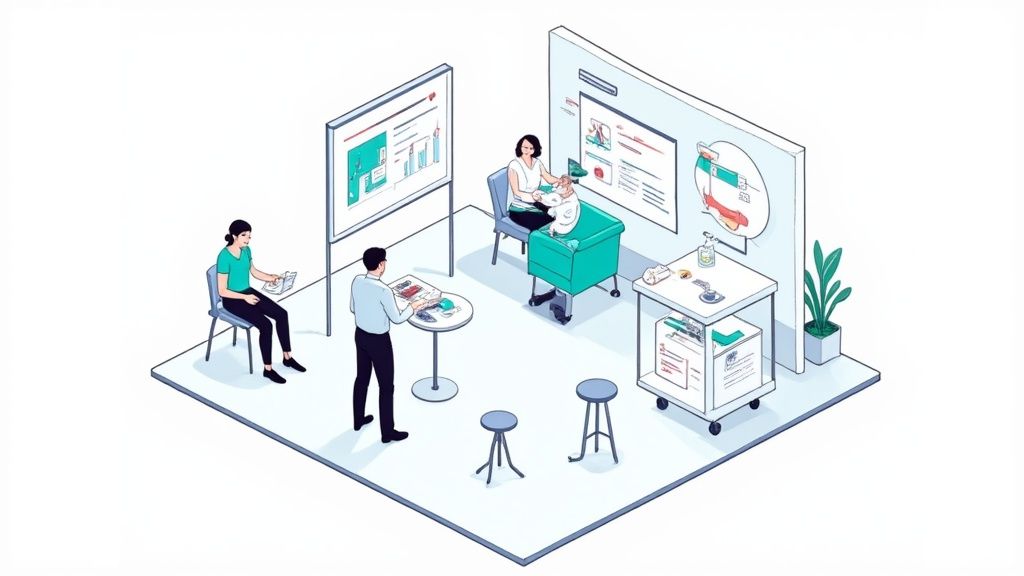
Your appearance at a trade fair depends on the people at your stand. Too few staff quickly leads to overwhelmed colleagues and disappointed visitors who can't speak to anyone. Overstaffing, on the other hand, only drives up costs unnecessarily. The first and most important step is therefore always to realistically determine the personnel requirements.
Analyze quantitative factors
Let's start with the hard numbers. They give you an initial, solid basis for the size of your trade fair team. It is best to collect the following information:
- Stand size: As a rule of thumb you can one person per 10-15 square meters expect an active conversation area. So a 50 square meter stand needs at least three to four people at the same time so that it doesn't look empty or become hectic.
- Trade fair opening hours: How many hours is the trade fair open every day? This is the basis for your shift planning and the total number of working hours required.
- Expected visitor numbers: Look at the data from past trade fairs. Are there typical peak times, such as on the first day or around lunchtime? You should plan buffers and have additional staff available for these phases.
Imagine you are planning for a trade fair that runs from 9 a.m. to 6 p.m. Experience shows that the busiest times are between 10 a.m. and 2 p.m. For these four hours, it makes perfect sense to increase the cast by at least one person. This way you avoid long waiting times for valuable prospects.
Consider qualitative aspects
Zahlen allein erzählen aber nur die halbe Geschichte. Die Art Deiner Produkte oder Dienstleistungen and Deine konkreten Messeziele spielen eine mindestens genauso grosse Rolle. Diese "weichen" Faktoren musst Du unbedingt in Deine Überlegungen einbeziehen.
Good personnel planning takes into account not only the number of people, but above all the specific skills that are crucial for success at the stand. It's about having the right expertise available at the right time.
Think carefully about which roles you need to fill at the stand. Each position fulfills a specific function and contributes to the overall success.
Define essential roles at the exhibition stand
A professional trade fair team does not just consist of salespeople. In order to appear competent and be able to respond to all requests, you need a good mix of different talents.
Practical examples of core roles:
- The stand manager: This is the person wearing the hat. She keeps an overview, coordinates the team on site, solves problems and is the central contact for the trade fair organization. Your job is also to keep motivation high and keep an eye on the goals.
- The sales professional: He specializes in conducting qualified conversations, generating leads and identifying potential customers. Depending on the size of the stand, you will of course need several of them.
- The product expert or technician: This role is worth its weight in gold, especially for technical products that require explanation. He can answer in-depth questions, show live demos and explain technical details that would limit a pure salesperson.
- The service person or the host: He or she is often the first point of contact. This person greets visitors, provides drinks and snacks, distributes information material and creates a welcoming atmosphere. In this way, it keeps the specialist staff’s back free.
When you combine these quantitative and qualitative analyses, you get a clear, realistic picture of your staffing needs. This careful preparatory work is the key to effective Personnel planning at trade fairs and prevents costly mistakes or missed opportunities.
Putting together the right team for the trade fair stand
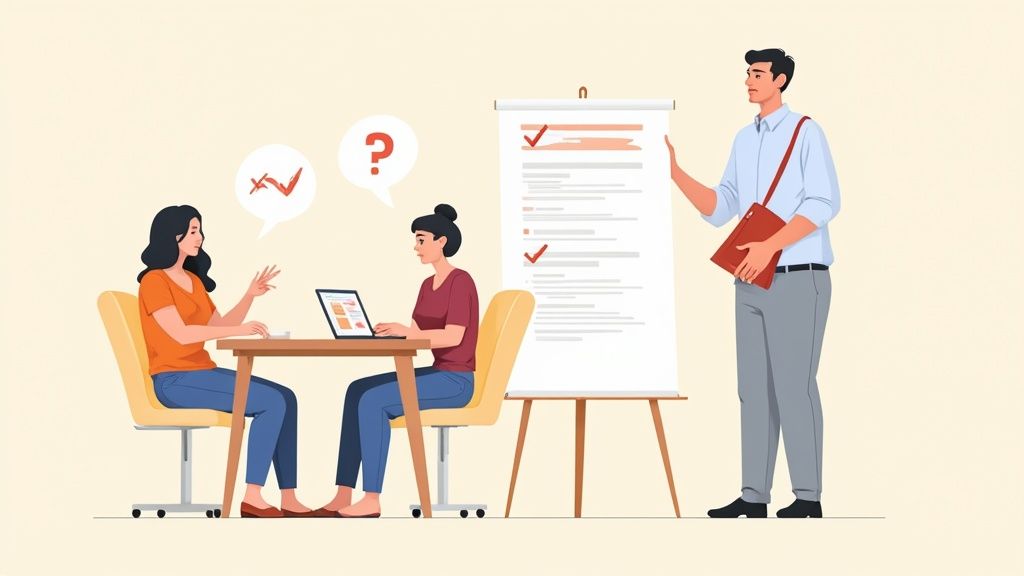
Once the personnel requirements have been determined, comes the supreme discipline: selecting the right people. Because one thing is clear: your trade fair team is Your local company. Their competence and demeanor decide whether a visitor becomes a valuable lead or moves on carelessly.
Careful selection is therefore not an option, but an absolute necessity. You need a team that not only excels professionally, but also fits the event personally and can cope with the stressful trade fair hustle and bustle.
The requirements profile as a compass
The first and most important step is a detailed one Requirements profile for each individual role at the stand. This document is your compass for the entire selection process. It ensures that you don't make decisions based on your gut instinct, but instead systematically find the best candidates.
A good profile goes far beyond pure specialist knowledge. Especially at a busy trade fair, social skills are often the tipping point. Your team must function under pressure, approach people proactively, and always remain professional and friendly.
For a crystal clear image you should cover these two areas:
- Professional competencies: Which product knowledge is indispensable? Are certain language skills required? How much experience in sales or customer service is a must?
- Social skills: Brauchst Du extrovertierte "Türöffner", die aktiv auf Besucher zugehen, oder eher geduldige Berater für tiefgehende Fachgespräche? Resilience and a high one Service orientation are a must at almost every trade fair.
A well-thought-out requirements profile prevents expensive wrong appointments. It forces you to define crystal clear in advance which skills really count and helps you compare candidates objectively.
If you want to delve deeper into the matter, we have a guide that will show you how to do a precise one Create requirements profile can make your search much easier.
Internal talent or external professionals?
With the finished profile in hand, the actual search begins. Basically, you have two options: you rely on internal employees or book external staff through specialized agencies. A mix of both is often the most effective solution.
Internal employees
The biggest advantage is obvious: you know the company, the products and the culture inside out. Don’t just look at sales! There are often real talents lurking in marketing, product management or even development who are eager to appear at a trade fair.
External trade fair professionals
Specialized hosts, promoters or moderators bring a lot of experience with them. They are used to approaching strangers and only need a short introduction to your products. They can be a great addition to relieve your core team and ensure constant presence.
This is what the selection process looks like in practice
Imagine you are looking for a product expert for a technology trade fair. Your requirements profile not only requires in-depth technical knowledge, but also the ability to explain complex issues in a child's play.
In the selection interview - whether internal or external - you should put this to the test.
- Question about professional competence: "Erklären Sie mir unser neues XY-Feature so, als wäre ich ein Kunde, der noch nie davon gehört hat."
- Question about resilience: "Beschreiben Sie eine Situation, in der Sie es mit einem sehr kritischen oder unzufriedenen Kunden zu tun hatten. Wie haben Sie reagiert?"
- Question about motivation: "Was reizt Sie besonders daran, für uns auf dieser Messe im Einsatz zu sein?"
Pay attention not only to the words, but also to the body language and general demeanor. A professional and committed impression is often the best indicator of a successful trade fair. This way you can ensure that your team represents your company in the best possible way and actively contributes to achieving your trade fair goals.
Cleverly design the roster for trade fair days
A successful trade fair appearance not only depends on who is at the stand, but above all When. Well thought-out shift planning is the heart of your work Employee planning for trade fairs. It ensures that your team remains motivated, energetic and efficient throughout the entire period. A carelessly cobbled together plan will inevitably lead to tired employees, unoccupied zones and ultimately missed opportunities.
A fair and cleverly designed roster is much more than just an Excel spreadsheet. It is a strategic tool that directs the energy of your team and ensures that your stand is welcoming and competently staffed at all times.
Comply with legal framework conditions
Before you dive into creative planning, you need to know the legal rules. In Germany, the Working Hours Act (ArbZG) is your essential guide. Anyone who slips here not only risks dissatisfied employees, but also serious legal consequences.
Here are the most important points you need to have on your radar:
- Maximum working hours: The daily working hours may 8 hours do not exceed. It can be up to 10 hours can be extended if an average of 8 hours on working days is not exceeded within 6 months. Trade fair days are long, so pay close attention.
- Break regulations: The breaks are clearly regulated. If you work more than 6 hours are 30 minutes Break is mandatory. At more than 9 hours have to do it 45 minutes be. These breaks are essential for recovery and concentration.
- Rest times: Employees must have at least: between two work assignments 11 hours uninterrupted rest periods are granted. This is a critical factor, especially for trade fairs lasting several days, that you have to plan for from the start.
These rules are not an obstacle, but an important protective mechanism. A rested team is a productive team. So integrate these specifications into your planning right from the start.
Develop layering models for maximum impact
A good shift schedule is flexible and based on the expected number of visitors. A rigid 8-hour block for everyone is almost always the worst solution. It is much better to develop models that are tailored to the typical dynamics of the trade fair.
Dein Ziel sollte es sein, die Standbesetzung an die "Pulskurve" der Messe anzupassen. Mehr Personal während der Stosszeiten, eine solide Grundbesetzung in ruhigeren Phasen – das is der Schlüssel zu einem guten Plan.
For example, consider working with overlapping layers. A core team could be on site all day, while additional staff could be targeted for the busy hours - let's say between 10:00 a.m. and 3:00 p.m - join in. In this way you ensure a complete staffing and at the same time enable everyone to take a breath and retreat for a moment.
Practical example of a shift schedule
Let's make it concrete: Imagine you are planning a three-day trade fair with a team of 8. Mass is daily from 9:00 a.m. to 6:00 p.m open. Your team consists of a stand manager, three sales professionals, two product experts and two service staff.
A possible plan could be structured like this:
| time window | Day 1 (Tuesday) | Day 2 (Wednesday) | Day 3 (Thursday) |
|---|---|---|---|
| 08:30 - 13:30 | Stand manager, 2 sales, 1 expert, 1 service | Stand manager, 2 sales, 1 expert, 1 service | Stand manager, 2 sales, 1 expert, 1 service |
| 1:00 p.m. - 6:30 p.m | 1 sales, 1 expert, 1 service | 1 sales, 1 expert, 1 service | 1 sales, 1 expert, 1 service |
| Flex force | 1 Sales (10am-3pm) | 1 Sales (10am-3pm) | 1 Sales (10am-3pm) |
This model ensures a deliberate overlap at lunchtime. This enables smooth shift changes and gives the team time for short but important coordination. The additional flex power confidently absorbs the expected midday peak.
Use digital helpers for planning
Honestly, creating such plans manually in Excel can quickly become a nightmare, especially when there are short-term changes. Modern software solutions relieve you of an incredible amount of work and dramatically reduce the error rate.
Specialized software makes it possible to create work schedules dynamically - based on the actual needs and qualifications of employees. This leads to a fairer workload and greater satisfaction.
Comparison of planning methods
The decision between an Excel list and specialized software has far-reaching consequences for the flexibility of your trade fair planning. Here is a short comparison:
| feature | Manual planning (Excel) | Specialized software |
|---|---|---|
| Flexibility for changes | Low, error prone, every change requires manual adjustments. | High, changes are synchronized in real time and conflicts are automatically detected. |
| communication | Inconvenient via email or messenger; Version chaos is inevitable. | Centralized via an app; everyone immediately has the current plan. |
| Compliance with the law | Manually checking breaks, rest periods, etc. is laborious and risky. | Automatic warnings in the event of violations of the Working Hours Act. |
| Availability query | Time-consuming due to separate queries and manual transfers. | Employees can enter their availability directly in the system. |
| Qualification Matching | No automatic matching; you have to keep in mind the abilities of each individual. | Filter functions enable targeted assignment according to skills. |
While Excel may still be sufficient for the very first draft, it quickly reaches its limits in the dynamic reality of a trade fair.
Such systems simplify Employee planning for trade fairs enormous. They allow you to query availability, take qualifications into account and assign shifts with a click. A comprehensive solution for the Operations planning can help you automate the entire process from planning to billing. Employees can submit changes or requests directly via an app - this saves you valuable time and increases flexibility for everyone involved.
Prepare the team properly before the trade fair
Ein perfekt ausgearbeiteter Dienstplan ist nur die halbe Miete. Wenn Dein Team nicht genau weiss, was von ihm erwartet wird, verpufft das ganze Potenzial Deines Messeauftritts. Eine gezielte Vorbereitung ist kein "Nice-to-have" – sie ist der entscheidende Schritt, damit alle am gleichen Strang ziehen and Deine Unternehmensbotschaft überzeugend rüberbringen.
Without a clear briefing, every employee only acts to the best of their knowledge and belief. The result? Contradictory statements, missed opportunities and an unprofessional overall impression. Your Employee planning for trade fairs must therefore necessarily include a clean preparation process.
The basis for everything else is of course a structured plan. The graphic below outlines the basic path to get there.

This process - from defining the time slots to assigning them using a digital tool - creates the organizational foundation on which you can now build.
The trade fair briefing as a central element
The heart of every preparation is a crisp, comprehensive trade fair briefing. Here you get everyone on board and bring them to a common denominator. It's the perfect opportunity to motivate the team and create a real sense of unity.
An effective briefing should cover at least these points:
- Aims of the trade fair appearance: What exactly do you want to achieve? It's about obtaining 150 qualified leads, introducing a new product or strengthening the brand in a new region? Only those who know the destination will find the way.
- Key messages and elevator pitch: Everyone on the team has to be in 30 seconds Be able to explain who you are, what you offer and what problem you solve for the customer. Practice this pitch together until it fits.
- Product highlights: Which features and benefits are particularly important this time? Concentrate on the most powerful arguments that really resonate with your target group.
- Rules of conduct at the stand: How do you greet visitors? How do you actively talk to them without seeming intrusive? Also clarify the dress code, break rules and how to use cell phones at the stand.
Interactive training instead of a frontal lecture
Let’s be honest: no one remembers a two-hour monologue. Make your training interactive and as practical as possible. Role-playing games are an excellent way to simulate typical conversation situations.
One team member plays the skeptical customer, another the curious prospect. In this way, your team learns to respond to different types of customers, refute objections and confidently steer conversations in the desired direction.
This playful approach breaks down inhibitions and gives everyone the security they need for real action. In order to convey knowledge flexibly and effectively, you can also use modern Online training fall back.
Have logistics under control
Preparation also includes ensuring that all logistics for the team run smoothly. Nothing is more demotivating than stress over organizational mishaps. Make sure everyone has all the important information on time.
Checklist for logistical organization:
- Team clothing: Is the clothing ordered in the right size for everyone and distributed in a timely manner?
- Arrival and accommodation: Are the travel plans clear? Does everyone know how to get to the trade fair and the hotel?
- Contact details: Create a list with the cell phone numbers of all team members and the stand manager. This means everyone can be reached in an emergency.
- Trade fair documents: Does everyone have access to important documents such as price lists, brochures or the lead capture form?
Well-thought-out preparation not only gives your team the necessary knowledge, but also the self-confidence to shine at the trade fair stand. This effort is guaranteed to pay off – in the form of motivated employees and better results.
Everything under control on site: managing and following up on the trade fair
The starting shot has been fired, the trade fair stand is buzzing - now we're entering the hot phase. A clever one Employee planning for trade fairs But it doesn't stop with the finished roster. How you lead and coordinate your team on site ultimately determines whether the horsepower will actually be put on the road and the goals will be achieved.
And when the lights go out? Then the work is far from over. Clean follow-up gives you pure gold for the next event and ensures that everything runs smoothly administratively.
The role of the stand manager: More than just a boss
The stand manager is the heart of the trade fair appearance. He is not only an organizer, but also a coach, spontaneous problem solver and motivator. His mission: to ensure everything runs smoothly and to keep the team focused and in a good mood.
Daily ones are an absolute must Morning briefings. A short, sweet one 10 minute meeting before the start of the trade fair is enough to get everyone ready for the day.
What belongs in a morning briefing:
- Clear goal for the day: "Okay Leute, heute legen wir den Fokus voll auf unser neues product X. Unser Ziel: mindestens 20 qualified interviews dazu führen. Packen wir's an!"
- Special dates: "Wichtig: Um 11 a.m kommt eine angemeldete Journalistengruppe. Lisa, Du übernimmst bitte die Führung, ja?"
- A dash of motivation: Honest praise for the previous day's performance can work wonders. This gives the team the energy they need for a long day at the trade fair.
A good stand manager doesn't lead from above, he lends a hand. He steps in when someone is missing, makes sure that breaks are actually taken, and always has an open ear.
Time and expenses: bill cleanly without chaos
Who wants to deal with illegible timesheets or lost receipts after a strenuous day at the trade fair? No one. Transparent and easy recording of working hours and expenses is not only important for payroll accounting - it is a sign of appreciation for your team.
Imagine an employee has to spontaneously organize a taxi for an important customer. Without a clear process for expense reporting, he risks being stuck with the costs. This demotivates and creates mistrust.
Checklist for administrative processing:
- Digital time recording: Use an app that allows employees to easily clock in and out using their smartphone. This is precise, fair and saves you the hassle of adding additional information.
- Clear expense rules: Define clearly in advance which expenses (meal allowances, travel costs, etc.) will be reimbursed and up to what amount. A simple form or app function makes it easier for everyone.
- Digitize receipts: The simplest rule: take a photo of every receipt immediately with your cell phone and upload it. This means nothing is lost and the billing is completed in no time.
A modern one Employee app for scheduling cleverly bundles these functions in one place. This not only makes your life easier, but also gives the team the security that everything is happening correctly and transparently.
After the trade fair is before the trade fair: get feedback
The mission is over, everyone is exhausted, but at best happy. Now comes a step that is often forgotten but is extremely valuable: feedback. Only if you know what went great and where things went wrong can you really improve the planning for the next event.
Your team was at the forefront and gained priceless impressions - you have to tap into this knowledge! A short, anonymous survey is often the best way to get honest and constructive feedback.
Example of a feedback form
A good feedback form specifically asks about various aspects of the operation. Give your team an evaluation scale and leave space for open comments - that's where the best ideas often lie.
| Ask | Rating (1 = bad, 5 = great) | Your open comment |
|---|---|---|
| How good was the organization in advance (briefing, information)? | 1 – 2 – 3 – 4 – 5 | What did you particularly like or miss? |
| How fair and sensible did you find the roster? | 1 – 2 – 3 – 4 – 5 | Did you have enough breaks and time to recover? |
| What was the cohesion and atmosphere in the team? | 1 – 2 – 3 – 4 – 5 | What can we do to further strengthen the team spirit? |
| Did you have all the materials and information you needed at the stand? | 1 – 2 – 3 – 4 – 5 | Was there something you were missing to make your work even better? |
This structured follow-up is not a chore, but a smart investment in the future. She helps you, yours Employee planning for trade fairs To professionalize step by step and get the most out of every event.
The most burning questions about personnel planning for trade fairs
You have the strategy, now come the details. Here I answer the typical questions that come up again and again in everyday trade fair life. With these tried and tested answers you are ready for the hot phases of your life Employee planning at trade fairs well prepared.
How many employees do I need per square meter?
There is no rigid formula, but a good rule of thumb is: Plan ahead one employee per 10–15 square meters more active Stand area. This will ensure that your stand looks lively and that every visitor can quickly find a contact person.
However, the expected flow of visitors and the number of your conversation stations are much more important than the sheer number of square meters.
For typical peak times – such as late morning or the first day of the trade fair – you should always plan at least one person as a buffer. This reserve is worth its weight in gold because it allows for breaks and prevents your team from being overwhelmed when there is a lot of pressure.
Take a look at the visitor frequencies at past trade fairs to determine your needs even more precisely. This is how you find the perfect balance between presence and a good plan.
What do I do in the event of a short-term outage?
A case of illness on the first day of the trade fair – the absolute classic and without an emergency plan a small catastrophe. The key, as so often, is preparation.
Create a pool in advance "Stand-by"-Mitarbeitern who can step in in an emergency. These can be colleagues from the office who have received at least a basic briefing on the trade fair products and objectives.
The most important steps for an emergency:
- Keep contact list handy: An up-to-date list with the cell phone numbers of all team members and potential replacements is essential.
- Use digital tools: Modern planning tools are your lifeline here. They show you at a glance which employees with the right qualifications would be available. This way you can close gaps quickly and effectively instead of panicking.
A solid emergency plan takes away the stress and ensures that your trade fair appearance continues professionally and smoothly, even in the event of unexpected turbulence.
How do I measure the success of the deployment of personnel?
The success of your trade fair team is not a gut feeling, but can be measured using specific key figures. In this way, you finally make the contribution of your staff visible and can specifically improve future operations.
Hard facts (quantitative key figures):
- Number of qualified conversations (leads) conducted per employee.
- Number of agreed follow-up appointments or even direct sales transactions.
- Number of product demos carried out at the stand.
Soft factors (qualitative aspects):
- Team feedback: Get targeted feedback from your team after the trade fair. Ask about their experiences, biggest challenges and specific suggestions for improvement.
- Visitor feedback: If the situation allows it, ask visitors directly about their experience and the quality of advice at the stand.
Analyze which team members generated the most qualified leads. This will help you recognize your individual strengths and apply them to the next one Employee planning for trade fairs to be used even more precisely. This means that every event becomes a learning curve that will continually improve you.
Ready to take your employee planning from the chaos of notes into the digital age? With job.rocks You automate the entire process – from availability queries to time recording. Discover now how you can save valuable time and set up your trade fair team perfectly: https://job.rocks