
What is net wage and how do you calculate it in Switzerland?
Your net salary is the amount that actually arrives in your bank account at the end of the month. While the higher gross wage is agreed upon in the employment contract, the net wage is the money that is actually available to you for rent, shopping and leisure time. Knowing this difference is important for your personal...
Yours Net wage is the amount that actually arrives in your bank account at the end of the month. While in the employment contract the higher Gross wages is agreed, the net salary is the money that is actually available to you for rent, shopping and leisure time. Knowing this difference is absolutely crucial for your personal financial planning.
From gross wages to real income
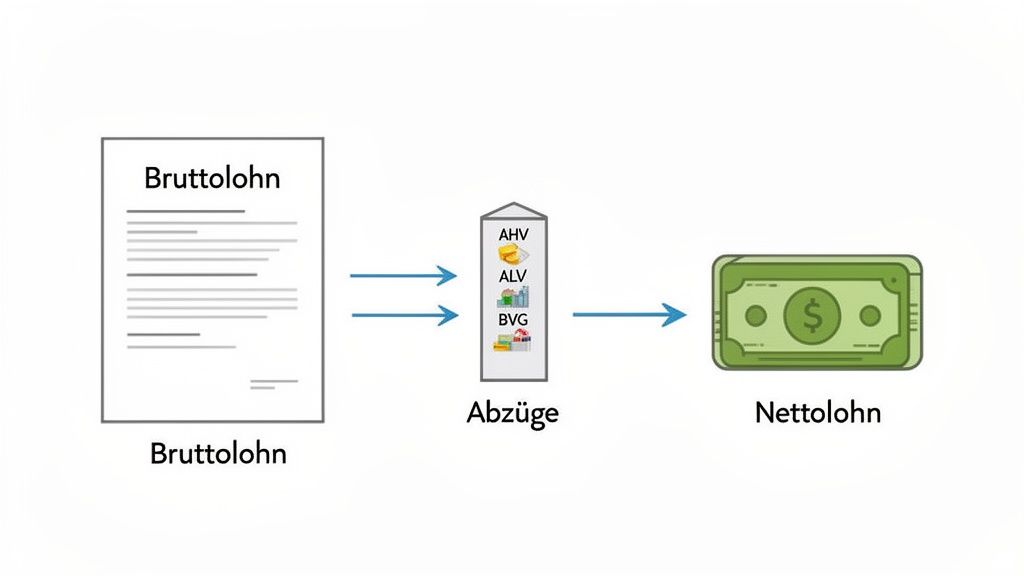
When you think about your salary, you probably have the big number from your employment contract in mind. This is your gross wage. It is the starting point for the calculation, but not the amount you can spend.
Think of gross wages like the total sales of a small shop. Before the owner can take his profit home, he must first cover all costs - rent, goods, wages. It works in a similar way with your wages: various mandatory contributions are deducted from the gross amount before your net wages remain.
What exactly is being deducted?
In Switzerland, these deductions flow directly into your social security and form a stable safety net for your future. The most important deductions are:
- Old age and survivors insurance (AHV): The foundation of your state pension.
- Disability insurance (IV): Your protection if you become unable to work.
- Income compensation regulations (EO): Secures your income during military service, community service or maternity leave.
- Unemployment insurance (ALV): Your financial protection if you lose your job.
- Occupational pension provision (BVG / pension fund): The second pillar that complements your retirement provision.
Your net wage is much more than just a number on your payslip. It shows how our social system works: part of your earnings is invested directly into your future security.
While these deductions reduce the amount available immediately, they also build your retirement foundation and protect you from unforeseen life events. What remains after these solidarity contributions is your net salary - and that is the true size of your monthly budget.
The journey from gross wages to net wages
The path from the high number in your employment contract to the amount that actually ends up in your account is a short but important journey. Every stop on this path is a deduction - a contribution that flows directly into your social security and your future. Only then will your net salary be freely available to you.
Imagine your gross salary like a freshly baked cake. Before you have it all to yourself, a few pieces are set aside for the community and your own provision. These pieces are the mandatory social security contributions.
The most important deductions on your payslip
In Switzerland, the system is designed fairly: You and your employer usually share the social security contributions. You will therefore find the following items on almost every payslip:
- AHV/IV/EO (1st pillar): This is the foundation of your precautions. With 5.3% With your gross wages, you secure your pension (old-age and survivors' insurance), receive protection in the event of disability (disability insurance) and finance wage replacement benefits in the event of maternity or military service (income compensation scheme).
- Unemployment insurance (ALV): Your personal safety net in case you lose your job. Become for this 1.1% deducted from your wages.
- Occupational pension provision (BVG / pension fund): This is the second pillar of your retirement provision, which will help you maintain your usual standard of living even in retirement. The contribution rate depends on your age and is usually between 7% and 18%.
- Non-occupational accident insurance (NBU): This insurance kicks in if an accident happens to you in your free time. The contribution rate varies depending on the insurance company and industry.
What the calculation looks like in practice
Let's make it concrete. Let's say you earn 6,000 CHF gross per month. Your deductions could then look like this:
- AHV/IV/EO (5.3%): -318 CHF
- ALV (1.1%): -66 CHF
- Pension fund (example: 7%): -420 CHF
- NBU (Example: 1%): -60 CHF
Yours Net wage is in this case 5,136 CHF. This is the amount that you actually have left after all deductions. By the way, this is a very high proportion compared to other countries. The Net wage in Switzerland makes an average of around 81% of the gross wage, while in Germany it is only about 62% are. If you want to delve deeper into the numbers, take a look at the current wage statistics in Switzerland.
A payslip explained step by step
Gray theory rarely helps. Let's make it concrete: Let's go through a fictitious payslip together for a project manager from the event industry. Our example employee lives in Zurich and has a gross monthly salary of 6,500 francs.
To understand what actually happens on the way from gross to net, a simple picture helps: Your salary starts as a whole, the mandatory deductions take their share, and what's left at the end is your net salary.
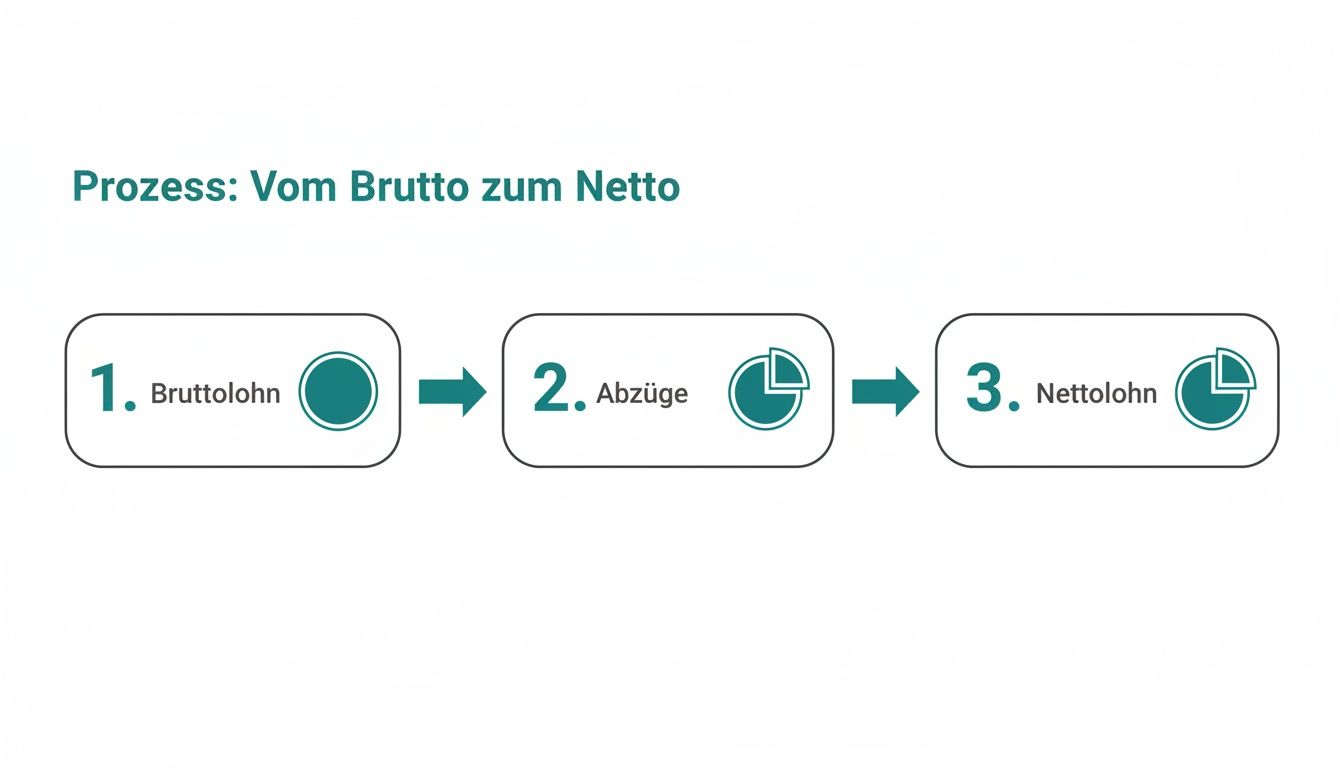
This visualization makes it clear: the deductions are not a secret, but a fixed and calculable part of the wage calculation that directly determines the final payout amount.
From gross to net in numbers
Now let's apply the common percentages to our project manager and see what's really left.
This is what the calculation looks like in detail:
- Gross wage: 6,500.00 CHF
Social security contributions are now deducted from this. Specifically, it is about the employee share, which is made up as follows:
- AHV/IV/EO (5.3%): 344.50 CHF
- Unemployment insurance (ALV, 1.1%): 71.50 CHF
- Pension fund (BVG, exemplary 8%): 520.00 CHF
- Non-occupational accident (NBU, example 1.2%): 78.00 CHF
The total of these deductions amounts to: 1,014.00 CHF. If you subtract this amount from the gross wage, you get a net wage of 5,486.00 CHF. This is the amount that ends up in his account - assuming he is not subject to withholding tax.
For industries such as catering or event agencies that job.rocks supports, this net value is crucial. A gross salary of 6,000 francs in Zurich often results in a net salary of over 4,800 francs, which makes flexible employee pools attractive for employers. Regional differences play a big role here - in Zurich there is often more left over than in Ticino, for example.
A clear overview of deductions is crucial. This is the only way you know exactly where your money is going and why your net salary looks the way it does.
This example shows how transparent a payroll statement can be if you understand the individual items. For an even more detailed breakdown, check out our guide to Payroll in Switzerland.
Special features: freelancers, temporary work and cantonal differences
Not every job fits the classic employee mold. In today's flexible working world, there are a few special cases that have a direct impact on your net salary. This primarily includes temporary work and working as a freelancer.
If you are a freelancer or self-employed person, you are an employer and employee in one person. This means: You are completely responsible for paying your social security contributions correctly. While employees share the contributions with the employer, as a freelancer you have to save and transfer the full amount for AHV/IV/EO yourself.
What you need to have on your radar as a freelancer
All social security contributions are deducted from the gross fee that you invoice your customer. Contributions to the pension fund are voluntary for the self-employed, but strongly recommended. So you have to calculate very disciplinedly so that you end up with a realistic net salary in your pocket.
- Social contributions: You pay the full contribution rate for AHV/IV/EO. There is no splitting.
- Pension fund (BVG): Your occupational pension provision is solely in your hands. Take care of it!
- Taxes: You are responsible for the correct taxation of your income and must set aside the money yourself.
Cantonal differences – your place of residence determines your net salary
Where you live in Switzerland has a big influence on what is actually left of your gross wage. Two factors are crucial here: the cantonal tax rates and the cantonal minimum wages. A gross salary of 7,000 francs leads to a noticeably higher net wage in the tax-efficient train than in Geneva or Bern, for example.
In addition, cantonal minimum wages set a clear lower limit for your income. Geneva is at the forefront here 24.32 francs per hour, which corresponds to a gross wage of around 4,100 francs and a net wage of around 3,300 francs. Other cantons such as Basel-Stadt (21.70 francs) and Neuchâtel (21.09 francs) are following suit. These regulations ensure that your net salary cannot fall below a certain threshold.
Withholding tax is also a central issue for temporary workers. It is deducted directly from the wages and influences the net wages immediately and without any detours.
Anyone who works temporarily in Switzerland should read the rules carefully. Our guide will explain everything you need to know Withholding tax for temporary work.
How you as an employer can simplify salary preparation
Anyone who works in dynamic industries such as catering or event management knows this: wage preparation can quickly become complex. Flexible employee pools, constantly changing hourly rates and high fluctuation make the entire process unnecessarily complex and error-prone. The be-all and end-all for a clean net wage is complete and correct time recording.
For every HR manager, this often means a huge administrative mountain that has to be managed month after month. But this is exactly where modern workforce management platforms can be a real relief.
The path to automated payroll accounting
The key is to eliminate the tedious manual steps. Imagine if, instead of collecting, deciphering and typing timesheets, your employees simply record their times digitally using an app. This data then ends up automatically validated exactly where it belongs: in payroll accounting.
This image shows how simple the path from digital time recording to error-free payroll can be.
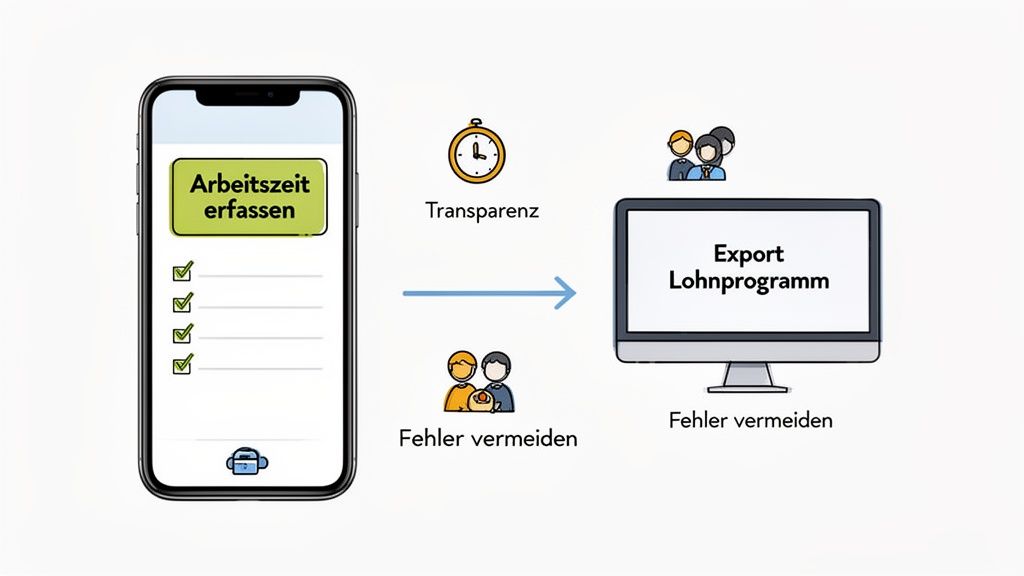
This direct connection between time recording and wage preparation makes the entire process not only faster, but also crystal clear and comprehensible. The result? You save valuable time, avoid expensive mistakes and create an absolutely clean data basis for calculating gross and net wages.
A digital solution like job.rocks brings you decisive advantages:
- Precise time recording: Your employees clock in and out via the app. This ensures accurate data you can rely on.
- Automatic processing: The recorded hours are checked in the background and prepared ready for payroll accounting.
- Seamless data transfer: Thanks to interfaces to common payroll programs, all data flows to where it is needed without a single manual action.
Smart digitalization of your HR processes not only creates faster processes. Above all, it ensures transparency – for you and your entire team. Everyone knows immediately which hours are billed.
This approach helps you keep administrative effort to a minimum. This way you can rely on the payroll being accurate and free up time for the really important tasks. If you want to go deeper into how you like yours Digitize HR processes you can find the right information with us.
Frequently asked questions about net wages in Switzerland
There are many questions about net wages that arise again and again in everyday working life. We have collected the most common ones and answered them briefly and succinctly - so that you know exactly what is going on.
What is the difference to disposable income?
There is often confusion here, but the distinction is quite simple. Yours Net wage is the amount that your employer transfers to you after all mandatory social security contributions and any withholding tax have already been deducted. This is your starting capital for the month.
This disposable income is what you after that still remains. The amount that is left over when you have paid all of your private fixed costs such as rent, health insurance and regular taxes. The net salary is the starting point for your personal budget.
Does my marital status affect my net salary?
Yes, he can, but mostly indirectly. The marital status has a direct influence on employees who are subject to withholding tax - i.e. on people without a C permanent residence permit. Here, the marital status flows directly into the tax rate, which immediately changes the net wage.
For Swiss citizens or people with a C-ID card, the marital status only becomes noticeable when the final tax bill is issued at the end of the year. Married people are taxed jointly and often fall into a different tax bracket.
Your marital status does not change social deductions such as AHV or ALV, but through taxes it can influence the amount that is available to you at the end of the month or year.
Why is my net salary not the same every month?
This is completely normal and is usually due to one of the following reasons:
- Hourly wage work: If you work on an hourly basis, your gross wage varies depending on the number of hours worked. More hours mean more pay, but also higher deductions.
- Variable wage parts: Did you work overtime, receive a bonus, or claim expenses? Such variable components increase the gross wage in a month and thus also the net amount paid.
- Changes to the pension fund: Sometimes the contributions to the pension fund are adjusted during the year, for example if your salary increases or because you have reached a new age level.
Are child allowances part of the net salary?
Yes, absolutely. Child and training allowances are usually paid directly with your salary and are included in your net salary. The big advantage is that these allowances are exempt from social security.
This means that no contributions for AHV, IV, EO or ALV will be deducted. So they increase the amount in your account one to one.
Would you like to simplify salary preparation and offer your team full transparency? With job.rocks You automate time recording and ensure absolutely error-free data - from the time clock to payroll accounting. Discover the advantages now https://job.rocks.