
{
“@context”: “https://schema.org”,
“@graph”: [
{
“@type”: “FAQPage”,
“mainEntity”: [
{
“@type”: “Question”,
“name”: “Warum ist der GAV so wichtig?”,
“acceptedAnswer”: {
“@type”: “Answer”,
“text”: “Ein GAV schafft für alle gleiche und faire Wettbewerbsbedingungen. Ohne ihn könnten einige Unternehmen versuchen, sich durch tiefere Löhne oder schlechtere Arbeitsbedingungen einen unfairen Vorteil auf dem Markt zu verschaffen. Der GAV sorgt hier für gleiche Startbedingungen, von denen am Ende alle ”
}
},
{
“@type”: “Question”,
“name”: “Was regelt ein GAV konkret?”,
“acceptedAnswer”: {
“@type”: “Answer”,
“text”: “Ein GAV legt typischerweise die Rahmenbedingungen für die wichtigsten Aspekte des Arbeitsverhältnisses fest. Diese Punkte müssen dann auch in deinem L-GAV Arbeitsvertrag korrekt abgebildet sein.”
}
},
{
“@type”: “Question”,
“name”: “Die wichtigsten Säulen eines GAV-konformen Arbeitsvertrags”,
“acceptedAnswer”: {
“@type”: “Answer”,
“text”: “Diese Tabelle fasst die zentralen Elemente zusammen, die durch einen GAV geregelt werden und im Arbeitsvertrag korrekt abgebildet sein müssen.”
}
},
{
“@type”: “Question”,
“name”: “Mindestlöhne und korrekte Einstufung”,
“acceptedAnswer”: {
“@type”: “Answer”,
“text”: “Der wohl bekannteste Punkt in jedem GAV sind die verbindlichen”
}
},
{
“@type”: “Question”,
“name”: “Arbeitszeit, Überstunden und Ruhezeiten”,
“acceptedAnswer”: {
“@type”: “Answer”,
“text”: “Ein GAV regelt die genaue Dauer der wöchentlichen Arbeitszeit, die oft bei”
}
}
]
},
{
“@type”: “ItemList”,
“name”: “L GAV Arbeitsvertrag einfach erklärt für die Schweiz”,
“numberOfItems”: 3,
“itemListElement”: [
{
“@type”: “ListItem”,
“position”: 1,
“name”: “Geltungsbereich und die rechtliche Basis”
},
{
“@type”: “ListItem”,
“position”: 2,
“name”: “Lohn und Arbeitszeit – das Herzstück”
},
{
“@type”: “ListItem”,
“position”: 3,
“name”: “Ferien, Feiertage und Sozialleistungen”
}
]
},
{
“@type”: “BreadcrumbList”,
“itemListElement”: [
{
“@type”: “ListItem”,
“position”: 1,
“name”: “Home”,
“item”: “https://job.rocks”
},
{
“@type”: “ListItem”,
“position”: 2,
“name”: “Einsatzplanung”,
“item”: “https://job.rocks/category/einsatzplanung/”
},
{
“@type”: “ListItem”,
“position”: 3,
“name”: “L GAV Arbeitsvertrag einfach erklärt für die Schweiz”
}
]
}
]
}
AL-GAV employment contractis much more than just a piece of paper. It is the foundation for fair and legally secure employment, as it often ensures significantly better conditions than the legal minimum requires. At its core, it directly integrates the binding rules of a collective labor agreement (GAV) into your employment relationship, thus protecting both sides from unpleasant surprises.
What really makes an L-GAV employment contract

Imagine a collective labor agreement (GAV) as an overarching set of rules for an entire industry. This set of rules is painstakingly negotiated between employer associations and trade unions. YourL-GAV employment contractis then your very personal contract that must respect and implement these industry-wide rules.
This means concretely: Your individual contract must never fall below the minimum standards set in the GAV. However, better conditions for you are always allowed and even desired. This is also known as theprinciple of favorability
A practical example: If the GAV for your industry stipulatesfive weeksof vacation, your contract cannot suddenly grant only four weeks. Offering six weeks is perfectly fine and a nice bonus.
Why is the GAV so important?
A GAV creates equal and fair competitive conditions for all. Without it, some companies could try to gain an unfair advantage in the market through lower wages or worse working conditions. The GAV ensures equal starting conditions, from which everyone ultimately benefits – you as an employee just as much as your employer.
Some GAVs are even declaredgenerally bindingby the Federal Council or the cantons. This means they apply toallbusinesses in an industry in a specific area, regardless of whether the company is a member of an association or not. Thus, there is no escape.
What does a GAV specifically regulate?
A GAV typically sets the framework conditions for the most important aspects of the employment relationship. These points must then also be accurately reflected in your L-GAV employment contract.
Here are the central points that are almost always regulated:
- Minimum wages:It defines clear wage floors, which are often tiered according to professional experience, qualification, and region.
- Working hours:It regulates the maximum weekly working hours, break regulations, and how overtime is handled.
- Vacation:The number of vacation days is often higher than the legal minimum of four weeks. Five weeks are not uncommon.
- Social benefits:Provisions for the pension fund or mandatory daily sickness insurance can also be part of the package.
Imagine you work in a restaurant in Zurich, for which the L-GAV of the hospitality industry applies. Your employment contract must then comply with the minimum wage set for service personnel, even if you individually negotiated a lower wage. The GAV clearly protects you from wage dumping here.
The following table gives you a quick overview of the most important components that a GAV specifies and that must not be missing from your employment contract.
The most important pillars of a GAV-compliant employment contract
This table summarizes the central elements regulated by a GAV that must be accurately reflected in the employment contract.
| Contract aspect | What the GAV regulates | Why it is important for you |
|---|---|---|
| Minimum wages & salaries | Binding wage floors, 13th month salary, allowances. | Protects you from wage dumping and ensures fair, industry-standard compensation. |
| Working & rest times | Maximum weekly working hours, overtime regulations, breaks, weekly rest days. | Prevents exploitation and secures your necessary rest periods. |
| Vacation entitlement | Number of vacation days, regulations for youth and senior leave. | Ensures that you receive enough paid time off for recovery. |
| Social insurance | Contribution levels for pension fund, mandatory daily sickness insurance. | Provides you with financial security in case of illness, accident, and old age. |
| Notice periods | Often longer notice periods than in the Swiss Code of Obligations (OR), protection against abusive dismissals. | Gives both sides more planning security and protects you from arbitrary dismissals. |
As you can see, the GAV acts like a strong shield that supports you as an employee and creates clear, reliable framework conditions for your employment.
The core points of the GAV for your employment contract
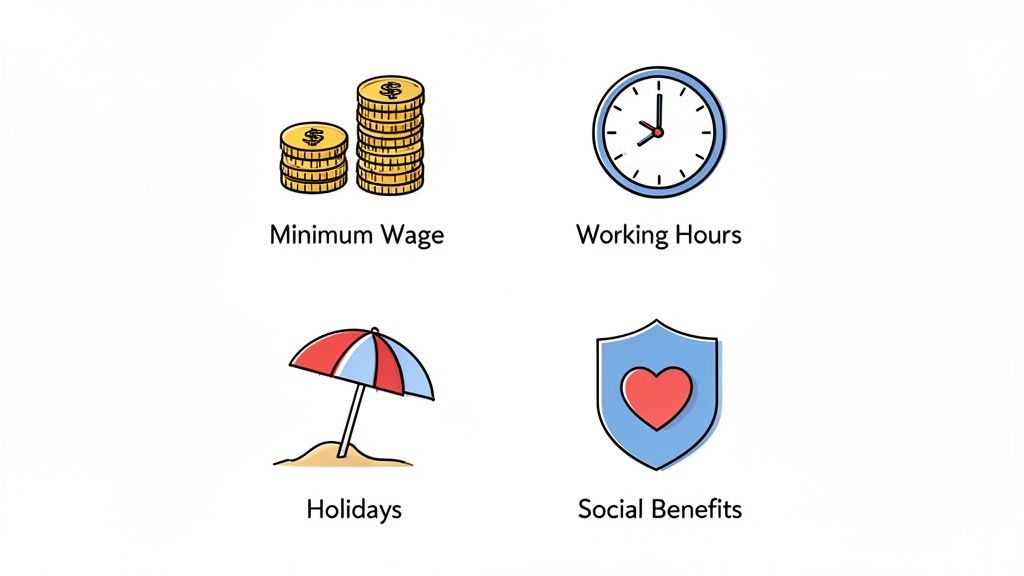
AL-GAV employment contractis anything but a standard document that can be copied from a template. It is the direct result of hard negotiations between social partners and sets the rules in four central areas – rules that often go far beyond the legal minimum.
These four pillars are the heart of every GAV and must be accurately reflected in your employment contract. Think of them as the foundation for a fair employment relationship. They not only create security for your employees but also protect you as an employer from legal pitfalls and costly claims.
Minimum wages and correct classification
The most well-known point in any GAV is the bindingminimum wages. These are usually neatly tiered according to experience, function, and sometimes even by region. Your task as an employer is to meticulously classify each employee into the correct wage category.
Imagine you hire a new service staff member. The L-GAV for the hospitality industry provides for very different wage levels depending on whether the person has completed training or not. A wrong classification not only leads to frustration in the team but can also result in significant wage back payments during an inspection.
Collective labor agreements are a central pillar of labor law in Switzerland. For the coming year, the social partners of the most important GAVs have decided on an average increase in effective wages of1.2 percent. Of this,0.4 percentis for individual and0.9 percentfor collective adjustments, affecting nearly 600,000 people. In total, around1,780,000 peoplein Switzerland are subject to a GAV with minimum wages. More details on these developments can be found on srf.ch in theirreport on GAV wages 2025
Working hours, overtime, and rest periods
A GAV regulates the exact duration of the weekly working hours, which often lies at42or43.5 hours. Equally important are the provisions regarding overtime, as conflicts often arise here.
The GAV clearly stipulates how overtime is to be compensated:
- Time compensation:Often, compensation in a 1:1 ratio is possible. However, this must be explicitly agreed upon.
- Financial compensation:If compensation through time off is not possible, a wage surcharge of25%is usually required.
A typical scenario from practice: An event technician works ten overtime hours during a large fair. The employment contract must clearly state according to the GAV whether these hours are compensated with time off or paid out with a surcharge. Without a clear regulation, trouble is pre-programmed.
Vacation entitlement above the legal minimum
The Swiss Code of Obligations (OR) legally prescribes four weeks of vacation per year. This is the absolute minimum. However, many GAVs go a significant step further and guarantee much better conditions.
Five weeks of vacationare already standard in many industries. Additionally, GAVs often provide for more vacation days for older employees or trainees. You must document these more generous regulations in the employment contract. A mere reference to the law is not sufficient when a GAV applies.
Further details on the L-GAV in the hospitality industry can be found in ourspecial guide to the L-GAV Gastro
Mandatory social benefits
A GAV can also stipulate which social benefits you must offer as an employer. This mainly concerns two crucial areas: theoccupational pension (pension fund)anddaily sickness insurance
For example, the GAV may stipulate that a daily sickness insurance is mandatory, covering the salary during illness for a certain duration at80%. The costs for the premiums are usually shared equally between employer and employee. This obligation must also be included in the employment contract – it creates transparency and avoids misunderstandings.
How to formulate GAV-compliant contract clauses
The theory is one thing, but how do you translate the dry L-GAV requirements into watertight contract clauses? A well-formulatedL-GAV employment contractis worth its weight in gold, as it creates clear conditions from day one and prevents exhausting discussions when things get tough later on.
It is not enough to merely mention the GAV in passing. The art lies in embedding the provisions in such a way that everyone understands them and no doubts arise.
As an absolute foundation, every contract needs a clear reference to the L-GAV. This clause is crucial and ensures that both sides operate under the same set of rules.
Practical example for the scope of application:
“In addition to this employment contract and the legal provisions, the employment relationship is subject to the Swiss national collective labor agreement of the hospitality industry (L-GAV) in its currently valid version. The provisions of the L-GAV take precedence over the regulations of this contract if they are more favorable for the employee.”
Correctly stipulate salary and working hours
Salary is always a sensitive issue. To ensure transparency from the outset, you not only state the gross salary but also explicitly refer to the correct wage category according to the GAV. This makes the classification understandable and facilitates later salary adjustments.
Practical example for the salary clause:
“The monthly gross salary is CHF [Betrag] and is based on the classification in wage category [Kategorie gemäss GAV] of the L-GAV. Any potential 13th month salary is governed by the provisions of the applicable GAV.”
You should be just as precise when it comes to working hours. Define the weekly target working hours and clearly specify how overtime is handled.
Here are some concise templates for working hours:
- Weekly working hours: “The weekly target working hours are [z. B. 42] hours, excluding breaks.”
- Overtime regulation: “Overtime hours are primarily compensated with time off of equal duration in consultation with the supervisor. If compensation is not possible, the overtime will be paid out according to the provisions of the L-GAV with a wage surcharge of 25%.”
The basis for correct billing here is, of course, a seamlesstime recording according to L-GAV, a topic we have dedicated a separate article to.
Clearly regulate vacation and social benefits
Of course, the vacation entitlement must also be clearly stated in the contract, especially when it deviates from the legal minimum and is more generously regulated by the GAV.
Practical example for the vacation clause:
“The annual vacation entitlement is [z. B. 5] weeks according to the L-GAV. The determination of the vacation period is done in consultation with the supervisor, taking into account operational needs.”
A typical mistake that happens repeatedly: Social benefits are formulated too vaguely. One refers generally to the pension fund but forgets to mention the mandatory daily sickness insurance if the GAV requires it. This is a problem because a clear regulation builds trust and shows that you have done your homework as an employer.
With these concrete formulations, you lay a solid, fair, and above all, GAV-compliant basis for every employment contract.
Avoid common mistakes in the L-GAV employment contract
Even experienced professionals in the HR department make mistakes when creating anL-GAV employment contracttime and again. The devil is often in the details, but the consequences can be costly. With the right knowledge, you can identify these pitfalls before you fall over them.
An absolute classic is thewrong wage classification.You hire a new employee but overlook a relevant qualification that would have actually promoted them to a higher wage class according to the GAV. The result is not only dissatisfied employees but also impending wage back payments that can severely impact the budget.
Equally tricky: Automatic wage increases that are provided for in many GAVs after a certain number of years of service are simply overlooked.
Hourly wage and holiday compensation
Especially for employees on an hourly wage, mistakes can quickly occur in the calculation ofholiday and holiday compensation.Often, a flat percentage is simply added to the wage without checking the exact requirements of the GAV.
You should definitely keep the following sources of error in mind:
- Wrong percentage:The GAV may prescribe a higher rate than you are applying. For 5 weeks of vacation, it is10.65 %, not just a flat 10%.
- Forgotten 13th month salary:The holiday compensation must also be calculated on the share of the 13th month salary. This often gets overlooked in the heat of the moment.
Imagine you employ temporary workers for a large event. You pay them an hourly wage plus 8.33% for holidays. However, the applicable GAV provides for 5 weeks of vacation, so 10.65%. During a check, it turns out that you have underpaid each employee for months – a costly correction is the result.
The danger of ignored GAV
Perhaps the biggest and most expensive mistake is completely ignoring the applicability of a generally binding GAV. Many entrepreneurs mistakenly believe they are not affected because they do not belong to an employers’ association. This is a misconception with far-reaching consequences.
Especially in times when the number of job seekers is rising, compliance with stable GAV conditions becomes even more important to retain qualified workers and minimize legal risks. In cantons like Zurich, the number of job seekers recently increased by20 %compared to the previous year. You can learn more about the current developments in the labor market in theAdecco Group Job Index.
If you do not apply a GAV, although you are obliged to do so, you risk not only back payments but also significant sanctions from the parity commission. A well-draftedL-GAV employment contractis your shield against such risks. This also includes knowledge of the correctL-GAV notice periods,which often deviate from the legal regulations of the OR.
The checklist for a watertight L-GAV employment contract
A solidL-GAV employment contractis more than just a formality – it is the foundation for a fair employment relationship and protects both you and your employees from unpleasant surprises. To ensure you don’t overlook anything in your next contract, I have summarized the most important points in a checklist.
Consider this list as your final safety check before the ink dries on the contract.
1. Scope and legal basis
Here you lay the foundation. It must be crystal clear to all parties involved what the rules of the game are.
- The right GAV?Have you checked whether your company is subject to a generally binding GAV or whether a membership in an association applies? This is the crucial first step.
- Anchored in the contract?Is there a clear clause in the employment contract that unambiguously refers to the correct GAV? Without this reference, everything else is moot.
- Consideration of the principle of favorability?Are you sure that not a single provision in the employment contract puts your employees in a worse position than the GAV? Remember: Better is always possible, worse never.
2. Salary and working hours – the core
This part determines satisfaction and fairness within the team. Precise and correct information is essential here to exclude later conflicts from the outset.
- Minimum wage adhered to?Does the agreed salary correspond to the correct classification according to the GAV? Function, experience, and education must be accurately reflected here.
- 13th month salary regulated?If the GAV prescribes a 13th month salary, is this entitlement clearly formulated in the contract?
- Weekly hours defined?Is the target working time according to the GAV correctly recorded?
- Overtime clearly regulated?Is the compensation for overtime – whether through time off or wage surcharge of25%– unambiguously regulated?
Especially in sectors with many temporary positions, a correct GAV contract is crucial. The unemployment rate in Switzerland was recently at2.9 percent, with tens of thousands of contracts being concluded, whose wages often barely exceed the GAV minimum rates. A small mistake here can have significant legal consequences. Learn more about thecurrent labor market situation in Switzerland.
3. Vacation, holidays, and social benefits
This is about the important framework conditions that go far beyond the monthly salary and ensure security and appreciation.
- Vacation entitlement correct?Is the vacation entitlement specified in the GAV clearly anchored in the contract?
- Social benefits complete?Are all mandatory insurances such as the pension fund and especially the often-forgotten daily sickness allowance insurance mentioned?
- Notice periods observed?Do the notice periods comply with the requirements of the GAV? These are often longer than the legal minimum and offer more protection.
How to simplify the management of your GAV contracts
Anyone who has ever tried to manually manage GAV-compliant employment contracts knows the pain. You juggle with Excel sheets, sift through countless emails, and lose track during constant checks. This costs not only time but also a lot of nerves.
Especially when you work with flexible employee pools, such as for events or in gastronomy, the error rate quickly rises. A small mistake, a forgotten regulation – and suddenly severe penalties threaten.

Imagine you could reduce all this effort to a minimum. This is exactly where digital solutions likejob.rockscome in. Instead of going through eachL-GAV employment contractindividually, you store the GAV rules once centrally in the system. That’s it.
Automatic GAV check during deployment planning
The system essentially becomes your digital GAV expert, watching over your shoulder. You define the rules that apply to your staff once, and the software takes care of the rest.
- Minimum wages:Store the correct wage levels based on the qualifications and experience of your people.
- Surcharges:Define what applies for night, Sunday, or holiday work.
- Working time limits:Specify how many hours per day or week may be worked at most.
With each individual deployment planning, the software checks these rules in the background. Fully automatically. This way, you can be sure that every deployment is GAV-compliant without having to give it a second thought.
With the right digital tools, the GAV regulations transform from an administrative hurdle into an automated standard process. This not only gives you absolute legal certainty but also valuable time back that you can invest in your core business.
Transparency for your employees
A mobile app for your employees additionally creates clarity and trust. Everyone can view their planned deployments, the expected remuneration, and the hours already recorded directly on their own smartphone.
This is worth its weight in gold. It not only strengthens the relationship with your team but also reduces constant inquiries in the HR department to a minimum.
In the end, you not only save time in administration and avoid costly mistakes but also ensure satisfied and well-informed employees. A classic win-win situation.
The most common questions about the L-GAV employment contract in practice
In the jungle of paragraphs, the same questions keep coming up. Here we shed light on the darkness and answer the most important points that you are guaranteed to encounter in everyday life.
What happens if my employment contract deviates from the GAV?
One of the central rules first: If individual clauses in your employment contract provide worse conditions than the GAV, they are simply invalid. Instead, the better provisions of the GAV automatically apply. In technical terms, this is called theprinciple of favorability.
Better conditions in the individual contract are, of course, always allowed and remain valid.
Imagine: The GAV prescribes5weeks of vacation, but your contract only provides for4. In this case, you automatically have a claim to5weeks. If the contract, on the other hand, offers6weeks, then these apply because they are more favorable to you than the GAV regulation.
How do I find out which GAV applies to my company?
An absolutely crucial question that determines everything else. Basically, there are two ways to find out:
- Check association membership:Is your company a member of an employers’ association that has concluded a GAV? If so, this GAV applies to you and your employees.
- Clarify general applicability:If there is no association membership, you need to check whether a GAV has been declared generally binding for your industry. This means it applies toall businessesin this industry – without exception.
You can find a current overview of all generally binding GAVs at any time on the official website of the State Secretariat for Economic Affairs (SECO). There you can conveniently filter by industry and canton.
Do I have to attach the GAV to the employment contract?
Yes, as an employer, you are obliged to inform your employees in writing about the applicable GAV. Transparency here is not just a nice gesture but a legal obligation.
The cleanest and easiest way is to attach a copy of theL-GAV employment contractto the GAV. Alternatively, a clear reference to where the GAV can be viewed at any time – for example, in the intranet or at the HR department – is also sufficient. This obligation to inform creates trust and prevents costly misunderstandings from arising in the first place.
If you keep these points in mind, you create a clear and fair basis for collaboration and avoid legal pitfalls before they can even arise.
Do you want to finally simplify the management of your GAV-compliant employment contracts and eliminate sources of error?job.rockshelps you to digitally store GAV rules so that they are automatically considered in every deployment planning. Discover the smart solution for your personnel administration athttps://job.rocks