
{
“@context”: “https://schema.org”,
“@graph”: [
{
“@type”: “FAQPage”,
“mainEntity”: [
{
“@type”: “Question”,
“name”: “The three pillars of sustainability (ESG)”,
“acceptedAnswer”: {
“@type”: “Answer”,
“text”: “The ESG criteria are not a theoretical construct, but a practical framework to organize your sustainability efforts. Each pillar highlights a central area of your entrepreneurial actions.”
}
},
{
“@type”: “Question”,
“name”: “Why this topic is relevant to you right now”,
“acceptedAnswer”: {
“@type”: “Answer”,
“text”: “Especially in the service industry – whether at events, in hospitality, or in personnel services – expectations are noticeably rising. Many large clients today demand clear evidence of their suppliers’ sustainability efforts. Those who have nothing to show”
}
},
{
“@type”: “Question”,
“name”: “1. CO₂ reduction and resource efficiency”,
“acceptedAnswer”: {
“@type”: “Answer”,
“text”: “This area is often the first and most tangible step. It is about actively reducing your ecological footprint. This not only protects the environment but often also directly lowers your operating costs – a classic win-win situation.”
}
},
{
“@type”: “Question”,
“name”: “2. Social responsibility and fair working conditions”,
“acceptedAnswer”: {
“@type”: “Answer”,
“text”: “Sustainability does not stop at environmental protection; it also concerns the people in your company. Satisfied employees are more engaged, productive, and remain loyal to you as an employer for longer. Fair working conditions are therefore not a nice gesture, but a clear economic necessity.”
}
},
{
“@type”: “Question”,
“name”: “3. Sustainable procurement and supply chain”,
“acceptedAnswer”: {
“@type”: “Answer”,
“text”: “Every product and service you purchase has its own story. Where does the coffee in your hotel come from? Under what conditions was the workwear for your security team produced? Sustainable procurement means asking these questions and not turning a blind eye.”
}
}
]
},
{
“@type”: “ItemList”,
“name”: “Sustainability for businesses: Your practical guide for service providers”,
“numberOfItems”: 4,
“itemListElement”: [
{
“@type”: “ListItem”,
“position”: 1,
“name”: “CO₂ reduction and resource efficiency”
},
{
“@type”: “ListItem”,
“position”: 2,
“name”: “Social responsibility and fair working conditions”
},
{
“@type”: “ListItem”,
“position”: 3,
“name”: “Sustainable procurement and supply chain”
},
{
“@type”: “ListItem”,
“position”: 4,
“name”: “Transparency and reporting”
}
]
},
{
“@type”: “BreadcrumbList”,
“itemListElement”: [
{
“@type”: “ListItem”,
“position”: 1,
“name”: “Home”,
“item”: “https://job.rocks”
},
{
“@type”: “ListItem”,
“position”: 2,
“name”: “Deployment planning”,
“item”: “https://job.rocks/category/einsatzplanung/”
},
{
“@type”: “ListItem”,
“position”: 3,
“name”: “Sustainability for businesses: Your practical guide for service providers”
}
]
}
]
}
Sustainability in business is no longer a buzzword – it is astrategic necessity, which determines whether your company will still thrive tomorrow. At its core, it is about linking ecological vision, social equity, and economic success in such a way that your company not only survives but grows and remains stable in the long term.
What sustainability really means for your business
Do not view sustainability as a boring checklist full of regulations, but as the foundation upon which your business model rests. It is about making conscious decisions that benefit both your business, the environment, and society. This concept can be best understood through the three pillars of sustainability, often referred to as ESG criteria.
The three pillars of sustainability (ESG)
The ESG criteria are not a theoretical construct, but a practical framework to organize your sustainability efforts. Each pillar illuminates a central area of your entrepreneurial actions.
-
Environment (Environment):This is concretely about protecting our planet. As a service provider, you could reduce your team’s CO₂ emissions through cleverly optimized route planning. An event caterer that consistently relies on regional and seasonal products reduces transportation distances. A hotel significantly decreases its water and energy consumption through modern technologies.
-
Social (Social):This pillar places humans at the center – your employees, your clients, and the community in which you operate. Do you offer fair working conditions and flexible working models that allow for a true work-life balance? A service provider that ensures transparent contracts and timely salary payments acts in a socially sustainable manner. This is not a luxury, but the foundation of motivated teams.
-
Governance (Governance):Here, everything revolves around responsible and transparent management. This may seem boring, but it means very concrete things: fair business practices, strict compliance with laws, and the protection of sensitive data. As an agency, you ensure that all client data is processed in absolute compliance with the GDPR. This builds trust.
Sustainability is not an expense, but an investment. It guarantees you access to new markets, strengthens your brand, and makes you an attractive employer, where the best people want to work.
Why is this topic particularly relevant for you now?
Especially in the service sector – whether for events, in hospitality, or in staffing services – expectations are significantly increasing. Many large clients today require clear evidence of their suppliers’ sustainability efforts. Those who cannot prove anything quickly fall out of favor. At the same time, legal requirements are becoming increasingly strict.
In Switzerland, companies are facing increasingly clear requirements for sustainability reporting. The government estimates that about50,000 companieswill be affected by the new regulations of the Code of Obligations (CO). For large companies, reporting obligations already apply today, and the gradual adaptation to EU standards will tighten the screws for many other companies. You will learn more in this overview of thenew reporting obligations for Swiss companies.
Addressing the issue now is therefore no longer a ‘Nice-to-have’, but a smart and forward-thinking decision. It provides you with a real competitive advantage and ensures the sustainability of your business in a rapidly changing market.
Your four key areas of action for more sustainability
Sustainability is a big word, but where to start concretely? To make the topic tangible, you can divide it into four core areas. Think of these areas of action as the four wheels of a vehicle: all must turn smoothly for your business to move forward.
The following infographic shows the three main areas Environment, Social, and Governance, which form the foundation of any good strategy.
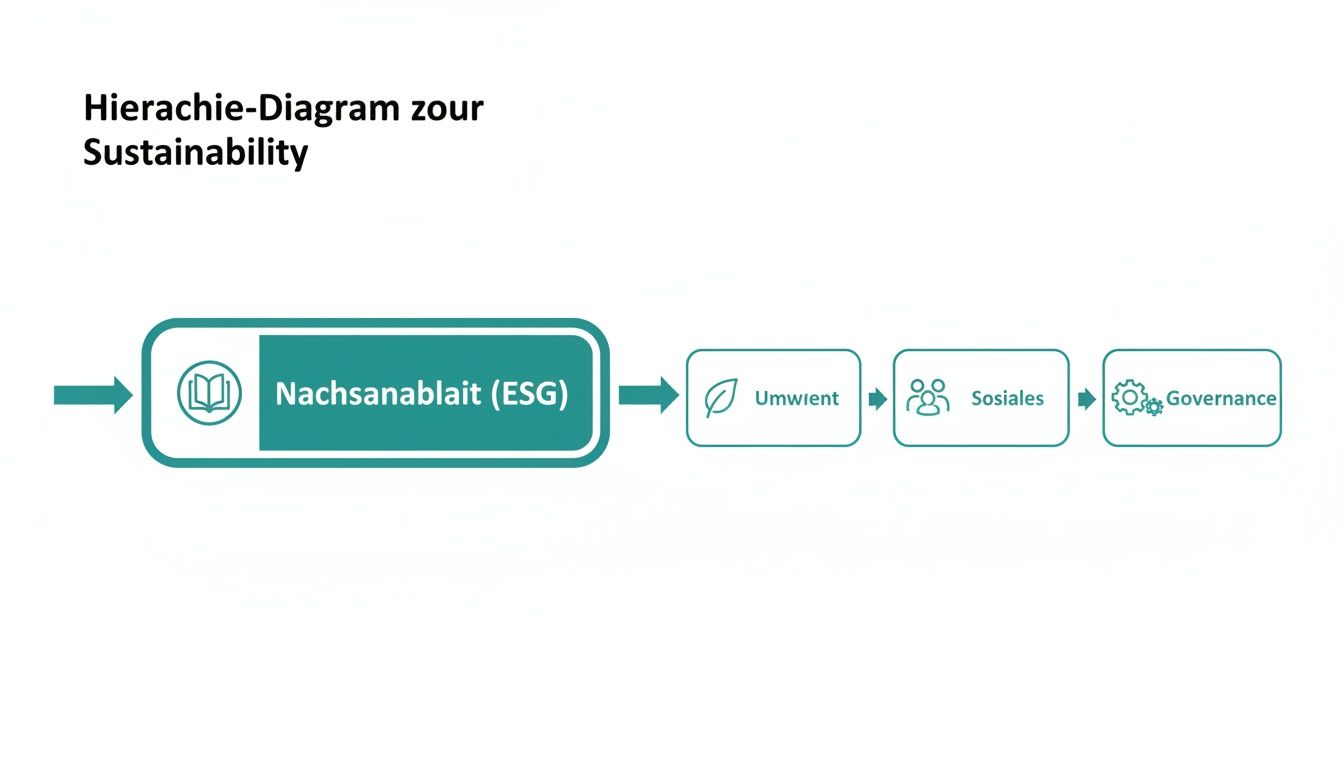
The visualization clearly shows thatsustainability for businessesrests on the pillars Environment, Social, and good governance (Governance). This means for you: if you group your measures according to these three categories, you create a clear and effective strategy.
1. Reduction of CO₂ and resource-efficient use
This area is often the first and most tangible. It is about actively reducing your ecological footprint. This not only preserves the environment but often also directly reduces your operating costs – a classic win-win situation.
A practical example is planning the routes of your sales or event team. Instead of uncoordinated travel across the city, you can group and optimize interventions geographically. Smart software calculates the shortest paths, saving kilometers, time, and precious fuel. Thus, a catering company can reduce its CO₂ emissions by several tons per year with just10 vehicles.
Another important lever is digitization. Ask yourself: how many documents do you print each day? Employment contracts, schedules, timesheets – it adds up quickly. Switching to digital processes, such as a mobile app for time tracking, makes mountains of paper unnecessary.
A small hotel can save more than5,000 sheets of paperper year by switching to fully digital personnel management. This is not only good for the forest, but it also speeds up your internal processes.
2. Social responsibility and fair working conditions
Sustainability does not stop at environmental protection; it is primarily about the people in your company. Satisfied employees are more engaged, more productive, and remain loyal to their employer longer. Fair working conditions are therefore not a nice gesture but a clear economic advantage.
This includes transparent employment contracts, timely and correct pay, and a healthy working environment. Overtime is a recurring issue in many service sectors. Instead of viewing it as inevitable, you can actively reduce it through proactive workforce planning.
Good intervention planning takes into account the availability and wishes of your employees, ensures an equitable distribution of workload, and prevents burnout. This is particularly crucial in the events or healthcare sector, where pressure is often high. If you want to learn more about how digitization can help in human resources, read our article ondigitization in the field of human resources.
3. Sustainable sourcing and supply chain
Every product and service you purchase has its own story. Where does the coffee in your hotel come from? Under what conditions were your security team’s work clothes made? Sustainable sourcing means asking these questions and not turning a blind eye.
It is about deliberately choosing partners and suppliers who also adhere to ecological and social standards.
- Event agency:Choose a caterer who focuses on regional and seasonal foods to avoid long and unnecessary transport distances.
- Hotel:Systematically opt for certified eco-friendly cleaning products and buy textiles from fair trade.
- Service provider:Only work with partners who pay fair wages and respect social standards.
This approach not only strengthens your credibility externally but also makes your entire value chain more resilient in the face of crises.
4. Transparency and reporting
Last but not least: talk about what you do. Transparency builds trust – with customers, partners, and potential employees. You don’t need to create a brilliant and complex report that will just gather dust on a shelf.
Start simply by gathering straightforward figures: how much CO₂ have you saved through optimized route planning? What is the actual reduction in your paper consumption? How has employee satisfaction evolved since the new intervention planning? This data makes your commitment real and measurable.
Honest communication, which does not hide challenges, is much more important than perfection. It shows that you take the subjectsustainability for businessesseriously and that you are on a clear path.
Four areas of action for sustainability at a glance
To move from theory to practice, we have summarized the four key areas. This table serves as a compass and shows you where you can take concrete action as a service provider.
| Area of action | Focus | Practical example (Event, Hospitality, etc.) |
|---|---|---|
| Reduction of CO₂ & resource-efficient use | Reduction of ecological footprint, cost reduction. | Digital planning of interventions for route optimization, paperless staffing processes, energy efficiency in hotel operations. |
| Social responsibility | Fair working conditions, employee retention, health protection. | Reduction of overtime through smart team planning, transparent pay, training opportunities. |
| Sustainable sourcing | Responsibility in the supply chain, ethical standards. | Choosing local caterers, purchasing fair trade textiles, collaborating with certified partners. |
| Transparency & reporting | Credibility, building trust, communication. | Publishing simple figures (e.g., CO₂ saved), honest communication about progress and goals. |
Each of these areas offers countless opportunities to make a real difference. The key is to start simply – even with small but significant steps.
How workforce management supports your sustainability goals
Your staff is your most valuable resource – and your workforce planning is an extremely powerful tool for moresustainability in business.. Often, we first think of sustainability in terms of solar panels or recycled paper. But how you plan and utilize your team has a direct and measurable impact on the three ESG pillars.
A modern workforce management software is much more than just a digital calendar. It is the command center with which you actively manage ecological, social, and economic goals.
Ecological sustainability through smart planning
Every unnecessary kilometer your employees travel consumes resources and generates CO₂. This is precisely where intelligent intervention planning comes into play.
Instead of sending your team all over the city, good software geographically clusters interventions. Imagine an event agency that needs three different teams for setup and teardown in different neighborhoods on a Saturday. AI-assisted route planning not only calculates the shortest access paths for each team but also takes real-time traffic data into account.
The result is a significant reduction in travel times and fuel consumption, which directly reduces your company’s CO₂ footprint.
Practical example:A cleaning service provider with20employees in the field was able to reduce its annual distance traveled by15 %thanks to AI-based route planning. This represents savings of several thousand francs in fuel costs and a significant reduction in emissions.
Another decisive point is the reduction of paper. Digital processes are a simple yet effective contribution to environmental protection.
- Digital schedules:Instead of printed lists, employees receive their schedules directly on their smartphones.
- Mobile time tracking:Clocking in and out is done via an app, making timesheets obsolete.
- Paperless payslips:All relevant data is recorded digitally and transmitted directly to payroll accounting.
This transition not only preserves forests but also makes your management faster and less prone to errors.
Social sustainability through fair and healthy working conditions
The social pillar of sustainability revolves around the well-being of your employees. An excessive workload and constant overtime are detrimental to your team’s motivation and health. This is where workforce management becomes a decisive factor.
Preventive and digitized shift planning helps you systematically avoid overtime. The software quickly detects bottlenecks and suggests appropriate available employees, instead of overloading the existing team.
A central element of sustainable workforce management isfair working conditions and remuneration in temporary work.Transparent processes and accurate time recording are the foundation of trust here and strengthen the social aspects of your personnel strategy.
Moreover, a good system takes into account the wishes and availability of your collaborators. This leads to a better work-life balance and greater employee satisfaction, which in turn reduces turnover.
Economic sustainability through clear processes and transparency
Sustainable management means using resources in a way that ensures your company is successful in the long term. Ineffective personnel planning is exactly the opposite: it wastes time, money, and the potential of your employees.
This dashboard shows how a central platform simplifies assignment planning.
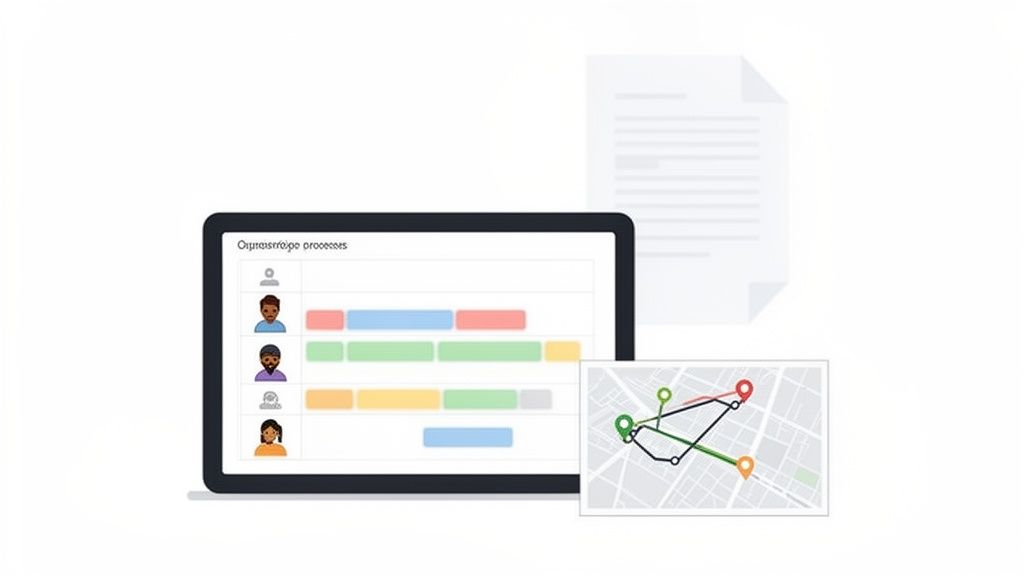
By automating routine tasks like availability requests or shift assignments, you reduce administrative burden. The time your planners previously spent making calls and sending emails can now be used for strategically more important tasks.
A central platform ensures total transparency. You can see at a glance who is on duty when and where, what qualifications are needed, and what the costs of a project look like. This data-driven overview helps you make better decisions and minimize downtime. Thus, you ensure that your most valuable resource – your personnel – is always used optimally. A deeper insight into how such systems work is provided by ourWorkforce Management Guide.
By linking ecological, social, and economic benefits, it becomes clear: modern workforce management is not just an administrative tool, but an active driver of your sustainability strategy.
Thus, sustainability is experienced in your sector
Theory is one thing, practice is another. The fundamental principles of sustainability are indeed the same everywhere, but their implementation is completely different in each sector. Whether you are organizing an event, managing a hotel, or recruiting staff, your levers for greater sustainability are unique. Let’s look at some concrete examples that you can directly apply to your business.
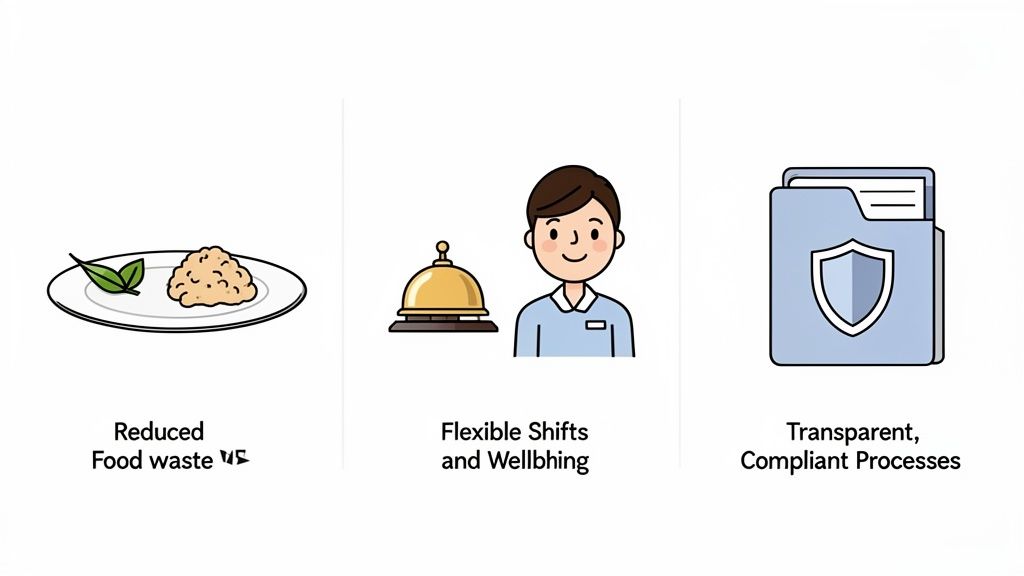
Event sector: Ending food waste
Anyone working in the event and catering industry knows the problem: at the end of the evening, the leftovers from the buffet pile up. Planning is often done for an estimated number of guests, resulting in huge amounts of leftover food. This is not only an ecological disaster but also an economic one.
This is where smart, demand-oriented personnel planning comes into play. If you know exactly how many servers, cooks, and logisticians you need for the final number of guests, you can also calculate food quantities much more accurately.
- Flexible personnel pool:With software likejob.rocks, you can quickly respond to the final participant numbers and book staff accurately, instead of planning broadly and hoping it works out.
- Precise planning:Less staff overlap leads to a more realistic estimate of food needs. A cook plans completely differently if they know they are cooking for150instead of “about 200” people.
- Direct communication:Via a central platform, you can immediately communicate the final numbers to your kitchen team. This optimizes ordering processes and avoids last-minute chaos.
A medium-sized caterer can save up to20 %food waste per event through precise personnel and resource planning. This not only preserves the environment but also directly improves your margin.
Hospitality: Fair working conditions as a success factor
The hospitality industry relies on excellent service. And this service depends on employee motivation. The problem: rigid schedules and unpredictable working hours often lead to frustration and high turnover. Social sustainability starts here – with the design of working conditions.
Flexible shift models that meet staff needs are an incredibly powerful lever. Instead of rigid rotation plans, employees can enter their availability and wishes via an app. Intelligent planning software generates a fair and balanced shift schedule that suits everyone.
This not only improves work-life balance but also signals to your team that you take their personal situation seriously. At the same time, you ensure that there is always enough qualified staff on site during peak hours to maintain service quality. A win-win situation.
Staffing agencies: Trust through transparent processes
For staffing agencies, trust is the most important currency. This trust is based on transparent communication, fair treatment, and the protection of sensitive data. Sustainable business management (governance) is not an abstract concept here, but a daily practice.
The first and most important step: ensuring that all processes comply with GDPR. This concerns the storage of candidate data as much as the communication of assignment details.
- Secure data storage:Use a central platform that adheres to the highest data protection standards. Sending sensitive information via email or messaging is to be avoided.
- Clear communication:Ensure that employees receive all relevant information regarding an assignment – from the address to the payslip – in a clear, understandable manner and through a secure channel.
- Transparent processes:Comprehensive documentation of working hours and expenses creates transparency and avoids misunderstandings from the outset.
These measures not only strengthen the trust of your clients and employees but also protect your business from significant legal risks.
Swiss SMEs are increasingly being indirectly affected by international ESG regulations, especially if they are part of global supply chains. Requirements like the EU’s CSRD also extend to service providers in logistics, cleaning, or hospitality. For these companies, optimized staff planning, such as that offered by job.rocks with AI-assisted assignment and route planning, means a direct reduction in emissions. In the restaurant sector, demand-based shift planning can significantly reduce food waste – of which Switzerland generates each year2.6 million tons.More information on these links can be found in theFHGR study for SECO.
You see: sustainability is not a one-size-fits-all solution, but always adapts to the specific conditions of your sector. The common denominator, however, is to make conscious decisions that simply make more sense ecologically, socially, and economically.
How to measure and communicate your successes correctly
“What you do not measure, you cannot improve.” This old adage is more relevant than ever in sustainability management. To make your progress visible and manage it in a targeted manner, you need clear indicators.
Imagine it like the cockpit of an airplane: without the right indicators, you do not know if you are on the right track, if you are gaining altitude, or if you are saving fuel. This is exactly what sustainability indicators do: they translate your commitment into concrete and comparable numbers. They show you where you are really making a difference and where you still need to adjust. Thus, a good feeling becomes a measurable fact.
The most important indicators for your business
No worries, you do not need to keep an eye on dozens of data points. It is about starting with a few indicators, but which are all the more significant and directly connect to your strategic action areas.
Here are some proven examples that are particularly valuable for service providers:
Environmental indicators:
- CO₂ emissions per hour of assignment:This figure is the ultimate efficiency check for your teams. As soon as you reduce the kilometers traveled through smart route planning, you immediately see this value decrease.
- Paper consumption per employee per month:A surprisingly simple but powerful indicator. It clearly shows you where you stand on the path to a digital office.
- Energy consumption per square meter:Whether in the office or at the hotel – this value precisely measures the success of your energy-saving measures.
Social indicators:
- Employee turnover:A low turnover rate is almost always a clear indicator of high satisfaction and fair working conditions – an invaluable advantage in today’s job market.
- Average overtime hours per employee:A direct measure of workload and the quality of your staff planning. This is where you see if your planning really works.
- Training hours per person:This indicator proves black on white that you are investing in the development and future of your team.
Transparency is key here. It is not about presenting perfect values from the start. It is about honestly showing where you are and where you want to go.
Collecting data without losing sight of the whole
The biggest obstacle to measurement? Often, the administrative burden. No one has the time to spend hours gathering figures from different Excel sheets. The good news is that much of this data already exists within your company. You just need to use it smartly.
A modern workforce management software becomes your best friend here. It records many of these indicators almost as a by-product of daily planning – entirely automatically:
- The kilometers traveledare directly recorded during route optimization.
- Working hours and overtimeare recorded in any case in the digital time tracking system.
- Employee datafor calculating turnover is already in the system.
Such automated reports completely free you from the tedious data collection. With one click, you have the facts you need for your communication. If you are interested in how these processes work in practice, take a look at ourstudy on the automation of assignment planning.
Why sustainability reports are becoming increasingly important
In Switzerland and the EU, reporting rules are becoming increasingly strict. What applies today to large companies will also be relevant tomorrow for SMEs that are part of larger supply chains. Do not view these reports as a boring obligation, but as a huge opportunity to present your commitment professionally.
The expectations regarding the quality of these reports are, however, high. A study by Ethos, which examined137 sustainability reportsfrom Swiss listed companies, recommended only39.7%for acceptance – a significant drop compared to the previous year. This shows: investors and partners are paying more and more attention.Ethos Study on Sustainability Reports, what really matters.
For you as a provider, this means: clear ESG objectives, based on data and communicated honestly, are no longer a “Nice-to-have”. They are essential for building trust and being perceived as a reliable partner. Your measured successes thus become the convincing internal management tool of your company.
Sustainability in Business: Your Most Frequently Asked Questions
Here, we clarify the questions we encounter most often in practice. They should reassure you and kickstart your own sustainability strategy.
Is sustainability really relevant for my small business?
Yes, absolutely. Many think of sustainability in terms of large companies, but the leverage is often much more direct for SMEs. Measures like saving energy or reducing paper immediately cut your costs. At the same time, customers and partners increasingly expect proof of sustainable action – even from small businesses.
Sustainability is therefore not a question of company size, but of strategic vision. Especially in niche markets, a clear commitment to ecological and social standards can be the decisive competitive advantage.
Where to start? The topic seems so vast.
We know this feeling well. The trick is not to try to do everything at once. Start with an area where you can quickly make an impact and that truly aligns with your business. It’s not necessary to completely change the company right away.
Choose a concrete point from the four areas of action and get started. This could be optimizing your team’s routes, transitioning to digital processes, or fairer working conditions through better team planning. Small, but consistent steps add up quickly.
Do I need an expensive consultant for my ESG strategy?
To start: no. With the areas of action and indicators described here, you can already establish a solid foundation without external help.
Many valuable data for an initial report are already lying dormant in your systems. A good workforce management software provides you with figures on route optimization or overtime at the click of a button. A consultant can become useful later when requirements become more complex or if you aim for official certification. Focus initially on implementing authentic and measurable measures.
Do you want to make your human resource planning more sustainable and efficient?job.rockshelps you achieve your ecological and social goals through smart planning of assignments and routes. Discover now how to save resources, motivate your team, and reduce costs at the same time.Learn more about job.rocks