
{
“@context”: “https://schema.org”,
“@graph”: [
{
“@type”: “FAQPage”,
“mainEntity”: [
{
“@type”: “Question”,
“name”: “Die drei Säulen der Nachhaltigkeit”,
“acceptedAnswer”: {
“@type”: “Answer”,
“text”: “Um das Ganze greifbarer zu machen, schauen wir uns die drei Kernbereiche einmal genauer an. Jeder dieser Bereiche bietet ganz konkrete Ansatzpunkte für deinen Betrieb.”
}
},
{
“@type”: “Question”,
“name”: “ESG und CSR: Was ist der Unterschied?”,
“acceptedAnswer”: {
“@type”: “Answer”,
“text”: “In Diskussionen über Nachhaltigkeit im Unternehmen stolperst du bestimmt über die Begriffe”
}
},
{
“@type”: “Question”,
“name”: “Kosten senken und Effizienz steigern”,
“acceptedAnswer”: {
“@type”: “Answer”,
“text”: “Einer der direktesten und spürbarsten Vorteile ist die Senkung deiner Betriebskosten. Ein bewusster Umgang mit Ressourcen schont nicht nur die Umwelt, sondern vor allem deinen Geldbeutel.”
}
},
{
“@type”: “Question”,
“name”: “Deine Marke stärken und neue Kunden gewinnen”,
“acceptedAnswer”: {
“@type”: “Answer”,
“text”: “Dein Engagement für Nachhaltigkeit ist ein starkes Signal an den Markt. Kunden achten heute mehr denn je darauf, wofür ein Unternehmen steht. Studien zeigen, dass”
}
},
{
“@type”: “Question”,
“name”: “Die besten Talente für dich gewinnen”,
“acceptedAnswer”: {
“@type”: “Answer”,
“text”: “Der Wettbewerb um qualifizierte Fachkräfte ist härter denn je. Gerade die jüngeren Generationen suchen nicht einfach nur einen Job – sie wollen einen Arbeitgeber, dessen Werte sie teilen können. Eine transparente und gelebte Nachhaltigkeitsstrategie macht dich da sofort zu einer Top-Adresse.”
}
}
]
},
{
“@type”: “BreadcrumbList”,
“itemListElement”: [
{
“@type”: “ListItem”,
“position”: 1,
“name”: “Home”,
“item”: “https://job.rocks”
},
{
“@type”: “ListItem”,
“position”: 2,
“name”: “Einsatzplanung”,
“item”: “https://job.rocks/category/einsatzplanung/”
},
{
“@type”: “ListItem”,
“position”: 3,
“name”: “Nachhaltigkeit im Unternehmen als Erfolgsfaktor nutzen”
}
]
}
]
}
Sustainability in business – this is the key to aligning economic goals with social justice and ecological responsibility. It’s about finding a balance that makes your businesslong-term successful and future-proof, rather than just chasing short-term profits.
What sustainability in business really means
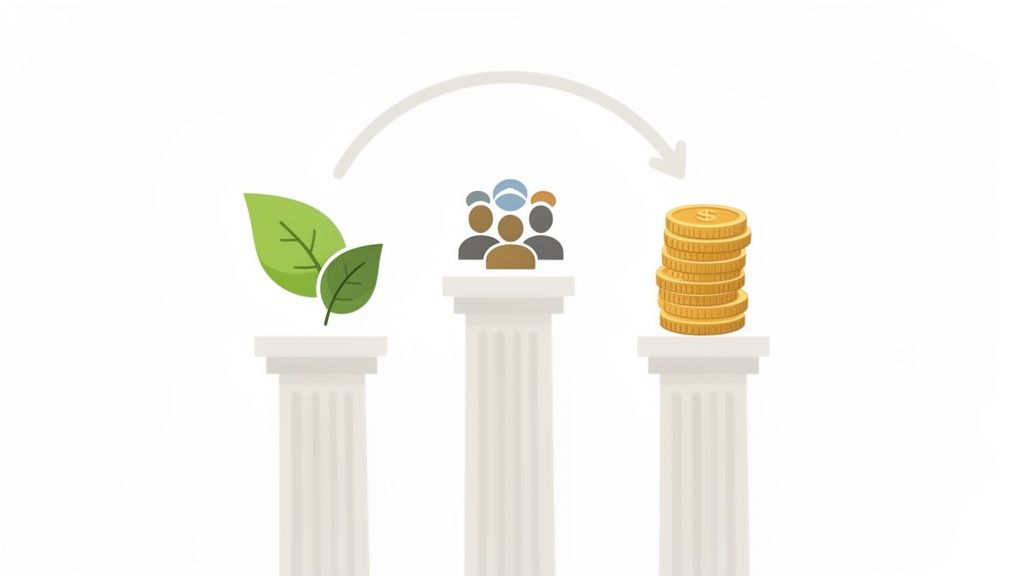
When you think of sustainability, you might first picture solar panels on the roof or waste separation in the office. That’s a good start, but the concept goes much deeper. It is based on three pillars that are inseparably connected and together form the foundation for a truly resilient business.
If there is an imbalance here – if you neglect one pillar – it will sooner or later lead to problems. Imagine your business maximizes profit (economy), but at the expense of employee health (social) or through reckless exploitation of resources (ecology). Such an approach is not future-proof and will damage your reputation in the long run.
The three pillars of sustainability
To make it more tangible, let’s take a closer look at the three core areas. Each of these areas offers very concrete points of approach for your business.
The following table gives you a clear overview of the three dimensions of sustainability, supplemented by examples that show you how to apply them in your business.
The three pillars of sustainability at a glance
| Pillar | Description | Practical example (event agency) |
|---|---|---|
| Ecological sustainability (Planet) | This is about protecting the natural foundations of life. The goal: to keep your company’s ecological footprint as low as possible. | You refrain from single-use plastics, use regional catering providers, and offer CO2 compensation for guests’ travel. |
| Social sustainability (People) | This area puts people at the center – both your employees and the society in which your company operates. | You pay fair wages, offer flexible working time models, invest in the training of your staff, and adhere to occupational safety standards. |
| Economic sustainability (Profit) | This is about operating in a way that allows your company to exist in the long term without jeopardizing ecological or social foundations. | You build long-term supplier relationships, invest in energy-efficient technology to reduce costs, and manage risks in your supply chains. |
As you can see, all areas are interconnected and mutually dependent. True sustainability can only work in the interplay of these three pillars.
True sustainability only arises when all three pillars are in balance. A financially strong company that values its employees and protects the environment is well-positioned for the future.
ESG and CSR: What is the difference?
In discussions about sustainability in business, you will surely stumble upon the termsESGandCSR. Although they sound closely related, they have different focuses.
CSR (Corporate Social Responsibility)refers more to a company’s voluntary commitment to act ethically and make a positive contribution to society. It is often qualitative and communication-driven. Imagine a catering company that donates unsold food to local food banks. This is a commendable initiative based on the company’s sense of responsibility.
ESG (Environmental, Social, Governance)is a more structured and data-driven approach. Primarily, investors and analysts use ESG criteria to assess a company’s future viability and risks.
- Environmental:Measures the handling of resources, emissions, and climate risks.
- Social:Assesses working conditions, diversity, and social engagement.
- Governance:Analyzes leadership structures, transparency, and compliance.
In short: ESG makes sustainability measurable. An event service provider could track its CO2 emissions per employee trip (Environmental), measure employee satisfaction through regular surveys (Social), and implement clear anti-corruption policies (Governance). This makes sustainability performance transparent and comparable – a clear advantage in the competition for customers and capital.
How your company benefits from sustainability
Perhaps you still see sustainability as a pure cost factor. A misconception, as is becoming increasingly clear. Targetedsustainability in business.is indeed one of the smartest investments in your future viability. And the best part: it pays off on multiple levels – often faster than you think.
Consider it this way: a sustainably operating business is more resilient to crises, a magnet for top talent, and financially more stable. It’s not about renunciation, but about operating smarter and more responsibly.
Reducing costs and increasing efficiency
One of the most direct and noticeable benefits is the reduction of your operating costs. A conscious approach to resources not only protects the environment but especially your wallet.
- Lower energy consumption:A hotel that consistently switches to LED lighting and uses smart thermostats sees the savings immediately on the next electricity bill.
- Avoiding waste:A logistics company that optimizes its routes consumes less fuel. At the same time, intelligent personnel planning ensures that empty trips are avoided because the right team is always at the right place at the right time.
- Conserving resources:A cleaning company that switches to ecological cleaning concentrates not only reduces its material costs. It also saves on storage and the expensive disposal of hazardous materials.
Each of these steps not only improves your environmental balance but also directly relieves your budget. Every liter of fuel saved, every kilowatt-hour not used, and every ton of waste avoided is a gain for you.
Strengthening your brand and attracting new customers
Your commitment to sustainability is a strong signal to the market. Customers are paying more attention than ever to what a company stands for. Studies show thatover 70% of consumersare willing to pay more for products from brands they perceive as sustainable and authentic.
A positive, responsible image attracts new customer groups and strengthens the bond with existing ones. You clearly distinguish yourself from competitors who still ignore this issue. Your commitment thus becomes a real selling point.
An authentic sustainability concept is no longer just a nice extra. It is a central building block for a strong brand that excites both customers and employees and builds trust.
Attracting the best talent for you
The competition for qualified professionals is tougher than ever. Especially younger generations are not just looking for a job – they want an employer whose values they can share. A transparent and lived sustainability strategy immediately makes you a top address.
When you show that you actively care about social aspects like fair working conditions, reliable shift schedules, and the health of your team, you send a crystal-clear message. The result? Higher employee satisfaction, lower turnover, and a magical attraction for motivated talent.
Securing access to capital and investments
For investors and banks, sustainability is no longer a “soft” topic, but a hard factor. They use so-calledESG criteria(Environmental, Social, Governance) to assess the long-term risks and opportunities of a company. Those who are well-positioned here are considered less risky and future-proof.
This improves your chances of obtaining loans on better terms and makes you interesting for forward-looking investors. Here, it is crucial to not only know the right metrics but also to communicate them transparently. A solid ESG profile can open doors that remain closed for others.
Understanding legal requirements and reporting
Sustainability in business is no longer a voluntary exercise. The legal requirements, especially in Switzerland, are becoming clearer and more binding. If you ignore these rules, you risk not only legal consequences but also a loss of trust among customers and investors.
The good news is: transparent reporting is also a huge opportunity. It makes your commitment visible, creates a solid basis of trust, and can give you a competitive advantage. Those who do their homework prove that they act future-proof and responsibly.
The reporting obligation in Switzerland according to OR 964a ff.
The heart of the regulatory requirements in Switzerland is the obligation to report on non-financial matters, which is enshrined in the Code of Obligations (OR). But don’t worry, this does not apply to every small business.
The obligation applies to so-calledpublic interest companies.These are usually:
- Publicly listed companies.
- Banks, insurance companies, and other supervised financial institutions.
Additionally, these companies must achieve at least500 full-time positionson average over the year and abalance sheet total of 20 million francsor asales revenue of 40 million francsin two consecutive financial years together with the companies they control, both domestic and foreign.
This screenshot from the official publication platform of federal law shows you the exact text of the law.
The regulation clearly aims to require large, capital market-oriented companies to be more transparent. The legal text makes it clear that reporting is not just a formality but should deeply intervene in corporate governance.
What belongs in a sustainability report?
The legislator provides clear topics that must be addressed in your report. It’s about painting a comprehensive picture of your business activities and their impacts – honestly and transparently.
Your report must provide information on:
- Environmental matters:This is where it gets to the core, for example, regarding your CO2 emissions and how you specifically want to reduce them. A logistics company could report on savings from optimized route planning.
- Social matters and employee concerns:This includes topics such as compliance with labor standards, measures to promote diversity, and the health of your employees.
- Respect for human rights:You must show how you ensure that human rights are respected throughout your entire supply chain – from raw material to end product.
- Combating corruption:This concerns the measures you take to prevent bribery and unethical behavior.
A good sustainability report is more than just a mere fulfillment of duty. It is a strategic tool that communicates your values and shows how you create long-term value – for your company, society, and the environment.
Why the quality of reporting is crucial
A report can be written quickly, but does it also convince? Investors and analysts pay close attention. A recent study by the Ethos Foundation shows how critically the reports of Swiss companies are evaluated.
In 2025, 137 publicly listed Swiss companies were required to publish a sustainability report. However, Ethos only recommended39.7 percent of the reportsfor acceptance – a significant decrease compared to the previous year. You can find more about this in theresults of the Ethos study on Swiss sustainability reports
These numbers are a wake-up call. They show that superficial or incomplete reports are not acceptable. Transparency and the quality of data are absolutely crucial to gain the trust of the capital market. Careful collection and processing of data is essential. Also read how aGDPR-compliant deployment planningcan help meet governance requirements in the social sector.
Your roadmap for more sustainability in the business
You are convinced and want to get started now? Perfect. Anchoring sustainability in the company is not a quick sprint, but a strategic process. With a clear roadmap, you ensure that your efforts do not simply fizzle out, but deliver tangible, measurable results. This plan will guide you step by step from the first idea to a firm anchoring in your corporate culture.
The path to more sustainability always begins with an honest and ruthless inventory. Before you define any goals, you must know exactly where you stand today. This is your starting point, your baseline for everything that follows.
Step 1 The honest inventory
Take the time for a truly thorough analysis. Where does your business consume the most resources? Where do the highest emissions occur? And how is the satisfaction and safety of your team?
Be consciously aware of all three pillars of sustainability:
- Ecology:Analyze your energy and water consumption, your waste generation, and the CO2 emissions produced by your fleet.
- Social:Evaluate the working conditions, turnover rate, existing training opportunities, and diversity in your team.
- Economy:Check your supply chains for risks, your compliance structures, and the longevity of your business relationships.
A cleaning service provider might find in this analysis that a large part of its CO2 footprint comes from the long travel distances of mobile teams. At the same time, a high sickness rate could indicate the handling of aggressive chemicals. These are valuable insights for the next steps.
Step 2 Set clear goals and KPIs
Without measurable goals, every plan is doomed to fail. Based on your analysis, define concrete, realistic, and time-bound goals. Vague resolutions like “we want to become more environmentally friendly” will not get you anywhere.
Instead, formulate your goalsSMART(Specific, Measurable, Attractive, Realistic, Timed).
- Specific:“We will reduce the fuel consumption of our fleet.”
- Measurable:“… by15 %.”
- Attractive:This not only lowers costs but also improves our image.
- Realistic:The goal is achievable through route optimization and targeted driver training.
- Timed:“… by the end of the next business year.”
You assign relevantKey Performance Indicators (KPIs)to each of these goals. Only these metrics make your progress truly visible. For the cleaning service provider, these metrics could be “liters of diesel per cleaned square meter” or “number of workplace accidents per 1,000 hours.”
The following process shows how a pure analysis leads to a verified and reliable data basis for your goals through reporting.
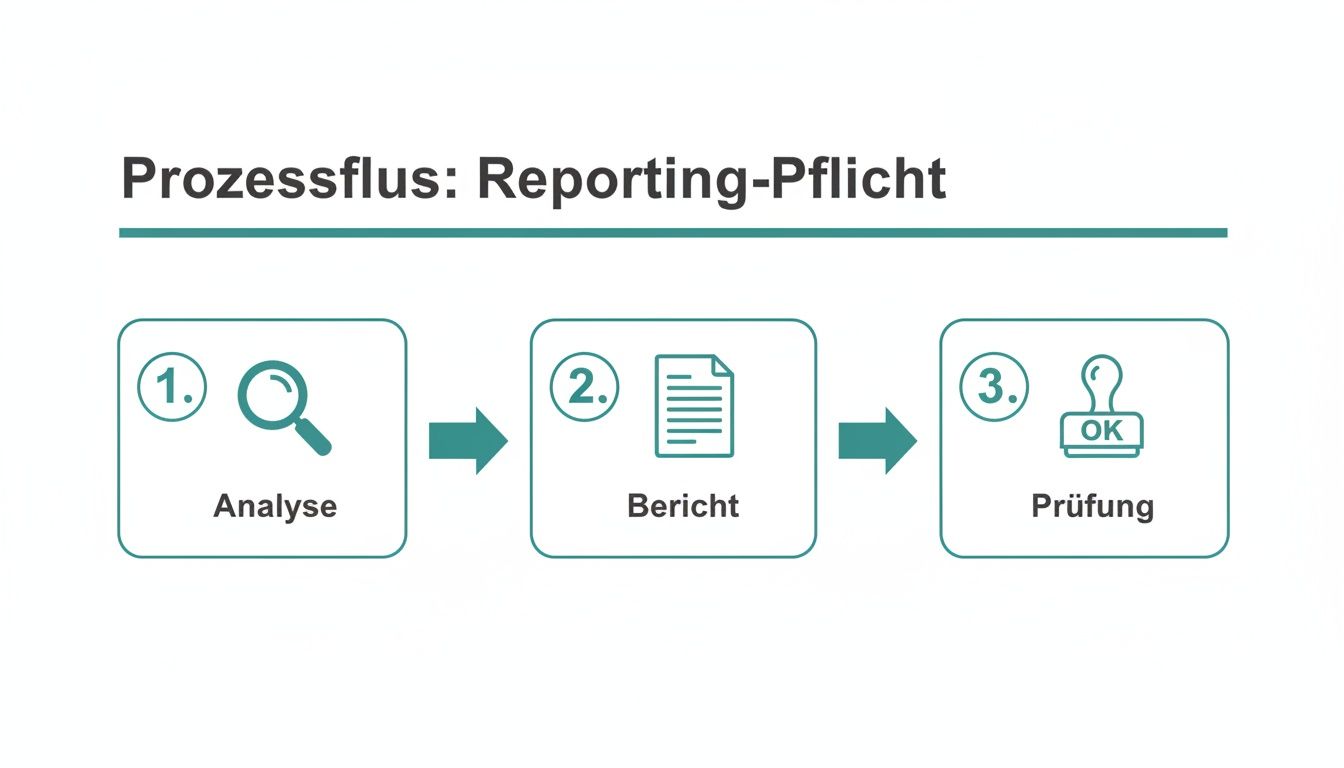
This visualization makes it clear that a structured approach is crucial to move from mere data collection to verified and credible results.
Step 3 Develop the strategy and involve the team
Your strategy is the concrete action plan with which you achieve your goals. For our cleaning service provider, this means: implementing software for route optimization, gradually switching to biodegradable cleaning agents, and conducting regular safety training.
Sustainability is not a task for a single person or department. It must be lived by everyone in the company, from management to trainees.
Communicate your goals and the underlying strategy transparently throughout the company. Explain why these changes are necessary and what benefits each individual has from them. Actively involve your team by collecting ideas and clearly distributing responsibilities. Only then will sustainability become a joint project that everyone supports.
Swiss SMEs are increasingly affected by international ESG regulations, often indirectly through their supply chains. A FHGR study from 2025 shows that the EU Corporate Sustainability Reporting Directive (CSRD) also affects Swiss companies with EU subsidiaries. The driving force is often the customers who demand sustainable practices and thus enhance competitiveness. Discovermore insights into the growing importance of validated climate goals at firstclimate.com
By involving your team, you not only create acceptance but also benefit from practical knowledge. Your employees often know best where there are potentials for improvements in everyday work. A digital approach can support this process. Learn how thedigitalization in the human resources sector.can help you engage your team better and optimize processes.
Practical sustainability measures for your industry
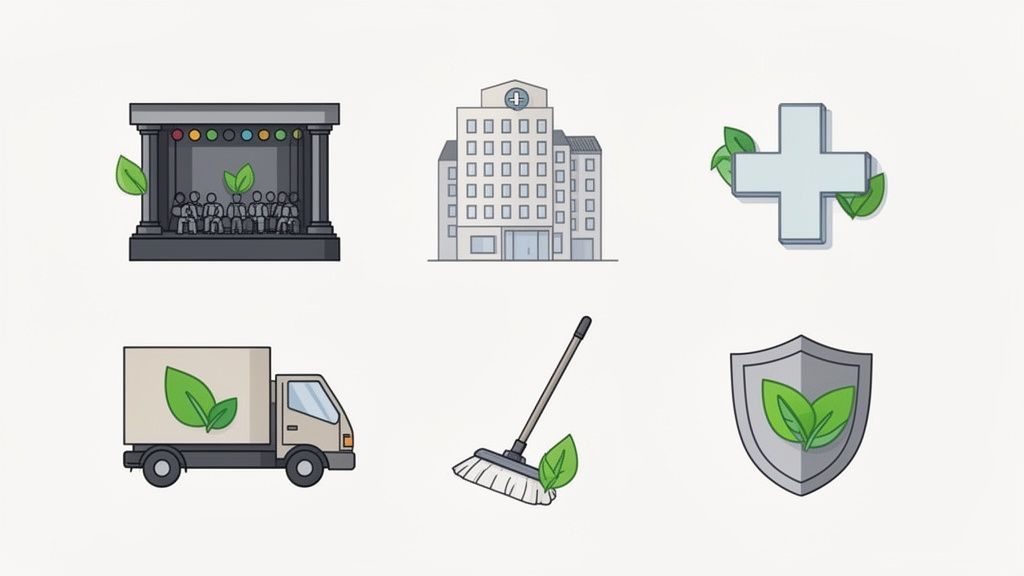
Theory is good, but in the end, practice counts.sustainability in business.becomes alive only when it is implemented through concrete, tangible measures in everyday work. Each industry has its own levers to achieve the greatest positive impact.
Let’s now take a look at some tailored and directly applicable ideas for various service sectors. See these examples as inspiration to recognize the potentials in your own business and get started immediately.
Events and Hospitality
In the hospitality industry and at events, a significant ecological footprint often arises. At the same time, the potential for visible changes is enormous, as guests and customers directly experience your commitment.
- Rethink waste management:Consistently rely on reusable systems instead of disposable dishes. Implement clean waste separation and cooperate with partners who pass on food surpluses to social institutions instead of disposing of them.
- Prefer regional partners:Source food, beverages, and even decorative materials from local suppliers. This not only strengthens the local economy but also reduces CO₂ emissions through significantly shorter transport routes.
- Intelligent personnel planning:Avoid short-term over- or under-staffing through planning that is based on actual needs. This not only reduces stress in the team but also prevents unnecessary travel for short-term substitute personnel.
Healthcare and Nursing
In the healthcare sector, the well-being of people and social responsibility are practically part of the job description. Here, social and ecological sustainability go hand in hand, often with direct impacts on the quality of care.
A key point is the responsible handling of materials. In a practical guide onsafe storage of hazardous materialsyou will find valuable tips.
- Resource conservation in everyday life:Reduce the consumption of disposable materials wherever it is medically safe and reasonable. Optimize the energy consumption of devices by consistently turning them off when not in use.
- Fair and healthy working conditions:A forward-looking shift planning that considers wishes and plans enough recovery phases is a central pillar of social sustainability. This reduces turnover and significantly improves the quality of care.
Logistics and Transport
Your fleet is one of the biggest levers for ecological improvements. Every kilometer saved and every liter of fuel counts here twice – for the environment and for your balance sheet.
An optimized route is the shortest connection between economic reason and ecological responsibility. Every trip avoided is a direct gain.
- Efficient route planning:Use modern software to optimize your tours. Incorporate real-time traffic data to avoid traffic jams and consistently eliminate empty trips.
- Modernize the vehicle fleet:Gradually invest in vehicles with lower consumption or alternative drives. Even regular maintenance and tire pressure checks help to noticeably reduce fuel consumption.
Cleaning and Security
Mobile service providers like cleaning or security companies can make significant progress through smart organization. The key often lies in the intelligent coordination of teams on-site.
That such industry-specific approaches lead to success is also shown by the ranking ‘World’s Most Sustainable Companies 2025’ by TIME. Among the top500companies worldwide are20Swiss companies. Novartis ranks11with waste reduction and the replacement of PVC in packaging – a clear sign of successful measures in the supply chain.
- Use ecological products:Switch to biodegradable cleaning agents and use concentrates to drastically reduce packaging waste.
- Geographical deployment planning:Bundle orders that are spatially close together. Plan your teams’ deployments so that travel distances are minimized. This saves time, costs, and emissions.
- Employee training:Train your employees in the economical use of water, cleaning agents, and energy directly on-site with the customer. Small behavioral changes often have a big impact.
How workforce management improves your sustainability

Did you know that your personnel planning has a direct impact on your sustainability balance? Many think of large investments, but often the biggest lever lies directly in daily processes. Intelligent workforce management is much more than just a tool for increasing efficiency; it is a crucial lever to achieve your ecological, social, and economic goals.
A modern platform like job.rocks thus becomes a central building block of your ESG strategy. It helps you deploy your most important resource – your employees – so cleverly that you avoid waste while strengthening your team at the same time.
Ecological benefits through smart planning
One of the largest and fastest noticeable levers for ecological sustainability lies in reducing unnecessary trips. Demand-oriented and automated deployment planning is the key here.
Instead of sending employees randomly across the city, an intelligent system can geographically bundle orders and shifts. It automatically assigns the person who has the shortest route to the deployment site. The result is an immediate reduction in CO₂ emissions and fuel costs – a direct gain for the environment and your budget.
- Practical example from the security sector:A security service must check several sites at night. Instead of random allocation, the software creates an optimized route. The employee who lives closest starts the tour and visits the sites in the most logical order. This saves up to30% travel distanceper night, thus saving money and emissions.
Social sustainability through fairness and flexibility
The social pillar of sustainability revolves entirely around people. This is where good personnel planning showcases its greatest strengths, as it ensures fair working conditions, improves work-life balance, and noticeably strengthens employee satisfaction.
Flexible shift models give your team more control over their own working hours. Through an employee app, they can manage their availability, swap shifts, and view their schedule at any time. This not only reduces everyday stress but also the number of unplanned overtime hours – a direct contribution to well-being.
Fair, transparent, and flexible working conditions are not a luxury but the foundation for motivated teams and low turnover. Workforce management makes these principles livable in everyday life.
Governance through digital and compliant processes
Clean corporate governance (Governance) requires transparent, traceable, and above all, legally compliant processes. A digital workforce management solution provides the perfect foundation for this and lifts a great burden off your shoulders.
Digital time tracking ensures seamless and error-free documentation of all working hours. All data is stored centrally and complies with legal requirements, providing absolute security during audits. At the same time, GDPR-compliant processes protect your employees’ sensitive data. Would you like to dive deeper into the topic? OurGuide for Workforce Management 2026offers you comprehensive information.
This illustration shows how modern personnel deployment planning visualizes the allocation of personnel to different deployment locations and time periods.
Such clarity allows planners to identify personnel shortages and surpluses early and take countermeasures. This, in turn, avoids unnecessary costs and stress for the entire team.
So, curious? Great. Here we tackle the most common questions we encounter in everyday life regarding sustainability in companies. We provide you with clear, practical answers – from the first step to the cost question and measuring success. Let’s clear the last doubts out of the way so you can start with full enthusiasm.
How do I best start with sustainability in my business?
It’s simple: with an honest assessment. Forget complicated tools and expensive consultants for the beginning. Just take a look at where your company stands today. A few simple questions are often enough: Where do we consume the most energy? In which area is the largest amount of waste generated? And very importantly: How satisfied are my people actually?
The trick is not to get sidetracked. Choose an area where you can achieve a significant impact with little effort – a so-called “quick win.” A logistics company could start with optimized route planning. This immediately reduces fuel consumption, which you can see directly on the fuel bill. Such quick successes are worth their weight in gold, as they motivate the whole team for the next, larger steps.
Isn’t sustainability just expensive?
We often hear this concern, but it is usually unfounded. Many measures forsustainability in business.are actually disguised cost-saving programs. Switching to LED lights reduces the electricity bill, less paperwork saves office supplies, and intelligent personnel deployment planning prevents costly overtime and unnecessary trips.
Sure, there are also larger chunks, like modernizing the fleet. But don’t see this as a cost, but as an investment in your future viability. Lower operating costs, a stronger brand, and better prospects in the next funding round – this pays off in the long run.
Sustainability is not an expense but an investment. It reduces risks, lowers operating costs, and strengthens your market position for the coming years. Every franc saved is a direct profit for your company.
How do I measure the success of my sustainability measures?
Success must be visible; otherwise, motivation fades. Therefore, you need clear key performance indicators (KPIs) that truly match your goals. Vague intentions like “we want to be greener” won’t get you anywhere.
Here are a few concrete examples:
- Ecological:CO₂ emissions per kilometer driven, waste volume per order in kilograms, or energy consumption per square meter.
- Social:employee turnover in percent, number of training hours per person, or the average score in the last employee survey.
- Economic:cost savings through energy efficiency in francs, share of orders from customers specifically looking for sustainable partners.
Start small, with a few but meaningful numbers. Record the baseline value and track the development regularly, for example, every quarter. Only then will you see what really works and where you might need to adjust again.
Do you want to make your personnel planning more efficient, fairer, and more sustainable?job.rockshelps you reduce CO₂ emissions through optimized routes, avoid overtime, and increase your team’s satisfaction.Discover now how to elevate your workforce management to the next level!