
4-Shift Model: Advantages, Disadvantages + Template for 2026
What is the 4-shift model? The 4-shift model (also called the 4-shift system) is a shift schedule where four separate teams alternate to maintain a 24/7 operation. Each team works rotating shifts – typically early, late, night, and off shifts. This model is often used in...
What is the 4-Shift Model?
The 4-shift model (also called the 4-shift system) is a shift schedule where four separate teams alternate to maintain a 24/7 operation. Each team works rotating shifts – typically early, late, night, and off shifts.
This model is commonly used in industries that require continuous production or service:
- Industry and Production: Chemicals, pharmaceuticals, automotive
- Healthcare: Hospitals, nursing homes
- Logistics & Transport: Distribution centers, airports
- Energy & Utilities: Power plants, waterworks
- Security Services: Property protection, surveillance
The big difference compared to the 3-shift model: The 4-shift system provides more recovery time between shifts – at the cost of requiring more personnel.
Get the 4-Shift Model Template for Free
Enter your email and first name – we will send you the template directly. Ideal if you want to plan your 4-shift model faster and document it clearly.
How Does the 4-Shift Model Work? The Typical Rhythm
The classic 4-shift model is based on a 4-day cycle. Each of the four teams goes through the following shifts:
Standard 4-Shift Cycle
| Day | Team A | Team B | Team C | Team D |
|---|---|---|---|---|
| 1 | Early Shift (06:00-14:00) | Late Shift (14:00-22:00) | Night Shift (22:00-06:00) | Off |
| 2 | Late Shift (14:00-22:00) | Night Shift (22:00-06:00) | Off | Early Shift (06:00-14:00) |
| 3 | Night Shift (22:00-06:00) | Off | Early Shift (06:00-14:00) | Late Shift (14:00-22:00) |
| 4 | Off | Early Shift (06:00-14:00) | Late Shift (14:00-22:00) | Night Shift (22:00-06:00) |
Then the cycle starts over. Each team works 3 days and then has 1 day off.
Alternative: 4-Shift Model with Longer Off Shifts
Some companies use an extended cycle with more consecutive off days:
- 2-2-3 Model: 2 days early shift, 2 days late shift, 3 days off (then rotation)
- 4-4-4 Model: 4 days work (rotating shifts), 4 days off
These variants increase predictability for employees but require more staff and more complex planning.
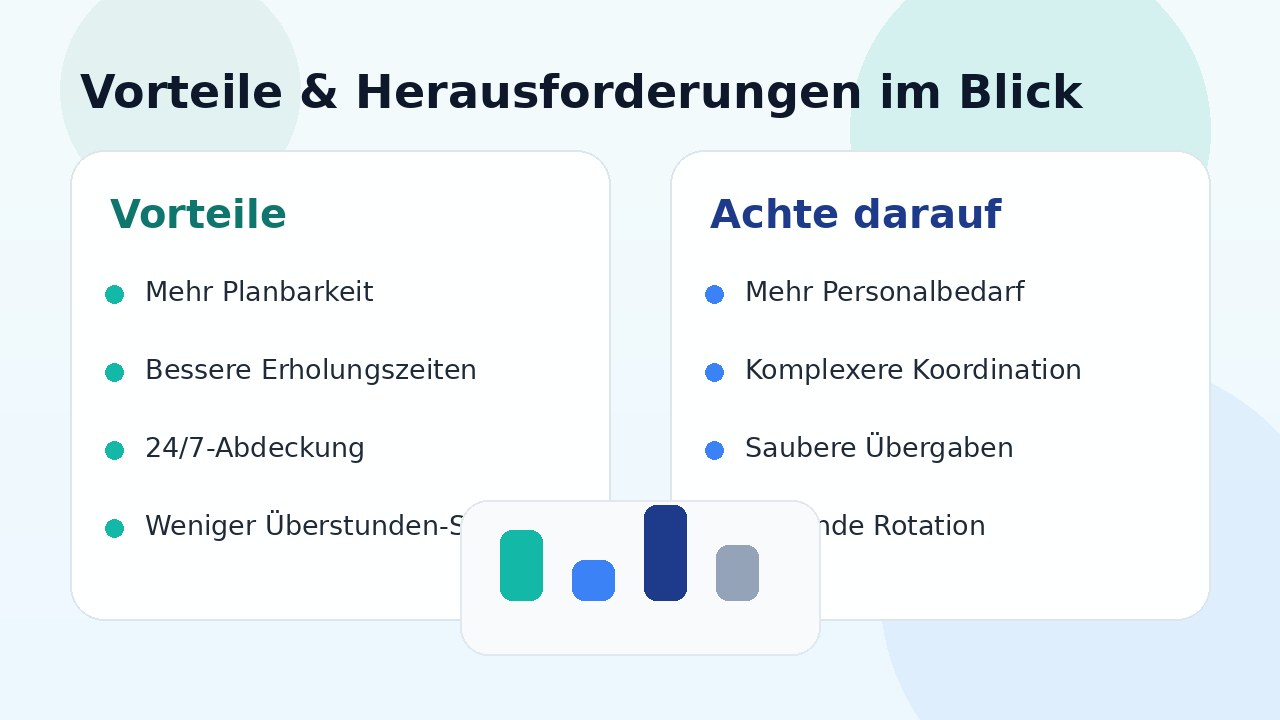
Advantages of the 4-Shift Model
For Employers
- Continuous operating hours: 24/7 production without interruption
- Higher utilization: Machines and equipment run around the clock – maximum efficiency
- Less overtime: With four teams, workload is better distributed, fewer absences due to illness or overload
- Planning reliability: Clear rotation, fewer conflicts in shift scheduling
- Competitive advantage: Faster delivery times, higher production capacity
For Employees
- Regular rhythm: Predictable shift rotation – you always know when you work
- More consecutive free time: Compared to the 3-shift model, there are more frequent longer free phases
- Allowances: Night, Sunday and holiday allowances (at least 25% for night work in Switzerland, see Night Allowance Switzerland)
- Flexibility: Free days can be used for appointments, family or hobbies
- Lower burnout risk: Better work-life balance than with 3-shift or permanent night shifts
Disadvantages of the 4-Shift Model
For Employers
- Higher personnel costs: Four teams mean more employees – plus allowances for night and weekend work
- More complex planning: Vacation coverage, sick leave and training must be coordinated across four teams
- Communication effort: Four teams never work simultaneously – information transfer is more difficult
- Training time: New employees need longer to adapt to the rhythm
For Employees
- Strain on biorhythm: Constant switching between early, late and night shifts can disrupt sleep
- Social restrictions: Weekend and holiday work, irregular working hours complicate family life and friendships
- Health risks: Long-term shift work increases risk of sleep disorders, cardiovascular diseases and gastrointestinal problems
- Less spontaneous free time: Free days are fixed, spontaneous activities are harder to plan
- Adjustment phase: Some people never fully adapt to shift work
Comparison Table: 4-Shift vs. 3-Shift vs. Alternating Shifts
| Feature | 4-Shift Model | 3-Shift Model | Alternating Shifts (2-Shift) |
|---|---|---|---|
| Teams | 4 | 3 | 2 |
| Operating hours | 24/7 | 24/7 | 16 hours/day (e.g. 06:00-22:00) |
| Off shift rhythm | Every 4th day off (or longer in variants) | Every 3rd day off | Weekly rotation (e.g. 1 week early, 1 week late) |
| Recovery time | High (longer free phases) | Medium | Medium to high (no night shift) |
| Personnel costs | High | Medium | Low |
| Planning complexity | High | Medium | Low |
| Allowances | Yes (night, Sunday, holiday allowances) | Yes (night, Sunday, holiday allowances) | Partially (only Sunday/holiday) |
| Typical industries | Industry, hospitals, logistics, energy | Production, service | Office, retail, light production |
| Work-life balance | Medium (more free time, but irregular) | Low (less free time) | High (no night shift) |
Conclusion: The 4-shift model offers the best balance between operating time and recovery time – but only if you cope well with shift work.
Template: Sample Schedule for the 4-Shift Model
Here is a practical 4-week shift schedule for four teams (A, B, C, D). Each team works on a 4-day cycle.
Week 1
| Day | Team A | Team B | Team C | Team D |
|---|---|---|---|---|
| Mon | Early Shift | Late Shift | Night Shift | Off |
| Tue | Late Shift | Night Shift | Off | Early Shift |
| Wed | Night Shift | Off | Early Shift | Late Shift |
| Thu | Off | Early Shift | Late Shift | Night Shift |
| Fri | Early Shift | Late Shift | Night Shift | Off |
| Sat | Late Shift | Night Shift | Off | Early Shift |
| Sun | Night Shift | Off | Early Shift | Late Shift |
Week 2
| Day | Team A | Team B | Team C | Team D |
|---|---|---|---|---|
| Mon | Off | Early Shift | Late Shift | Night Shift |
| Tue | Early Shift | Late Shift | Night Shift | Off |
| Wed | Late Shift | Night Shift | Off | Early Shift |
| Thu | Night Shift | Off | Early Shift | Late Shift |
| Fri | Off | Early Shift | Late Shift | Night Shift |
| Sat | Early Shift | Late Shift | Night Shift | Off |
| Sun | Late Shift | Night Shift | Off | Early Shift |
The cycle repeats over weeks 3 and 4.
Template as Excel/PDF Download
Do you need a ready-made template for your company? With job.rocks you can automatically create shift schedules, assign employees and calculate allowances – including export as PDF or Excel.
When is the 4-Shift Model Worthwhile?
The 4-shift model is not suitable for every company. Here are the main criteria:
The 4-Shift Model fits if…
- …your company must operate 24/7 (e.g. production, hospital, logistics)
- …you have enough staff to form four teams (at least 20-30 employees)
- …your employees are willing to work shifts (including night and weekend shifts)
- …you want to achieve a high utilization of your equipment
- …personnel costs are offset by higher productivity
The 4-Shift Model does NOT fit if…
- …you only work during the day or until evening → Then a 2-shift model is sufficient
- …you have too few staff → One team absence endangers the entire operation
- …your order situation fluctuates strongly → Then flexible models are better (e.g. part-time, floaters)
- …your employees are not healthy enough for shift work
FAQ: Frequently Asked Questions about the 4-Shift Model
How many employees do I need for a 4-shift model?
At least 4 employees per position – so one team per shift. In practice, you should also plan for floaters or reserve employees (about 10-20% more) to cover vacations, illness and training.
How high are the allowances in the 4-shift model?
In Switzerland, the following minimum allowances apply:
- Night work (23:00-06:00): at least 25%
- Sunday work: depending on collective agreement 50-100%
- Holiday work: depending on collective agreement 100-200%
Many collective labour agreements (GAV) provide for higher allowances. More details: Night Allowance Switzerland
Can I as an employee refuse the 4-shift model?
It depends on your employment contract. If it states that shift work is part of your duties, you must generally agree. If such a clause is missing, you can refuse shift work.
Is the 4-shift model healthier than the 3-shift model?
Yes, generally it is. The 4-shift model offers more recovery time between shifts and longer free phases. But: Shift work in general strains health. Important are:
- Regular medical check-ups (mandatory from 25 nights/year in Switzerland)
- Healthy diet, exercise, sufficient sleep
- Bright workspaces, ergonomic workplaces
How do I plan vacation in the 4-shift model?
Vacation planning must be coordinated early – ideally 3-6 months in advance. Only one person per team should take vacation at the same time to keep shifts staffed. Good shift planning software helps a lot (e.g. job.rocks).
What is the difference between the 4-shift model and continuous shift work?
"Continuous shift work" is the umbrella term for all models that run 24/7. The 4-shift model is a specific variant of this – with four rotating teams.
Are there legal requirements for the 4-shift model in Switzerland?
Yes. The Labour Act (ArG) regulates:
- Maximum working hours: max. 45-50 hours/week (depending on industry)
- Rest periods: at least 11 hours between shifts (can be reduced to 8 hours if compensated within 24 hours)
- Night work: max. 10 hours per shift, at least 25% allowance
- Sunday work: only with permission, allowance according to collective agreement
Conclusion: Is the 4-Shift Model Right for You?
The 4-shift model is a proven system for companies that must operate around the clock. It offers a good balance between operating time and recovery time – but only if you have enough staff and your employees cope well with shift work.
Advantages summarized:
- 24/7 operation possible
- Regular, predictable rhythm
- Better work-life balance than 3-shift
- Higher productivity and equipment utilization
Disadvantages summarized:
- Higher personnel costs
- Strain from shift work (health, social life)
- More complex planning
Do you want to implement or optimize a 4-shift model? With job.rocks, shift planning is easy: automatic rotation, allowance calculation, vacation planning and more – all in one app.