
Event Staffing Avoid bottlenecks for smooth events
Avoiding staff shortages at events means planning ahead instead of just reacting. The core lies in examining your personnel needs early and realistically, building an adaptable employee pool and relying on clever digital tools. This is the only way you can stay even with short-term...
Avoiding staff shortages at events means planning ahead instead of just reacting. The core lies in examining your personnel needs early and realistically, building an adaptable employee pool and relying on clever digital tools. This is the only way you can remain capable of acting even in the event of short-term failures or unexpected changes.
Why you need to reset your event staff planning
Imagine this: your big company anniversary is just around the corner. The decoration is perfect, the catering is ordered - but suddenly three people from the admission team call in sick. A classic nightmare that in today's world becomes reality faster than you would like. The old methods of personnel planning, such as endless Excel lists or desperate call chains, are reaching their brutal limits here.
The changes in the job market have caught up with us
The labor market has changed noticeably. The situation is particularly tense in Switzerland, which makes finding good event staff even more difficult. The golden days when you could rely on a huge pool of available and motivated helpers are definitely over.
A current look at the job market shows a clear trend: the Swiss job market is stagnating. This particularly affects administrative and commercial professions - exactly the people who are crucial for the organization and logistics of an event. In the first half of the year there was a sharp decline in job advertisements -24% compared to the previous year. For you as a planner, this means: fewer professionals available for coordination, back office and all the invisible but important tasks. You can find out more about this in the study Adecco Group Swiss Job Market Index.
This change forces you as an event manager to rethink. You are no longer just competing for the best people with other organizers, but with companies from every conceivable industry.
What this means specifically for your event
So what happens if you don't find the right people? The consequences go far beyond an unfilled position and can seriously harm your event.
- Loss of quality: Inexperienced or completely overworked staff can ruin the guest experience. Imagine long waiting times at the entrance, inattentive service or poorly informed contacts - these are immediately noticeable negatively.
- Stress for your core team: Your permanent team has to fill the gaps. This inevitably leads to overload, mistakes and a loss of motivation, which is passed on to the entire event.
- Budget overruns: In an emergency, you resort to expensive emergency solutions such as overpriced agencies that exceed your carefully planned budget.
The following table shows you the real causes of the most common staffing problems at events. If you know these patterns, you can intervene much earlier.
Typical staff shortages at events and their real causes
| problem area | Possible cause | Practical countermeasure |
|---|---|---|
| Short-term outages | Low employee retention; unclear communication; late booking | Building a permanent pool of employees; transparent operating conditions; automated booking confirmations |
| Wrong qualifications | Inadequate needs analysis; no qualification filters when booking | Create a detailed requirements profile for each role; Use digital tools with skill matching |
| Too little feedback | Cumbersome application process; poor accessibility of planners | Mobile-first availability queries; central communication platform instead of email chaos |
| Overload on site | Staffing levels planned to be too tight; no jumpers or backups planned | Plan for a buffer of 10-15%; Set up a standby pool for emergencies and remunerate it fairly |
If you know these causes, it becomes clear: planning a little better is not enough. You need a fundamentally different strategy.
A flexible, forward-looking HR strategy is no longer an option, but a business necessity. You need to identify bottlenecks before they become a real problem for your event.
A modern one Operations planning helps you keep track of things and react to changes quickly. It's not just about knowing how many people you need, but also, who has the right skills for the task. This is the only way you can ensure that your event runs smoothly and remains fondly remembered by your guests.
Lay the foundation with a precise needs analysis
Before you book a single person, the most important work comes: carefully examining your staffing needs. An inaccurate estimate almost always leads to problems. Either you have too few staff and your team burns out, or you have too many people and blow your budget. You definitely want to avoid both.
A good needs analysis is much more than a simple count. It's about truly understanding each individual role and the tasks associated with it. This way you avoid bottlenecks right from the start because you not only know how many, but above all which people you need.
Define the roles for each event phase
An event can be roughly divided into three phases: setup, implementation and dismantling. Each of these phases places very different demands on your staff. It's a classic mistake to plan with the same people for all phases.
Imagine you are organizing a big company anniversary for 500 guests. Your personnel planning could look like this:
-
Setup (1-2 days before the event): What you need above all here is hands that can get hands on.
- 4 logistics helpers: For transporting and assembling furniture, technology and decoration.
- 1 technician: Responsible for installing lighting and sound systems.
- 1 project manager: Coordinates the entire construction team and is the contact person for all trades.
-
Implementation (event day): Now the focus shifts to guest care and smooth operations.
- 6 service staff: For serving guests with drinks and food.
- 3 people at the entrance: Scan tickets, distribute badges and provide initial information.
- 2 cloakroom staff: Ensure a quick and organized process.
- 1 knight: A flexible person who steps in wherever there is a need.
-
Dismantling (night/day after the event): Efficiency and speed are again required here.
- 5 dismantling helpers: We dismantle everything systematically and load the material.
- 1 Supervisor: Supervises the dismantling and ensures that the location is handed over swept clean.
Find the right mix of fixed, flexible and specialized
Once the roles are clear, you think about how best to fill them. Not every task requires a highly paid specialist or a permanent employee.
Your goal should be to combine a small but powerful core team with flexible temporary staff and targeted freelancers. This way you stay agile and keep costs under control.
Your core team knows the event inside and out and takes on key positions such as project management. Temporary staff are ideal for clearly defined, time-limited tasks such as service or construction. Specialists such as the sound engineer come on board as freelancers only for their specific task.
Take regional differences into account when planning
Don’t forget to include the venue in your planning. The availability of skilled workers can vary greatly from region to region. The shortage of skilled workers in Switzerland is slowly easing, but the pressure remains, especially in sectors relevant to events.
You may find it easier to find staff in the Zurich region than in eastern Switzerland, where the shortage is still noticeable. This means that in some regions you will have to start your search earlier or rely on the support of personnel service providers to avoid bottlenecks. An adapted strategy depending on the venue is therefore essential. More about the regional differences on the Swiss labor market You can find out directly from SRF.
Build a flexible employee pool
Reactive planning is the biggest enemy of any smooth event. If you only start looking when the emergency is already there, you are letting chance take control. Your proactive protective shield against last-minute sick calls, unexpected order peaks or sudden cancellations is your own, flexible employee pool. It is the buffer that gives you room to maneuver while others have long since fallen into panic.
But such a pool is much more than just a contact list. Think of it as a strategically built network of reliable people you know and trust. It's about building a real community of talent - people who are happy to work for you and who you can activate at lightning speed when needed.
Where you find the right people
Building a strong pool starts with targeted search. Never rely on just one channel, but spread your efforts widely.
- Former employees and proven temporary workers: This is your gold standard. These people know your processes, your expectations and - most importantly - they have already proven their reliability. Keep the contact active, even if there is no event coming up. A short message every now and then works wonders.
- Student networks: Universities and technical colleges are a top source for motivated and flexible young people. Many people are specifically looking for project-based jobs that can be easily combined with their studies.
- Specialized platforms and forums: Online groups for event staff or freelancer platforms can be a useful addition. Here you can often find experienced staff that you can book for very specific tasks.
- Employee recommendations: Your best people often know other good people. A small thank you or a bonus for a successful placement is money well invested and increases the quality of your pool enormously.
To make your decision easier, we have summarized the most common channels with their advantages and disadvantages.
Channels for staff development in comparison
An overview of different channels for building your personnel pool with their advantages and disadvantages.
| channel | Advantages | Disadvantages | Suitable for |
|---|---|---|---|
| Former employees | Know processes, high reliability, hardly any training required. | Limited quantity, not always available. | Quickly fill important roles. |
| Student networks | High flexibility, motivated, often more cost-effective. | Less experience, availability fluctuates (exam phases). | General support duties, promotions, wardrobe. |
| Online platforms | Large selection, specialized specialists can be found. | Quality can vary greatly, less personal connection. | Supplementing the pool with specific skills (e.g. technicians). |
| Employee recommendations | High accuracy of fit, cultural fit often given. | Danger of "collusion", limited horizons. | Strengthening the core team with trustworthy people. |
Each channel has its strengths. The best strategy is almost always a mix of everyone, so you can rely on both familiar faces and fresh talent.
Organize your pool for reactions in seconds
A disordered Excel spreadsheet with names and numbers is worthless in an emergency. You need a system that shows you at a glance who is available and has the right skills. Sure, a simple table is a start. But a proper workforce management platform takes your planning to a whole new level.
The key lies in the structured collection of data. You need to know who has what skills, when someone is available and how to reach them quickly. This is the only way you can find the right person immediately when you need it.
An example that every agency has experienced:
Imagine you are organizing a big gala. On the morning of the event, the entire four-person catering team from an external service provider called in sick. The pure nightmare. An agency was able to master exactly this situation because it had a well-maintained employee pool in its software.
With just a few clicks, the planner filtered by “experience in banquet service” and “available immediately”. Within 15 minutes the system sent an automated request 25 suitable people. After more 30 minutes There were four confirmations and the new team was already on the way to the location. The guests were completely unaware of the chaos behind the scenes.
This success was only possible because all relevant data – skills, availability, contact details – was organized centrally and digitally. A manual search by telephone would have been a hopeless and nerve-wracking undertaking. To delve deeper, like you clever personnel planning with flexible employees implemented, you can find further tips from us here.
A well-organized pool is not just an emergency plan. It is a strategic advantage that gives you security and flexibility Event staffing to avoid bottlenecks, before they even become a problem.
Automate your workforce planning with the right tools
Who doesn't know it? Excel lists that are never up to date, endless telephone chains and confusing email processes. Manual personnel planning is not only a time waster, but also a huge source of errors. A small number error or an overlooked answer and you're faced with massive problems on the day of the event. This is exactly where targeted automation comes in – it not only makes your processes faster, but above all safer.
Modern workforce management tools take the most tedious tasks off your hands. Imagine creating a shift and sending a request to your entire relevant staff pool with just one click. Instead of waiting hours for replies, you'll have a clear overview of who's available and qualified within minutes. This is how you can do it Avoid event staffing bottlenecks, long before they can even emerge.
From chaos to clarity through smart filters
A good system can do much more than just query availability. The real advantage is automatic filters. You define which skills are crucial for a specific role – be it “experience in service”, “Class B driving license” or a “certificate for security personnel”.
The system then ensures in the background that your request only goes to the people who actually meet these criteria. This not only saves you but also your staff a lot of frustration and ensures that you only receive qualified feedback. Manually digging through lists looking for a needle in a haystack is finally a thing of the past.
The following graphic shows what this process looks like in practice - from setting up the employee pool to targeted, automated activation.
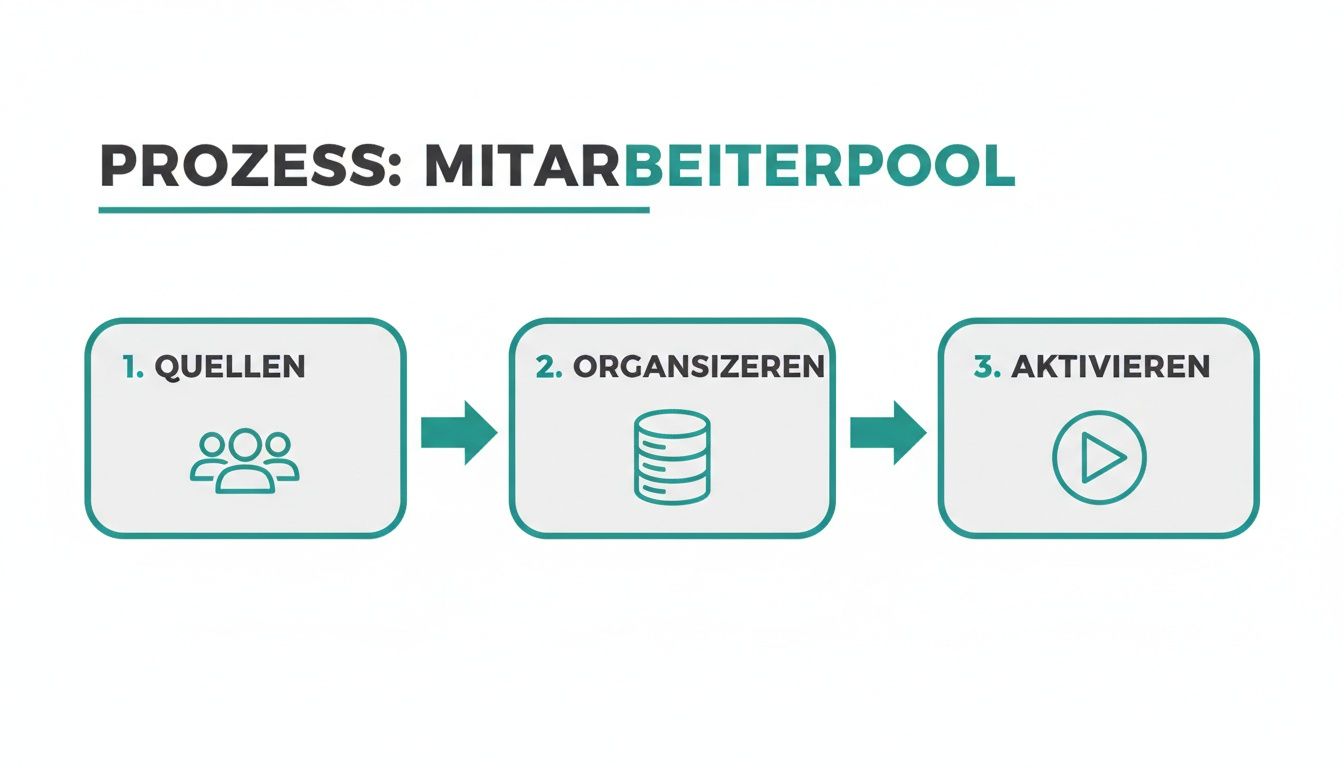
You can clearly see that a systematic approach is the basis. If the sources are correct, the data is neatly organized and the activation is targeted, automation becomes a real success.
How this really works in practice
Platforms like job.rocks digitize the entire process, from the first inquiry to the final booking to time recording. Communication is bundled in a central location and can be understood by everyone at any time.
Automation does not mean losing personal contact. It means having more time for important conversations because the administrative routine is eliminated.
Instead of struggling with pure coordination, you can finally concentrate on the strategic and creative aspects of your event. Software like job.rocks gives you a clear interface where you keep all the reins in your hands and never lose track.
The result is massive time savings, a drastically reduced error rate and ultimately higher satisfaction among your staff. Clear processes and fast communication are simply well received. You gain the security that your personnel planning is based on a solid, digital foundation.
An emergency plan just in case
Let's be honest: Even the most ingenious planning cannot prevent unforeseen failures. What do you do when your most experienced team leader calls with a fever on the morning of the event? It's exactly for moments like this that you need a plan B that's in place immediately.
A good emergency plan is not rocket science. Rather, it is a series of clear, thoughtful steps that will help you keep a cool head in stressful situations. It's about determining in advance who will step in if a key person is unavailable and how communication will proceed. This way you avoid chaos behind the scenes and ensure that your guests don't notice any of the little drama.
Define backup roles and clear communication chains
First, you need to identify the key positions. These are the roles whose failure would put the running of your event at greatest risk - typically the project manager, the technical manager or the chef de service.
Establish a crystal-clear replacement policy for each of these critical positions. Who will take on the tasks? Does this person know what needs to be done and does he or she know the most important procedures? Make sure contact details and responsibilities are available to everyone on the team at all times.
A simple but extremely effective communication chain is also crucial:
- Who reports the outage? The missing person informs the project manager directly and without detours.
- Who activates the backup plan? The project manager informs the defined deputy and the affected team.
- How is communication done? Use a central channel like a messenger group. This means everyone is up to date at the same time and no important information is lost.
The strength of personnel service providers as a lifeline
Sometimes internal backup isn't enough, especially when multiple people go down at the same time. This is where professional personnel service providers come into play. They are your external lifeline and a central building block Event staffing to avoid bottlenecks. A good partnership can be worth its weight in gold in an emergency.
A reliable HR service provider is more than just a supplier – it is an integral part of your broader HR strategy. Build that relationship long before you desperately need it.
In Switzerland in particular, the temporary employment industry plays an important role in flexibly cushioning work peaks. Swissstaffing reports how crucial these companies are for the economy. Although the market is cooling down a bit, still expect 33% the service provider's growth - a clear sign of their continued importance when it comes to flexible personnel needs.
If things have to happen really quickly, one can Software for short-term shift staffing be the rescue and help you close open gaps in record time.
When choosing your partner, make sure that they really understand your industry and have a pool of qualified, vetted employees. A good service provider can often find suitable staff within a few hours and, in case of doubt, saves your entire event.
The most frequently asked questions about event staffing shortages
From practice for practice: Here you will find clear and direct answers to the questions that you come across again and again in everyday life. No long blah blah, just solid advice that will help you avoid the typical hurdles in personnel planning Event staffing avoids bottlenecks.
How far in advance should I start planning my workforce?
As a rough rule of thumb you can remember: For large events you should at least three to six months start with the first needs analysis beforehand. Four to six weeks are often enough for smaller events. This gives you the buffer you need to find the right people without the usual last-minute stress. This means you don’t have to make any lazy compromises on quality in the end.
Even more important than a rigid schedule is a flexible and well-maintained employee pool. If you can rely on a network of tried and tested people who you know and trust, you will remain deeply relaxed even in the event of last-minute requests or unexpected failures.
What is the biggest mistake when planning staff for events?
By far the most common mistake is to focus solely on the head count and ignore people's specific skills. Someone who greets guests with a smile at the entrance needs a completely different skillset than the person who inconspicuously keeps the technology running in the background or who flexibly tackles whatever is needed as a jumper.
The fallacy that “someone” will do the job almost always ends in a loss of quality and pure stress on site. Define crystal-clear requirements for each individual role - this is the only way to avoid skills bottlenecks when it matters most.
An exact definition of the roles and the skills required for them is therefore the be-all and end-all. This way you can ensure that you not only enough, but above all that correct Have staff on board for every task.
Is it worth working with a personnel service provider?
Yes, absolutely – especially as an integral part of your emergency plan. A good personnel service provider is essentially your insurance against unforeseeable failures. He has access to a large, already vetted pool of specialists and can often step in even if someone is unavailable at short notice on the day of the event.
This partnership gives you enormous security and protects you from the worst stressful situations. So don't see a service provider as an expensive emergency solution, but rather as a strategic partner who massively increases your flexibility and reliability.
How do I keep my employee pool happy and motivated?
A motivated pool is a loyal pool. The key to this is very simple: appreciative and regular communication. Get in touch with your people even if there is no event coming up. A short message, a small update or just a greeting shows them that they are more than just a name on a list.
Always ensure fair conditions and a good atmosphere at the location. Honest and constructive feedback after the job is just as important. It's often the small gestures that make the difference: a shared beer after a long day or a small thank you can do wonders. This way you can ensure that people will be happy to work for you again next time.
Ready to take your workforce planning to the next level and put bottlenecks aside for good? job.rocks gives you the tools to cleverly manage your employee pool, plan assignments automatically and maintain a complete overview at all times. Discover now how you can save valuable time and gain security: https://job.rocks