
Successful employee onboarding: your practical guide
Successful onboarding for new employees is more than a warm welcome. Learn the phases, checklists, KPIs and practical steps that help new hires stay.
A successful one Onboarding for new employees is more than just a nice gesture – it is an economic necessity. It is the moment that decides whether your new team member starts motivated or is already mentally on the move again.
Why good onboarding is crucial for your company
Imagine this: You have invested weeks of time and a lot of budget to find the perfect person for an open position. The contract has been signed and anticipation is great on both sides. And then? If the reality on the first day of work doesn't keep up with expectations, the initial enthusiasm evaporates faster than you think. In the worst case, a bad start leads directly to early termination.
This rapid departure of new employees, also known as early fluctuation, is unfortunately not a rare phenomenon. It's an expensive problem that goes far beyond just recruiting costs. Every termination means lost knowledge, disrupted team processes and the need to start the entire recruiting process all over again.
The hidden costs of early turnover
Especially in dynamic industries where things have to happen quickly - think of event and promotion agencies, catering or security services - a smooth start is the be-all and end-all. New staff must be ready for action from day one. A botched start not only causes frustration for the new hire, but also puts a strain on the existing team, which has to fill the gaps and manage the training somehow on the side.
The reasons for termination during the probationary period are often homemade. A current study in German-speaking countries provides alarming figures: In over half of the companies surveyed, false expectations of new employees lead to early dismissals. And just under 38 % Are there interpersonal problems with the team or the manager that make the difference.
A structured onboarding process is your best insurance against high early fluctuation. It creates clarity, builds trust and ensures that new talents really join the team and stay.
More than just an induction plan
A well-thought-out onboarding goes far beyond a mere training plan. It is the first, formative encounter with your corporate culture. It strengthens social bonds and gives new colleagues the feeling of being valued and belonging from the very first moment. It is the foundation for long-term, successful cooperation. Because the way you welcome someone shapes your entire attitude towards the company.
The good news? You have it in your hand. According to a study, 83% of HR managers believes that a better onboarding strategy can significantly reduce turnover. It is a direct investment in the stability and future success of your company. If you want to strengthen the importance of human resources in your company, you can find out about them in our article central role of the human resources department valuable starting points. The effort for systematic onboarding pays off in several ways.
The roadmap for successful onboarding in four phases
A successful one Onboarding new employees is not a coincidence, but the result of a clear, well thought out plan. The entire process can best be divided into four phases that logically build on each other. This way you can ensure that nothing important is left behind and that your new team member feels valued and in good hands from the very first moment.
This structure gives you a common thread to take the right measures at the right time. From the signing of the contract to the end of the first month, each phase has a specific objective that gradually consolidates social and professional integration.
Phase 1: Preboarding (between signing the contract and the first day of work)
The time between acceptance and the first day of work is often a delicate phase, filled with uncertainty and sometimes even doubt. Use this stage to build on your new talent's initial enthusiasm and build your first real bond. The goal is clear: create anticipation and get rid of annoying administrative hurdles before the job even begins.
A small welcome package can work wonders here. Send not only the necessary contract documents, but also a few personal words from the team or direct manager. An example would be a handwritten card from the team that says “We look forward to seeing you, Maria!” This shows that there are people waiting who are happy.
Practical examples of strong preboarding:
- The welcome email: Send a short, friendly message with all the information you need to get started: When and where exactly should the person be? Who is the first point of contact? Is there a dress code?
- Digital documents: Use a tool like the job.rocks app to collect all documents such as the personnel questionnaire or tax information digitally and securely. This saves valuable time and nerves on the first day.
- A first face of the team: A short cell phone video introducing the team or a link to the team page on your website can help break down the initial social barriers before you've even met in person.
Well-thought-out preboarding sends two signals: appreciation and professional organization. It takes away the nervousness before the first day and minimizes the risk of termination before starting work - a problem that studies show occurs in over a third of companies.
Phase 2: The first day of work (orientation and arrival)
The first day is formative - it's not about productivity. It's about orientation, getting to know the most important people and a feeling of welcome. At the end of the day, your new employee should feel comfortable and take home a positive first impression of the company culture. That is the main goal.
This also includes ensuring that the workplace is completely set up and ready for use. Nothing is more frustrating than when your laptop is missing on the first day or the access doesn't work.
A well-planned first day could look like this:
- Personal Greeting by the manager or a previously designated “buddy”. No brushing off at reception.
- A tour of the company, to show the important places – kitchen, toilets, meeting rooms.
- Introduction to the direct team, ideally over a casual coffee or lunch together.
- Handover of the induction plan for the first week. This immediately creates clarity about expectations.
The following graphic shows what often fails and why new people leave early. This is exactly what you can prevent with a good start.
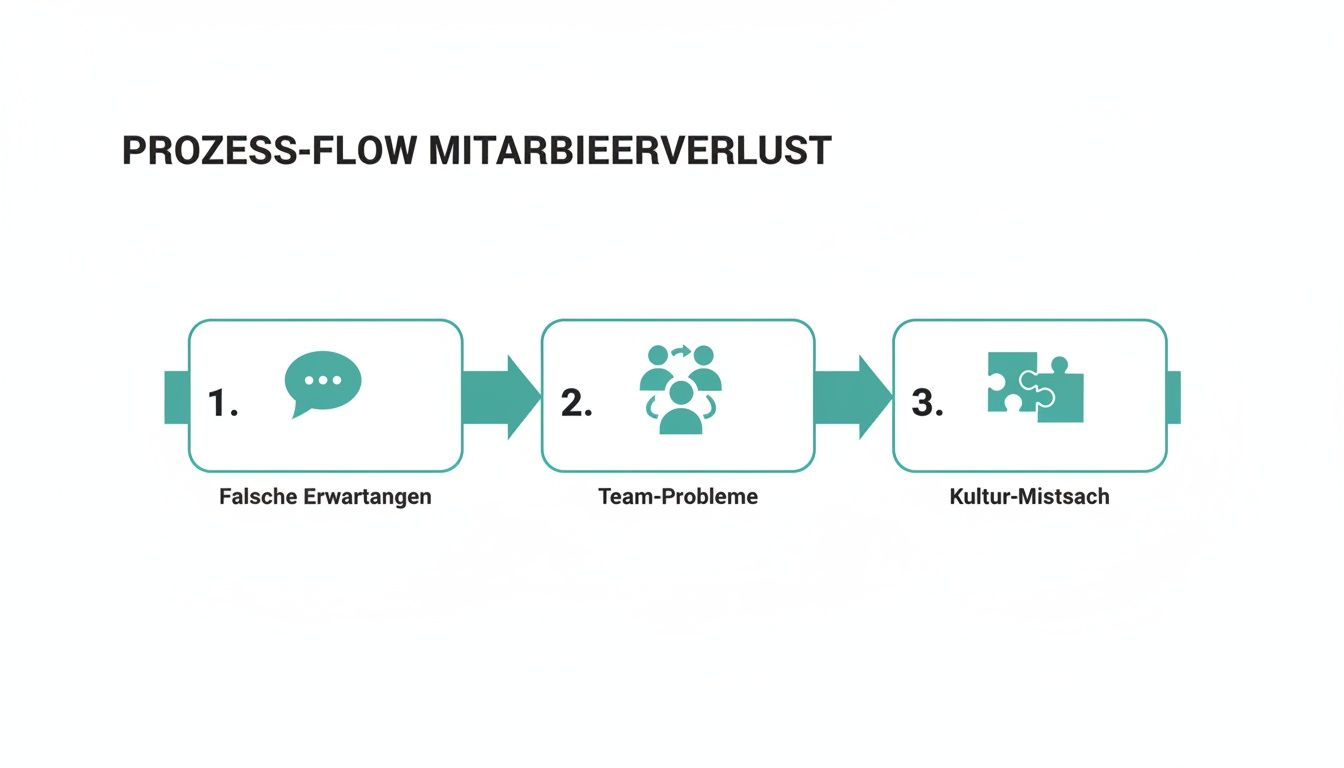
You can clearly see: Unclear expectations, social problems in the team and if the chemistry with the company culture is not right are the main drivers for early termination.
Phase 3: The first week (technical training and social networking)
The actual training begins in the first week. Now it's time to take on your first tasks, get to know the internal processes and deepen your contacts within the company. Your goal must be to quickly create the first small experiences of success and to actively involve the person in the team's daily processes.
A detailed training plan is your most important tool here. It should contain clear learning goals, specific tasks and scheduled meetings with important colleagues.
What should not be missing in the first week:
- Regular check-ins: Schedule short, daily conversations (10-15 minutes) with the manager. In this way, questions can be clarified quickly and progress can be discussed.
- A mentor or buddy: Assign an experienced colleague to the new employee. This person is the informal contact for all the little everyday questions that you don't dare ask the boss.
- First real tasks: Give manageable but meaningful tasks that can be completed independently. For example, you could give a new marketing employee the task of creating a brief competitor analysis of a specific product. This immediately strengthens the feeling of being needed and making a contribution.
Phase 4: The first month (deepening and initial feedback)
After the first month, integration – both professionally and socially – should be well advanced. The new employee knows the most important processes, works on their own projects and has built up their first social network. The aim of this phase is to consolidate what has been learned and to carry out an initial joint assessment of the situation.
A structured feedback discussion at the end of the month is absolutely crucial. Here you can reflect together on what went well and where you might still need support.
This conversation should definitely cover these points:
- Feedback from the employee: How did the person feel at first? Were expectations met? What was surprising?
- Feedback from the manager: Honest and constructive feedback on previous performance and development potential.
- Goals for the next few months: Together, determine the next steps and goals for the remainder of the probationary period.
When you automate administrative tasks, you have more time to focus on the human side of this important process. As the Digitalization in Human Resources You can find out how we can specifically support you in our further article.
This table summarizes the key actions and goals for each of the four onboarding phases, from contract signing to the end of the first month.
Onboarding phases at a glance: actions and goals
| phase | Central actions | Primary goal |
|---|---|---|
| Preboarding | Welcome email, digital documents, team introduction | Create anticipation, reduce administrative hurdles, build initial relationships |
| 1st working day | Personal welcome, tour, team lunch, induction plan | Create positive first impressions, provide orientation, convey a welcoming culture |
| 1 week | Professional training, assignment of a buddy, regular check-ins | Enable initial success experiences and start social and professional integration |
| 1 month | Independent tasks, feedback discussions, goal setting | Deepen integration, first determine your position, consolidate what you have learned |
With this clear structure, your onboarding process will not only be better, but it will also ensure that your new employees feel like a valuable part of the team right from the start.
Strengthen employee loyalty from day one
The purely technical training is only half the battle. Whether a new employee will stay with you long-term is often decided in the first few weeks - on a human level. This is exactly where you create the foundation for a strong, emotional connection to your company.

A well-thought-out process is more than just professional, it is a clear sign of appreciation. Companies that are conscious in it Onboarding new employees invest, improve their retention by impressive amounts 82 %. It's about creating an atmosphere where people feel welcome and part of something bigger. Just take a look at them Employee onboarding statistics on appical.com on – the potential is huge.
The decisive factor: the manager
The most important person in the entire onboarding? Clearly the direct manager. There is no substitute for their commitment and attention. Regular, personal contact in the initial phase has an enormous effect on satisfaction and the feeling of having really arrived.
In fact, there are new employees 3 times more likely highly satisfied with their start if their manager speaks to them every day in the first month. This doesn't have to be a long meeting. A quick check-in in the morning or a quick inquiry at the end of the day already signals: “You are important to me, I am there for you.”
Targeted promotion of social networking
Especially in industries with flexible teams - think security services, restaurants or healthcare - social connection is often a real challenge. The colleagues change, the locations vary. This makes it all the more important to actively shape networking and not leave it to chance.
Here are a few simple but incredibly effective methods:
- Shared breaks: In the first week, consciously organize a coffee break or a team lunch together. An informal meeting breaks the ice much faster than any official meeting.
- Introduce team rituals: Do you have any fixed rituals like having breakfast together on Friday? Involve new colleagues from day one.
- Cross-departmental contacts: Plan short get-to-know-you meetings with one or two people from other departments. This helps enormously to build initial bridges and understand the big picture. An example: Your new sales representative meets with someone from the product team for 15 minutes.
A strong social network in the company is like a safety net. It absorbs uncertainties, accelerates the transfer of knowledge and creates a feeling of belonging that supports even stressful phases.
The Buddy: A turbo for integration
A formal mentoring program or informal “buddy system” is one of the most powerful tools out there. A buddy is an experienced colleague - deliberately not the manager - who acts as a trustworthy contact for all small and large everyday questions.
The advantages are obvious:
- He answers the “stupid” questions: “Where can I find the coffee cups?” or “How exactly does expense reporting work?” You might not dare ask your boss questions like these.
- He conveys the unwritten rules: Every company has its own culture and informal codes. A buddy helps to understand these quickly and avoid mistakes.
- He is the first friend at work: This personal relationship gives the new employee a solid anchor point from day one and accelerates social integration enormously.
By the way, a buddy doesn't have to be a subject matter expert in the newcomer's area. Openness, patience and a positive charisma are much more important.
By focusing on the human side of arrival, you invest directly in the long-term loyalty of your employees. And remember: regular employee meetings are crucial to strengthening this bond beyond the initial phase. If you are still looking for the right inspiration, you can find an overview here important questions in employee interviews. This way you can ensure that the positive start leads to a sustainable and successful collaboration.
Onboarding is a marathon, not a sprint
Many companies make one crucial mistake: they check this Onboarding new employees after the first week mentally. But in doing so they are wasting a huge opportunity. Real integration takes time – much more than just a few days.
Think of a new job like moving to a new city. In the first week you will get to know the main streets. But only after months do you discover the hidden alleys, the best cafes and really feel at home. It's the same in the company. The initial expertise is just the surface.
From welcome to real integration
A long-term process that extends over the entire probationary period or even the first year is much more effective. In this way, you give new team members the space they need to fully find their way not only professionally, but also culturally and socially.
You learn the unwritten rules, build trust with your colleagues and understand how decisions are really made in the company. This approach turns onboarding from a one-time event into an ongoing process and ensures that initial motivation is converted into sustained engagement.
A short, intensive onboarding is like a sprint - you quickly become exhausted. A long-term process is a marathon - it builds endurance, strength and a deep, lasting connection to the company.
The duration of an effective process is often longer than many people think. For simpler tasks, one to three months may be enough. However, experts today recommend that onboarding be continued until the end of the year six month probation period or even about that entire first year to stretch. This gives new employees the time to build a stable network and fully integrate into the company culture. You can find out more about the optimal duration and the background to it read here at HR Praxis.
Milestones as signposts
A long-term plan does not mean constantly taking someone by the hand. It's more about setting structured signposts that provide orientation. Define clear milestones for the first three, six and twelve months.
- After 30 days: The person knows their core tasks and the most important contact persons. An initial detailed feedback discussion takes place.
- After 90 days: The person increasingly works independently and takes on their first projects. Social integration into the team is consolidated.
- After 6 months: The person is fully integrated professionally and contributes their own ideas. The probationary period discussion serves to determine a joint course for the future.
Regular feedback as a compass
Regular feedback discussions are the compass on this marathon. It is not a one-way street, but rather a dialogue at eye level. They help to make course corrections at an early stage, eliminate misunderstandings and strengthen the relationship between employees and managers.
A concrete example from the event industry: A new project manager organizes his first big event. A check-in will take place after 30 days. It turns out that he is insecure about budget responsibility. Instead of waiting until a problem arises, the manager can provide targeted support and coaching. This turns a potential source of error into a valuable learning experience.
Yes, this marathon approach Onboarding new employees may seem more complicated at first glance. But the investment pays off twice or threefold. You reduce fluctuation, increase productivity and build a stable foundation for loyal, long-term collaboration. In the end, you not only gain a new employee, but also a real influencer in the future of your company.
Measure onboarding success with the right KPIs
You can't improve what you don't measure. This ancient wisdom applies particularly to this Onboarding new employees. A good gut feeling is a start, but to really know whether your processes are working, you need hard facts. Clear, measurable key figures – so-called Key Performance Indicators (KPIs) – are essential in order to objectively evaluate and specifically improve the success of your training.
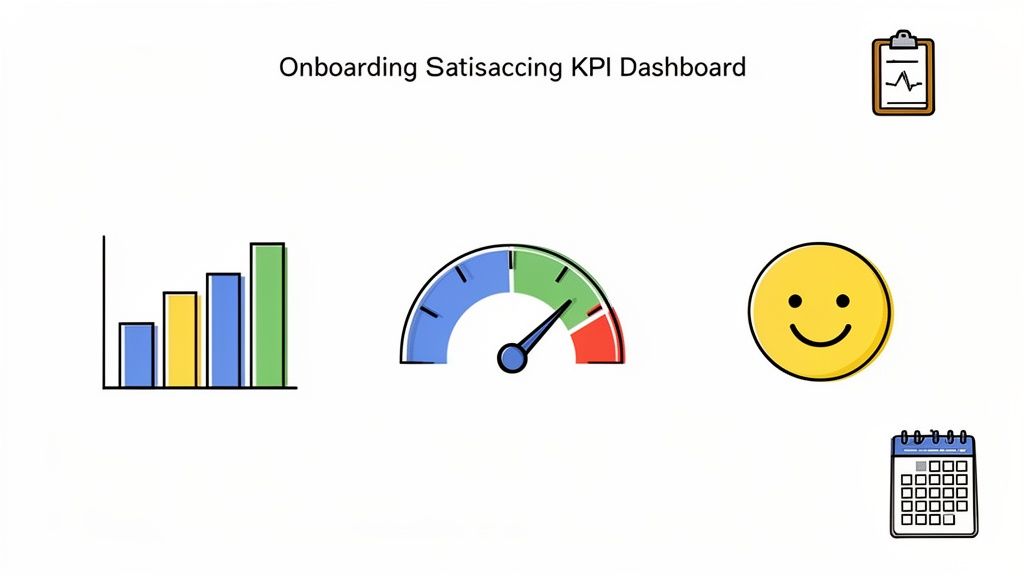
A dashboard like this helps you keep track of things and identify trends early on. This way you can see at a glance where your onboarding is already going really well and which adjustments you still need to make.
KPIs that really mean something
Sure, the fluctuation rate in the first six months is a classic. But it only scratches the surface and often only tells half the story. To understand the bigger picture, you need to dig deeper and look at more specific metrics.
The following KPIs give you a much clearer picture of the success of your onboarding:
- Time to Productivity: How long does it really take for a new employee to get started? Here you measure the time until a person completes their core tasks without intensive supervision and reaches a predefined performance level.
- Satisfaction of new employees: How do your new arrivals actually feel? Short, regular pulse surveys after the first week, the first month and after 90 days provide honest and unfiltered feedback.
- Engagement level after 90 days: Does the person actively contribute to the team? Do you contribute your own ideas? This can be easily found out through observations of the manager and in short check-in discussions.
- Onboarding task completion rate: Were all tasks and training defined in the induction plan completed on time? This number shows you whether your plan was realistic and understandable for the new employee.
Very important: The goal of measurement is not control, but continuous improvement. The data collected should help you uncover weak points in the process and make the experience even better for all future employees.
How you use practical data for yourself
Modern tools can provide you with valuable data that you can use directly to evaluate your onboarding. Imagine using digital time tracking like the one from job.rocks. Not only can you see when someone is working, but you can also specifically record the time spent on training.
You then simply compare this value with the originally planned hours. This way you can objectively determine whether the induction plan is being adhered to or whether certain topics may require more time than expected. This is the perfect, data-supported basis for the next feedback discussion. To demonstrate the long-term benefits and success of onboarding measures, it is crucial to understand the return on investment (ROI). Similar principles on how to create one measurable ROI achieved can also be found in other business areas.
Key KPIs to measure onboarding success
A comparison of the most important metrics to objectively evaluate the success of your onboarding process, including a description and measurement method.
| KPI (key figure) | What is being measured? | How is it measured? |
|---|---|---|
| Time to productivity | The time until a new employee delivers the full, expected performance. | Definition of milestones and performance goals; regular evaluation by the manager. |
| Satisfaction of new employees | The subjective feeling and satisfaction during the training. | Regular, short pulse surveys (e.g. after 1 week, 1 month, 3 months) with scale questions (1-5). |
| Engagement rate | The active participation and emotional commitment of the employee after training. | employee engagement surveys; Observe participation in team meetings and projects. |
| Onboarding task completion rate | The percentage of tasks from the onboarding plan completed within the time frame. | Comparison of the onboarding plan (checklist) with the tasks actually completed in an HR tool. |
| Fluctuation during the probationary period | The proportion of employees who leave the company within the first 6 months. | HR system data: Number of terminations during the probationary period / Total number of new hires in the same period. |
These metrics give you a solid, data-based basis to make informed decisions and specifically improve your onboarding.
Just ask: actively collect feedback
Often the most direct route is also the best. To measure satisfaction, just ask! A short, ideally anonymous survey can work wonders here and provide invaluable insights.
With these simple questions you can quickly get a feel for where the problem is:
- How well did we prepare you for your first day? (Scale 1–5)
- Do you feel like you have received all the tools and information you need? (Yes No)
- How helpful was your buddy/mentor in the beginning? (Scale 1–5)
- Do you feel welcome and well received in the team? (Scale 1–5)
- What was the most positive moment in your first few weeks? (Open text field)
- What could we have done better? (Open text field)
Such short surveys show you immediately what is going well and where you need to start to improve yours Onboarding new employees to continually improve. This way you make decisions that are based on facts - and not on pure assumptions.
Frequently asked questions about onboarding
Here I have summarized the answers to the most burning questions about onboarding new employees for you. Short, to the point and straight from practice.
How can I organize onboarding for flexible or temporary employees efficiently?
Especially in industries such as gastronomy or events, where you constantly work with flexible staff, a lean, digital process is the be-all and end-all. Here you need above all speed and a uniform standard without losing the personal touch.
The trick is to make everything important available digitally before the first use. With a platform like job.rocks you can display all documents, initial instructions and information directly via a mobile app. This means that every newcomer has the most important basics immediately on their smartphone.
Create short video tutorials for recurring tasks or concise checklists for the respective role. A central, digital hub that your people can access at any time saves you an incredible amount of administrative effort. This way you can ensure that everyone is on the same page, even if they are only with you for short or irregular assignments.
Digital onboarding for flexible staff is no longer a “nice-to-have” but an absolute necessity. It ensures a consistent standard of quality and gets new people up and running much faster and with fewer headaches.
What are the biggest onboarding mistakes and how do I avoid them?
By far the biggest mistake? Labeling onboarding as a mere formality for the first day. A good start is a process, not a one-time event.
Other classics you should definitely avoid:
- Lack of preparation: Nothing is more frustrating than standing in front of a workstation that isn't set up on the first day or when IT access is missing. This immediately signals: “You weren’t important enough to us.”
- Unclear expectations: If new employees are in the dark about what is expected of them in the first week, this leads to massive uncertainty.
- No fixed contact person: A new colleague who has to think about who he can disturb every little question quickly feels isolated and not part of the team.
You can avoid these mistakes with a solid checklist that you work through weeks before the starting signal. Be crystal clear about your first week and first month goals. Stell dem Neuzugang einen „Buddy“ zur Seite – jemanden, der für all die kleinen, informellen Fragen da ist, die man der Führungskraft vielleicht nicht sofort stellen will. And very important: Regular, short check-ins help you to identify early on where there are problems.
What role does the manager play in the onboarding process?
The direct manager is the absolute key person for successful onboarding. Your commitment is the strongest lever for retaining new employees right from the start and showing them real appreciation.
Their most important tasks include:
- Create a well-thought-out induction plan.
- Set clear and realistic goals for the beginning.
- Introduce the new colleague personally to the team.
- Conduct regular, scheduled feedback discussions.
- Create an open and trusting atmosphere in which “stupid questions” can also be asked.
The manager is not only responsible for technical matters. It is crucial for social inclusion and for bringing company culture to life. To do this, she has to consciously block out time in her calendar.
How do I ensure my onboarding process is GDPR compliant?
Data protection has been a critical issue from the very first minute. Careless handling of sensitive data can not only be extremely expensive, but it can also destroy trust before it is even built.
Make sure you only collect the data that is really necessary for the employment relationship. Be sure to use secure, encrypted systems to transmit and store documents such as your employment contract or social security number. An unsecured email is an absolute no-go here.
Transparently inform new employees which data you process and for what purpose. It is just as important to consistently delete data that is no longer needed after the legal deadlines have expired. Platforms like job.rocks help you standardize this entire process and make it GDPR-compliant. They offer you secure digital personnel files and controlled allocation of rights so that you are always on the safe side.
Would you like to take your onboarding to the next level and ensure that all processes run smoothly and GDPR-compliant? job.rocks helps you integrate new employees quickly and professionally, minimize administrative effort and build strong relationships from day one. Discover the possibilities on job.rocks now and design your onboarding so that your best people actually stay.