
Discover job.rocks vs. legacy software: how modern UX wins in hospitality
The difference is basically simple: job.rocks is a flexible, mobile and automated platform. By contrast, old solutions rely on rigid, manual workflows such as spreadsheets and countless phone calls. Your choice determines whether staff planning is a daily burden or a strategic advantage.
The difference is actually quite simple: job.rocks is a flexible, mobile and automated platform. Stand in contrast to this old solutions based on rigid, manual processes like Excel spreadsheets and countless phone calls. Your choice determines whether you see personnel planning as a daily burden or as a strategic advantage.
Why the old way of staff planning in the hospitality industry is over
You know the situation all too well: an employee calls in sick at short notice and chaos breaks out. You dig through endless Excel lists, make desperate calls and send messages to confusing WhatsApp groups just to somehow fill the open shift. This manual effort is not only grueling, but also extremely error-prone.
Outdated systems – often a mix of tables, email and paperwork – are simply no longer able to cope with today’s demands in the catering industry. They come from a slower, less changeable working world. What you need today is a solution that responds to outages in real time and immediately shows you who is available and qualified. Imagine being able to send an open shift to all the right people with one click instead of making ten calls.
The hidden costs of old systems
The problems go far beyond just the time involved. Every manual step involves risks that end up costing you money. Just think of the most common sources of error:
- Incorrect payroll: Manually transferred hours inevitably lead to errors. An employee worked an hour longer, but you forgot to enter it. This not only frustrates your employees, but can also have unpleasant legal consequences.
- Common no-shows: If communication is unclear or takes place through too many channels, misunderstandings occur. An employee missed a message and forgot his shift. Every no-show means pure stress for the rest of the team and potential loss of sales.
- High administrative effort: The time your managers spend hunting for replacements could be better spent looking after guests or training the team.
Old systems create a vicious circle of poor planning, employee frustration and financial losses. Trying to run a modern hospitality business with outdated tools is like trying to navigate a foreign city with an old map and no GPS - it's slow, frustrating, and rarely gets you anywhere.
The lack of personnel further exacerbates the situation
The hospitality industry in Switzerland has been suffering from an acute shortage of staff for years, which has massively increased the pressure on good planning. The Adecco Group Swiss Job Market Index for Q1 2023 shows that the number of job vacancies remains at a historic high.
In this environment, you simply cannot afford to lose good employees due to chaotic processes. You can find out more about the background in the study results, which show how the Swiss labor market is challenging the catering industry. A modern platform is therefore no longer a luxury, but rather a business necessity in order to remain competitive and be attractive as an employer.
Modern operation and old systems in direct comparison
Let's speak plainly. What does “service” really mean in the hectic everyday life of the catering industry? It's the difference between a smooth, almost invisible process and the pure chaos of calls, messages and outdated Excel lists.
To make this tangible, let's look at two typical situations that everyone who plans personnel in the catering, hotel or event sector knows. Once with the old tools, once with a modern platform like job.rocks.
Scenario 1: The short-term free shift
Friday afternoon, the store will soon be buzzing and your most important service employee calls in sick. The pulse increases. You need a replacement immediately.
- The old way (Excel & WhatsApp): Your first stop is the Excel spreadsheet. Who could tonight? The list is of course not current. You start a broadcast, send messages to the general WhatsApp group and trigger a flood of replies that you can hardly keep track of. Who has agreed now? Who even saw the message? You lose valuable minutes, your nerves are frayed, and in the end you may still be left without a replacement.
- The modern way (job.rocks): You open the dashboard, see the open shift and create a request with one click. job.rocks automatically filters all employees who available and for exactly this position qualified are. They receive a push notification directly on their cell phone and can immediately accept or cancel in the app. The first person to accept gets the shift. The plan updates itself and everyone involved is informed. What used to take an hour is now in less than 5 minutes completed.
Scenario 2: The desired shift swap
Two team members want to swap shifts with each other. Sounds simple, but it rarely is.
- The Old Way (Oral & Email): The employees will come to you or write you an email. Now you have to check manually: Do both have the necessary qualifications? Does the exchange fit with the statutory rest periods? Then you painstakingly enter the change into the Excel plan and send the new version by email - in the hope that everyone will actually see and pay attention to the latest version.
- The modern way (job.rocks): An employee submits the exchange request directly in the app. The exchange partner confirms with a click. As a manager, you will receive the request for final approval on your dashboard. The system has long since checked in the background whether qualifications and legal requirements match. One click from you and the exchange is approved. The deployment plan is updated in real time for everyone. No paperwork, no misunderstandings.
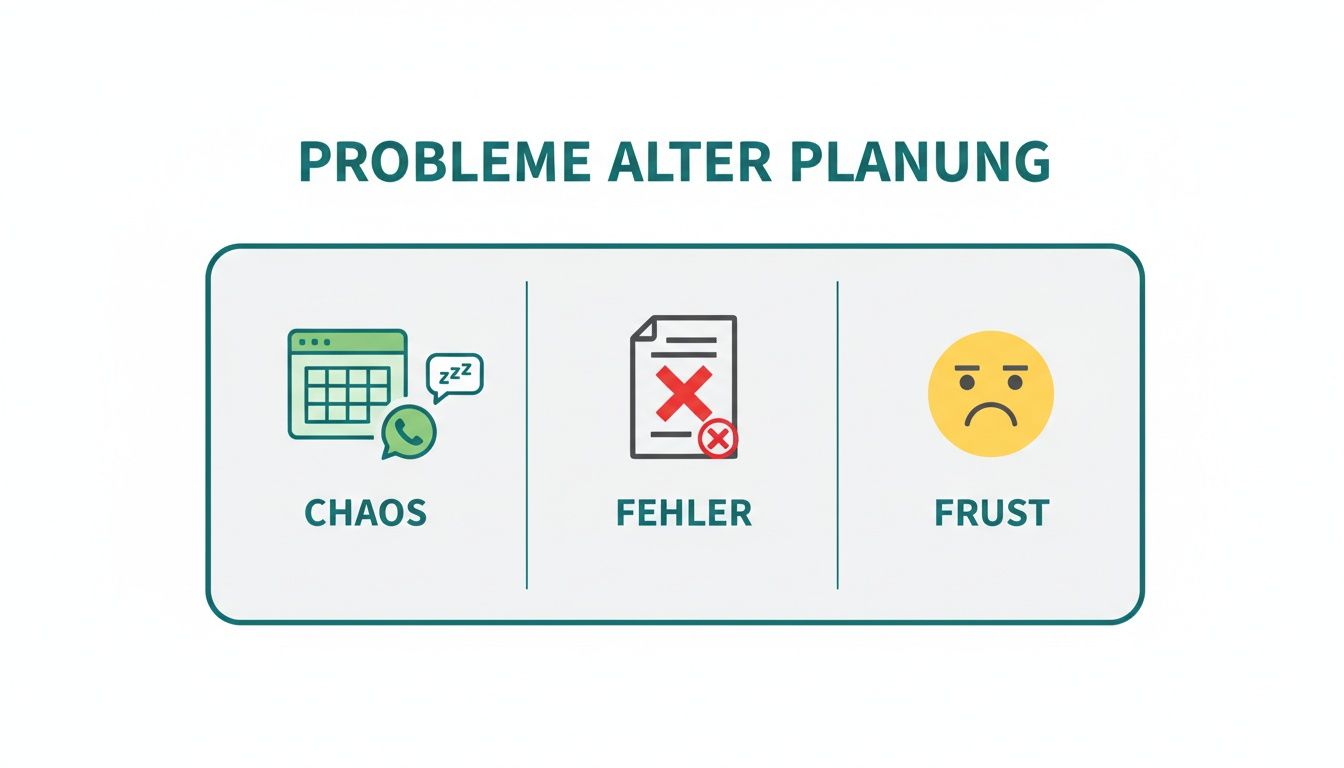
The graphic below highlights the problems with old planning methods. Manual processes inevitably lead to chaos, errors and frustration – for you and your team.
Comparison of core features: job.rocks vs. legacy software
In order to show the differences even more clearly, we compare the daily tasks in personnel planning. The table shows how job.rocks compares to traditional tools such as Excel, email and telephone in key functions.
| function | Old software (Excel, email, etc.) | job.rocks (modern platform) |
|---|---|---|
| Shift staffing | Manual calls, confusing chats, a lot of time. | Automated requests to qualified, available employees. |
| Shift swap | Verbal agreements, manual plan changes, risk of errors. | Employee-controlled process in the app with final manager approval. |
| Time tracking | Paper timesheets, error-prone manual transmission. | Mobile time clock via app, GPS validated and accurate to the second. |
| Availabilities | Orally or by message, manual maintenance in lists, often out of date. | Employees maintain their availability independently and in real time. |
| Wage preparation | Laboriously adding up hours, typing them manually into the payroll system. | Automated data export with one click, error-free and fast. |
| communication | Mixing of private and professional channels (e.g. WhatsApp). | Centralized and documented communication within the platform. |
The crucial difference lies in intelligent automation and the clever shifting of responsibility. With job.rocks you give your employees a tool with which they can control many processes independently - while you remain in full control at all times. This dramatically reduces your administrative effort.
So you see: a modern one Service is not a nice extra, but rather the engine for faster, more precise and more employee-friendly processes. This speed is a tough competitive advantage. Every click you save is time that you can invest back into your core business.
Curious? Find out more about the benefits of a modern one Operations planning software in our detailed article.
How a good user experience strengthens employee loyalty
Your employees are the heart of your business. Outdated systems, cumbersome processes and unclear communication cause daily frustration - and are often the real reason for high fluctuation. Imagine if you could give your team a tool that would actually make their lives easier. This is exactly the core of a good user experience.
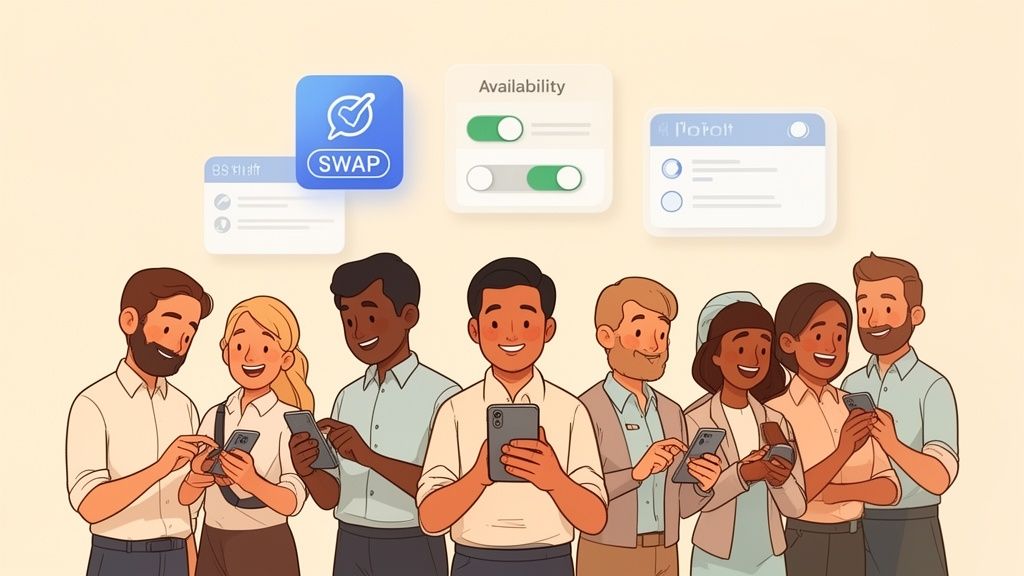
Modern platforms like job.rocks put the team at the center. Instead of overloading managers with endless phone calls and manual scheduling, employees get back control over their working hours. The key word for this is Employee Self Service (ESS).
Personal responsibility through employee self-service
ESS means quite simply: Your employees carry out administrative tasks independently using a simple app. This not only takes a lot of pressure off your managers, but also gives your team a strong feeling of autonomy and appreciation.
Specifically this means:
- Maintain availability yourself: Everyone can enter their days off or desired times directly in the app. You can immediately see who can work when without having to ask around.
- Simply swap layers: An employee wants to hand over a shift? He offers them directly in the app. A qualified colleague can take over with one click - you just have to briefly confirm the exchange.
- View working hours transparently: All hours worked are clearly recorded and can be accessed at any time. This creates trust and ends discussions regarding payroll.
Here's a practical example: Anna studies and works part-time in your café. With old software, she would have to email you her schedule every week. Using job.rocks, she enters her lecture times once as recurring absences. So she won't even be asked for shifts during this time. This avoids frustration on both sides.
Meeting the needs of Generation Z
Flexibility and a digital working environment are crucial, especially for younger employees – Generation Z. They are used to organizing their lives via their smartphone, from ordering food to banking. They simply see personnel planning using Excel lists as a relic from another time.
The job.rocks Flex Work Study 2026 clearly shows what is important to this generation: for the average 24-year-old Flexibility at 25.63% is almost as important as salary (28.80%). Whole 47.52% even consider them priceless. While many still visit classic job portals, they are already making a bet 21.05% on specialized apps like job.rocks to find flexible work. You can find out more about the expectations of young talent in Read the comprehensive recruiting statistics for Switzerland.
If you want to attract and retain the best talent, you have to offer them modern, mobile tools. An intuitive app is no longer a “nice-to-have” today, but rather a clear signal that you are a modern employer.
Communication that really binds employees
A modern platform also improves daily communication and thus strengthens loyalty to your company. Instead of important information getting lost in noisy WhatsApp groups, job.rocks provides clarity.
Just think about automatic shift reminders via push notification the day before. This little feature drastically reduces no-shows. Or the option of storing all relevant information about the shift – such as special tasks or contact persons – directly in the app. This provides security and shows your team that you take their work seriously.
In the end, it's quite simple: satisfied employees who feel heard and respected stay longer, are more committed and actively contribute to the success of your company. A good user experience is a direct investment in your most important asset: your team.
Measurable results: What really counts at the end of the day
At the end of the day, you want to know what a new solution actually brings – in numbers that you understand. Switching to a modern platform like job.rocks is not just a cosmetic fix for your processes. It's a tangible business decision that directly impacts your speed and costs.
Let’s move away from the abstract benefits and towards tangible results. It’s not just about “saving time,” it’s about how many hours per week your managers are actually freeing up for value-added tasks.
Drastically reduce administrative tasks
The biggest and immediately noticeable benefit lies in the automation of tasks that are constantly repeated. Just imagine the typical process of filling an open position at short notice. With old methods this means countless calls, emails and the manual comparison of qualifications and availability.
- The old way: You spend easy 30-60 minutes to find a single employee for a shift that has become available at short notice. If there are several outages per week, this quickly adds up to several hours that are simply gone.
- The new way with job.rocks: You create a request and the system automatically contacts all appropriate employees. The occupation often takes place in less than 10 minutes.
This means you can reduce the time it takes to fill open positions by up to Shorten by 80%. Your operations manager can use this freed up time to take care of guests, coach the team or plan new activities - instead of hanging on the phone in frustration.
Reduce costs through precise planning and clean execution
Mistakes in personnel planning are expensive. They lead to unnecessary overtime, incorrect pay slips or, in the worst case, even legal problems. A modern platform systematically minimizes these risks and gives you back control over your spending.
Accurate payroll is not a luxury, but a necessity. Every mistake not only costs money, but also the trust of your team. job.rocks ensures that every minute worked is recorded and exported correctly.
Here are three areas where you can specifically save costs:
- Avoiding expensive overtime: The system warns you if you schedule employees who would exceed their contractual working hours. This way you can act proactively and avoid expensive surcharges from the outset.
- Reduction of no-shows: Automatic shift reminders via push notifications significantly reduce the number of missed shifts. Fewer no-shows means less stress and no costly last-minute emergency solutions.
- Error-free payroll: Digital time recording via app is accurate to the second. The manual transfer of timesheets is completely eliminated, which means that errors in wage preparation are virtually eliminated. This alone can reduce your labor costs by several percentage points.
A simple example calculation shows the potential: Suppose you reduce labor costs by just 100% through more precise planning and fewer errors 5% and your manager's administrative workload by four hours per week. For a medium-sized business, these savings can add up quickly several thousand francs per year sum up.
Keep compliance and legal security under control
Compliance with regulations such as the GDPR and labor law is complex. Complete documentation is crucial, but difficult to manage with Excel lists. job.rocks documents every step automatically - from the shift confirmation to the recorded working hours.
This not only gives you security during exams, but also protects you from possible fines or legal disputes. These hidden costs are often underestimated, but can threaten your existence.
To shed more light on the financial impact, there are specific ones Key figures such as prime cost of great importance. A clean data basis from job.rocks helps you to precisely determine such important key figures and to control your operations more effectively. This way you can see in black and white how better personnel planning affects your overall costs.
How event agencies and hotels benefit in practice
Theory is one thing, but what counts is everyday life. About the difference between job.rocks and old software To make this really tangible, let's look at two scenarios that everyone in the hospitality industry is familiar with. This shows how a modern platform not only solves old problems, but also opens up completely new paths.
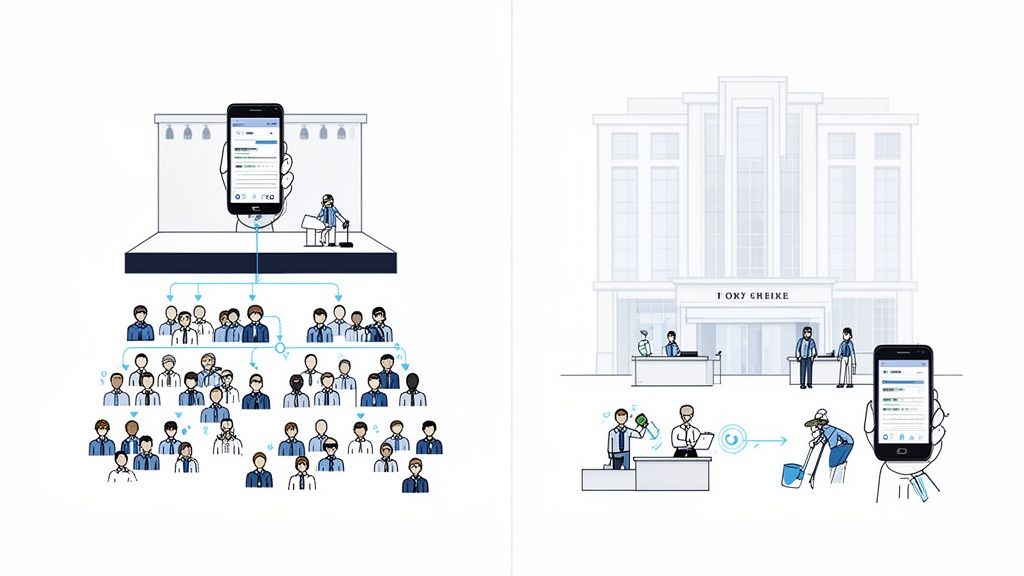
Scenario 1: The event agency’s major event
Imagine you run an events agency. Order: a company party 500 guests. The catch? It takes place in two weeks. So you need extremely short notice 50 qualified service staff.
With old systems, pure stress is now breaking out. You dig through outdated Excel lists, spend hours on the phone and lose track of countless email chains. Manual coordination takes days, and in the end there is uncertainty as to whether all commitments are really reliable.
And this is what the process looks like with job.rocks:
- Create job in minutes: You create the stake directly in the platform. You define crystal-clear requirements such as “experience in banquet service” or “fluent English”. No guessing, no misunderstandings.
- Start a targeted query: Instead of contacting everyone, the system automatically filters your pool of employees. Only those available and If you are qualified for the job, you will receive an invitation via a push message on your smartphone.
- Get quick confirmations: Your people see all the important details directly in the app and can accept or decline with a single click. The first 50 Commitments fill the open positions - all in real time, without manual follow-up.
- Automatic briefings & confirmations: As soon as the team is formed, everyone automatically receives a confirmation. At the same time, they have access to all relevant information: dress code, contact person, exact location.
What would previously have taken a whole working week can be done in just a few hours with job.rocks. You have the security that your team is a perfect fit and you gain valuable time that you can invest in the actual event planning.
Scenario 2: Dynamic shift planning in the hotel
Now let's put ourselves in the shoes of a hotel manager. The occupancy rate fluctuates weekly – depending on the season, weather and booking situation. Every week you have to flexibly put together the shifts for reception, cleaning and restaurant.
The old method of posting notices and verbal agreements is a nightmare. You juggle the availability of your permanent staff, the wishes of part-time employees and short-term temporary workers. Errors and gaps in the plan are almost inevitable.
This is how you master planning with job.rocks:
The first step is simple: All employees independently maintain their availability and absences in the mobile app. This creates a reliable and always up-to-date database for your planning.
The decisive advantage is that you no longer have to chase availability. Instead, you have a central overview that shows you in real time who you can count on and when.
You then define your personnel requirements for the coming week directly in the system. The platform automatically compares this need with the stored availability. You can immediately see where there are potential bottlenecks and can send open shifts to suitable employees from your pool.
The finished deployment plan is distributed to everyone with a click. Everyone sees their shifts directly on their cell phone and receives a timely reminder. Reliable planning can be that simple. If you would like to delve deeper into how the world of work is changing, you will find exciting insights in our article on the future of the gig economy and flexible working.
Your path to modern personnel planning – a practical checklist
The thought of changing the system often feels like a mammoth task. But switching from an outdated isolated solution to a modern platform like job.rocks is not an insurmountable obstacle. With the right preparation, the transition will go smoothly and you will get your team on board from the first moment. This checklist is your roadmap.
A successful change does not start with the software, but with your own processes. Take a moment and look closely: Where are you wasting the most time today? Which tasks are particularly error-prone? Most of the time it's the small, recurring annoyances - like manually transferring hours or the chaotic search for a replacement for an open shift.
The preparation phase
Before you get started, you need to know your goal. What exactly is the new solution supposed to do better for you and your team? Define clear, measurable goals.
- 1. Do an as-is analysis: Document your current personnel planning processes. Where is the problem? Which manual steps cost you and your managers the most time and nerves? A practical example: Stop the time it takes you to find a replacement for a missed shift.
- 2. Define requirements: Derive clear requirements from your analysis. Do you need mobile time recording, automated shift swapping or a quick export for payroll? Record what is essential and what would be nice to have.
- 3. Involve the team early: Get your employees on board. Ask them about their biggest challenges with the old tools. Their acceptance is the key to success because they are the ones who will use the new solution every day.
A typical mistake is to view the changeover as a pure IT project. In reality, it is a change process that directly affects your team. Communicate the benefits clearly: less frustration, more transparency and fairer planning for everyone.
The implementation phase
Now it's time for the concrete introduction. A step-by-step approach has proven useful here instead of changing everything at once. This way you don't overwhelm anyone and you can learn from your first experiences.
- 4. Prepare data: Collect all important employee data such as contact details, contracts and qualifications. A clean data base is the foundation for the new platform to function smoothly.
- 5. Start pilot group: Start with a small department or select team. This allows you to test the processes in practice, collect feedback and iron out teething problems before rolling out the solution throughout the entire company.
- 6. Ensure training and support: Plan a short, sweet training session for your team. Show them the most important functions that really make their everyday life easier. Make sure everyone knows who to contact if they have any questions.
These steps will take the transition from a chore to a real strategic improvement. If you want to delve deeper like this Digitalization in the human resources area If you can help your business move forward, you can find further information from us.
A software change always raises questions - here are the answers
Changing your usual software often feels like a big step. This is completely normal. So that you know exactly what to expect, we have collected the most common concerns from practice and give you short, clear answers here.
How long does it really take to introduce job.rocks?
Much shorter than most people think. Most of the time goes into properly preparing your existing employee data - and that is time well spent. As soon as this basis is in place, the actual start with a first pilot team is often already within a week feasible. Not a months-long project, but quick, noticeable progress.
Do my employees need special technical knowledge for this?
No, not at all. The job.rocks app was deliberately developed in such a way that it is virtually self-explanatory. Anyone who uses a smartphone for WhatsApp or social media will find their way around here straight away. The operation is intuitive and guides users through all functions without having to read through thick manuals.
The best software is the one your team actually enjoys using. That's why the focus of the design was on easy usability. Your team will see the benefits so quickly that they won't want to be without the app.
What happens to all of our existing data?
Don't worry, they won't get lost. Your existing employee data from Excel lists or old systems can usually be imported easily. The job.rocks team is pitching in and ensuring that all important information – from contact details to qualifications – is stored correctly in the new system from the start. This way you start with a clean and reliable database.
Is such a change even worthwhile for a small business?
This question is crucial. Think of it less as a cost and more as an investment that will quickly pay for itself. Add it all up: the time saved in administration, the avoidance of expensive overtime through better planning and the reduction of errors in payroll accounting.
A practical example: If your manager only saves two hours of administrative work per week, that's already over 4,000 CHF per year with an hourly wage of 40 CHF. The change often pays off after just a few months. The hidden costs for no-shows, short-term failures and poor planning usually far exceed the license fees.
Are you ready to finally make your personnel planning easier and better? Discover how job.rocks advances your business, makes your team happier and makes your everyday life noticeably easier. Request your personal demo now https://job.rocks.