
L-GAV notice periods explained clearly and applied safely
When it comes to notice periods, Switzerland often dances to its own tune. The Code of Obligations (OR) sets the basic rhythm, but many industries have their own score: the collective employment agreement, or GAV for short. The L-GAV notice periods are the notes written specifically for your industry...
When it comes to notice periods, Switzerland often dances to its own tune. The Code of Obligations (OR) sets the basic rhythm, but many industries have their own score: the collective employment agreement, or GAV for short. The L-GAV notice periods These are the notes that were written specifically for your profession and often take precedence.
What L-GAV notice periods really mean for you
Confused by all the abbreviations? Stell dir das Schweizer Arbeitsrecht am besten wie ein Haus vor. This is the foundation Code of Obligations (OR) – this applies to everyone, no matter where they work. That's what they're building on Collective employment agreements (GAV) on, so to speak, tailor-made floors for individual industries. A L-GAV (National Collective Labor Agreement) is a particularly stable level that applies to the whole of Switzerland.
These industry-specific contracts define notice periods that often differ from the general rules of the OR. There are good reasons for this, because every industry works differently.
An example from everyday hotel life
Imagine you run a hotel in the mountains. A long-time employee – who has been there for five years – quits. According to OR you would have a notice period of two months. But that one L-GAV for the hospitality industry maybe write three months before.
That one extra month is worth its weight in gold. It gives you the breathing space you need to calmly find a qualified successor, especially when the high season is just around the corner. At the same time, this regulation also protects the employee from losing his job too abruptly. You can find out more about the special features of this industry in our article about it L-GAV in the catering industry.
The core of GAV deadlines is simple: They create predictability and stability for both sides - for you as an employer and for your employees.
Why these differences are so important
Such adapted rules are not a product of chance. They are the result of negotiations between employers' and employees' associations and reflect the reality of an industry.
- Seasonal fluctuations: In the event or tourism business, workload is constantly up and down. Shorter deadlines for seasonal workers, which are anchored in a CLA, give you the flexibility you need for your personnel planning.
- Project security: In construction, the sudden departure of a key person can bring an entire project to a standstill. Longer deadlines ensure completion and prevent people from running away from you just before the deadline.
- Protection for employees: In other industries, longer deadlines ensure that employees have more security and, above all, more time to look for a job.
Understanding these basics is the first step to confidently applying the rules for your industry. In this way, you can avoid expensive mistakes when it comes to terminations right from the start and create clear, fair relationships in your team.
Notice periods in direct comparison: GAV vs. OR
Around the L-GAV notice periods To use them correctly in practice, you need to understand how they differ from the legal standard – the Code of Obligations (OR). The OR lays the foundation for every employment relationship in Switzerland. However, a collective employment agreement (GAV) can build on this and define its own, often stricter or simply more tailored rules. This is exactly where the crucial differences lie.
The Code of Obligations (OR) specifies the absolute minimum periods, which are staggered according to the length of employment. During the probationary period there are 7 calendar days. One month applies in the first year of service, two months from the second to the ninth year of service and three months from the tenth year of service - each at the end of the month. These deadlines are the legal minimum that must not be fallen short of.
Why are there differences at all?
The big question is: Why does a GAV differ from the OR? The answer lies in the specific requirements of an industry. A construction company needs a high level of personnel stability in order to be able to plan long-term projects safely. If key people leave suddenly, it can result in expensive delays.
A CBA in the construction industry could therefore require a notice period of three months stipulate, although the OR only requires one month here. The goal is clear: to ensure continuity on the construction site.
Things look completely different in the event industry. Short-term projects and seasonal peaks shape everyday life here. A CLA for event staff could set more flexible, shorter notice periods so that you as an employer can react more quickly to a fluctuating order situation. It's always about finding a fair balance - between the necessary flexibility for the company and the planning security for the employees.
This infographic summarizes the hierarchy of legal bases:
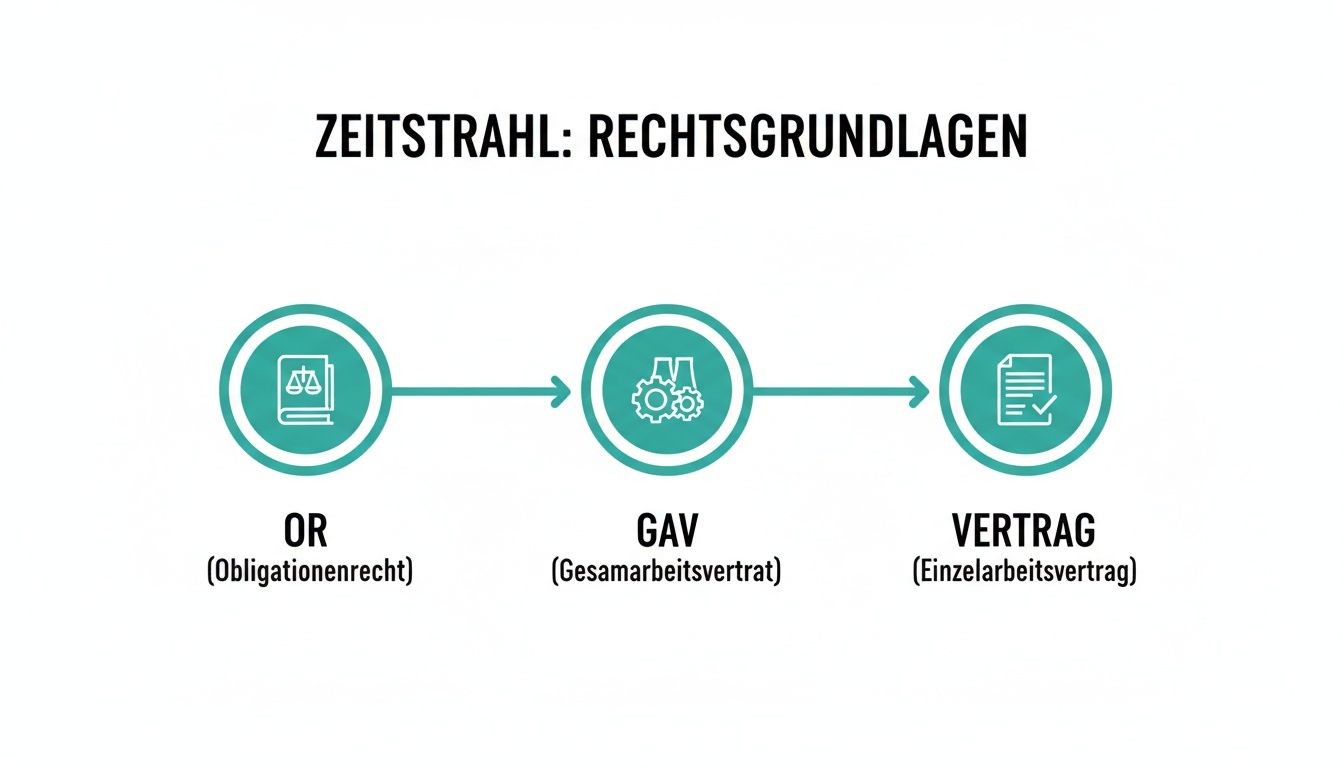
The graphic makes it clear: The GAV stands as an industry standard between the general law (OR) and the individual employment contract. And that's exactly why he often sets the really decisive rules of the game.
Overview of the notice periods L GAV vs. OR
The following table shows at a glance how the statutory minimum periods of the OR can differ from typical regulations of an L-GAV. Remember: GAV values are just examples and can vary greatly depending on the industry and contract.
| Year of service | Notice period according to OR (legal minimum) | Example notice period according to L-GAV (industry-specific) |
|---|---|---|
| Probationary period (max. 3 months) | 7 days | 7 to 30 days (depending on the GAV, the deadline can be extended) |
| 1st year of service | 1 month at the end of the month | 2 months at the end of the month (as in the hospitality industry) |
| 2nd to 9th year of service | 2 months at the end of the month | 3 months at the end of the month (as in technical professions) |
| From 10th year of service | 3 months at the end of the month | 3 to 6 months at the end of the month (often in management positions) |
This comparison makes it clear that the GAV often extends the deadlines in order to create more stability.
Important: The regulation in the GAV almost always takes precedence over the OR - as long as it is at least equivalent or better for you as an employee. A shortening of the statutory minimum periods is only possible to a very limited extent and only through a CBA.
This knowledge is pure gold for practice. When you draw up a contract, you must check whether a CLA applies to your industry. A mistake here can invalidate a termination or unintentionally extend the employment relationship. The correct handling of these deadlines is therefore a central component of legally compliant personnel management. You can find more details about this in our guide Employment contract in the L-GAV.
The most important deadlines in practice
So now it's getting concrete. Let's look at the three scenarios that occur most often in everyday work. Whether termination during the probationary period, a regular termination or even without notice - each has its own rules and deadlines. Anyone who knows this has a clear advantage and is legally on the safe side.
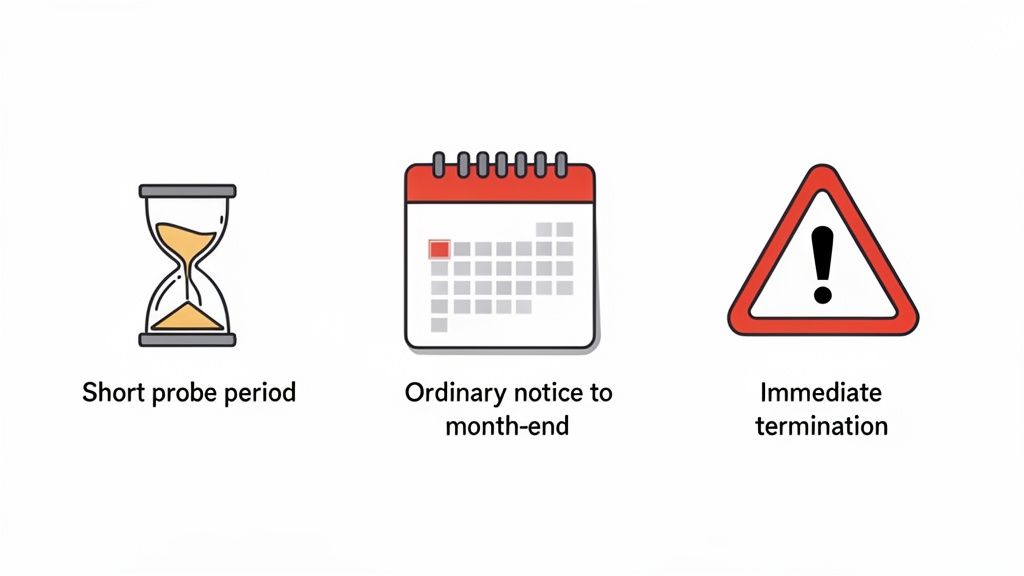
Termination during the probationary period
The probationary period is for getting to know each other. Does it fit or doesn't it fit? This is exactly why the deadlines here are kept particularly short. The Code of Obligations (OR) sets a notice period of just seven calendar days firmly.
This deadline is completely flexible and is not tied to the end of the month. It can be pronounced on any day. The decisive moment is when the other person receives the notice of termination. From then on the clock starts ticking.
An example from everyday life:
Your new service worker starts on March 1st. As early as March 10th you realize that the chemistry just isn't right. You give her the written notice of termination on the same day.
- Day of access: Tuesday March 10th
- Start of the period: Wednesday March 11th
- End of deadline: Tuesday, March 17th (exactly seven days later)
- Last working day: Tuesday March 17th
But be careful: an L-GAV can change the rules of the game. He may extend the probationary period from one to up to three months and also adjust the notice period. It is therefore mandatory to take a look at the GAV that applies to your industry.
Ordinary termination after the probationary period
Once the probationary period has been passed, the normal notice periods from the employment contract or the CBA apply. These are significantly longer and almost always end at the end of a month. One of the biggest traps lurks here: it's not the date on which you post the letter that counts, but rather the day on which the employee receives it.
A termination is a “declaration of intent that requires receipt”. This means: It only becomes legally effective when the other side has received it - be it in the mailbox or by handing it over in person.
If you miss this deadline by even a single day, there will be expensive consequences. The employment contract is automatically extended by a whole month, which not only costs money but also throws your entire personnel planning into disarray.
A calendar example for clarity:
An employee has been working for you for three years. According to the GAV, a notice period of: two months to the end of the month. You plan to terminate your employment relationship at the end of August.
- Desired termination date: August 31st
- Notice period: 2 months
- Latest day for receipt of the cancellation: June 30th
The letter of termination must be in the employee's mailbox by June 30th at the latest. If he doesn't arrive until July 1st, everything is postponed - the termination is only valid for the next possible date, i.e. September 30th.
Termination without notice as a last resort
Termination without notice is the sharpest sword in labor law. It terminates the contract with immediate effect, without any notice period. And that's exactly why the hurdles are extremely high.
You can only terminate without notice if there is an “important reason”. This means that the employee's misconduct must be so serious that it is unreasonable for you to continue the employment relationship for even one day longer until the normal deadline has expired.
What are such important reasons?
- Crimes at work: Theft, fraud or physical altercations.
- Serious refusal to work: Stubborn and unfounded ignoring of reasonable instructions.
- Treason of trade secrets: Passing on sensitive company data to competitors.
- Acceptance of bribes: Personal enrichment at the expense of the company.
One thing is clear: a single late arrival or a botched task is far from enough. In such cases, a formal warning is the only appropriate course of action.
Formal steps for termination without notice:
- Act immediately: As soon as you find out about the incident, you must react immediately. Anyone who delays for too long will lose their right to termination without notice.
- Justify in writing: Even if a verbal termination would theoretically be valid, always do it in writing. If the employee requests it, you will have to explain the reasons in detail anyway.
- Secure evidence: Document everything completely. Witness statements, emails or other evidence are worth their weight in gold if the matter ends up in court.
Termination without notice is not an instrument for everyday use. Only use it if the situation is really intolerable and you are absolutely sure about it.
Avoid common mistakes with GAV notice periods
In the hectic pace of everyday life, a small inattention in the event of termination can have major, expensive consequences. The pitfalls with them L‑GAV notice periods usually lurk in the details. If you know the typical stumbling blocks, you can effectively protect your company from legal disputes and unnecessary costs.
The classic: the incorrectly calculated deadline
One of the most common and most expensive mistakes is incorrectly calculating the termination date. Many still assume that the date of the postmark is crucial. A fatal mistake. Legally, the only thing that counts is the day on which the employee receives the letter of termination.
A practical example:
You want to give notice to a chauffeur who has been working for you for four years at the end of October, giving two months' notice. This means that the notice of termination must be given to him no later than August 31st be delivered.
You send the letter by A Mail on August 30th. But due to an unforeseen strike at the post office, it doesn't arrive until September 1st. Even if you are not at fault, the deadline has been missed. The termination will only take effect on the next possible date – i.e. November 30th. The result? You pay a full monthly wage extra even though you have long since stopped scheduling the employee.
Tip from the pro: Always send cancellations by registered mail! This is the only way to have legally secure proof of the exact delivery date and put a stop to all discussions. Also always plan a few days buffer.
Failure to comply with formal requirements
Another pitfall is ignoring the formal requirements laid down in the GAV or the law. Even if the reason for termination is crystal clear, a simple formal error can ruin everything.
- Writing: Many CBAs stipulate that termination must be made in writing. A verbal termination, given in the heat of the moment, is then legally invalid - even if there were witnesses there.
- Obligation to give reasons: Terminated employees have the right to request written reasons at any time. If you refuse this, this can have legal consequences, even if the termination itself remains valid.
Imagine, after a heated argument, you shout to an employee: “You’re fired!” If the applicable CLA requires the written form, this statement has zero legal effect. The employee remains employed and you must submit a formal, correct, written notice of termination, which then sets the deadlines in motion.
Special cases and protection against dismissal are overlooked
Certain life circumstances require employees to receive special protection. These so-called blocking periods undermine the normal ones L-GAV notice periods out of. Any termination given during such a period is simply void.
The most important blocking periods at a glance:
- Illness or accident: After the probationary period, employees are protected in the event of incapacity to work through no fault of their own. This protection is in the first year of service 30 days, from the second to the fifth year of service 90 days and from the sixth year of service 180 days.
- Pregnancy: A staff member is present throughout the entire pregnancy and in the 16 weeks protected from termination after birth.
- Military or civilian service: Termination may not be made during the period of mandatory service or four weeks before and after.
So if you terminate an employee and she tells you two days later that she is pregnant (and was already pregnant at the time of termination), your termination is invalid. You have to wait for the protection period to expire before you can cancel again. This knowledge is crucial in order to act in a legally compliant manner and avoid expensive proceedings from the outset.
Manage terminations cleverly with the right software
Notice periods, remaining vacation, final billing, handovers – the administrative effort involved in leaving can quickly become a time-waster. Anyone who relies on Excel lists and manual calendar entries runs the risk of making errors that are not only annoying but can also be expensive. This is exactly where modern technology comes into play, which takes care of the entire process L-GAV notice periods professionalized and, above all, legally secure.
A good workforce management platform is much more than just a digital address book. It works like an intelligent co-pilot that actively navigates you through the cancellation process and takes the annoying administrative burden off your shoulders. This leaves you more time for what really counts: a clean handover and finding the right replacement.

Automated processes for more security
Imagine you enter the GAV deadlines that apply to your company once in the system. If you receive a notice of termination, you no longer have to tediously browse through the contract or the CLA. The software knows what to do.
- Automatic deadline calculation: The system immediately determines the correct exit date based on the termination date and the rules stored. No more mental arithmetic and calendar scrolling.
- Proactive reminders: You will automatically be reminded of important deadlines, be it for the creation of the employment reference or the final payslip. Nothing will be forgotten anymore.
- Digital personnel file: All relevant documents – from the letter of termination to the confirmation of receipt to the handover protocol – are stored centrally and in an audit-proof manner in one place.
This automated approach minimizes the risk of human error, which is almost inevitable when calculating manually or using paperwork. The result is a high level of compliance and the certainty of being legally on the safe side.
Data-based final billing at the push of a button
The final settlement is often a puzzle made up of different pieces. How many overtime hours are still open? How high is the remaining vacation entitlement? An integrated software solution gives you the answers at the touch of a button.
A clean, transparent final invoice is not only a legal obligation, but also an act of appreciation. It leaves the departing employee with a professional final impression and prevents later, unpleasant discussions.
Thanks to seamless digital time recording, all working hours, breaks and absences are precisely documented. The system calculates the balance of overtime and holiday credit fully automatically and provides a precise basis for payroll accounting. The tedious task of collecting data from different lists is now a thing of the past. If you would like to learn more about how such a solution works, you can find more information about ours here Temporary employment management software.
Close gaps in the personnel plan immediately
Every termination creates a gap in the team structure and the operational plan. Smart software not only supports you in the clean processing, but also helps to fill this gap quickly and efficiently.
With just a few clicks you can check the availability of other employees, part-time workers or proven freelancers from your pool on the platform. You can send inquiries directly to qualified people and fill the open position - often before the outgoing employee has even left the company. In this way, you ensure continuity in operations and keep productivity high without interruption.
Termination is never easy – neither for the employee nor for you. But with a clear timetable you can ensure that everything is fair, professional and, above all, legally compliant. A well-thought-out approach not only saves you time and stress, but also prevents expensive mistakes and unnecessary discussions.
This checklist will guide you step by step through the entire process so that you don't forget anything important.
Phase 1: Preparation – laying the foundation
Before you even write the letter of termination, the basics have to be right. Proper preparation is half the battle and prevents the termination from failing due to a formal error.
- Check contractual basics: Which L-GAV and which individual employment contract exactly apply here? Write down the exact notice periods and dates, which are set out in black and white.
- Calculate years of service correctly: Count the employee’s full years of service. This is crucial because the deadlines are often staggered accordingly. Any mistake here can make the termination voidable.
- Exclude blocking periods: Is the employee perhaps pregnant, sick, had an accident or is in military service? A termination that is given during such a blocking period is simply void.
- Prepare the conversation: Schedule a personal meeting to hand over the notice of termination. This shows respect, creates clarity and is the professional way.
Phase 2: Letter of termination – clear and unambiguous
The termination letter is the official document. Precision is required here, because any formal error can, in the worst case, invalidate the termination.
A letter of termination must be a crystal clear announcement. Any vague wording opens the door to interpretation and can get you into legal trouble later.
To make your work easier, we have prepared a sample template. Download our customizable one here Resignation letter template Download and customize it for your business.
What really matters in writing:
- Full addresses: Your company and the employee must be clearly identifiable.
- Clear subject: Call the child by its name: “Termination of employment.”
- Exact termination date: Indicate the exact date on which the employment relationship ends.
- Rules for remaining vacation: Mention how the remaining vacation entitlement will be handled (receipt or payment).
- Offer for a job reference: Point out that a certificate will be issued.
- Valid signature: The letter must be signed by an authorized signatory.
Delivery – the last critical step
This is always the safest personal delivery against a confirmation of receipt or that Shipping by registered mail. This is the only way to have complete proof of when the employee actually received the notice of termination. This is crucial for calculating the deadline.
Phase 3: The settlement – a clean conclusion
The work is not done once you have given notice of termination. Now the processing phase begins. Here too, care is crucial in order to end the collaboration professionally.
- Create final invoice: Calculate your final wages exactly - including all overtime, holiday credits and the pro-rata 13th month's wages.
- Write a job reference: Issue a fair, benevolent and complete employment reference. This is not only a duty, but also your business card as an employer.
- Organize handover: Plan to return keys, laptops, and other work supplies. Also ensure that knowledge is passed on cleanly to the successor.
- Complete exit formalities: Deregister the employee correctly from social insurance (AHV, pension fund, etc.).
So that you can keep an overview, we have summarized the most important points in a table.
Checklist for the cancellation process
A step-by-step guide to ensure that all aspects of an L-GAV termination are handled correctly.
| Step | Task | Completed |
|---|---|---|
| 1. Preparation | L-GAV and contract checked, deadlines noted | ☐ |
| Years of service correctly determined | ☐ | |
| Blocking periods (illness, accident, etc.) excluded | ☐ | |
| Personal interview planned | ☐ | |
| 2. Letter of termination | Template used and adapted | ☐ |
| All mandatory information (addresses, appointments, etc.) included | ☐ | |
| Signed by an authorized signatory | ☐ | |
| 3. Delivery | Delivery method (personal/registered mail) selected | ☐ |
| Proof of delivery securely archived | ☐ | |
| 4. Processing | Final statement (salary, holidays, 13th) prepared | ☐ |
| Work reference written and handed over | ☐ | |
| Handover of material and knowledge organized | ☐ | |
| Deregistered from social insurance | ☐ |
This list will help you master the process in a structured and legally secure manner.
Even if you do everything to the best of your ability, discrepancies can arise. In the event that legal disputes do arise, this is a good one Legal protection sensible insurance that has your back.
Notice periods in the L-GAV: The most frequently asked questions from practice
Finally, we clarify the questions that arise in our everyday lives L-GAV notice periods keep crossing paths. Here are the answers – short, sweet and straight from practice.
Can I shorten a GAV notice period in the employment contract?
A clear no. The deadlines in a collective employment agreement are the absolute minimum. Think of it like a safety net. You can strengthen this network at any time in the individual employment contract, i.e. extend the deadlines, but never create holes by shortening them to the detriment of your employees.
Shortening would only be an option if the GAV expressly allowed it - and in reality that almost never happens.
What happens if I give notice of termination during illness?
Quite simply: a termination that you give during a restricted period such as illness or accident is void. Legally speaking, it is as if it never existed. You must wait until the protection period is over and only then send the notice of termination again, completely formally and correctly.
Blocking periods are not a trivial offense. They provide massive protection for employees. If you ignore them, you not only risk legal trouble, but you also inadvertently prolong the employment relationship.
Is the 13th month's salary included in the termination?
Yes, absolutely. The 13th month's salary is not a bonus, but a fixed salary component. If an employee resigns or is resigned, he or she is entitled to his or her 13th monthly salary (pro rata temporis) until the last working day.
A quick example:
An employee is leaving your company at the end of June. So it suits him exactly 6/12 – half – of his full 13th month’s salary. You pay this amount out as normal with your last payslip.
Do I always have to give reasons for termination?
Not immediately. Freedom of termination applies in Switzerland, which means that you can initially give notice of termination without giving reasons.
But be careful: the employee can request a written explanation at any time. And then you're in the Dutyto put the cards on the table. If you refuse, it can quickly be interpreted as abusive. My tip: An honest, comprehensible justification is always the cleanest and best way.
Is cancellation by email or WhatsApp valid?
You should be extremely careful here. A termination is only valid if it is in the correct form. If the L-GAV Writtenness prescribes - and he does - then an email or a WhatsApp message is not enough. The handwritten signature is missing.
Play it safe: Always give the notice of termination in writing on paper. Either hand it over in person with a confirmation of receipt or send it by registered mail. This way you have clean proof and avoid expensive formal errors.
Having cancellations, availability and the entire operational planning under control doesn't have to be a headache. job.rocks gives you the right tools to digitize your HR processes and make them legally compliant. Discover now https://job.rocksHow you can minimize administrative effort and have more time for your core business.