
Your L-GAV staff leasing guide for Switzerland 2026
Imagine you're organizing a big festival and you need it very quickly 50 People for construction and catering. This is exactly where it comes from L-GAV Personnel leasing into the game - it is your set of rules that ensu…
Imagine you're organizing a big festival and you need it very quickly 50 People for construction and catering. This is exactly where it comes from L-GAV Personnel leasing into the game - it is your set of rules that ensures that this flexible deployment is fair for everyone. This guide will show you step by step how to apply the collective employment agreement (GAV) correctly and always be on the safe side legally.
What the L-GAV personnel leasing means for you
See the L-GAV personnel leasing as the foundation of the entire temporary employment industry in Switzerland. It creates clear rules of the game and protects both you as a lender and your temporary employees. Without this set of rules, there would be wild growth in wages and working conditions, which would make fair competition practically impossible.
This contract is crucial for you as an agency, event service provider or catering company for several reasons:
- It creates a level playing field: All lenders must adhere to the same minimum standards. This prevents competitors from undercutting you with low wages.
- It offers legal certainty: If you stick to the guidelines, you will be protected from expensive additional charges and fines. You know exactly what wages, benefits and social benefits you have to pay.
- It increases your attractiveness as an employer: Temporary employees know that you will treat them fairly. This helps you find and retain qualified and motivated people for your personnel pool.
Who is subject to L-GAV?
It's quite simple: In principle, all staff leasing companies in Switzerland are subject to L-GAV as soon as they need a permit for staff leasing. It applies to all temporary employees that you loan out to companies - regardless of the industry or for how long.
Take the example of an event agency: You rent out hostesses, technicians and logisticians to a customer for three days for a product launch. Every single one of these people falls under L-GAV. You must pay the correct minimum wage for each person, record working hours accurately and account for social benefits correctly.
The L-GAV is not just a legal obligation, but a quality feature. It shows that you work professionally and take responsibility for your employees.
Incidentally, the GAV personnel leasing is the largest collective employment contract in Switzerland and covers over 400,000 employees away. His graduation in the year 2012 was a milestone because it guaranteed secure wages and working conditions for temporary staff throughout Switzerland for the first time.
By 2024 The contract was extended and wages increased, which makes it even more relevant for industries such as event services, hospitality and logistics. If you want to delve deeper into the background, you can find out more about it at swissstaffing.
Compliance with L-GAV is therefore not an obstacle. It is the basis for a sustainable and fair business model in personnel leasing. This guide gives you the knowledge you need to safely implement all regulations in your everyday life.
The central provisions of the L‑GAV are clearly explained
After we have clarified what the L-GAV means for your business, we now get down to the nitty-gritty: the specific rules. Think of these regulations as your navigation system that will guide you safely through operational planning and payroll. We break down the most important points so that you know exactly what is important in practice.
Correct wage determination, flexible deployment and clean documentation are the three pillars of an L‑GAV‑compliant practice. The following process will give you the overview.
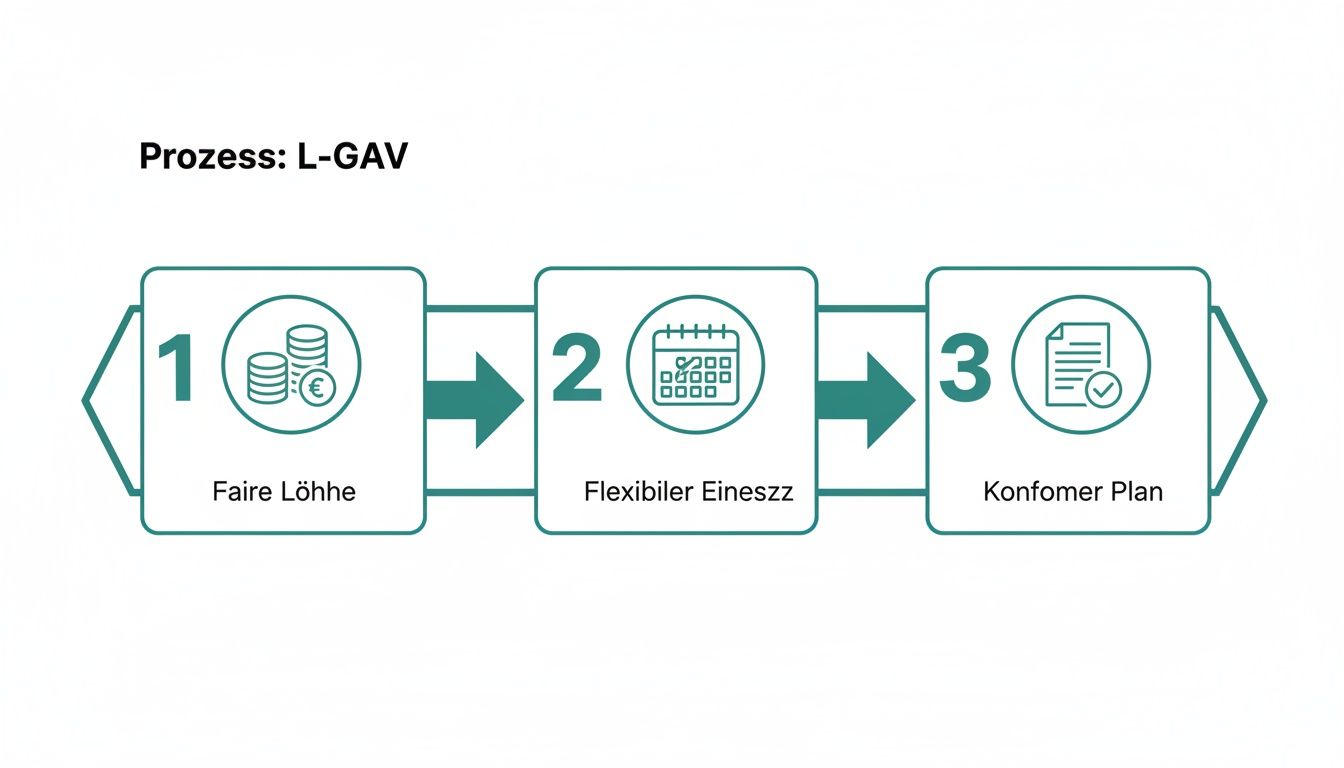
Each of these steps is crucial to avoiding legal pitfalls and dealing fairly with your temporary employees.
Minimum wages by qualification and region
At the heart of the L‑GAV are the mandatory minimum wages. They are the most important instrument for guaranteeing fair wages for temporary workers and preventing wage dumping. The crux of the matter is that the wages are not a flat rate, but depend on two crucial factors: qualification of the employee and the region of the place of use.
The L‑GAV grades wages according to three clear qualification levels:
- Learned: People with a federal certificate of proficiency (EFZ) or equivalent training.
- Trained: People with at least two years of professional experience in the relevant role but without a formal qualification.
- Unskilled: People without specific professional experience or training for the job.
This classification is decisive for the match. Imagine hiring out a chef. If he has EFZ training, he is considered “trained”. However, if he has been working as a kitchen assistant for three years without a qualification, he falls into the “semi-skilled” category.
Since its introduction on January 1, 2012, the GAV personnel leasing has massively professionalized the industry. Today it is the largest GAV in Switzerland and protects up to 400,000 Employee. A concrete wage example: In 2024, the minimum wage for skilled employees in a high-wage area (such as Zurich or Geneva) was 26.73 CHF per hour while in Ticino 23.27 CHF fraud. These rates are regularly renegotiated and tend to increase.
Working times, breaks and rest periods
Flexibility is the currency in personnel leasing, but it has clear limits. The L‑GAV sets the framework for how long your employees are allowed to work and which recovery times are mandatory.
- Maximum weekly working hours: Basically, the upper limit is 45 hours. An extension to 50 hours is possible, but requires precise planning and compensation.
- Breaks: From 5.5 hours of work 15 minutes Break is mandatory. If it's more than 7 hours 30 minutes, and if over 9 hours, a whole hour.
- Daily rest time: Between two work assignments there must always be at least 11 hours uninterrupted rest period.
A classic practical example: You plan an employee to set up and dismantle an event. Setup takes from 8:00 a.m. to 5:00 p.m. (including lunch break). Dismantling is scheduled to start that same evening at 11:00 p.m. This is not permitted because the 11-hour rest period is clearly exceeded. You must definitely plan a second person for dismantling.
Wage supplements and social benefits
Correct payroll doesn’t stop at the basic wage. The L‑GAV prescribes clearly defined surcharges for extraordinary working hours, which are often overlooked.
Important: Correct billing of surcharges is one of the most common stumbling blocks in practice. Complete and precise time recording is the absolute basic requirement for this.
The most important surcharges at a glance:
- Overtime: 25% Surcharge from the 46th hour of work per week.
- Night work: 25% Surcharge for work performed between 11 p.m. and 6 a.m.
- Sunday work: 50% Surcharge for operations on Sundays.
Let's take our trained chef in a high-wage area again. He works at a catering event on Saturday from 4:00 p.m. to 1:00 a.m. For the two hours from 11:00 p.m. to 1:00 a.m. he has to pay a night supplement of CHF 26.73 in addition to his basic wage 25% receive.
As a lender, you are also responsible for the full billing Social benefits responsible. This includes registration and contribution payment for AHV/IV/EO, unemployment insurance (ALV), accident insurance (UVG), occupational pension provision (BVG) and daily sickness benefit insurance. You can find everything you need to know about the contract itself in our detailed article L-GAV Employment contract.
Your duties as a lender: This is how you master everyday administrative work
Knowing the rules of the L‑GAV personnel leasing is one thing. Implementing it seamlessly in the hectic everyday life of a rental company is a completely different matter. So let’s take a look at what this specifically means for your administrative processes and how you can ensure that you are on the safe side with every check.

Imagine you run a security service and provide staff for major events. You must be able to provide absolutely watertight documentation for each individual employee and each operation. If this does not succeed, an inspection could result in severe fines and expensive additional demands.
Reporting and proof requirements in detail
Your central task is to be able to prove compliance with L-GAV at any time. This process begins long before the first payroll and does not tolerate verbal agreements.
- The written framework agreement: The basis for everything. Before even a single assignment takes place, you need a written framework agreement with your temporary employee. It regulates the fundamental conditions of cooperation.
- The written confirmation of use: A separate, written confirmation is required for each individual use. The most important key data must be recorded there: location, duration, function and of course the agreed salary.
Remember: Verbal promises are worthless and legally untenable within the scope of the L‑GAV. The written form is your only insurance. Without clean papers you will lose an exam from the start.
Correct time recording and contribution accounting
Accurate time recording is the heart of your L-GAV compliance. Not only does it form the basis for the correct payroll including all surcharges, but it is also your most important proof during checks.
The complete recording of every single hour of work is much more than just a annoying chore - it actively protects you from miscalculations and unjustified claims. Whether you use digital time clocks, mobile apps or classic timesheets is up to you. The only important thing is that the data is recorded reliably and in a tamper-proof manner. You can read more about this in our guide Working time recording according to L‑GAV.
Correct billing and forwarding of contributions to the training fund is just as important (temptraining) and the Contribution to enforcement costs. These solidarity contributions finance the further training of temporary workers and the controls themselves. The exact percentages are set out in Section GAV and must be shown transparently on every payslip.
This is how an inspection by the Joint Commission works
Compliance with the L‑GAV is strictly and regularly monitored by the Joint Commission (PK) for Personnel Leasing. The inspection density is high - so you should expect an inspection at any time.
Alone in the year 2024 were in Switzerland 39,244 employment relationships checked for GAV conformity in personnel leasing. This number alone shows how seriously the controls should be taken. Added to this 1,182 re-examinations based on spot checks or complaints, which underlines the high level of activity of the law enforcement agencies. You can see the detailed results in current annual report of the joint implementation read up.
An inspection usually follows a clear pattern:
- Announcement: Everything starts with a written announcement. This will give you a deadline to submit the required documents.
- Submission: Now it's your turn. You provide the commission with all relevant documents for a specific review period - these include employment contracts, pay slips, timesheets and receipts for paid social benefits.
- Test: Experts take a close look at your documents and check them for completeness and correctness.
- Result: Finally you will receive a report. If there are no defects, the process is over. In the event of violations, corrective measures and, if necessary, a fine will be ordered.
Good preparation is half the battle here. If your administration is clean and complete from the start, control becomes a mere formality. The following checklist will help you put your processes to the test.
Checklist for your L‑GAV compliance
- Is there a valid, written framework contract for each employee?
- Is a written confirmation created for each individual deployment?
- Is time recording seamless and understandable for all employees?
- Are all wage supplements (night, Sunday, overtime) calculated and shown correctly?
- Are the contributions for further training (temptraining) and enforcement billed and paid correctly?
- Are all social security contributions declared correctly and paid on time?
Common mistakes with the L-GAV and how to avoid them
The best way to learn is from other people's mistakes. This is particularly true for L-GAV personnel leasing, because there are a few classic pitfalls that can cost you dearly - from hefty additional payments to legal consequences and lasting damage to your image.
See this section as your personal radar: I'll show you the typical mishaps in practice and how you can avoid them from the start. Because most of these mistakes are completely avoidable once you are aware of them.
Mistake 1: The incorrect classification of employees
One of the most costly mistakes of all: misclassifying your people. It may sound tempting to classify someone as “unskilled” in order to reduce wage costs on paper. But this shot almost always backfires.
Imagine that you run a promotion agency and declare several student assistants as “unskilled” for a roadshow. What you don't notice: Some of them have already worked at various similar events. According to L-GAV, they are already considered “semi-skilled” if they have two years of relevant professional experience. If this is discovered during an inspection, the difference in wages will be demanded for the entire period of employment - per employee. That adds up quickly.
Important to know: The qualification does not solely depend on the formal qualification (EFZ). Demonstrable professional experience in the specific function also counts. An honest and precise examination when hiring will save you from unpleasant and expensive surprises later.
How to avoid this mistake:
- Document your experience clearly: When hiring, ask specifically about relevant previous experience and have this documented. Employment references or confirmations of employment are worth their weight in gold here.
- Define clear profiles: Create precise requirement profiles for your typical functions. This makes the classification as “unskilled”, “semi-skilled” or “skilled” child’s play.
- If in doubt for the employee: If you are unsure, it is always safer to put someone in the higher salary category. The costs for back payments, fines and administrative work are almost always higher than the original wage difference.
Error 2: Incorrect calculation of vacation and public holiday compensation
A real perennial issue are errors in flat-rate compensation for vacations and public holidays. These surcharges must be shown separately and correctly on each individual payslip. An “all-in wage” is not permitted.
A typical oversight is to apply the percentage on an incorrect basis (e.g. only to the basic wage without shift bonuses) or to simply forget about holiday compensation.
Both compensations are mandatory:
- Holiday compensation: 8.33% (for 4 weeks holiday entitlement) or 10.60% (for 5 weeks) on the gross wage.
- Holiday compensation: The rate varies depending on the canton because the number of paid holidays varies.
If you forget these items or calculate them incorrectly, a time bomb is ticking. Across all employees and assignments, a considerable sum quickly accumulates and is due in one fell swoop during an audit.
Mistake 3: Disregarding work and rest times
In hectic everyday life, especially with short-term assignments, working and rest times can quickly become overlooked. An employee works longer because there is a need. An employee jumps back in the next morning without having observed the prescribed rest period. Sound familiar?
A classic from the event industry: A technician dismantles a stage late into the night and is supposed to be ready to set it up at the next location at 7 a.m. the next morning. This clearly violates the statutory rest period 11 hours. Such violations are immediately apparent when checking the timesheets.
This is how you keep track:
- Use digital helpers: Good workforce management software will automatically warn you if you try to schedule an employee in violation of rest time. It's like a built-in safety net for your dispatchers.
- Raise awareness among your team: Regularly train the people who are responsible for operational planning on the provisions of L-GAV. The knowledge must be present in day-to-day business.
- Plan buffers: Especially in the case of unpredictable events, it is smarter to plan one more employee as a backup instead of pushing the legal limits of your regular crew until the last minute. This not only saves your nerves, but also your compliance account.
How to automate your L-GAV processes with job.rocks
You now know the rules of the L-GAV personnel leasing and the most common pitfalls. That's a solid foundation. But let’s be honest: Manually juggling all of these regulations in your day-to-day business can quickly become a full-time job. This is exactly where automation comes in to keep your back free.
Imagine your administrative processes running like Swiss clockwork – precise, reliable and without unnecessary effort. A modern workforce management platform like job.rocks was developed precisely for this purpose. It helps you to ensure the L-GAV requirements without getting lost in paperwork.
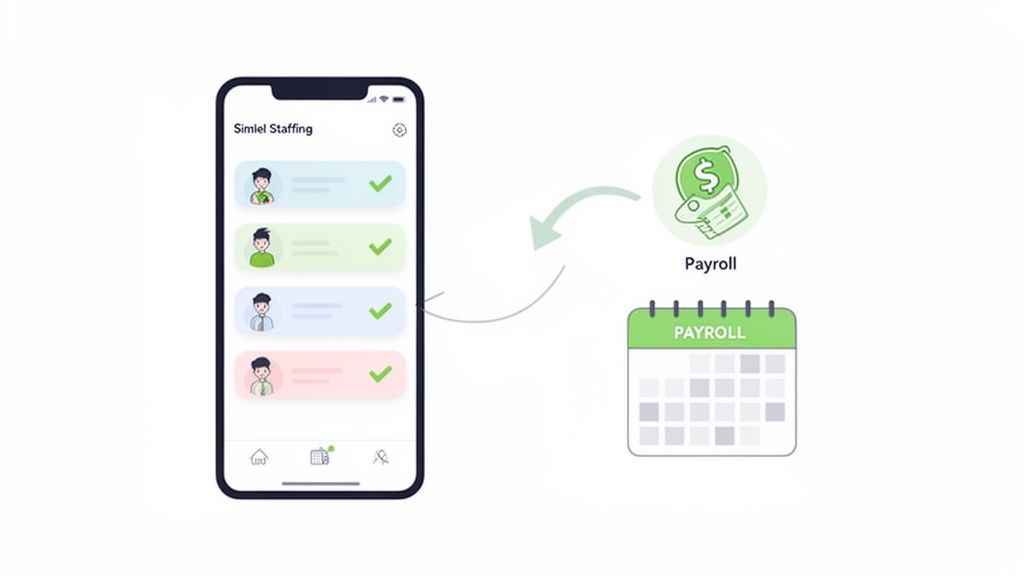
The picture shows it perfectly: A central platform brings all the threads together. Employee profiles, deployment planning and payroll preparation are digitally linked, which drastically reduces sources of error and speeds up the entire process enormously.
Automatically assign correct pay levels
One of the greatest levers for avoiding errors is the correct classification of your employees. With software like job.rocks it's not rocket science. You store the qualification levels and professional experience once in the digital profile of each employee.
If you plan a new assignment, the system automatically accesses this data. It ensures that the person is immediately linked to the correct minimum wage depending on their qualifications – whether unskilled, semi-skilled or skilled.
Your advantage: You don't have to manually check for every single booking whether the wage is correct. The system takes control and automatically applies the correct wage rates that comply with L-GAV. This gives you security and prevents expensive additional claims.
A practical example: A hotel requests service staff with EFZ for a banquet at short notice. In job.rocks you simply filter for available employees with the qualification “learned/service”. The system only suggests suitable candidates who already have the correct salary profile - that's it.
Time tracking and surcharges without headaches
The complete documentation of working hours is one of the core obligations of L-GAV. A mobile time tracking app makes this process a breeze.
Your employees clock in and out of their working hours directly on site on their smartphone. This data flows into the system immediately and in a tamper-proof manner - without any manual transmission.
- Precise detection: Start, end and breaks are documented down to the minute.
- Automatic surcharges: The system automatically recognizes whether it is night work or Sunday work. The corresponding surcharges from 25% or 50% are prepared directly for payroll.
- Transparency for everyone: Both you and your employees have access to the recorded hours at any time. This means that discrepancies can be resolved immediately, not just at the end of the month.
This automated process not only saves valuable time in administration. It also creates watertight documentation that can withstand any inspection by the Joint Commission. You can export all relevant data with just a few clicks.
The use of a specialized Software for temporary offices helps you optimize your business processes and finally concentrate on your core business again.
GDPR compliance and secure data storage
In addition to the L-GAV, data protection is also a central issue that no lender can ignore. After all, you process highly sensitive personal data of your employees, from contract details to salary information.
A professional platform like job.rocks ensures that all data is stored and processed in accordance with GDPR. Communication with your employees takes place via a secure app, instead of via insecure channels such as WhatsApp. This not only protects your privacy, but also professionalizes your entire external image. By digitizing such processes, you minimize risks and show that you take data protection seriously.
The most frequently asked questions about L-GAV personnel leasing in practice
In the hectic everyday life of staff leasing, the same questions about L-GAV arise again and again. Here we give you clear and practical answers so that you can quickly get back on the safe side and avoid expensive mistakes.
Does L-GAV also apply to extremely short assignments?
Yes, without restrictions. As soon as you hire out an employee within the framework of the Employment Act (AVG), Section L-GAV applies - regardless of whether the assignment lasts just one day or a few hours. There is no minimum bet duration.
Imagine hiring someone for a four-hour event assignment. Even for this short period, you have to pay the correct minimum wage, account for the pro-rata vacation and public holiday compensation and pay all social benefits correctly. Complete, mobile time recording is worth its weight in gold here in order to be able to precisely document and provide evidence of such short assignments.
What if the GAV of the operating company stipulates better conditions?
It's simple: Then you have to apply the better conditions. The L-GAV personnel leasing is to be understood as a minimum standard, a kind of safety net for temporary workers.
If the industry-specific GAV of the employing company - for example in the construction industry or in the hospitality industry - provides for higher wages, more vacation days or shorter working hours, the regulation that is more advantageous for them always applies to your employee. As a rental company, you are therefore obliged to check before each use whether a different GAV applies and offers better conditions.
This is where it works Principle of favorability: The better of the two regulations always applies to the employee. This is a key point that is often overlooked in practice and can lead to significant additional payments.
Do I also have to pay further training contributions for occasional employees?
Yes, the obligation to contribute to the further training fund «temptraining» applies to all temporary workers without exception who are subject to L-GAV. It doesn't matter whether someone works for you full time or only sporadically.
The contribution is calculated as a percentage of the salary subject to AHV. These funds flow directly into the further training of your temporary employees, thereby increasing their qualifications and possible applications. The correct payment is an important part of your compliance obligations and is carefully checked during inspections by the Joint Commission. Automating this billing is a great way to improve your Optimize business processes and minimize sources of error.
Would you like to simplify your L-GAV processes and make them legally compliant? job.rocks automates your scheduling, time recording and payroll. Find out more on https://job.rocks.