
Shift planning for flexible employees: create legally compliant rosters
Thoughtful shift planning for flexible employees is the difference between organised success and administrative chaos. Learn how to plan fairly, transparently and legally.
A well thought out one Shift planning for flexible employees is often the fine line between organized success and administrative chaos. A cleverly drawn up plan not only reduces your own effort, but also noticeably increases the satisfaction and reliability of your team.
Why smart shift planning makes the difference
Imagine this: You are juggling a pool of part-time workers, temporary workers or students. The classic paperwork or endless WhatsApp groups almost always lead to frustration, misunderstandings and, in the end, unfilled shifts. This is exactly where a structured approach comes into play and becomes the foundation for smooth operations.
A really good plan is so much more than just filling gaps in the calendar. It's about creating a system that is fair, transparent and comprehensible for everyone. As soon as your people have the feeling that their wishes are taken seriously and shifts are distributed fairly, their motivation increases enormously.
The benefits go far beyond just organization
A smart system for shift planning brings tangible advantages that are directly reflected in your business figures:
- Less administrative work: You spend significantly less time checking availability or maintaining manual lists.
- Higher employee satisfaction: If employees can better balance their working hours with their private lives, they will be happier, more committed and will stay loyal to you for longer.
- Lower failure rates: Transparent and early communicated plans massively reduce short-term cancellations and no-shows. A catering business was able to reduce its no-show rate for temporary workers by a whopping amount Reduce 40% , when he switched from pieces of paper to a digital system.
- Better coverage during bottlenecks: You react much faster to unexpected failures because you immediately have an overview of who is available and qualified.
A plan that takes into account the needs of your flexible employees is not a cost factor - it is an investment in the stability and quality of your service.
The world of work is changing, and flexible models are no longer a niche. In Switzerland in particular, the number of employees with flexible working time models has increased significantly in recent years. According to a survey by the Federal Statistical Office, 2023 had already 47.7 percent of employees flexible working hours. You can find out more about this at current working time models in Switzerland .
This trend makes it essential to adapt your own planning to this new reality. A rigid shift schedule simply no longer fits many people's living conditions. With the right strategy, you can create a real win-win situation: your business runs smoothly and your employees appreciate the flexibility they have gained. In the following sections I will show you how to set up such a system step by step.
Query availability efficiently and assign shifts
The heart of every flexible personnel planning is the quick and smooth query of availability. Without a clean process, you immediately sink into a chaos of emails, calls and WhatsApp messages. The goal must be to make this process so lean and clear that it is crystal clear for you and your employees.
The right method depends largely on your team size. A simple Excel spreadsheet may somehow still work for a small team with five temporary workers. At 50 employees and different qualifications, you immediately reach the limits of what is possible. Modern approaches therefore consistently rely on self-management: employees independently enter their available times into a system. This saves you an incredible amount of time and stress.
Find the right path for your team
There are countless tools for querying availability - from simple, free solutions to specialized software for deployment planning.
- Shared online calendars or tables: Tools like Google Calendar or Sheets are an easy starting point. You create a document in which employees enter their preferred times or unavailability. Simple, but also prone to errors.
- Online forms:Using services like Google Forms or Typeform, you can quickly create surveys to query availability for a specific period of time. At least the answers end up clearly arranged in a table.
- Specialized employee apps: This is where things get professional. Real planning software offers its own apps in which employees can maintain their availability, view open shifts and apply directly. This is the gold standard.
No matter which method you choose: always bet clear deadlines by when availability must be reported. And what happens if someone doesn't respond? Determine this in advance too. A simple rule could be: Anyone who does not provide information by the deadline will not initially be considered for the coming planning period. That creates commitment.
The following infographic shows the path from everyday chaos to structured and ultimately successful planning.
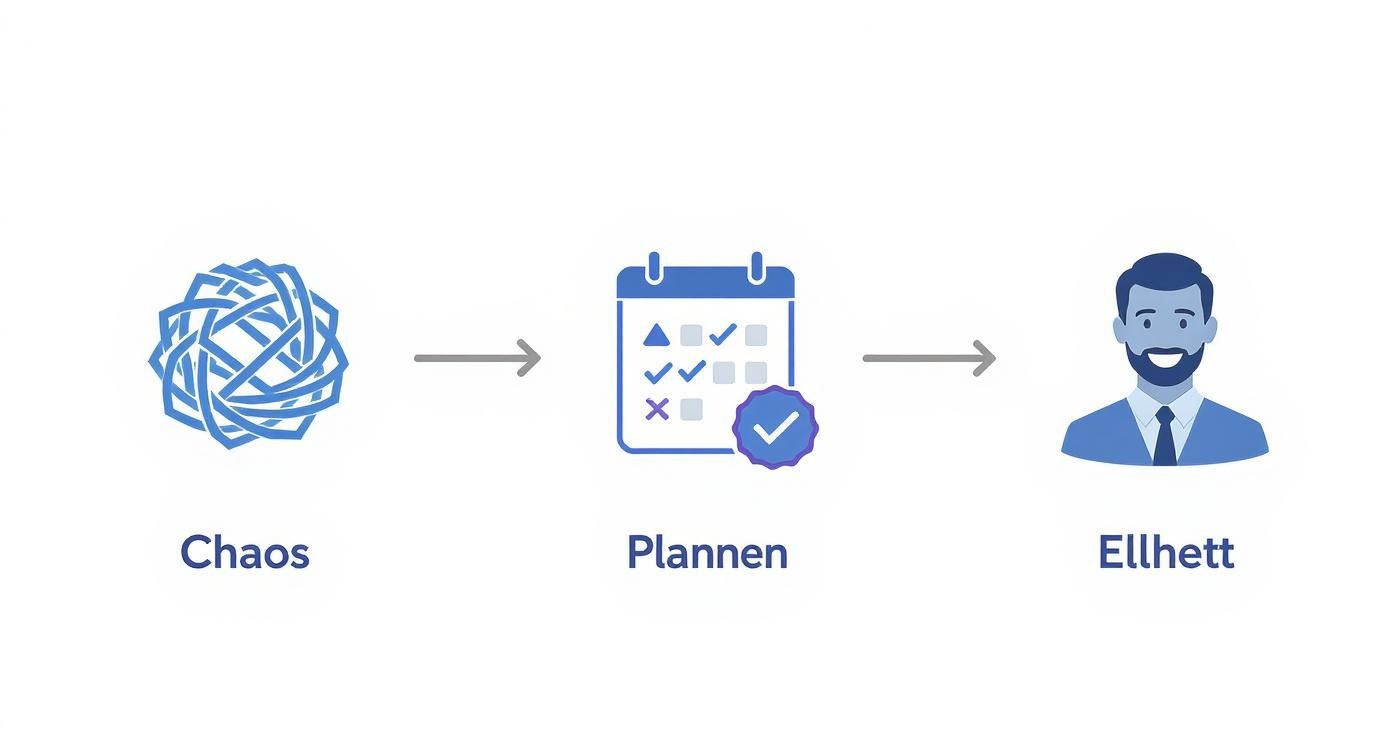
The illustration makes one thing clear: the key to success lies in an organized planning process that transforms the initial chaos into satisfied employees and a smooth process.
Methods for querying availability in comparison
In order to make the right choice, a direct comparison of the most common tools helps. Here you can see at a glance which method is best suited to your situation, rated according to effort, costs and clarity.
| Method | Advantages | Disadvantages | Ideal for |
|---|---|---|---|
| WhatsApp/Email | Fast, no training required | Extremely confusing, no central database, prone to errors | Small teams (<5 people) for very short-term arrangements. |
| Excel/Google Sheets | Cheap, flexibly adaptable | High manual effort, confusing for many employees | Small teams with low fluctuation and simple shift models. |
| Online forms | Structured data collection, easy to create | One-way communication, no dynamic overview | One-off events or projects where availability is requested for a fixed period of time. |
| Special software | Automated, transparent, self-service for employees, qualification filter | More expensive, training required | Medium to large teams where reliability is crucial. |
The table clearly shows: Once a certain level of complexity has been reached, there is hardly any way around a professional software solution to keep the administrative effort under control.
Qualifications as a crucial filter
Availability alone is often not enough. You also need to make sure the person has the right skills for the shift. Checking this manually is not only error-prone, but also extremely time-consuming.
An intelligent system for shift planning for flexible employees filters not only by time, but also by competence. This avoids incorrect appointments and guarantees quality.
Imagine an event agency. You need certified technicians to set up the stage, trained staff with experience in dealing with guests for service, and people with a health certificate for the bar. A good planning system allows you to store exactly these qualifications in the employee profile.
If you then advertise a shift, you simply specify which skills are required. This means only the right people will see the request and can apply. You can find more information about the digitalization of such processes in our further article on modern operational planning .
This approach of «qualification matching» Not only does it save you hours on assignment, but it also ensures your quality standards are met. You no longer have to manually check every single application for a shift, but can rely on only qualified personnel to be selected.
Comply with legal principles and data protection
Flexible shift planning does not mean that you are in a legal gray area. Quite the opposite: Clear rules create trust and protect both you and your team. Especially when it comes toShift planning for flexible employees There are a few sticking points in Switzerland that you definitely need to keep on your radar.
This starts with the basic working time laws. You must ensure that the legally required rest periods between two assignments are observed - as a rule these are at least 11 hours . The maximum weekly working hours, which vary depending on the industry, must not be exceeded. Accurate working time recording is therefore not an option, but simply an obligation.
Correctly handle on-demand work
A popular model for flexible teams is on-demand work. It is crucial here that you contractually stipulate fair and crystal-clear advance notice periods. A notice period of four days is often a good guideline to give your people enough planning security. Spontaneous requests are of course possible, but should remain the exception and be honored accordingly.
A legally clean framework is the basis for fair and motivating cooperation. It shows your employees that you respect their time and their rights.
Imagine a fashion store with many part-time employees: They use planning software that automatically takes break regulations into account. Does a manager try to schedule someone before the rest period of 11 hours has expired, the system blocks the entry. This prevents violations of the law from the outset.
Data protection as a central issue
When planning, you inevitably collect personal data: names, contact details, availability, maybe even proof of qualifications. The handling of this information is subject to strict data protection laws.
Here it is important to follow a few simple rules:
- Data economy: Only collect data that is really necessary for planning. Bank details have no place in the shift schedule.
- Earmarking: Use the data exclusively for personnel planning and the associated administration.
- Secure storage:Use protected systems. Open lists in WhatsApp groups or unsecured Excel files are an absolute no-go.
Don’t forget: Your employees have the right to know what data you store about them and for what purpose. Transparency is the best way to build trust and be legally on the safe side. A well thought out one Template for your shift plan helps you capture the right information right from the start while remaining data protection compliant.
Ultimately, it's about establishing a process that enables flexibility without disregarding the legal guidelines. This protects you from fines and creates a reliable work environment in which your team feels comfortable.
Communication and automation: This is how things run smoothly
A perfectly designed shift plan is worthless if it doesn't reach your people or only causes chaos when changes are made. Crystal-clear, direct communication is therefore just as important as the planning itself. It is about creating fixed channels through which all information flows reliably and without detours.
You have to think carefully: How do you publish the plans? How do you inform about short-term changes? And how should a shift swap work without you constantly having to play the role of mediator? A fixed process brings peace and prevents the usual chaos of calls, emails and countless chat messages.
Cleverly automate recurring tasks
The biggest lever for... Shift planning for flexible employees The real way to save time lies in automation. Many of the communication steps are repetitive and can be perfectly transferred to a system. This gives you the freedom to focus on what really needs your attention.
Think about these typical time wasters:
- Pre-shift reminders: An automated message 24 hours beforehand massively reduces the no-show rate.
- Confirmation of shift takeovers:If someone grabs an open shift, the system can automatically confirm this and update the schedule for everyone.
- Notification of plan changes: Instead of writing to everyone manually, the system sends a targeted push message to those affected.
A co-working space, for example, uses automated notifications to inform the reception team about new bookings. The manager no longer has to constantly type messages himself - this not only reduces the error rate, but also saves him an incredible amount of time.
Automation is not a luxury. It is your tool for consistent and reliable communication without having to type out every single message yourself.
Create clear rules for swapping shifts
A common reason for communication chaos? Unregulated shift changes. Without clear rules, agreements take place via private channels, and in the end you no longer know who actually comes to work. A clearly defined process is worth its weight in gold here.
Specify exactly how an exchange request is made, who must approve it, and what the final confirmation looks like. Modern planning tools often come with an integrated exchange platform. An employee stops his shift, qualified colleagues see the offer and can apply. You then only have to approve the exchange with one click. It's that easy.
By the way, flexible working models have a direct impact on well-being. A study by the Swiss Employers' Association 2024 shows that flexible working hours reduce stress and increase satisfaction. Parents in particular benefit enormously because they can combine care tasks with their job much better. More about the positive effects of flexibility in the job you can read directly in the study.
By combining clear communication channels with targeted automation, you build a system that almost manages itself. Your team gains more autonomy, you keep an overview at all times and the entire organization becomes noticeably more agile.
Mobile apps for more personal responsibility in the team
Give your employees the tools to actively shape their planning themselves. A mobile app is often the most direct and effective way. Instead of passively waiting for a finished plan, your team can take action via their smartphone - this changes the entire dynamic in the company.
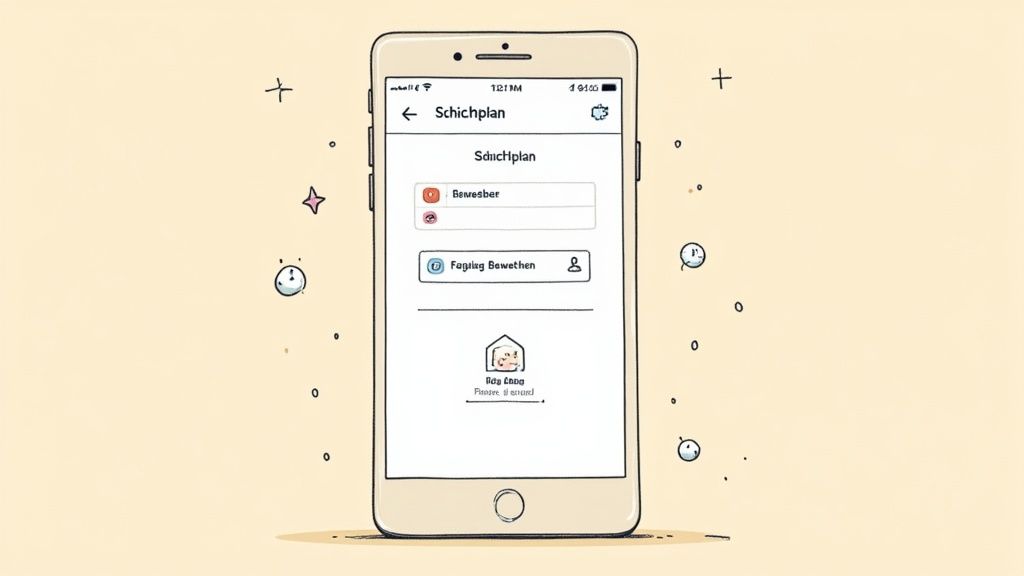
The idea behind it is very simple: employees receive an application through which they can enter their availability, view open shifts and apply directly.
This takes a lot of pressure off of you as a planner because you no longer have to call every single person. Instead, you publish a shift and the right people get in touch on their own.
Features that really make a difference
When choosing an app, you should pay particular attention to functions that give your team real autonomy and noticeably simplify your processes.
- Self-service for availability: Your people manage their available times completely themselves. You can see in real time who can work when, without having to laboriously compare lists.
- View open shifts: Your team can proactively search for job opportunities and apply for shifts that fit their schedule and skills.
- Shift exchange exchange: Someone can't start a shift they've already taken over? The person can easily offer the shift for exchange via the app. A qualified colleague takes over and you just have to approve the exchange.
The flexibilization of working hours no longer only affects classic flextime models. Concepts such as part-time, job sharing or the four-day week are on the rise. In the ‹Information and Communication› As an example, one in five employees already regularly works from home, while almost 38.4% of all employees work from home at least occasionally.
A good employee app transforms the passive planning assumption into active participation. This not only increases satisfaction, but also the sense of responsibility in the team.
A logistics delivery service has impressively completed this change. Previously, allocating delivery windows was a complex, manual process that took a lot of time. With the introduction of one Employee app that has completely changed.
Today the company publishes the open delivery routes directly in the app. The drivers see the tours, apply for them and the system automatically assigns them based on qualifications and previous workload. The result: filling open delivery windows is much quicker, the administrative effort has been reduced to a minimum and the drivers appreciate the control they have gained over their operating times. Find out more about the benefits of one specialized employee app for deployment planning .
Ultimately, with a mobile solution like this, you hand over some of the responsibility to your team - and at the same time give them the necessary tools to do so. This creates trust and leads to a more reliable and agile system Shift planning for flexible employees .
Measure and improve the success of your planning
How do you actually know if yours Shift planning for flexible employees really works? A plan that looks great on paper first has to prove itself in everyday life. Without a regular look at the facts, you're driving blind and missing the opportunity to really strengthen your system.
The key is to keep an eye on the right metrics. This doesn’t have to be complex data analysis. It's about tangible values that show you immediately where things are going smoothly and where things are going wrong. This way you create a solid, data-driven basis for your decisions instead of just relying on your gut feeling.
Key figures that tell you the truth
Focus on a few but really meaningful metrics. They give you a quick overview of the health of your entire planning process.
Here are the main ones that have proven themselves in practice:
- Utilization rate:How many of your advertised shifts are actually filled? A high quota is a clear signal that your offer is attractive to employees.
- Rate of short-term cancellations: How often does someone bail out just before the start of their shift? If this happens often, it could be due to unclear communication or a lack of commitment.
- Time until shift filling: How long does it take on average for an open shift to find a buyer? The shorter this period of time, the more agile and responsive your system is.
- Employee satisfaction: What does your team say about the planning process? Direct feedback is worth its weight in gold and often reveals problems that are not visible in the pure numbers.
A small café, for example, noticed through monthly evaluations that the shifts on Tuesday and Thursday mornings always stayed open the longest. The solution? A small wage bonus for exactly these unpopular times. The result was astonishing: Suddenly these very shifts were the first to be taken.
From measurement to action
Of course, numbers alone don't change anything. The crucial step is to draw the right conclusions from the findings and derive concrete measures. Your most valuable tool for this is regular feedback.
A good planning process is never «finished». It thrives on you listening carefully, evaluating data and having the courage to adjust things that just don't work.
Plan specific moments to collect feedback systematically. This can be a short, anonymous online survey once a quarter or a fixed agenda item in the next team meeting.
Ask open-ended questions such as: «What would make shift planning easier for you?» or «What do you see as the biggest hurdle if you want to accept a shift?».
When you combine this qualitative feedback with your metrics, you get the complete picture. This is how you can do yours Shift planning for flexible employees continuously improve instead of always just reacting to acute problems.
Frequently asked questions from everyday planning
When talking to those responsible for planning, the same questions keep coming up. Here are the answers to the most common uncertainties Shift planning for flexible employees stand in the room - very practical and without legal gibberish.
How quickly can I call on an employee?
This question regularly comes to my desk. The answer almost always lies in the details of your contract – keyword “work on call”.
In Switzerland there is no generally applicable legal deadline, but the courts often rely on a notice period of four days . This is considered a fair guideline that usually holds up even in the event of a dispute.
My practical tip: A clearly communicated deadline of several days is more than just legal protection. It shows respect for your people's time and promotes their reliability immensely. So be sure to take a look at the individual contracts and check whether a collective employment agreement in your industry may specify even stricter rules. Better safe than sorry.
What if no one shows up for a shift?
An open layer is rarely a coincidence, but usually a symptom. Before you panic, get to the bottom of the matter.
Is the shift at a brutally unattractive time, like five on a Sunday morning? Or maybe the pay for the strenuous job is simply no longer up to date? Sometimes small incentives work wonders, such as a slightly higher hourly wage or a small bonus for exactly that unloved shift.
In the long term, you can only solve the problem by building up a sufficiently large and, above all, motivated pool of flexible employees. Good working conditions and fair planning are the best insurance against gaps in the roster.
If no one wants to take on a shift, the problem is rarely with the employees. It is almost always a clear signal that the general conditions of the shift are simply not attractive enough.
Which tool is the best for availability queries?
The search for the «best» Tool is like finding the best car - it depends on what you want to do. Your team size and the complexity of your planning are the decisive factors here.
- For small, uncomplicated teams: A shared online document such as Google Sheets or a simple shared calendar is often enough to start with. This allows availability to be coordinated quickly and without much effort.
- For larger teams or complex requirements: But as soon as you start filtering for certain qualifications, need automatic reminders or want to enable a fair shift swap, you come across Excel & Co. quickly reach its limits. Here, specialized roster software is a much better choice. It relieves you of an enormous amount of manual work and minimizes errors that end up costing you time and nerves.
Do you want to see how you do yours? Shift planning for flexible employees can you finally get it under control with a professional tool? job.rocks automates your processes from availability inquiries to payroll. Book your personal demo now job.rocks .