
Night work supplement: when you get it and how to calculate it
When exactly does the night surcharge actually apply? If you work at night in Switzerland, you are entitled to additional compensation - but at least a 10% wage supplement if you temporarily take on night shifts. This is not a goodie from the boss, but your right. This surcharge is intended to compensate for…
When exactly does the night surcharge actually apply? If you work at night in Switzerland, you are entitled to additional compensation - but at least 10% wage supplement if you take on night shifts temporarily. This is not a goodie from the boss, but your right.
This supplement is intended to compensate for the special strain that working against the internal clock brings with it.
Your entitlement to a night supplement simply explained
Du fragst Dich jetzt sicher, ab welcher Uhrzeit die Kasse für Dich klingeln sollte. The answer to this is provided directly by the Swiss Labor Law (ArG). It protects you as an employee and clearly states: Anyone who works late must be paid fairly.
The thing is: night work is more than just a postponed daily routine. It can really mess up the body. Many who regularly work at night know the feeling of being tired despite having enough sleep because the natural biorhythm is disturbed. The surcharge is much more than just a financial band-aid - it is an important recognition of this additional physical and social burden.
Night surcharge at a glance
So that you don't have to scroll through the legal text for a long time, we have summarized the most important things for you in a table. Here you can see at a glance what the law stipulates as a minimum and what is added in practice - often through collective employment agreements (GAV).
This table shows the legal basis and typical regulations for night surcharges in Switzerland.
| Aspect | Legal regulation (ArG) | Typical practice in GAVs |
|---|---|---|
| Time window | 11:00 p.m. to 6:00 a.m. | Often different, e.g. 10:00 p.m. to 6:00 a.m. |
| Claim | For temporary night work | Often also applies to regular night work |
| Height | Wage supplement of at least 10% | Often higher rates, e.g. 25% or more |
| Alternative | Time compensation for permanent night work | Can be replaced with higher surcharges |
See this overview as your initial guide. The law forms the basis, but in many industries the GAVs have enforced significantly more generous regulations.
In the next sections we will go into more detail. We clarify what exactly “temporary” and “permanent” mean and how you can specifically calculate and enforce your claim.
The legal basis: exact times and rules
To really understand when you are entitled to a night supplement, we have to go straight to the source: the Swiss Labor Law (ArG). This law is your most important ally when it comes to your rights as an employee. It clearly defines what is considered night work and what conditions must be met.
So the crucial question is: Night surcharge from when exactly? The law provides an answer that leaves no room for interpretation.
The legally defined time window for night work
According to Article 16 of the Labor Act (ArG), night work includes the period between 11:00 p.m. and 6:00 a.m.. If your working hours fall within this exact window, you are legally doing night work. This clear demarcation is the basis for every claim to a wage or time supplement.
Imagine you work in a bar and your shift lasts from 8 p.m. to 4 a.m. In this case, the hours from 11 p.m. to 4 a.m. are considered statutory night work. You are entitled to compensation from your employer for these five hours.
Of course, this rule exists for a reason. It is designed to protect your health and your social life, because working against the natural biorhythm places a significant strain on the body.
Why do these rules even exist? A little look back
The idea of protecting employees from the strain of night work is not a modern invention. It has a long tradition in Switzerland that goes back to the 19th century. An international milestone was set as early as 1877 with the Federal Factories Act. It strictly banned night and Sunday work and limited the working day to protect workers' health. You can read more about these historical roots of employee protection, which laid the foundation for our current regulations.
The motivations back then are still just as relevant today. Night work can disrupt the sleep-wake cycle, impair concentration and, in the long term, lead to serious health problems. That is why the law not only provides for a surcharge, but also links the permissibility of night work to clear conditions.
Important to know: Night work generally requires a permit in Switzerland. Your employer is not allowed to assign you to night shifts just like that, but needs official approval for this.
Requirements and protective measures for you
Not everyone is allowed to work at night just like that. The Labor Act links the permit for night work to certain requirements. This is intended to ensure that work is only carried out at night where it is absolutely essential for technical or economic reasons.
There are some key protective measures that apply to you as a night worker:
- Medical examination: If you regularly work at night, you are entitled to a medical examination and advice. This ensures that night work is safe for your health.
- Special duty of care: Your employer must take special precautions to protect you. This could be, for example, organizing transport home when public transport no longer runs.
- Right to information and a say: You and your colleagues must be informed about planned night work and have a right to have a say.
These legal principles are the foundation on which all other regulations - such as collective employment agreements (GAV) - are built. They ensure that your work at night is not only fairly paid, but also safe and healthy. In our comprehensive guide you can find out more about the details of the night surcharge in Switzerland and which specific rules might apply to you.
In the next section we'll make it very specific and show you how you can easily calculate your surcharge yourself.
How to calculate your night surcharge correctly
Now that you know exactly when night work begins, it's time to get down to the nitty-gritty: the calculation. But don't worry, it's easier than you might think. The formula behind it is pretty straightforward.
All you need are three values: your gross hourly wage, the exact number of hours you worked at night, and of course the surcharge rate that applies to you.
The basic formula is:
Gross hourly wage × number of night hours × surcharge rate = your night surcharge
With this simple multiplication you can see exactly what you are entitled to in addition to your normal salary.
Simple calculation examples from everyday life
Let's explain it with a few practical examples. This way you can see directly how the statutory minimum surcharge of 10% affects your wages.
Example 1: Security work
Imagine you work for a security company and your hourly wage is CHF 25.00. Your shift runs from 10 p.m. to 6 a.m.
- The statutory night time (11 p.m. - 6 a.m.) covers 7 hours in your shift.
- The statutory minimum surcharge is 10% (i.e. 0.10).
- Invoice: CHF 25.00 × 7 hours × 0.10 = CHF 17.50
For this one night shift you get CHF 17.50 in addition to your basic wage.
Example 2: Working in the catering industry
You help out in a restaurant and earn CHF 23.00 per hour. Your shift ends at 2:00 a.m. and started at 6:00 p.m.
- Your night work starts at 11 p.m. and ends at 2 a.m., so that's 3 hours.
- The minimum surcharge of 10% also applies here.
- Invoice: CHF 23.00 × 3 hours × 0.10 = CHF 6.90
For this evening you will earn an additional CHF 6.90. It is therefore crucial to know the exact duration of your nighttime hours. If you are unsure how to do this, you can find information here on how you can calculate your daily working hours so that you can record everything correctly.
To give you an even better feel for the impact of different hourly wages and bonus rates, we have put together a small overview table for you.
Example calculations for night surcharges
| Your hourly wage | Night hours | Surcharge rate | Additional earnings per night |
|---|---|---|---|
| CHF 24.00 | 8 | 10% | CHF 19.20 |
| CHF 28.50 | 6 | 10% | CHF 17.10 |
| CHF 32.00 | 7 | 25% (GAV) | CHF 56.00 |
| CHF 25.00 | 4 | 30% (GAV) | CHF 30.00 |
As you can see, higher surcharge rates agreed upon in collective agreements make a significant difference in your payroll.
What happens if surcharges overlap?
Sometimes it gets a little more complex. For example, what if your night shift falls on a holiday? In principle, night and holiday surcharges can come together, which is then referred to as cumulation. Whether this is the case for you is usually stated in your employment contract or in the applicable collective employment agreement (GAV).
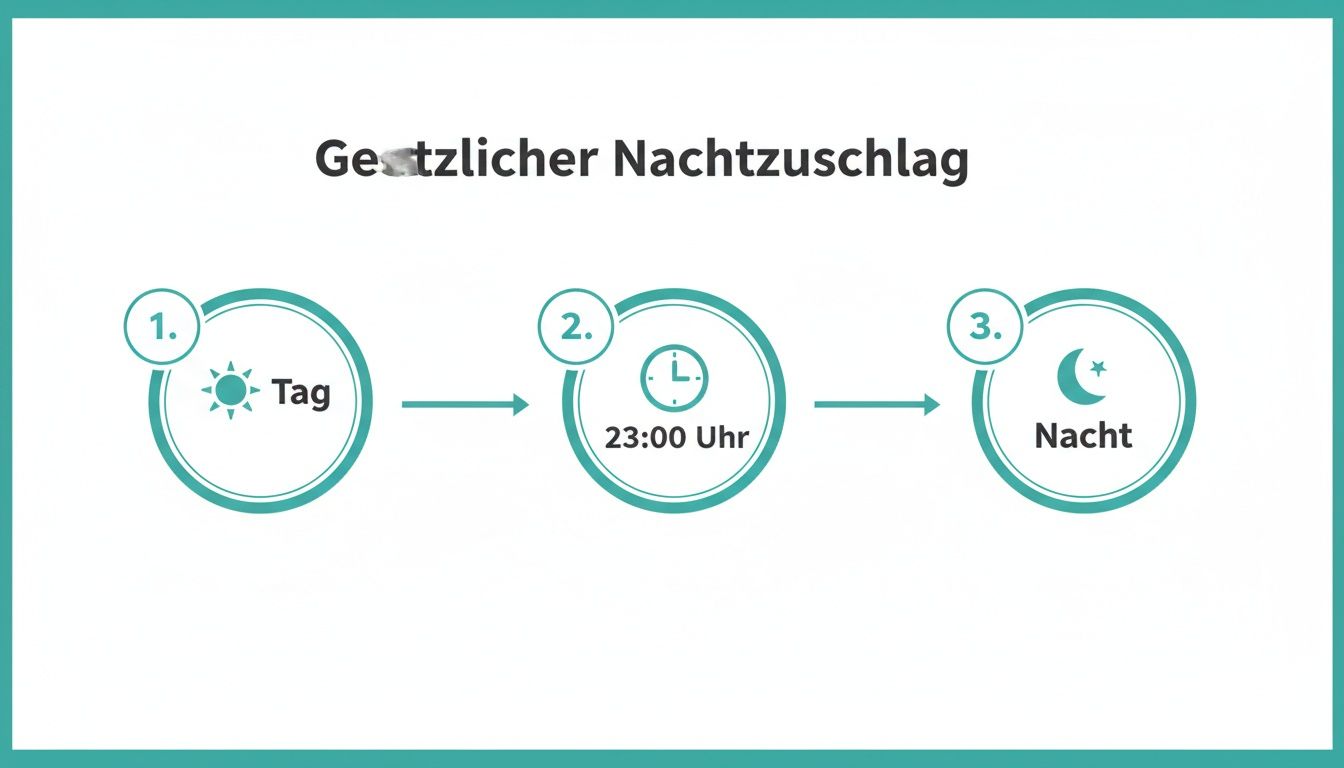
This graphic once again illustrates the simple starting point: The statutory night surcharge takes effect promptly at 11:00 p.m..
A GAV can, for example, stipulate that you receive both the night supplement and a holiday supplement for night work on a public holiday. So it's always worth taking a close look at your contractual agreements.
How to check your payslip
With this knowledge, you are well prepared to control your payroll. Make sure that the night surcharge is listed as a separate item. This makes it transparent and you can see exactly for how many hours and at what rate the surcharge was calculated.
- Check hours: Compare the night hours shown on the billing with your own records. Does that match?
- Check surcharge rate: Make sure that the correct percentage (at least 10% or the higher rate from your contract/GAV) has been applied.
- Follow the calculation: Use the formula above to see if the amount shown is correct.
If any discrepancies arise, it is best to speak to your human resources department first. Most of the time it is a small oversight that can be quickly resolved. Your precise knowledge of the calculation principles gives you the necessary security in the conversation.
Specific rules for your industry
The law only sets the rough framework. In practice, almost every industry has its own, often much better, rules of the game. These are usually found in a collective employment contract (GAV) and almost always offer you as an employee more generous conditions than the legal minimum. Deshalb ist es so wichtig, nicht nur das Arbeitsgesetz, sondern auch den für Dich gültigen GAV zu kennen.
This is exactly where the question “night surcharge from when?” often answered differently and more advantageously for you. A CLA can extend the time window for night work or significantly increase the bonus rate - a fair response to the special stresses that arise in certain professions.
Health care and care
There is no break in healthcare. Nurses, doctors and medical staff are on duty around the clock to ensure the well-being of patients. It goes without saying that the physical and psychological stress is particularly high here.
For this reason, GAVs in the health sector often have more generous regulations in their luggage. It is not uncommon for the night surcharge to be due from 8:00 p.m. or 10:00 p.m. Surcharges of 25% or more are the rule here, not the exception.
An example from practice:
A nurse works from 9:00 p.m. to 7:00 a.m. According to your hospital's GAV, night time starts at 10 p.m. and the surcharge is a whopping 25%. So she receives the full allowance for eight hours, while the dry law would only cover the period from 11 p.m. to 6 a.m. A huge difference on the pay slip.
Gastronomy and hotel industry
Life is pulsating here, often well into the night. Whether in service, in the kitchen or at the reception – night work is part of everyday life. The state collective employment agreement (L-GAV) for the hospitality industry takes this into account with specific regulations.
Here too, the agreements differ significantly from the law. The L-GAV not only sets higher percentages, but often defines nighttime differently to reflect the industry's typical working hours. Compensation for night work has developed in Switzerland over the years, with industry contracts playing a crucial role. While the Labor Act (ArG) stipulates a minimum surcharge of 10%, this can be up to 30% in the catering industry and often 25% in the hotel industry. Around 15% of Swiss people now work at night - with particularly high proportions in healthcare (28%), logistics (22%) and at events (18%). Mehr zur historischen Entwicklung dieser Regelungen kannst Du hier nachlesen.
Many GAVs in the hospitality industry use a sliding scale: the later the hour, the higher the surcharge. This is not only fair, but also motivates and balances out the increasing burden.
Logistics and security
In logistics, goods have to be moved around the clock so that they reach the customer on time the next morning. The situation is similar for security services that guard objects and areas at night. In these industries, the night shift is an integral and indispensable part of work organization.
That's why there are industry-specific CLAs that go far beyond the legal minimum.
- Earlier start of night time: In many logistics centers, according to GAV, night time starts at 10:00 p.m. in order to neatly cover the transitions between shifts.
- Higher supplements: Instead of the statutory 10% for temporary night work, a flat rate of 25% or more is often paid, no matter how regular the assignments are.
A specific case:
An employee in the security service has a shift from 10 p.m. to 6 a.m. His CLA provides for a night surcharge of 25% for the entire duration of the shift because the contract clearly defines the night time from 10 p.m. to 6 a.m.
These examples make one thing crystal clear: your employment contract and the CBA that applies to you are the crucial documents. You determine when the night surcharge begins and how high it is. If you are unsure, ask your union or human resources department which GAV applies to you. This is the only way to ensure that you get the compensation you deserve.
How modern time recording tools simplify billing
Anyone who calculates night surcharges manually knows the pain: Not only is it tedious, hard work, but it is also extremely error-prone. A small number change, a forgotten hour – and the entire payroll is no longer correct. This is exactly where modern digital tools come in and finally bring order to chaos.
Imagine if you no longer had to check every single layer by hand and calculate the surcharges with a calculator. Instead, intelligent software does it for you. Precise, reliable and fully automatic.
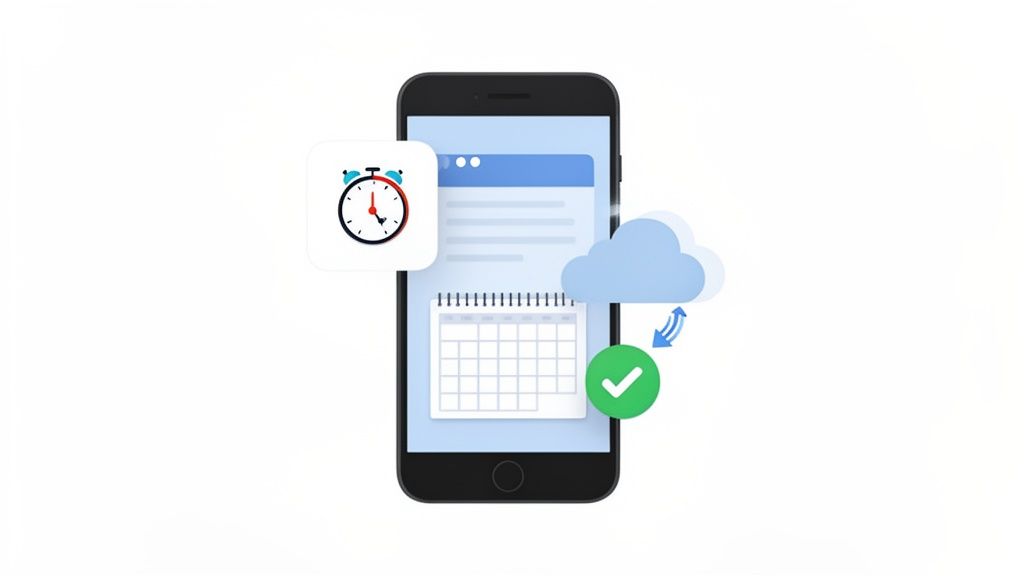
Modern workforce management platforms like job.rocks are built precisely to take this burden off your shoulders. They clearly map even complex working time models and make salary preparation much easier.
Automatic detection and correct application
The biggest lever of digital systems is automation. You enter the rules that apply in your company - be it the legal time window from 11:00 p.m. to 6:00 a.m. or a different regulation from your GAV. The system takes care of the rest.
And this is what it looks like in practice:
- Precise time recording: Your employees simply clock in and out using the app on their smartphone. Every minute of work is recorded digitally and seamlessly. If you want to know more about it, take a look at how smart time tracking via time tracking works.
- Rule-based calculation: The software analyzes the stamped times in the background. If a working time falls within the defined night window, the system automatically applies the stored surcharge rate.
- Error-free payroll accounting: The calculated surcharges are incorporated directly into the payroll preparation. Manual typing errors or calculation errors are now a thing of the past.
Once properly set up, the system ensures that every hour of the night is paid fairly and in accordance with the law. This not only creates trust among your employees, but also gives you as an employer the necessary legal security.
A practical example from the event sector
An event service provider plans his team for a large evening event that lasts until 3:00 a.m. in the morning. A night surcharge of 25% is anchored in his GAV from 10:00 p.m..
Without digital help this would be a huge administrative effort. At the end of the month, the planner would have to go through the timesheets for each individual employee, laboriously filter out the night hours and calculate the surcharge. With a team of 20 people this can quickly take up a whole working day.
With a tool like job.rocks, he only saves the GAV rule once. Employees clock in via app. The system immediately recognizes that the 25% surcharge applies from 10:00 p.m. and prepares the payroll correctly for everyone in the team. The planner saves hours of administrative work and can concentrate on the essentials.
More than just billing: transparency for everyone
Good time recording systems can do more than just bill correctly. They create transparency for both sides – for you and your team. Employees can view their recorded working hours and the resulting bonuses at any time in their own app.
This clarity prevents misunderstandings from the outset and strengthens trust in you as an employer. For you, this means fewer questions from the team and a clean, comprehensible data base that stands up to any test. The question “When does the night surcharge start?” is answered automatically by the system and understandable to everyone.
The most frequently asked questions about the night surcharge – answered briefly and succinctly
Okay, we've covered the legal basics and calculation examples. But in everyday working life, completely different, much more tangible questions often arise. That's exactly what we want to look at now - without complicated legalese, but straight to the point.
This section is your cheat sheet for practice. Here you will find clear answers to the typical insecurities that arise again and again when working at night.
Do I have to work regularly at night to get a supplement?
This is one of the biggest mistakes and the answer is a clear No. Swiss labor law makes a subtle but important distinction between “permanent” and “temporary” night work.
- Temporary night work: If you only cover night shifts occasionally or for a limited period of time, you are entitled to a wage supplement of at least 10%. The law defines “temporary” as an activity that is limited to up to 24 nights per calendar year.
A practical example:
Imagine you work in an event agency and are assigned to a three-week project in which you have to work night shifts. Since this is clearly a temporary matter, you are entitled to the wage supplement for every hour in the statutory night window. Even a one-off use on the weekend is included.
What is the difference between permanent and temporary night work?
This distinction is the pivotal point because it determines the type of compensation you are entitled to. It all depends on how often you are on duty at night per year.
The rule of thumb is simple: As soon as you work 25 or more nights in a calendar year, your night work is considered permanent by law.
From this point onwards the rules of the game change. Instead of a wage supplement, you are now entitled to a time credit of 10% of the night hours worked. Your employer must grant you this time as free time within one year.
An example from logistics:
A warehouse clerk who regularly works the night shift can easily do over 100 night shifts a year. So his night work is clearly “permanent”. If he works 40 hours at night in a month, he will receive a time credit of four hours (10% of 40) on his working time account.
Important to know: Your employer cannot simply continue to pay you the wage supplement if you work continuously at night. Compensatory time is required by law because the idea of relaxation is the main focus here. However, many collective employment contracts (GAV) are more generous and provide for a combination of compensatory time and wage supplements.
Are breaks during the night shift paid?
The break regulation at night is an important protective measure and is different than during the day. If you work during your night shift and are not allowed to leave your workplace during your break, this break must be paid.
Imagine you are alone at a hotel reception at night. You can't possibly close the hotel for half an hour to take a break. In such a case, your break time counts as working time and must be paid as such.
The length of the breaks remains the same as for daytime work:
- 15 minutes if you work more than 5.5 hours
- 30 minutes for more than 7 hours
- 60 minutes over 9 hours
This rule ensures that you get the rest you need at night without suffering financial disadvantages if the company does not allow you to leave your workplace.
My employer doesn't pay the supplement - what can I do?
This is of course a delicate situation, but you are not helpless. The right to the night supplement is anchored in the law. If your employer doesn't pay it, he is violating his obligations.
But before you immediately bring in the cavalry, it's best to proceed step by step:
- Speak to the conversation: First, talk calmly to your manager or the human resources department. Often it is just an oversight or an error in payroll that can be quickly resolved. Take your timesheets with you and refer to the legal regulations.
- Demand it in writing: If the conversation doesn't help, you should put your demand in writing. Set a clear deadline for the additional payment. A registered letter is the safest way here, as it gives you proof.
- Get support: If this is also ignored, it is time for professional help. Your union or legal protection are now the right contacts. They can advise you and plan the next steps with you.
Important to know: Your claim to the surcharge usually expires after five years. So you have enough time to enforce your claim, but you shouldn't wait too long.
Do the rules also apply to part-time workers and mini-jobbers?
Yes, 100%. The labor law makes absolutely no difference. Whether you work full-time, part-time or on a part-time basis does not matter at all when it comes to your entitlement to the night supplement.
The only decisive factor is the fact that you work during the legally defined night time period. A cashier at a gas station who only works a night shift twice a month is entitled to the same percentage of the supplement as her full-time colleague.
This equal treatment is a central principle in Swiss labor law. Every employee should be fairly compensated for the special burden of night work, regardless of how high their workload is.
The correct recording and billing of night surcharges can be quite tricky - but with the right tool it becomes child's play. job.rocks automates this entire process for you. Our platform records working times with millimeter precision, automatically applies stored rules from your GAV and ensures squeaky-clean wage preparation. Save valuable time and protect yourself legally. Find out more at https://job.rocks.