
Master shift management for temporary workers cleverly
Good shift management for temporary workers is much more than just filling gaps in the roster. It is the engine that keeps your business running by allowing you to react flexibly to fluctuating personnel needs and at the same time ensure satisfied, motivated employees. Why good shift management…
A good one Shift management for temporary workers is much more than just filling gaps in the roster. It is the engine that keeps your business running by allowing you to react flexibly to fluctuating personnel needs and at the same time ensure satisfied, motivated employees.
Why good shift management makes the difference
You're probably familiar with this: a temporary worker calls in sick at short notice, another has changed her availability, and the WhatsApp group explodes with messages. Coordinating temporary workers is often like juggling too many balls - time-consuming, nerve-wracking and extremely error-prone. Without a clear process, you quickly lose track and risk unfilled shifts, which directly costs your sales.
Structured shift management solves exactly these problems. It's about switching from purely reactive mode - constantly putting out fires - into forward-looking, strategic planning. Instead of just reacting, you create a system that brings stability and reliability.
The direct comparison: chaos vs. control in the catering industry
Imagine a restaurant on a busy Friday night. In the first scenario, the plan is managed manually via shouting and in various chat groups. A waiter is unavailable. A panicked search for a replacement begins, countless calls and messages remain unanswered. The result: pure stress for the entire team, dissatisfied guests due to long waiting times and ultimately a loss of sales.
Now the second scenario: There is an organized, digital process here. The failure is reported in a central system. A notification is automatically sent out to all available and suitably qualified temporary workers. Within minutes, someone answers and the shift is filled again - without chaos and without disrupting operations for even a second.
More than just a plan on paper
A truly thoughtful approach to shift management has benefits that go far beyond just organization:
- Higher employee satisfaction: If temporary workers can enter their availability easily and digitally and the plan is fair and transparent, they feel valued. This is the basis for long-term commitment.
- Increased reliability: Clear communication and reliable plans mean that far fewer shifts are canceled at short notice. The “no-show rate” drops noticeably.
- Legal security: You ensure that working hours are recorded correctly and that all legal requirements, such as rest periods, are fully adhered to. This protects you from expensive mistakes and legal consequences.
The importance of shift work is constantly increasing in Switzerland. A survey by the Federal Statistical Office shows that the proportion of shift workers is: 14.3% in 2002 to 15.9% in 2022 has increased. This trend highlights how crucial professional shift management has become to meet flexible staffing needs in many industries. You can find out more about this in the official analysis of shift work developments in Switzerland.
A good system not only creates order, but above all trust. Your temporary workers know where they stand, and you can rely on your business to run smoothly even in the most stressful times.
The most common stumbling blocks when planning temporary employment
Planning temporary employment is often like a puzzle in which the pieces constantly change shape. Even with the best intentions, mistakes quickly creep in and lead to frustration on both sides – you and your team. Let's look at the three biggest challenges Shift management for temporary workers Let's take a closer look so that you can avoid them in the future.
The biggest difficulties usually arise not from bad will, but from unclear processes and a lack of overview. Do these problems sound familiar to you from your everyday life?
Problem 1: Unpredictable availability
Temporary workers particularly value flexibility - but that's exactly what makes planning so complex for you. Their availability often changes weekly, sometimes even daily, depending on studies, other jobs or private appointments. Without a central system in which this information comes together cleanly, the roster quickly becomes a mere patchwork of assumptions.
Imagine you are planning the coming week for your fashion business. You rely on the promise from Anna that you received via WhatsApp last week. On Monday morning she texts you that she forgot an important exam and can't take it. And the stressful search for a replacement begins while the store is already understaffed.
Attempting to manage flexibility with unstructured methods paradoxically leads to more chaos and less true agility for everyone involved.
This constant back and forth when querying availability via email, calls and chats not only costs an incredible amount of time, but is also extremely error-prone. Information is lost or misinterpreted. The result? Your entire personnel planning becomes unstable.
Problem 2: Inefficient agreements and communication
How do you communicate plan changes? Via calls, emails, text messages or a confusing chat group in which important information is lost? When information is scattered across too many channels, misunderstandings are inevitable. One temporary worker misses a message, another has saved an outdated version of the plan - and then no one is available for the morning shift.
A classic from the retail trade: The shift schedule for the Christmas season is sent to the team group as a PDF. Shortly afterwards there are two changes that you just quickly forward to the people affected. A third employee swaps shifts with a colleague, which you only confirm verbally. In the end, no one knows which plan really applies.
Such unclear communication not only leads to tangible operational problems, it also erodes trust. Your temporary workers feel poorly informed and are unsure which agreements are now binding. This undermines the reliability of your entire team.
Problem 3: Unfair distribution of shifts
Every company has them: the popular shifts on Saturday afternoons and the less popular ones on early Monday mornings or late Friday evenings. If the allocation of these shifts is not transparent and comprehensible, dissatisfaction quickly arises within the team. Are certain temporary workers perhaps subconsciously preferred just because they respond faster or are considered particularly reliable?
- Motivation decreases: If some employees always have to take on unpopular tasks, their motivation suffers greatly. They feel disadvantaged and their willingness to step in flexibly decreases noticeably.
- Team dynamics suffer: A perceived injustice can quickly lead to tensions between temporary workers. This poisons the working atmosphere and harms collaboration in everyday life.
- High fluctuation: In the long run, unfair treatment causes good people to look for other jobs. You lose valuable workers that you have laboriously trained.
A fair shift distribution is much more than just a nice gesture. It is a crucial factor for the satisfaction and loyalty of your employees – and therefore for the stability of your business.
Legal basis and data protection for temporary workers
A clean one Shift management for temporary workers It doesn't stop with perfect planning - it also has to be legally watertight. In Switzerland there are clear requirements that affect you as an employer. Anyone who ignores this not only risks severe fines, but also quickly loses the trust of their own team.
The good news is: If you know the basics, you'll be safe. At its core, it's about creating transparency and protecting the rights of your employees, especially when it comes to sensitive issues such as working hours and data protection.
Recording working hours is mandatory
Regardless of whether your temporary workers only work a few hours per week, Swiss labor law requires you to fully record their working hours. This means that you must precisely document the start, end and duration of each shift and all breaks. A simple note on a piece of paper is far from enough.
Imagine running a bar and relying on your temporary staff to record their hours themselves at the end of the month. During an inspection by the labor inspectorate, it turns out that the records are incomplete and rest times were ignored. Such a violation can quickly result in fines of several thousand francs, not to mention additional payments for overtime.
Accurate time recording is not an option, but a legal obligation. It not only protects your temporary workers, but also you from legal consequences and ensures a fair billing basis.
This recording obligation specifically includes:
- Daily working hours: Accurate start and end times of each shift.
- Breaks: Document all breaks of 30 minutes or more.
- Rest times: Ensuring the legally required rest period of at least 11 hours between two missions.
- Maximum weekly working hours: Monitoring the maximum permitted working hours.
Data protection in shift management
When planning shifts, you inevitably collect personal data from your temporary workers - from contact details to availability to bank details. The handling of this information is subject to strict data protection laws. Your job is to ensure that this data is stored securely and only used for its intended purpose.
Things get particularly tricky when communicating via insecure channels such as WhatsApp. Sharing rosters with full names, phone numbers and locations in a large group message is a real data protection risk. Everyone in the group can see, save or forward this sensitive data - you no longer have any influence on it.
A concrete example: You post the shift schedule as a photo in your WhatsApp group. A temporary worker leaves the company but remains in the group. Suddenly an external person still has access to all internal information - a clear violation of data protection principles. It is much safer to use platforms where each employee only sees their own, relevant shift information. Find out more about how you Data protection in human resources is implemented correctly.
What you can do specifically
To be on the safe side legally, you don't need complicated processes. Simple but effective measures are often enough. A digital solution can relieve you of an enormous amount of work and at the same time ensure the necessary compliance.
- Use a digital time recording system: Tools that allow employees to clock in and out via app automatically create legally compliant timesheets. This means you are always prepared for inspections.
- Manage data centrally and securely: Use a platform that complies with data protection guidelines and protects sensitive employee data from unauthorized access.
- Communicate via protected channels: Instead of open chat groups, you should rely on systems with individual access. So everyone only sees what they are allowed to see.
To ensure comprehensive legal certainty, it is also important to familiarize yourself with a company's general data protection regulations. A well worded one Privacy Policy shows that a company takes its responsibility seriously. In the end, a clean, legally compliant approach gives you the peace of mind you need to fully concentrate on growing your business.
A clear roadmap for your organizational process
Now that you know the typical problems and legal framework, it's time to get down to business: practical implementation. A well-thought-out organizational process is the be-all and end-all for a stress-free Shift management for temporary workers. With the following four steps you can build a system that saves you time, avoids errors and ensures significantly more satisfaction in the team.
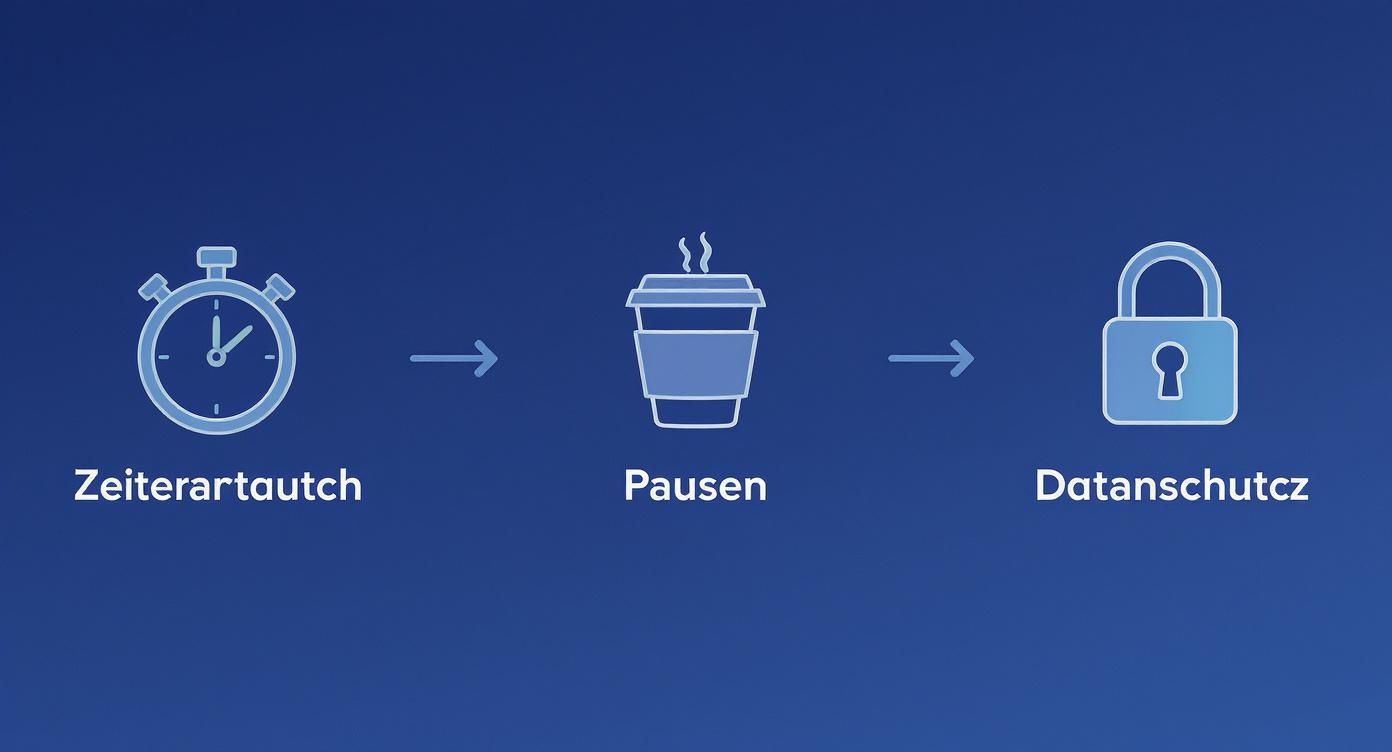
This simple process shows you how to create a solid foundation with clear rules for time tracking, breaks and data protection.
The visualization makes it clear: a stable process rests on these three pillars. It helps you elegantly combine legal security and organizational clarity.
Step 1: Record availability centrally and clearly
The first step to a better plan? End the chaos of availability queries. Instead of countless messages on WhatsApp, by email or by phone, you need a central place where all information comes together. This immediately creates clarity – for you and your temporary staff.
A shared online calendar is a good place to start. Every temporary worker can independently enter their available and blocked times there. This saves you the constant hassle and you can see at a glance who is ready and when.
A central calendar is your only truth. What is not there does not exist for planning purposes. This simple rule prevents most misunderstandings and duplication from the outset.
Specialized tools go one step further, allowing temporary workers to maintain their availability directly in an app. This means you always have up-to-date data at hand, without any manual transmission errors.
Step 2: Create understandable and accessible shift schedules
A good shift plan is one that everyone understands immediately. Confusing Excel tables with cryptic abbreviations only lead to frustration and errors. Your goal must be a clear, visually appealing format that leaves no questions unanswered.
The best way to do this is to create templates that you use over and over again. These should contain the most important information at a glance:
- Name of the temporary worker: Who is assigned to the shift?
- Date and day of the week: When does the shift take place?
- Exact time: When does the operation begin and end?
- Location or task: Where or what is the person responsible for?
Make sure the plan is available to everyone at all times. A link to an online document is good, an employee app is better. This means everyone always has the latest version on their smartphone and cannot claim to have missed a change.
Step 3: Communicate plan changes clearly and directly
Changes are part of everyday life - how you deal with them makes the difference. Short-term failures or exchange requests must not turn into panic. A fixed process for exactly these cases gives you and your team the necessary security.
Build one Springer pool on. This is a small group of reliable temporary workers who you contact first in the event of short-term absences. This way you don't have to alert your entire team and you can find a replacement much more quickly.
Also set clear rules for shift swap requests. Determine by when such requests must be reported and that an exchange is only valid after your official confirmation. This prevents uncontrolled agreements between each other that you are not aware of. The definition of the required skills is central here; Read our article to find out how you can create a meaningful one Create requirements profile to always find the right people for the right shift.
Step 4: Create a fair system for shift allocation
Justice is a huge motivating factor. When shifts are distributed fairly, everyone feels valued. Opaque decisions, on the other hand, quickly lead to frustration and the feeling of being disadvantaged.
This is a proven method “First come, first served” principle for open shifts. Publish unfilled shifts centrally so that all available temporary workers have an equal chance to apply for them. This promotes personal responsibility and is perceived as extremely fair.
Alternatively, you can Rotation system for particularly popular or unpopular shifts. This way you ensure that the “good” and “bad” tasks are distributed fairly across everyone’s shoulders. Digital tools can support you by automatically ensuring balanced distribution.
Comparison of manual planning vs. digital platform
To make the differences more tangible, let's take a look at everyday practice. The following table compares traditional planning with Excel and WhatsApp with a modern, digital solution.
| aspect | Manual planning (e.g. Excel, WhatsApp) | Digital platform (e.g. job.rocks) |
|---|---|---|
| Availabilities | Chaotic queries across multiple channels | Central, always up-to-date overview in one app |
| Plan creation | Time-consuming, error-prone, manual comparison | Automatic suggestions based on availability & skills |
| communication | Confusing, risk of loss of information | Direct push notifications for changes, all in one place |
| Changes | Panicked search for replacement, lots of phone calls | Springer pools, open shifts with 1-click application |
| fairness | Subjective allocation, difficult to understand | Transparent rules (e.g. rotation), automatic distribution |
| Legal certainty | Manual examination of working time laws necessary | Automatic warnings for violations (e.g. break times) |
| Expense | High, takes up many hours per week | Minimal, focus on strategic rather than administrative tasks |
The comparison makes it clear: While manual methods may seem easier in the short term, in the long term they lead to more effort, errors and frustration. A digital platform is not just a tool, but a strategic decision for greater efficiency and a better working atmosphere.
How digital tools really make your shift planning easier
Anyone who has ever tried to plan shifts using paperwork or endless Excel lists knows the pain. As soon as there are more than a handful of temporary workers involved, it becomes confusing, prone to errors and eats up an incredible amount of time. This is exactly where digital tools come into play – they solve typical problems before they can even arise.
Imagine a platform specifically for that Shift management for temporary workers was built. Instead of having to laboriously gather information, you have everything in one central location. Such systems not only take the administrative burden off your shoulders, but also create a transparent and fair working environment for your entire team.
From chaos to clarity with central functions
Good digital platforms combine all important processes in a single, clean application. In concrete terms, this means: You say goodbye to scattered information and say hello to an organization that simply works.
The core functions of such software are designed to eliminate the most common points of friction:
- Independent availability planning: Your temporary workers simply enter their available times themselves in an app. You can immediately see who can work when without having to write a single message. That alone will save you hours of back and forth per week.
- Active application for open shifts: You post an open shift and all qualified temporary workers receive a notification. Anyone who has the time and desire can apply with just one click. This way you can fill gaps proactively instead of making desperate calls for a replacement.
- Automatic notifications: A shift changes? The system automatically informs everyone affected via push message. Misunderstandings because someone overlooked an email are now a thing of the past.
This image shows how clear the whole thing can look in a mobile app.
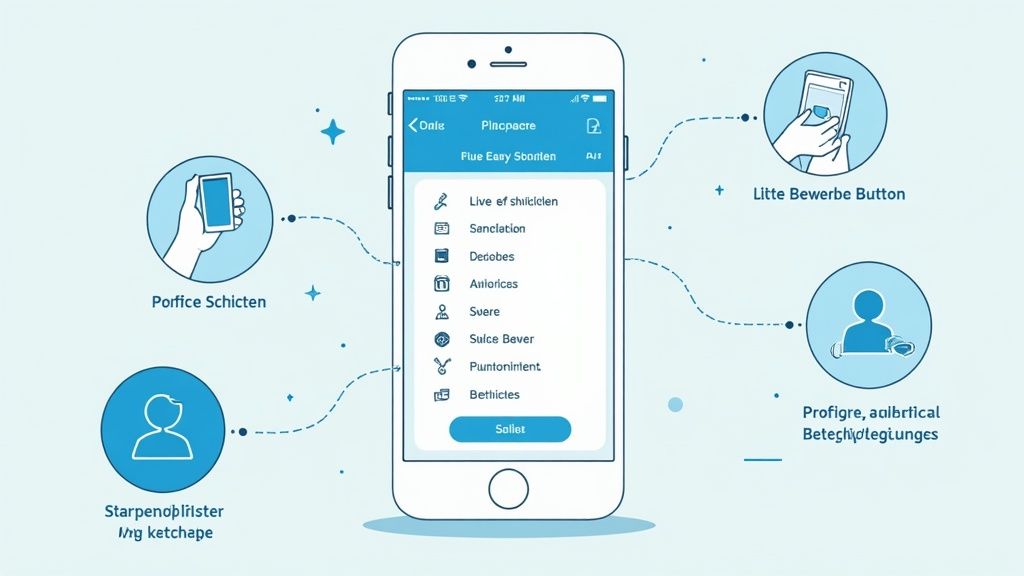
The temporary workers have all the important details about their assignments at a glance, which makes the organization enormously easier for everyone involved.
A digital platform is like a personal assistant that works for you 24/7. It keeps everyone on the same page without you constantly having to chase people.
A practical example from the event industry
Imagine you are organizing a large music festival. Two hours before the start, some of your bar staff call in sick. Panic would now break out in the old, manual world. You'd have to go through your contact list and hope someone can step in at short notice.
With a digital solution the situation looks completely different. You create an urgent shift request in the platform and filter for “bar staff” with the appropriate qualifications. The system will immediately send a notification to all available temporary workers in your pool who match this profile. You will receive feedback within minutes and can refill the shift.
This quick and targeted process not only ensures that your event runs smoothly, but also reduces stress for you and your entire team to a minimum. You can rely on us to find a solution quickly, even in the event of unforeseen outages. Find out more about how a specialized Operations planning software can help you master such challenges confidently.
More than just saving time
Switching to digital shift management not only reduces your administrative workload. It also brings noticeably more fairness and transparency into the game, which has a direct impact on the motivation of your temporary workers.
If everyone has the same opportunities to apply for attractive shifts and the planning is understandable, satisfaction within the team increases. And that's exactly how you bind good people to your company in the long term.
So, how do you actually measure whether your shift management for temporary workers is really any good?
A good plan is only half the battle. In the end, what counts is what comes out of it. Instead of relying on your gut feeling, you should look at a few simple but tough metrics. This helps you identify problems before they escalate and make targeted improvements.
Don't worry, you don't need any complicated analysis tools or extensive reports. A few simple metrics that you keep an eye on regularly are enough. This way you can make decisions based on facts and see immediately where there are still problems.
The three most important metrics for your success
To get started, it's enough if you concentrate on three central areas: Are your shifts reliably staffed? How often do people drop out at short notice? And, very important: How satisfied are your temporary workers? These three KPIs will give you a damn clear picture of how healthy your planning process really is.
Let's take a closer look at these things - and how you can record them without much effort.
1. The occupancy rate
This is the simplest and most important key figure. It shows you clearly what percentage of your planned shifts actually end up being filled. A high quota means: Your planning is reliable and you have enough people on staff to keep the store running.
- How you measure them: Simply count all the shifts you have planned for a week. Then you count how many of them were actually filled. Divide the occupied shifts by the total number and multiply the result by 100.
- Example: You had for a week 50 layers to award. You could do that 48 occupy. Your occupancy rate is extremely strong 96%.
If your occupancy rate is consistently high, that's a great sign. It shows that your pool of temporary workers is large enough and that your communication is working.
2. The failure rate
The failure rate is your early warning system. It measures how often temporary workers cancel at short notice - i.e. less than 24 hours before the start of the shift. This number is a hard indicator of problems such as overwork, lack of motivation or unclear agreements. Every last-minute cancellation causes stress and a huge organizational rat tail.
- How you measure them: Write down the total number of scheduled shifts over a month and how often someone canceled at short notice. From this you calculate the percentage.
- Example: In a month there was 200 planned shifts. Of these were 10 canceled at short notice. So your failure rate is 5%.
Imagine running a small café and suddenly realizing that people are constantly absent from the morning shift on Mondays. Instead of just getting annoyed, get to the bottom of the matter. A short conversation in the team reveals: That's exactly when the big delivery of goods arrives and one person is completely overwhelmed. You then schedule additional help for these two hours - and lo and behold, the failure rate normalizes.
3. Employee satisfaction
Satisfied temporary workers are reliable temporary workers. Point. Your satisfaction may be the “softest,” but often the most crucial metric of all. When your team feels treated fairly and well informed, failure rates naturally decrease and motivation increases.
- How you measure them: Forget complex surveys. Simple, regular questions are enough: "On a scale of 1 to 5, how satisfied are you with the current shift planning?" or “Do you feel you are treated fairly when assigning shifts?”
- Example: You send out an anonymous online survey with just three questions every three months. The results quickly show you trends and give you valuable feedback on where you can make improvements - for example when communicating changes to plans.
With these three key figures you have a solid basis for not only controlling your shift management, but also continuously improving it. You can immediately see what's going well and where you need to intervene before something burns out.
Frequently asked questions about shift management with temporary workers
Finally, we clarify the questions that arise in everyday life Shift management for temporary workers keep cropping up. Here you will get direct answers from practice that will help you quickly get rid of typical uncertainties.
How do I deal with extremely short-term requests?
Imagine it's Saturday lunchtime and you urgently need a temporary service worker for the evening. The best and fastest way is to be prepared Springer pool.
This is basically a curated list of reliable people who you contact first in such emergencies. With a digital platform like job.rocks You can create an "SOS layer" that immediately sends a push message to exactly this pool - this way you can find a replacement much faster than with countless phone calls.
What if a temporary worker never wants the unpopular shifts?
This is an absolute classic. Fairness is the key here, otherwise the mood in the team quickly changes. Introduce a transparent and comprehensible system.
For example, you could stipulate that anyone who gets a popular Saturday night shift must also take a less popular Monday morning shift in return. Software helps you to automatically keep an eye on the distribution and ensures fair rotation all by itself.
Can I assign temporary workers to shifts via WhatsApp?
From a data protection perspective, this is more than just problematic, it is a real risk. Roster schedules contain sensitive, personal data such as names and exact working hours.
In a WhatsApp group, all members have full access, even if they have long since left the company. Protected systems in which each temporary worker only sees their own shift details are much better and more professional. This is not only GDPR-compliant, but also shows that you take your employees’ data seriously.
How can I make sure everyone is on the current plan?
Say goodbye to plans that you send as PDFs via email or group chat. Each new version only causes confusion. Instead, use a central platform that serves as the only reliable source (Single source of truth).
When you make a change, the plan there will immediately update in real time for everyone. Automatic notifications then ensure that no one misses an important change.
Are you ready to finally free your shift management from chaos? job.rocks offers you the right tools to simplify your planning, improve communication and be legally on the safe side.
Discover now how job.rocks is revolutionizing your temporary planning