
Shift scheduling for flexible working hours: how to plan smartly
A well-thought-out roster creation for flexible working hours is the core of keeping your team motivated and making your company agile. It gives you the tools to react to fluctuating staffing needs and at the same time maintain the balance between your work and leisure time...
A well thought out one Roster creation for flexible working hours is the core of keeping your team motivated and making your company agile. It gives you the tools to react to fluctuating staffing needs and at the same time greatly improve the work-life balance of your employees.
Why rigid rosters no longer work today
Do you remember the days when a roster was created once and then pinned to the wall unchanged for weeks? This rigid way of thinking simply no longer fits into our current working world. Agility is no longer a nice-to-have, but rather an operational necessity - it determines whether you remain competitive and retain the best talent.
The change to flexibility in Switzerland
The numbers speak for themselves: flexible working is on the rise in Switzerland. A study by the Zurich University of Applied Sciences (ZHAW) shows that already 65% of companies use flexible working time models. Around 47,7 % of employees are already benefiting from it. This reflects the growing desire to achieve a better balance between work and private life. This is precisely why modern duty planning that responds to individual needs becomes indispensable.
The complete study about New Work in Switzerland at knows.com provides exciting insights.
A practical example from the catering industry
Imagine your restaurant on a sunny Saturday. The rigid roster only provides for three service staff. Suddenly the terrace fills up unexpectedly quickly. What happens? The team is immediately overloaded, guests become impatient, and sales suffer.
With a moving plan you would have mastered the situation. For example, you would have scheduled employees on call or with a working time account to step in at short notice. This means your business remains fully efficient even during spontaneous peaks.
Don't ignore health aspects
Constant pressure from rigid plans and unforeseen bottlenecks creates stress - and that has consequences. Long-term stress can cause serious health problems. Find out about the effects of high cortisol levels on healthto better understand the connections.
Flexible rostering is also a direct investment in the well-being of your team. It strengthens personal responsibility and shows your employees that you take their living conditions seriously and value them.
The basis for flexible plans: needs analysis and Swiss law
Before you invest a minute into creating a new roster, you need a solid foundation. Without a thorough analysis of your staffing needs and a crystal-clear understanding of the legal guidelines in Switzerland, you are planning off the mark. A good plan always starts with data, not gut feeling.
The first logical step is this Needs analysis. Take a close look at your business data from the last few months. When do you have the most customers? On which days of the week and at what times is the busiest? In the retail sector, this is often Saturday morning or the after-work rush hour during the week.
It is precisely this analysis that shows you the difference between rigid and flexible plans, as the following graphic illustrates.
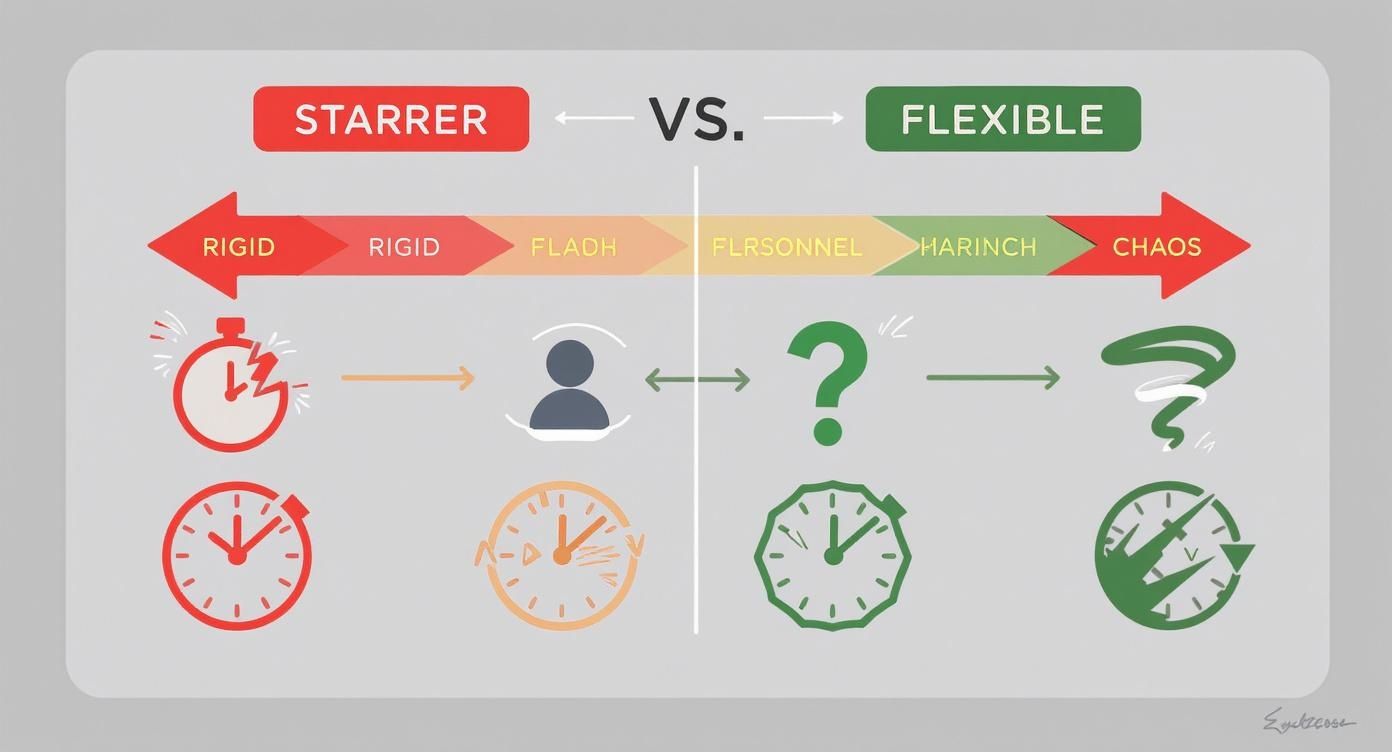
You can see straight away: Rigid planning quickly leads to bottlenecks and operational chaos, while a flexible approach ensures stability where it is needed.
Determine the specific personnel requirements
Once you know your peak times, it's time to get down to business: determine the exact staffing requirements for each time slot. But be careful - it's not just about the sheer number of employees, but above all about their number Qualifications. You may not just need three salespeople on Saturdays. You need someone with checkout experience, someone to clear the goods and a professional to advise customers.
A plan that only focuses on head count is doomed to failure. Having the right mix of skills at the right time is crucial to keeping operations running smoothly.
With this data you create a reliable basis that gives you a targeted Roster creation for flexible working hours allowed in the first place.
Observe legal requirements in Switzerland
Flexibility does not mean anarchy. The Swiss Labor Law (ArG) sets clear limits that you not only have to know but also have to adhere to meticulously. Violations can quickly become expensive and lead to unnecessary legal disputes.
Particularly in Switzerland, where the workload is high compared to other European countries, protecting employees plays a central role. In 2024, the contractual weekly working hours for full-time employees was average 42 hours and 29 minutes. Movable models are often a clever way to balance this burden and promote the health of employees.
To be on the safe side legally, you need an overview of the most important legal requirements that you have to consider when creating flexible rosters.
Legal cornerstones for flexible rosters in Switzerland (ArG)
| aspect | Legal regulation (excerpt) | Practical tip for planning |
|---|---|---|
| Maximum working hours | Depending on the industry 45 or 50 hours per week. Overtime must be compensated or paid out. | Define clear upper limits in your planning tool to receive automatic alerts if they are exceeded. |
| Daily rest time | At least 11 hours uninterrupted rest period between two work assignments. | Never plan a late shift followed by an early shift without taking this buffer into account (so-called “clopening”). |
| Break regulations | From 5.5h: 15 mins From 7am: 30 mins From 9am: 60 mins |
Breaks must be explicitly stated in the roster and compliance must be documented. |
| Sunday & public holiday work | Basically forbidden, only permitted with permission. Wage or time surcharges apply. | Clarify the licensing requirements for your industry and plan surcharges into the budget right from the start. |
These legal guardrails are non-negotiable. A solid needs analysis, combined with strict adherence to these requirements, creates the foundation for fair and effective flexible rostering from which your company and your employees benefit equally.
Find suitable shift models for your team
Finding the perfect shift model is like finding a unicorn – there is no one that fits all. Every industry, every team and every company works differently. Your task is to find exactly the model that supports your operational goals and at the same time takes the wishes of your employees seriously.
A rigid nine-to-five rule has long been outdated in many areas. Today there is a whole range of movable models that can do much more than just postpone the start of work. The right choice can noticeably increase the motivation and productivity of your team.
The most common models at a glance
Before you choose a system, you should know the most common options. Each model has its own strengths and weaknesses, which you have to compare with the reality in your company.
- Flexitime: Employees determine the start and end of their work themselves within a set framework (the core working hours). This model promotes autonomy and is a classic in office jobs.
- Working time accounts: All hours worked end up in one account. Plus hours can later be used as free time and minus hours can be reworked. This creates a valuable buffer for order peaks.
- Trusted working hours: The focus here is on the result, not on the mere presence. This model requires a high degree of personal responsibility and fits perfectly with project-based work.
- Job sharing: Two or more part-time employees share a full-time position and the associated tasks. A clever solution to keep valuable specialist expertise in the company, even if it is not 100% available.
Each of these models changes the way you do the Roster creation for flexible working hours tackle. The right choice depends heavily on your specific operational processes. A deeper examination of the strategic shift planning can help you make the best decision for your team.
Comparison of common flexible working time models
Choosing the right model can be overwhelming. This table will help you decide which model best suits the needs of your company and your team.
| Model | Ideal for… | Advantages for employers | Benefits for employees |
|---|---|---|---|
| Flextime | Office and administrative jobs with core working hours. | Higher employee satisfaction, fewer short-term absences. | Better work-life balance, more autonomy. |
| Working time accounts | Sectors with seasonal fluctuations (e.g. gastronomy, logistics). | High flexibility during peak orders, reduction of expensive overtime. | Possibility of compensating overtime as free time. |
| Trusted working hours | Creative and project work, knowledge-based professions. | Focus on results rather than attendance, promotes personal responsibility. | Maximum mobility and self-determination. |
| Job sharing | Demanding specialist and management positions. | Keeps important know-how in the company and promotes collaboration. | Allows demanding part-time work, good replacement in absences. |
Each of these models has the potential to positively change the way you work in your company. It is important that you not only see the advantages, but also create the conditions so that it works in practice - the keyword is trust and clear communication.
Industry and team structure are crucial
The requirements in nursing are fundamentally different than in IT support. A nursing team needs 24/7 coverage, while an IT team might get by with staggered shifts and clever on-call support.
A mistake that many people make: They adopt a model that works great elsewhere without adapting it to their own situation. Analyze carefully: When do how many people and what qualifications need to be available? The answer to this question is your compass.
Especially in Switzerland, where the workload is comparatively high, movable models are becoming increasingly important. Full-time employees worked on average in 2024 40 hours and 4 minutes per week. This number makes it clear how important well-thought-out models are to ensure work-life balance while ensuring operational performance. You can find more background information on this in the current development of working hours in Switzerland.
Involve your team from the start
The best plan is of no use if the team doesn't support it. So get your employees on board as early as possible. Conduct surveys to understand preferences and sticking points, or pilot a new model in a small department.
This co-creating approach not only creates acceptance, but also provides you with invaluable feedback directly from practice. You can immediately see where there is a problem and where still needs to be readjusted. The end result is a system that is supported by everyone and really improves everyday working life for everyone.
Organize employee requests and availability fairly
Flexible planning depends on good communication. You can design the smartest shift model - if the process for requests and availability is not crystal clear, frustration and chaos are inevitable. The trick is to find a fair balance between operational needs and the needs of your team.

The key to this is transparent rules that everyone can understand. If everyone in the team knows how to submit requests, what deadlines apply and what criteria are used to make decisions, the feeling of injustice doesn't even arise.
Build a transparent process
A structured process begins with systematic recording. Get rid of the paperwork or verbal agreements that get lost in the stress of everyday life! Even very simple methods bring a lot of order to the system.
- Well-thought-out Excel lists: A simple table in which employees enter their desired shifts or days off for the next planning period works wonders. Important: Set a clear deadline by which entries must be made.
- Digital wish books: Modern planning tools often already have this function built in. Employees store their preferences directly in the system, which not only makes it easier for you to keep an overview, but also allows the software to take these wishes directly into account during automatic planning.
What is crucial is that the rules of the game are the same for everyone. Determine how many desired Fridays there are per month or how desired shifts - for example on public holidays - rotate fairly. This creates commitment and takes the wind out of the sails of conflicts.
Clear rules for shift swaps and vacation
You strengthen the team's sense of responsibility enormously if you allow people to swap shifts. But this also needs clear guardrails so that the... Roster creation for flexible working hours doesn't get out of hand.
An exchange should always be approved by you or a shift manager. This is the only way to ensure that the qualifications continue to fit and that no statutory rest periods are violated. A digital shift exchange exchange in an employee app is ideal for this, as the entire process is documented cleanly and transparently.
Practical example from hotel operations
Imagine a hotel. The weekend shifts at reception are in great demand because they are paid with extra pay. There used to be constant discussions about this. The hotel manager then introduced a simple but ingenious process:
- Request delivery: Employees enter their shift requests in a digital tool by the 15th of the previous month. Everyone can specify two desired weekend shifts.
- Fair distribution: The system takes wishes into account and at the same time ensures fair rotation. Anyone who had a popular shift this month will move down the priority list next month.
- Transparency: The finished plan is published for everyone to see. Everyone can understand how the distribution came about.
The result? The discussions are off the table, satisfaction has noticeably increased and employees feel valued. A clear process not only simplified planning, but also actively improved the working atmosphere.
Digital tools that really save time
Let's be honest: them Roster creation for flexible working hours Working with paper and pen or confusing Excel tables is not only frustrating, but also extremely prone to errors. One wrong formula, one overlooked holiday wish – and the whole house of cards collapses. Digital tools are no longer a luxury here, but rather a simple necessity to save valuable time and sustainably increase the quality of planning.

Modern software solutions take the tedious detailed work off your hands. They automatically take into account legal requirements such as rest times, stored employee requests and the necessary qualifications for a shift. The result is a fair, optimized and, above all, legally compliant roster at the push of a button.
Features that make the difference
But not all software is the same. When choosing, you should pay attention to a few core functions that will really help you in everyday life. It's about reducing the administrative burden so much that you can concentrate on what's important again: your team and your business.
These functions have become indispensable in practice:
- Automatic plan creation: The software independently creates an initial draft plan based on your specifications (personnel requirements, qualifications, wishes). That alone saves hours.
- Digital time recording: Employees clock in their working hours directly via the app or at the terminal. The data flows cleanly into payroll accounting - no more manually transferring timesheets.
- Employee app (Employee Self-Service): Your team can enter availability, swap shifts, submit vacation requests and view the current roster at any time. This creates transparency and personal responsibility.
- Rules-based planning: You store all legal and operational rules once. The system automatically checks this every time the plan changes and sounds an alarm before an error occurs.
What you should pay attention to when choosing
The market for planning software is huge. In order to find the right solution for you, you need to know your own requirements exactly. Ask yourself the right questions: How big is my company? What is my budget? What specific needs does my industry have? A small catering business operates differently than a large logistics service provider.
By switching to a digital solution, a medium-sized logistics company was able to reduce its planning time by over 70 % reduce. At the same time, the error rate in payroll accounting fell to almost zero because the recorded times were processed directly and without manual intervention.
Before you decide, be sure to take advantage of the free trial periods. Involve your team - after all, they are the ones who have to work with the tool every day. A good one Comparison of workforce planning software for Swiss SMEs can provide initial orientation and help to separate the wheat from the chaff. Pay particular attention to uncomplicated support and intuitive operation so that the introduction goes smoothly and acceptance within the team is high right from the start.
The most frequently asked questions from practice
Anyone who introduces flexible rosters will sooner or later come across the same sticking points. Don't worry, this is completely normal. Here are the answers to the most common questions that I come across again and again in practice - so that you can confidently overcome typical hurdles right from the start.
How do I ensure that shift allocation remains fair?
The feeling of injustice is pure poison for any team atmosphere. The only solution that really works are Transparency and crystal-clear rules. Together, objectively determine the criteria according to which shifts will be distributed. A simple rotation principle for particularly popular or unpopular shifts has proven itself in countless teams.
A concrete example from nursing: A team decides that the unpopular night shifts will take turns on the weekend. Whoever had it this time will have a break next time. In this way, the burden is distributed fairly and the decision is immediately understandable to everyone, without any discussions arising.
The crucial point: Put these rules in writing and make them accessible to everyone, for example in the break room or in a shared team chat. If everyone knows where they stand, there is no room for speculation about supposed preferences.
What do I do if I have a short-term sick note or absence?
One call in the morning and the whole plan falls apart - the biggest stress test for any roster. Without an emergency plan, chaos quickly breaks out. A movable one Roster creation for flexible working hours has to show its strengths right here.
What has proven useful in practice is a pool of mobile workers or temporary workers that you can fall back on in an emergency. These are people who you can ask at short notice if necessary and who are happy about additional assignments.
Another smart method is to build an internal jumper pool. These are employees from our own team who volunteer for such spontaneous assignments. As an incentive, they often receive a small bonus or a bonus in the form of additional free time.
How do I deal with resistance in a team?
Not everyone on the team will welcome change with open arms. That's human. Most of the time, this is due to the fear of losing control or the worry that everything will only become more complicated. The key to overcoming these hurdles is open communication and active inclusion your team from the start.
- Explain the “why”: Make it crystal clear what advantages the new, flexible working hours have for each individual. It's about more self-determination and better planning of your private life, not more work.
- Start a pilot project: Don't introduce the new model to everyone right away, but test it in a small department or team first. Word will quickly spread about the positive experiences and convince even the biggest skeptics.
- Get active feedback: Create regular, easy opportunities for feedback. When your people notice that their concerns and ideas are taken seriously, acceptance grows almost automatically.
This is how you convert initial skepticism step by step into constructive cooperation. The end result is a system that is supported by everyone because it was developed together.
Are you ready to take your rostering to the next level and save valuable time and nerves? job.rocks offers you the right tools to organize flexible working hours easily, fairly and in accordance with the law. Discover now how you can finally automate your planning processes: https://job.rocks.