
Short-term shift staffing events: Your practical guide for smooth operations
If you just frantically reach for the phone when staffing shifts for events at short notice, you've already lost. The real key to success lies in strategic preparation. You need to build a reliable staffing pool long before the first emergency even occurs. This is how you act...
If you are at the short-term shift staffing for events If you just frantically pick up the phone, you've already lost. The real key to success lies in strategic preparation. You need to build a reliable staffing pool long before the first emergency even occurs. This way you act proactively instead of just reacting.
Build a solid staff pool for events
Before stress even has a chance, you lay the foundation for smooth processes. A well-organized personnel pool is your insurance against unfilled shifts and chaotic deployments. Instead of starting from scratch with the search for personnel for every new event, you simply rely on tried and tested staff.
This proactive approach not only saves a lot of time and stress, it also raises the quality of your service to a new level. If you know exactly who has what skills, you can fill every position precisely and quickly.
Define qualifications and record them centrally
It all starts with clearly defining the necessary qualifications. What do you really need for your events?
- Service experience: How many years of service is a must?
- Language skills: Which languages are essential for direct contact with guests?
- Certificates: Who absolutely needs a health insurance certificate or current hygiene training?
- Special knowledge: Are you looking for people with experience in cocktail mixing or technical construction?
This information belongs in a central, clear database. A simple Excel spreadsheet can help at the beginning, but it quickly reaches its limits. Professional tools like one Employee pooling software for deployment planning have a clear advantage here. There you can link profiles not only to skills and availability, but also to internal ratings.
Imagine you need a bartender with fluent English skills for Saturday evening at short notice. Instead of going through your entire contact list, you filter your pool with two clicks and immediately see all suitable candidates.
A well-maintained personnel pool transforms the reactive panic of staff shortages into proactive, controlled personnel planning. You no longer search, you choose.
Observe the legal basis in Switzerland
Especially for short-term employment, it is absolutely crucial to know the legal framework in Switzerland. Clean contractual processing protects you and your staff. This includes clear agreements on wages, working hours and social security contributions.
The high level of flexibility required in the event sector is also reflected in the job market. Worked in Switzerland in 2022 15.9% of all employed people in shift work. A large part of them work alternating shifts, which increases the vulnerability to short-term bottlenecks. Legally secure and well-organized planning is not a luxury here, but a necessity. This provides more details Federal Statistical Office.
Methods for building your personnel pool in comparison
Are you faced with a choice: work with lists manually or rely on a smart, digital solution? A direct comparison will help you find the right option for your event staff planning.
Comparison of methods for building your personnel pool
A direct comparison between manual management and a digital solution so that you can find the right option for your event staff planning.
| aspect | Manual method (e.g. Excel) | Digital solution (e.g. job.rocks) |
|---|---|---|
| Overview | It quickly becomes confusing with many employees and criteria. | Central database with filter and search functions for quick access. |
| Communication | Manual calls, emails or WhatsApp messages to everyone. | Targeted, automated inquiries to suitable and available people. |
| Data maintenance | Tedious and error-prone manual updating of contacts and availability. | Employees maintain their profiles and availability themselves via an app. |
| Legal certainty | Requires manual creation of contracts and documents, which can be risky. | Automated creation of deployment contracts and compliance with GDPR guidelines. |
In the end, the goal is clear: you need a pool of qualified people you can rely on. By relying on a clear structure and the right tools right from the start, you are laying the foundation for a successful and, above all, stress-free experience Short-term shift staffing at events.
Quickly query availability and select staff
If at the short-term shift staffing for events Time is short, literally every minute counts. Success depends on how efficiently you check the availability of your staff and select the right people. Frantic phone calls are the wrong approach here.
A structured process with clear communication templates is the be-all and end-all. Instead of passing on information piecemeal, you bundle everything important into a single, concise message. This way you avoid time-consuming queries and get quick, clear answers.
Direct communication with clear templates
Forget about long emails that get lost in your inbox. For urgent inquiries, direct channels such as SMS or WhatsApp are worth their weight in gold. The trick is to provide all the necessary information immediately so that no questions are left unanswered.
A good query should always contain the following points:
- What? The exact activity (e.g. bar employee, cloakroom assistant).
- When? Date and exact time (e.g. Saturday, 6:00 p.m. - midnight).
- Where? The exact location (e.g. Zurich exhibition hall, Hall 5).
- How much? The hourly wage or flat rate (e.g. 30 CHF/hour).
Imagine a short WhatsApp message to a predefined group of service staff:
Practical example of a WhatsApp request
“Urgent for Saturday: bar staff wanted for company event!
Where: Zurich exhibition hall
When: 6:00 p.m. – midnight
Wages: 30 CHF/hour
Who can and wants to? Please contact me directly!”
This type of communication is direct, transparent and provokes a quick reaction. People immediately know what it's about and whether it's an option for them.
Use qualification filters specifically
Instead of sending a request to your entire personnel pool, you should filter specifically. Why 100 Write to people if only 20 have the necessary qualifications? This not only saves your time, but also shows your staff that you know and value their skills.
Do you need someone for the cocktail bar? Then only contact those people who have appropriate training or proven experience. Modern tools allow you to search your pool according to specific criteria - and this is where a well-maintained system becomes the key to efficiency. Find out more about how a modern... Operations planning software Can help you keep track.
The following process shows how data maintenance for your personnel pool forms the basis for quick and targeted selection.
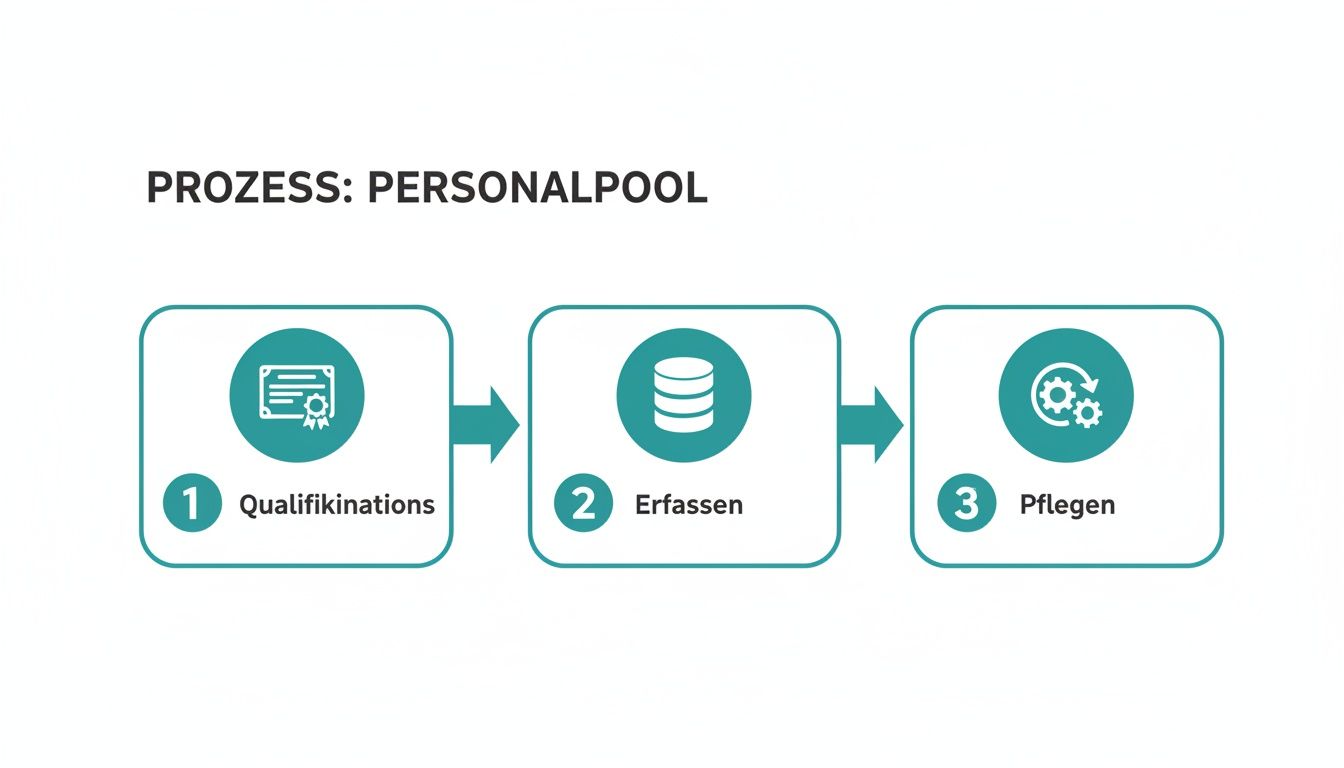
The graphic makes it clear: targeted personnel selection is only possible through the systematic recording and maintenance of qualifications.
Collect and evaluate answers
As soon as the first confirmations arrive, you have to keep track of things. Who agreed? Who else has questions? A simple list or table helps to systematically record the answers.
Request tracking table
| name | Contact (Tel/Mail) | Qualification | Answer (Yes/No/Maybe) | Confirmed |
|---|---|---|---|---|
| Anna M. | 079… | Bartender | Yes | Yes |
| Ben K. | 078… | Service | Maybe (asks for directions) | No |
| Clara S. | 077… | Bartender | No (planned) | No |
This simple method helps you to quickly see who is available and to whom you can send a binding confirmation. The principle is: “First come, first served”, but only if the qualifications are right. Be fair and transparent, even when it comes to rejections. A short message like "Thanks for your quick response! The shift is already occupied, but I'll get back to you next time" creates trust and keeps motivation high.
This combination – clear templates, targeted filters and structured evaluation – makes short-term shift staffing at events a controllable process. Not only will you find staff more quickly, but above all you will find the right staff for every task.
This is how a commitment becomes a binding booking
A quick confirmation via WhatsApp is a good sign, but it is not a guarantee. Especially with that short-term shift staffing for events Now comes the crucial step: you have to turn this commitment into an absolutely watertight booking. This is about professionalism and clear communication to avoid annoying no-shows and misunderstandings.
The key to this lies in a final booking confirmation that leaves absolutely no questions unanswered. This document is much more than just a formality - it is the contract between you and your staff for this one assignment. It creates commitment and signals to your employees that you value their time.
What belongs in a perfect booking confirmation
Incomplete confirmation is guaranteed to lead to queries and, in the worst case, to breakdowns on the day of the event. Your template must therefore contain all relevant details, prepared clearly and clearly.
Imagine an email that bundles all the information. Here is a checklist of the points that should never be missing:
- Exact address of the location: Not just “Messe Zurich”, but “Messe Zurich, Hall 5, North Entrance”. A direct Google Maps link is a small service with a big impact.
- Contact person on site: Who is the direct contact on the day of the event? Provide your name and cell phone number so that someone can be reached immediately in the event of delays or problems.
- Exact working hours: “Around 6 p.m.” is a no-go. Define it precisely: “Meeting point & briefing: 5:45 p.m., start of operation: 6:00 p.m., end of operation: approx. midnight”.
- Dress code: Be as specific as possible. Instead of “black clothing” you write: “Black trousers (no jeans), black shirt/blouse (long sleeves), black, closed and comfortable shoes”.
- Wage payment process: Clarify from the start how and when payment will be made. "Payroll will be paid by bank transfer by the 10th of the following month. Please make sure that your bank details are up to date."
These details may seem petty, but they are the very things that prevent the most common problems. Nothing is more annoying than staff waiting at the wrong entrance or showing up in the wrong outfit.
Commitment through clear deadlines and automation
Always request an active reconfirmation. A simple request at the end of your email such as “Please briefly confirm receipt of this booking and your consent by 6:00 p.m. this evening” creates a clear commitment.
A commitment without a final, confirmed booking is only a declaration of intent. Only mutual confirmation of all details turns it into a reliable plan.
This clear process is worth its weight in gold, especially in the dynamic Swiss labor market. The Federal Statistical Office counted a total in the first quarter of 2025 5.512 million employees in Switzerland. Of these worked 2.265 million (41.1%) part-time – a huge pool of flexible workers, which also makes precise planning absolutely necessary. You can find out more about these labor market figures here Watson.
The entire process – from the first inquiry through the confirmation to the finished deployment contract – can now be intelligently automated. Instead of manually typing emails and chasing confirmations, software like job.rocks take over the entire workflow for you.
The figure shows how shifts are assigned and confirmed in a modern platform, reducing manual effort to a minimum. The system automatically sends booking confirmations and monitors the feedback for you. This way you can concentrate on what really counts: the perfect execution of your event.
Develop contingency plans for unforeseen outages
Despite the best planning, failures will always occur. An important employee calls in sick shortly before the event begins, someone gets stuck in a traffic jam - chaos is inevitable. But only if you don't have a plan B in your pocket. An effective emergency plan ensures that your event does not falter, even if a key person is unavailable.
Instead of panicking and making frantic calls, use a structured process. The goal is not to prevent every failure - that is impossible. The goal is to be able to act immediately in an emergency and to close the gap quickly and professionally.
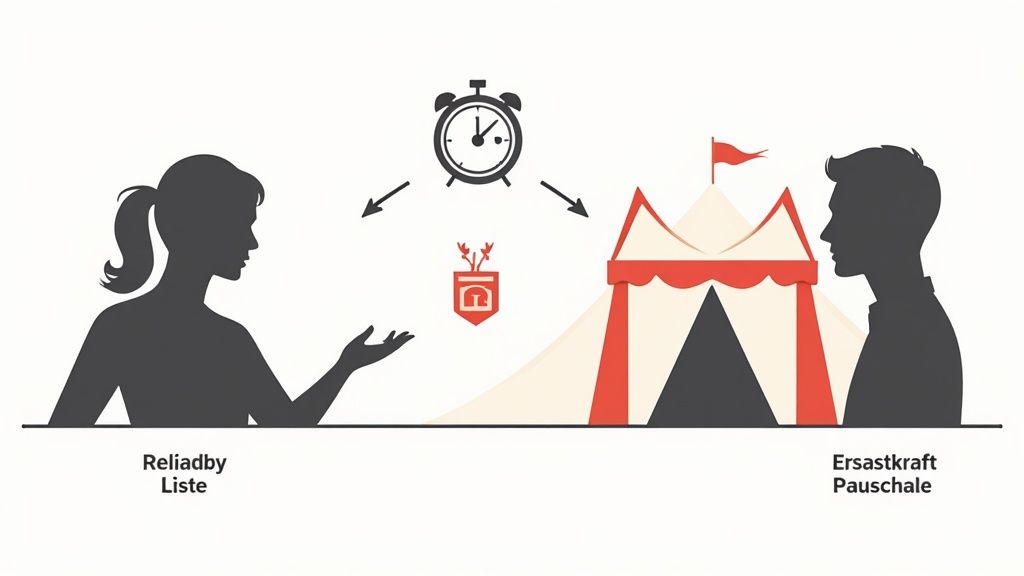
The standby list as your secret weapon
One of the most effective methods for Short-term shift staffing at events is the “standby list”. The concept is simple but ingenious: You define a small group of absolutely reliable employees who are willing to step in at short notice for a flat rate.
These people are your jokers, so to speak. They know they may not be used, but are ready to go when called.
- Set a flat rate: Offer fair compensation for the availability. This can be a fixed amount regardless of whether they are working or not.
- Make clear agreements: Define the exact period of availability and the maximum response time.
- Ensure qualifications: For the standby list, only select all-rounders who can be used flexibly in different positions.
Imagine you are organizing a large festival with several stages. You plan to have two of your best people as standbys per shift. When the bar team leader is unavailable due to an emergency, you call one of these forces within 30 minutes is on site and takes over. The event continues without any noticeable interruption.
Alternative procurement channels in an emergency
Sometimes even the best standby list is not enough, especially during large events or multiple simultaneous outages. That's why you need alternative procurement methods that you can use immediately in an emergency.
Working with a specialized personnel agency is often the answer here. These agencies have their own large pool of workers available at short notice. Build a relationship with one or two agencies in advance.
An emergency plan is like a fire extinguisher: you hope you never need it, but if there is a fire, you're glad it's handy. Define your processes before the fire breaks out.
Such plans are particularly indispensable in industries where shift work dominates. This is evident, for example, in the Swiss health and social services, where the high proportion of shift workers makes short-term absences a direct challenge to service quality. You can find out more about the connections in this sector in the Study by BSS.
Define clear communication chains
In the chaos of an outage, unclear communication is your biggest enemy. Who reports an outage? To whom? Who is responsible for organizing the replacement? These questions must be clarified beforehand.
Establish a clear communication chain:
- Notification of failure: The employee reports directly to a single, central person (e.g. the operations manager). Never with several people at the same time.
- Activation of the emergency plan: The operations manager immediately informs the person responsible for personnel planning.
- Organization of replacement: Personnel planning contacts the standby list first. If no one is available there, the partner agency will be contacted.
This structured process prevents panic reactions and ensures that everyone knows exactly what to do. It's about maintaining control when everything else seems uncontrollable. Proper preparation makes the difference between a minor stumbling block and a full-blown disaster. You can find out more about just-in-time recruiting in our Articles about temporary work and smart planning.
Analyze and optimize the process after the event
The event is over, the team did a great job – but the work is not over yet. Quite the opposite: Now begins the phase that will determine the success of your next missions. Instead of rushing straight to the next project, you should consciously take your time to collect valuable data and impressions.
This is the only way to transform a one-off operation into a learning process and ensure that your... Short-term shift staffing for events works more smoothly every time.

Important metrics you should measure
Gut feeling is a good guide, but hard data is better. In order to truly objectively evaluate your process, you cannot avoid recording a few key key figures (metrics). These numbers show you unvarnished where you stand and where there is still room for improvement.
A high no-show rate could indicate unclear communication. A long time-to-fill rate is often a clear sign that your staff pool is too small or poorly qualified.
Important key figures for measuring success
An overview of the most important metrics to measure and improve the success of your short-term shift staffing.
| Key figure (metric) | What she says | How you calculate them | Target value |
|---|---|---|---|
| Time to fill rate | The speed at which you were able to fill an open shift. | Time from the request to the binding commitment from the staff. | As short as possible, ideally under an hour. |
| No-show rate | The percentage of booked employees who did not show up for assignment. | (Number of no-shows / total number of bookings) * 100 | So close 0% as possible. |
| Occupancy rate | The percentage of actual shifts filled compared to scheduled shifts. | (Number of occupied shifts / Number of planned shifts) * 100 | 100% is the goal. |
| Feedback score | The average satisfaction of your staff with the deployment. | Average rating from a feedback form (scale 1-5). | About 4.5 |
With this data, you create a solid basis for specifically improving your processes instead of poking around in the fog.
Obtain direct feedback from your staff
But numbers alone only tell half the story. The most valuable insights often come directly from the people who were there on the front lines. A short, uncomplicated feedback form can work wonders here.
It's best to send it directly the day after the event, while the impressions are still fresh. The important thing is to keep it short and sweet. Focus on the essential points:
- Was the briefing on site clear and understandable? (Yes/No)
- How do you assess the communication in advance? (scale 1-5)
- Were there any problems or unexpected challenges? (Open text field)
- Would you work for us again? (Yes/No)
This direct feedback helps you uncover weaknesses that would never appear in pure numbers. Maybe the directions were unclear, the local contact person was poorly prepared or the break regulations were a mess.
A simple feedback process not only shows your staff that you value their opinions, it also makes them an active part of your quality improvement.
Evaluate performance and store it in the pool
After the event is before the event. That's why it's crucial to evaluate the performance of your staff. Who was particularly reliable, proactive and received positive customer feedback? Who was constantly late or had difficulty completing tasks?
This information is pure gold for your future planning. Store these reviews directly in the respective person’s profile in your personnel pool. This way, the next time you have an inquiry, you can see at a glance who your top people are and who you can rely on.
A simple star system can be enough here:
- 5 stars: Excellent, always happy!
- 4 stars: Reliable and good.
- 3 stars: Solid, but with small weaknesses.
- 2 stars: Requires more guidance or control.
- 1 star: No longer taken into account for missions.
Through this cycle of data collection, direct feedback and internal evaluation, you create a system that essentially improves itself with every event. In order to continually optimize the process, general ones will also help you Tips to make work easier. This means your shift staffing will become more precise, faster and, above all, more reliable.
Frequently asked questions about shift staffing at events
Here you will find answers to the most burning questions from your everyday planning. We'll go over the typical "what if" scenarios that you'd better have an answer for before they happen.
What do I do if someone cancels at extremely short notice?
A call five minutes before the start of the shift: “I can’t come.” Every event manager knows this moment. First things first: stay calm. Panic only leads to bad decisions. Now a good emergency plan pays off.
Your first move should always be Standby list go. These are exactly the people you have on hand for moments like this. With a bit of luck, someone will be there in a few minutes.
If no one on the standby list answers, plan B comes: your partner recruiting agency. A short, precise call with the most important information – location, time, required skills – can work wonders. Especially in urban areas, agencies can sometimes organize someone within an hour.
How do I deal with unreliable staff?
Unreliability is pure poison for any event planning. Whether someone is notoriously late, constantly canceling at short notice or – worst case scenario – simply not showing up (no-show), you have to be consistent.
Immediately after the event is the right time to note such incidents in the staff profile. A short note like “Canceled twice at short notice” or an internal rating system will help you make a smart decision the next time you receive an inquiry.
A personnel pool is only as strong as its weakest link. Consistently separate yourself from unreliable employees in order to protect the quality and reliability of your entire team.
For repeat offenders, this specifically means pausing their profiles or removing them from the active pool completely. This may sound harsh, but it is absolutely necessary to ensure the quality of your service and the reputation of your brand.
How do I ensure GDPR compliance when storing data?
Storing personnel data in a simple Excel spreadsheet is no longer appropriate today and is legally sensitive. Addresses, bank details or copies of ID cards are also subject to strict data protection rules in Switzerland.
The only safe way is through a professional software solution. These systems are designed precisely to protect sensitive data GDPR compliant to manage.
- Central storage: All data is encrypted on secure servers, not scattered on local computers.
- Clear access rights: You determine who can see and edit which information.
- Self-management by staff: Employees can maintain their data themselves via an app. This creates transparency and reduces your administrative effort.
Be sure to avoid sending documents such as passport copies back and forth via unencrypted email. Professional tools offer secure upload functions that are designed for this purpose.
Should I pay a higher wage for short-term assignments?
Absolutely. A financial incentive can massively increase the willingness to throw your own evening plans overboard.
For shifts that you do with less than 24 hours If you have to fill the lead time, there is a wage premium of 10-20% a strong argument. It is important to communicate this bonus directly and transparently in your request. So everyone knows immediately what it's about.
A practical example that works:
"Urgent: Service worker wanted for this evening, 7 p.m. - 11 p.m.! Due to short-term cancellation, we are paying a bonus: 35 CHF/hour instead of 30 CHF/hour. Who can step in?”
This small surcharge often decides whether a shift remains unfilled or you find someone who is motivated and happy to step in for you.
Are you ready to leave the chaos of shift planning behind you? job.rocks offers you the tools to manage your personnel pool professionally, query availability in seconds and book assignments in a legally secure manner. Automate your processes and regain control.
Discover the smart solution for your event personnel planning now at https://job.rocks