
Staff planning for flexible employees: your guide to smart planning
Good deployment planning for flexible employees is much more than just filling gaps in the roster. It is your strategic tool for reacting quickly to order peaks, keeping team satisfaction high and positioning your company in an agile manner on the market. Why a smart...
A good one Deployment planning for flexible employees is much more than just filling gaps in the roster. It is your strategic tool for reacting quickly to order peaks, keeping team satisfaction high and positioning your company in an agile manner on the market.
Why clever operational planning makes the difference
Imagine an event catering company. There's a huge wedding coming up at the weekend and a small company party during the week. The need for personnel fluctuates extremely. Without well thought-out planning, you will quickly find yourself faced with the usual hurdles.
Short-term failures, unpredictable personnel requirements and the coordination of completely different skills are part of everyday life. Who has the necessary experience as a service manager? Who has a driving license for the van? Juggling all of this manually quickly becomes a nightmare.
More than just a plan
A strategic one Deployment planning for flexible employees But it doesn't just solve organizational headaches. It creates real added value for your team. Ultimately, fair, transparent planning is a sign of appreciation. You show your people that you respect their time and their personal lives.
This is exactly what strengthens employee loyalty and motivation. When your team knows that availability and requests are taken seriously, people are more engaged and reliable. It allows them to better balance work and private life - a factor that is crucial in today's working world.
Flexibility as a strategic advantage
Around people work in Switzerland 1.3 million people in flexible forms of employment. About 14% of Swiss companies specifically integrate flexwork employees into your HR strategy. A seventh of companies even use special flex managers to cleverly cushion workload peaks and skills gaps. You can find out more about these trends in the Flexwork Report.
This trend shows how important an agile personnel pool has become. For you this means specifically:
- Fast responsiveness for unexpected orders or short-term failures.
- Full cost control through staff deployment that is based on actual needs.
- Access to specialists exactly when you really need it.
Good planning is not a rigid process, but a living system. It gives you the security of being prepared for every situation and your team the freedom they want.
In this guide, we will build the building blocks for your perfect deployment planning together. We'll start with the basics, look at how to intelligently manage availability and qualifications, and then dive into the world of automation and self-service. This turns your planning from a time-waster into a real success factor.
Build the foundation of your planning

Before you spend a minute on software and automation, your process needs to be crystal clear. A solid planning basis is the be-all and end-all for a functioning system Deployment planning for flexible employees. It is the foundation on which everything will later be built. And that always starts with an honest inventory: the needs analysis.
Know your staffing needs exactly
The first and most important question is: Who do I need, when and with what skills? Without a precise answer, you are poking around in the fog and planning without real needs. The goal is to systematically record your needs in order to avoid expensive over- or risky under-coverage.
Think of a logistics center. The need for personnel here is anything but static.
- Seasonal peaks: Parcel volumes explode during the Christmas business or before Easter. Here you suddenly need more hands in picking and packaging.
- Weekday fluctuations: Mondays are the day of returns, so inspection of goods must be increased. On Fridays, however, the focus is on shipping in order to get all deliveries on their way before the weekend.
- Current events: A major online retailer announces a 48-hour discount promotion. You know from experience: your package volume will increase in the next two days 30 % rise.
Your task is to recognize exactly these patterns and translate them into concrete numbers. Analyze your past data and derive reliable forecasts for the future. So you know exactly that you are ready for the Christmas season 20 additional temporary staff and every Monday five You have to plan additional staff for returns processing.
Create clear requirement profiles
Once you know how many People you need, you have to define, what these must be able to. A requirements profile is nothing more than a short, precise description of the skills required for a specific task. This is your most important tool for preventing bad appointments and ensuring the quality of your work.
Let's stay in the logistics center. An open shift in the warehouse is not just “warehouse work”. The requirements couldn't be more different:
- Goods receipt: Knowledge of how to use hand scanners and the merchandise management system is crucial here.
- Forklift driver: This role requires a valid forklift license and ideally experience with high racks.
- Picking: What counts most here is speed and accuracy. Special certificates are usually not necessary.
By creating these profiles cleanly and keeping them up to date, you can later specifically search for the right people for the respective shift. You don't waste time asking unqualified employees.
A clear requirements profile is like a filter. It ensures that only the right candidates are considered for a shift, saving you and your employees time and frustration.
Please note the legal framework
Your entire planning must be based on a legally secure foundation. This is especially true in Switzerland Working Hours Act (ArG) clear rules of the game that you must incorporate into your processes from the start. Ignorance does not protect against serious consequences here.
Pay particular attention to these three points:
- Maximum working hours: The daily and weekly maximum working hours are non-negotiable and may not be exceeded under any circumstances.
- Rest times: There must be a legally required rest period between two assignments. Although this can be shortened in some industries, it must be compensated for.
- Break regulations: Breaks are mandatory once you have worked for a certain length of time. The duration is clearly anchored in the law.
These rules are the guidelines for your planning. They must be firmly anchored in your system, ideally in such a way that mistakes cannot even happen. Only when these basics – needs analysis, requirement profiles and legal security – are solid are you ready for the next steps.
Manage availability and qualifications intelligently
Endlessly calling employees to find out who can work when not only costs you nerves, but above all valuable time. Anyone who still relies on call lists or confusing Excel tables today is wasting enormous potential. It's about creating transparency and giving your employees more responsibility.
Imagine a restaurant. There used to be a list in the break room where everyone could sign up for their desired shifts. The result? Chaos, gaps in the schedule and frustration because popular shifts were constantly overbooked. Today, employees enter their availability and desired times directly into an app. As a planner, you can see at a glance who is available and can fill the shifts fairly and according to needs.
Query availability cleverly
Making the leap to transparent planning is easier than many people think. Of course, there are different ways to keep track of things, but not everyone is suitable for every team size or complexity.
The following table shows the most common methods in direct comparison. It helps you take the path that's right for you without getting lost in impractical solutions.
Comparison of methods for availability queries
An overview of common methods for querying employee availability with their respective advantages and disadvantages.
| Method | Advantages | Disadvantages | Ideal for |
|---|---|---|---|
| Shared online calendar | Free, quick to set up. | Prone to errors with many entries, no qualification filters. | Very small teams or extremely simple planning requirements. |
| Spreadsheet | Flexible, customizable, widely used. | Manual maintenance, confusing with complex plans. | Teams that already work intensively with Excel or Sheets. |
| Specialized software | Automated, integrates qualifications, legally compliant. | Costly, requires training. | Companies that want to maximize efficiency and safety. |
For most growing businesses, a specialized software solution is the logical next step. Not only does it prevent double bookings, but it also automatically takes your people's qualifications into account.
An intelligent availability query system gives your team autonomy and gives you back control. Employees feel valued and you have a reliable database for your planning.
Actively manage qualifications
Good deployment planning does not end with mere availability. She has to make sure that the right person with the right skills on right place is. The management of qualifications is therefore not a nice extra, but a central component of quality and security.
A practical example: You plan an experienced forklift driver for an important unloading in the warehouse. A good system will automatically warn you when your forklift license expires in two weeks. This proactive information gives you enough time to remind them about the refresher or schedule a replacement before a bottleneck or even a security risk arises.
This type of administration goes far beyond simply storing certificates. You define clear requirements for each task, which you put into one Requirements profile for your employees hold on. This ensures that the system only suggests people with the right skills for a shift.
Flexible working hours have long been standard in Switzerland. In 2023 almost worked 47,7 % of employees in flexible models. In sectors such as information and communication, the proportion was even higher 77,3 %. These figures from the Federal Statistical Office show how crucial flexible models have become for recruiting skilled workers. More details about Spread of flexible work in Switzerland You can find it directly on the federal government’s SME portal.
Use automation and self-service to save time
Anyone who has ever tried to knit a complex roster in Excel knows the pain. Manual planning not only eats up a lot of time, it is also extremely error-prone. A table doesn't warn you if you accidentally schedule someone without the right qualifications or ignore a statutory rest period. This is exactly where automation and self-service come in and elevate your business Deployment planning for flexible employees to a completely new level.
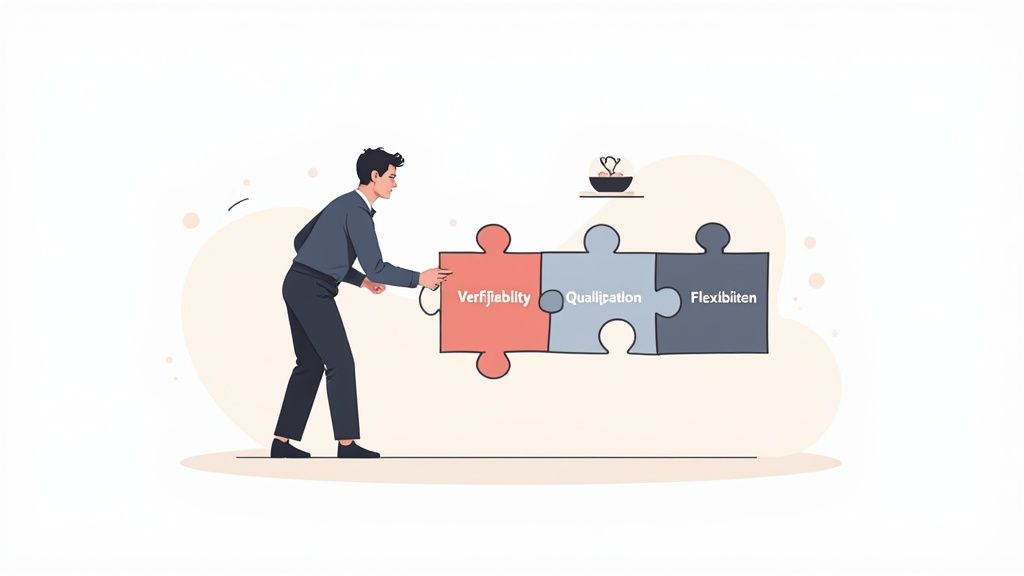
The key is to link availability, capabilities and actual needs in an intelligent system instead of looking at them in isolation.

The graphic makes it clear: Smart planning always starts with clean, reliable data on your team's availability and skills.
Your autopilot for shift planning
Imagine a typical situation in a nursing facility. You have a high level of need, a wide range of qualifications in your team (nursing specialist, nursing assistant, carer) and you have to adhere to strict legal requirements. Instead of manually puzzling for hours, you feed your system the basic rules of the game.
- Rule 1: At least two qualified nursing staff must always be present per shift.
- Rule 2: The statutory rest period of eleven hours between two shifts is inviolable.
- Rule 3: Weekend work should be distributed as fairly as possible among everyone.
Intelligent software automatically creates a draft plan for you based on this. It compares the requirements with the registered availability and the stored qualifications. The system only suggests people who really fit – and immediately sounds an alarm if a rule is violated. This not only saves hours of manual work, but also gives you the security of knowing that you have a fair and absolutely legally compliant plan in your hands.
Give your team more responsibility
The biggest lever for greater efficiency is to actively involve your team in the planning. Employee self-service is the magic word here. Your people can take action themselves using a simple mobile app, which takes a lot of the workload off of you as a planner.
A good example is the classic shift swap. Until now, you were the intermediary who called back and forth between two employees. Using a self-service tool, they make exchange requests directly to each other. You just define the framework conditions:
- Equality of qualifications: An exchange is only possible between employees with the same qualifications. A service worker cannot simply hand over her shift to a cook.
- Approval process: You decide whether an exchange goes through automatically or whether you or the shift manager have the final say.
Self-service means giving up control to gain more control. Your team manages operational details independently, while you can finally concentrate on strategic planning.
Flexibility in the workplace is a huge factor in employee retention. In Switzerland see around 50 % Employee flexibility is one of the most important criteria when choosing a job. By giving your team more autonomy through self-service tools, you not only increase satisfaction, but are also proven to reduce absenteeism and turnover.
From the operational plan to payroll
A smart process doesn't stop with the finished roster. Digital time recording is the next logical step. Your employees clock in and out directly via the app when their shift begins and ends - precisely and seamlessly.
But the real benefit is the seamless connection to payroll accounting. The hours you record and release automatically flow into the payroll system. Manual typing of timesheets is now a thing of the past. This not only minimizes the error rate, but also speeds up the entire billing process enormously. Everything you need to know about the benefits of one Employee app for software and deployment planning We have prepared a further article for you if you need to know.
Measure and improve your planning success
A good one Deployment planning for flexible employees is not a one-off project. It is a living process that you should constantly adapt and improve. To find out whether your strategy is really working, you need to look at the right metrics. This is the only way you can see where things are going smoothly and where you need to readjust.
It’s not about getting lost in complex data. Focus on a few but really meaningful metrics. These give you a clear, quick picture of the health of your planning processes.
Important key figures for your planning
Imagine your planning like a cockpit with different displays. Each of these displays gives you immediate information about a specific, critical area.
- Utilization rate: How well are your planned shifts actually staffed? A high quota is great, but keep an eye on whether the same people are always filling the gaps. This can be a warning sign.
- Cost per shift: How much does an average shift really cost you? This number is pure gold when it comes to better planning budgets and evaluating profitability.
- Sick leave and short-term absences: How often do employees miss work unexpectedly? High rates can be a clear indication of overwork or a lack of satisfaction - both of which are toxic for team morale.
- Time required to create the plan: How many hours do you or your team invest each month in creating rosters? A falling value is an unmistakable sign that your process is becoming more efficient.
Don't look at data as a judgment, but as a compass. They show you the direction in which you should develop your planning in order to work successfully and stress-free in the long term.
Learn from data and act immediately
Let’s look at an example from retail. You evaluate your data from the last three months and realize: The short-term outages on Saturday morning are massive 40 % higher than any other day of the week. This is not a coincidence, but a pattern.
With this knowledge you can now take targeted countermeasures. A possible response would be to set up a special diving pool that is specifically available for critical Saturdays. Or, better yet, talk directly to your team to understand the real reasons for the outages. Maybe the shifts are just too long or the distribution of tasks that day is unbalanced.
Combining your key figures with complete documentation of working hours gives you the complete picture. A precise one Solution for time recording and time tracking is the indispensable basis for this. It gives you the reliable, clean data you need for such analyzes and real improvements.
This turns your operational planning from a reactive, often nerve-wracking task into a proactive, strategic strength.
Frequently asked questions about scheduling flexible employees
When planning operations for flexible teams, the same questions always arise in practice. Here I have summarized the most common challenges and tried-and-tested answers so that you can avoid typical stumbling blocks right from the start.
How do I deal with very short-term requests?
Short-term failures or order peaks are the norm, not the exception. The trick is not to react in an emergency, but to be prepared. My tip: build a dedicated one Springer pool on. This is a solid group of reliable and experienced employees who are known to be flexible and happy to step in at short notice.
Instead of calling individual people in a panic, you send a request specifically to this pool via push message or SMS. Whoever agrees first gets the shift. This approach is not only worlds faster, but also fair and transparent for everyone.
What if no one shows up for an important shift?
An unfilled shift is always critical. But before you increase the pressure, briefly analyze what the problem could be. Is it an unpopular shift, for example late in the evening, physically demanding or with poor public transport connections?
If so, create targeted incentives. A small one often works Shift allowance or a slightly increased hourly rate works wonders. Sometimes it's smart to split the shift. Instead of one person for eight hours, you're looking for two people for four hours each. The hurdle for the individual is significantly lower, which immediately increases the chance of being hired.
How do I ensure fair shift distribution?
Fairness is a valuable asset for your employees. A good planning tool is worth its weight in gold here because it makes fairness measurable. It should show you at a glance who has worked how many weekend or holiday shifts in the last few months.
Transparency is the most direct path to true fairness. When your team sees that the distribution is based on clear data and not gut feeling, acceptance of the entire roster increases.
Define clear rules for assigning popular and unpopular shifts. A simple one Rotation principle can have a big impact here. This way you can ensure that everyone gets a turn and that no one feels systematically disadvantaged.
Are employees allowed to swap shifts with each other?
Yes, absolutely! Changing shifts independently relieves you as a planner enormously and gives your team more autonomy and flexibility. But it's important that you define clear rules of the game so that the whole thing doesn't end in chaos.
- Qualification check: An exchange may only take place between employees with identical qualifications. A bar worker can't just take a chef's shift.
- Approval process: Decide whether a trade is automatically approved or whether you or a shift manager has the final say.
The ideal solution is an app in which employees can submit exchange requests that automatically checks all criteria. You then just have to confirm the suggestion with one click.
Would you like to modernize your operational planning from the ground up and save valuable time? job.rocks offers you all the tools to intelligently manage availability, qualifications and shift planning. Find out more at job.rocks.