
Effective deployment planning in the call center for better results and motivated teams
Good deployment planning in the call center is the be-all and end-all for excellent service, satisfied employees and stable costs. It is the point that determines whether you react flexibly to call peaks or sink into chaos. Why your deployment planning is the key to success You juggle every day...
A good one Operations planning in the call center is the be-all and end-all for excellent service, satisfied employees and stable costs. It is the point that determines whether you react flexibly to call peaks or sink into chaos.
Why your deployment planning is the key to success
Every day you juggle several goals: the service level has to be right, your team has to stay motivated and the personnel costs must under no circumstances explode. Many people still use Excel lists, but quickly realize that they have their limits. The result of rigid planning is almost always the same: overstaffing or understaffing.
Both have painful consequences. Too few staff leads to long wait times, frustrated customers and a team working on the verge of burnout. However, having too many employees on duty causes unnecessary costs and leads to idle time - which can be just as demotivating.
The fine line between chaos and control
Imagine a telecommunications provider launching a new, highly anticipated product. Without forward planning, the hotline will be literally overrun with inquiries on the first day. The result? Agents who are completely overwhelmed, availability that tends to be almost zero, and damage to their image that is difficult to repair. A clever one Operations planning in the call center would have seen this peak coming and planned additional capacity in good time.
Strategic personnel planning is not just an administrative issue. It directly influences the quality of your customer service and the mood in your team.
This need is only made clearer by the continued growth of the call center industry. In Switzerland alone, the market is growing continuously, which inevitably leads to higher call volumes. However, the accuracy of personnel requirement forecasts is often only limited 75-85 percent, which leads directly to the casting problems described.
More than just a shift plan
Truly thoughtful planning goes far beyond simply creating rosters. It takes into account the individual skills of your employees, their wishes regarding working hours and of course the legal requirements. It is the tool you can use to find the perfect balance between operational requirements and the needs of your team.
A good one Operations planning is therefore the foundation for an efficient and healthy working environment. You can find out more about them in our further article Basics of operational planning.
Ultimately, a good organization ensures that the right people with the right skills are there when they are needed most. This is the difference between reactively managing problems and proactively shaping your success.
Meta description:
Are you looking for ways to improve your call center scheduling? Find out how to avoid overstaffing, motivate your team and ensure excellent service. Discover practical tips for planning that really works.
Realistically predict staffing needs and call volumes
Before you even think about the first shift plan, there is a crucial question: When do you need how many employees with which skills? A precise demand forecast is the absolute foundation for any functioning project Operations planning in the call center. Without it, you're just poking around in the fog.
The first logical step is to look in the rearview mirror. Your historical data is a gold mine – if you know where to dig. Analyze the call volumes of the last few months, ideally even the last few years. Keep an eye out for recurring patterns.
This graphic shows all too clearly what happens when this planning is based on shaky foundations:
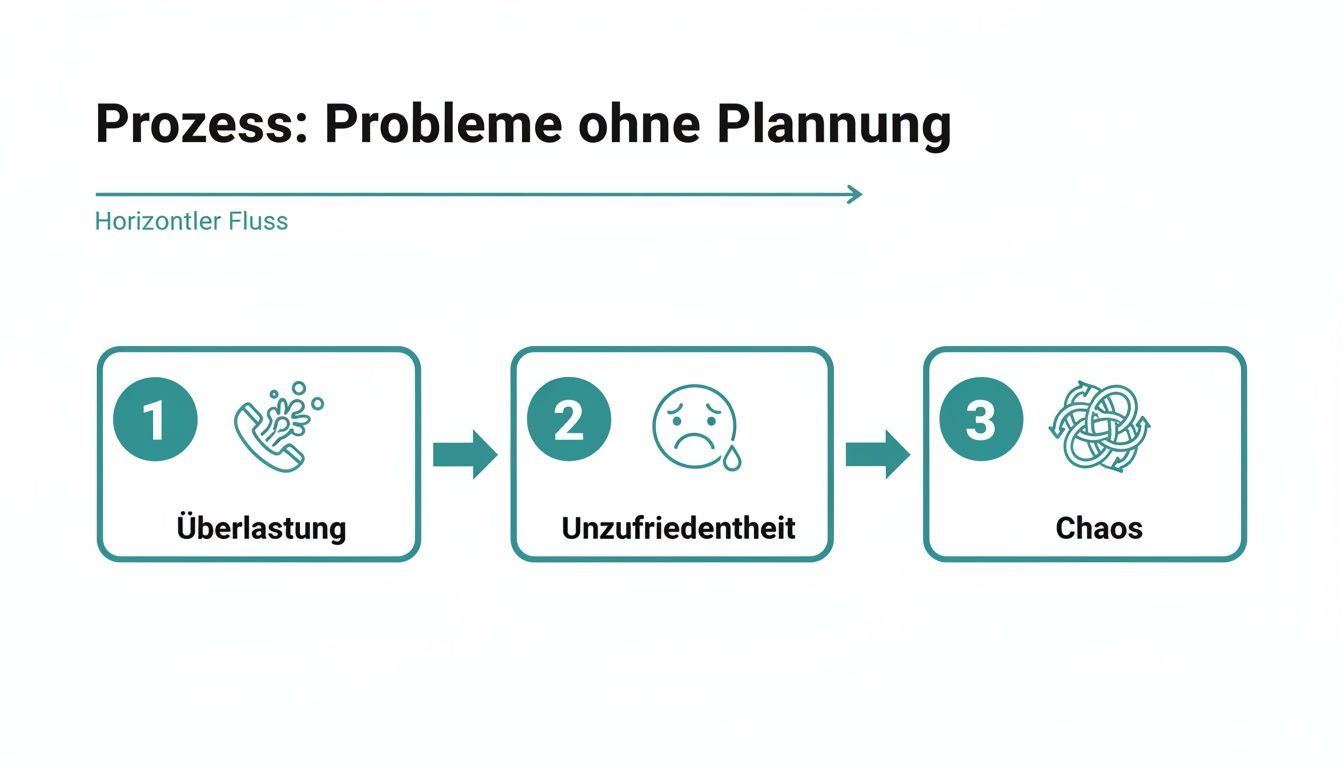
Without a data-based forecast, peak workloads inevitably lead to team overload. The result is a downward spiral of frustrated customers, stressed employees and, ultimately, operational chaos.
Interpret historical data correctly
Don’t just look at the big picture, break the numbers down. Analyze incoming calls per day, per hour and, for maximum precision, even in 15 minute intervals. This way you can immediately unmask the typical peaks, like the Monday morning or the hole after your lunch break.
Focus on these metrics:
- Call volume: The raw number of incoming calls at a given time.
- Average Handling Time (AHT): How long does a contact take on average, including all post-processing steps?
- Seasonal fluctuations: Are there cycles like the holiday season in e-commerce, the summer travel season or the rush after a big marketing campaign?
As a practical example: You control the call center of an online retailer. Your data shows that call volume increases by a whopping amount every year starting in mid-November 40 % increases and only reaches its peak shortly before Christmas. This is crucial information for getting additional staff on board in a timely manner.
The Erlang-C formula in practice
Now things get a little more technical, but don't worry, the principle is simple. The Erlang-C formula has been the standard model for decades to mathematically precisely calculate the personnel requirements in queuing systems - and that is exactly what a call center is.
Luckily, you don't have to do this by hand. Countless online calculators or WFM tools do the work for you. The only important thing is that you supply the right ingredients:
- Number of calls in a certain period of time (e.g. per hour).
- Average processing time per call in seconds.
- Your service level target (e.g. 80 % of calls should go in 20 seconds be accepted).
The calculator then shows you how many agents you need for this period to achieve your goal. This is a fantastic, data-based starting point for all your planning.
An accurate forecast is more than just an estimate. It is your insurance against overloaded lines and frustrated employees. Make decisions based on facts, not gut instinct.
Don't forget external influences
But your historical data only tells half the story. What about events that are new? A major marketing campaign, the launch of a new product, or an unforeseen disruption like a website outage can cause call volumes to skyrocket completely unexpectedly.
Here communication is everything. Communicate regularly with the marketing and product team. If a large-scale discount campaign starts, this must be reflected in yours Operations planning for the call centerreflect - otherwise you will run into overload.
Plan for the shrinkage factor realistically
A classic beginner's mistake is to set the staffing requirements exactly to the calculated number. In reality, your employees are not robots and not 100 % their paid time on the phone. They take breaks, take part in meetings, are in training courses or are absent due to illness.
This planned and unplanned time is called “unproductive” time in technical jargon Shrinking. A realistic value in most call centers is between 25% and 35%. Specifically, this means: If your Erlang C calculation requires 10 If there are people, you should actually rather 13 or 14 plan to cushion these absences and actually maintain your service level.
Comparison of manual vs. software-based forecast accuracy
The quality of your forecast has a direct impact on your most important metrics. The accuracy of Excel-based planning is often massively overestimated.
This table shows the typical differences in forecast accuracy and the resulting impact on key call center metrics.
| Key figure | Manual planning (Excel) | Software-supported planning |
|---|---|---|
| Forecast accuracy | Often +/- 15-20% deviation | Usually +/- 5% deviation |
| Service level achievement | Inconstant, collapses at peaks | Stable and plannable |
| Personnel costs | High buffers due to overstaffing | According to needs |
| Employee satisfaction | Stress due to overwork | Balanced workload |
The numbers speak for themselves: While manual methods often lead to expensive overstaffing or service-killing understaffing, data-supported software enables much more precise control.
Modern systems are designed to manage all of these complex variables. Find out more about how to have a good one in our guide Workforce management software can support you with the forecast and the actual operational planning. This way you can ensure that your planning not only looks good on paper, but also stands up to the rigors of everyday life in the call center.
Develop flexible shift schedules and skill-based assignment
The forecast is correct, the numbers are solid. But that's only half the battle. Now comes the real art of it Operations planning in the call center: putting the right people in the right place at the right time. It's about creating shift schedules that meet operational needs while respecting the wishes of your team.
A rigid 9-to-5 schedule has long been obsolete in most call centers. What counts today are flexible models. These can be flexible starting times, split shifts to cover peak loads or even compressed working weeks. The trick is to develop a pool of shift patterns that you can draw from depending on your projected call volume.
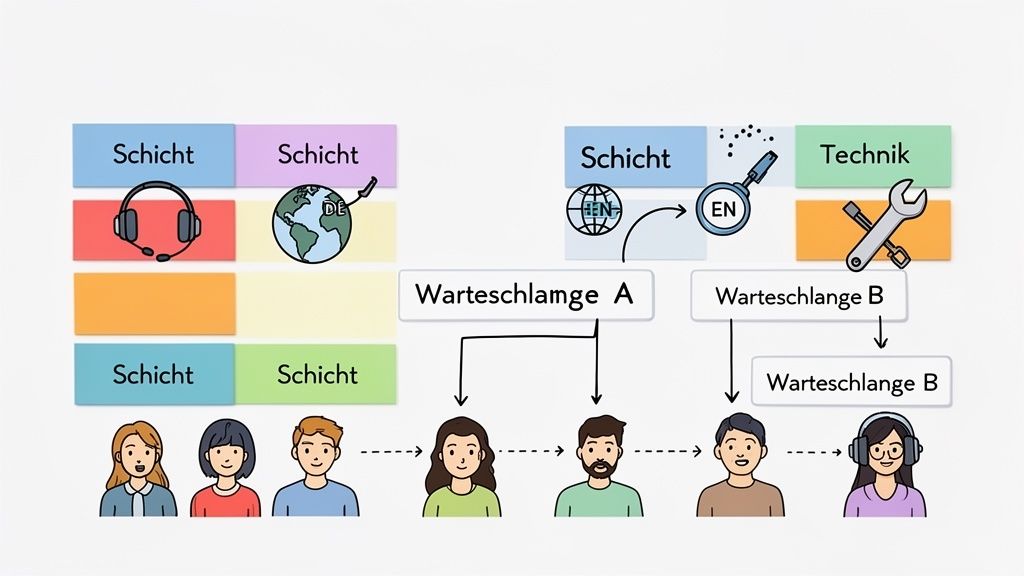
Skills as the foundation of your planning
Imagine the classic scenario: A customer with a complex technical problem ends up with an agent who actually specializes in sales. The result? Redirects, longer wait times and an increasingly frustrated customer. This is exactly where skill-based assignment comes in, better known as Skill-based routing.
Instead of seeing all employees as a homogeneous group, divide them according to their core competencies. This requires an honest assessment at the beginning: Who in the team speaks which languages fluently? Who knows product A down to the last detail? And who is an ace at dealing with angry customers?
Once you have created these profiles, you can assign them to the appropriate call queues.
- Language skills: Calls from France go directly to French-speaking employees.
- Technical know-how: Specific questions about software are immediately sent to the product experts.
- Sales talent: Inquiries about new contracts are routed to your sales team.
- Complaint management: Escalations are handled by your most experienced de-escalation professionals.
This targeted distribution not only makes everything faster, it also demonstrably increases the speed First Call Resolution Rate. If the first contact leads directly to the goal, unnecessary redirections are eliminated and customer satisfaction increases noticeably.
The right mix of generalists and specialists
However, purely specialized planning also has its pitfalls. What happens when all of your tech specialists are talking, but there's a lull in the general queue? The solution, as so often, lies in the golden mean.
You need a solid base Generalists, which can cover a wide range of standard queries. They are the backbone of your team. At the same time you are building Specialists for complex or particularly important topics. Fortunately, modern telephone systems allow you to assign employees multiple skill sets. An agent can be primarily responsible for general inquiries, but can also take on technical support calls if necessary when specialist colleagues are busy.
Thoughtful, skills-based planning transforms your call center from just a call receiving point into a center of excellence. You specifically use the strengths of your team to solve problems faster and better.
In the Swiss call center industry in particular, fluctuation has been a major challenge for years, making any planning difficult. Although the rate is below 7.1 percent is moderate in comparison, the increasing volume of calls is causing a high level of stress. A precise one Operations planning in the call center, which takes individual abilities into account, is therefore not a luxury but a necessity. Read more about how modern tools to quickly find suitable employees.
Incorporate employee wishes fairly and transparently
A shift schedule that completely ignores the wishes of employees is a surefire path to poor morale and high levels of absenteeism. Fair planning that takes preferences into account, on the other hand, increases motivation and loyalty to the company.
How does this work in practice?
- Availability queries:Use digital tools to regularly check when your employees can or want to work. This is worth its weight in gold, especially for part-time employees or students.
- Wish books or preference systems: Give your team the ability to specify preferred shifts or days off.
- Fair rotation principles: Make sure that unpopular shifts – such as late Friday evenings or weekends – are distributed fairly within the team.
- Shift exchanges: Enable employees to easily swap shifts with each other. This gives you more flexibility and takes the workload off of you as a planner.
Sure, not every wish can be fulfilled; operational needs take priority. But just the fact that you actively seek out your team's preferences and try to accommodate them makes a huge difference.
Example from the travel industry
A tour operator operates a multilingual service center for customers from all over Europe. During the peak booking season in spring, call volume explodes.
- Demand forecast: The analysis shows clear peaks in the morning (for rebookings) and in the early evening (for new bookings). There is also a massive increase in the need for Italian and Spanish-speaking agents.
- Capability-based planning: The company specifically uses multilingual employees for these time slots. Incoming calls are automatically routed by language.
- Flexible shifts: In order to cover the evening peak, additional late shifts are offered - a model that is extremely popular with student temporary workers.
- Result: Waiting times for non-German-speaking customers are drastically reduced. The first-time solution rate increases because customers immediately speak to someone who understands their language and is familiar with the country-specific offers. Customer satisfaction improves measurably.
This practical example shows how a well thought-out Operations planning in the call center, which combines flexible models with skills-based allocation, directly impacts your business goals.
How self-service tools relieve your team and your planning
A modern one Operations planning in the call center is no longer just about perfect coverage and optimized costs. It's about giving your team more control and flexibility. Imagine no longer having to chase down every vacation request or manage endless email chains for a simple shift swap. This is exactly where self-service tools come in and relieve you and your team of an enormous amount of administrative work.
Instead of fighting your way through paperwork and confusing tables, you put standard processes directly into the hands of your employees - via an intuitive employee app or a web portal. This not only creates freedom for you, but also strengthens personal responsibility and satisfaction in the team.
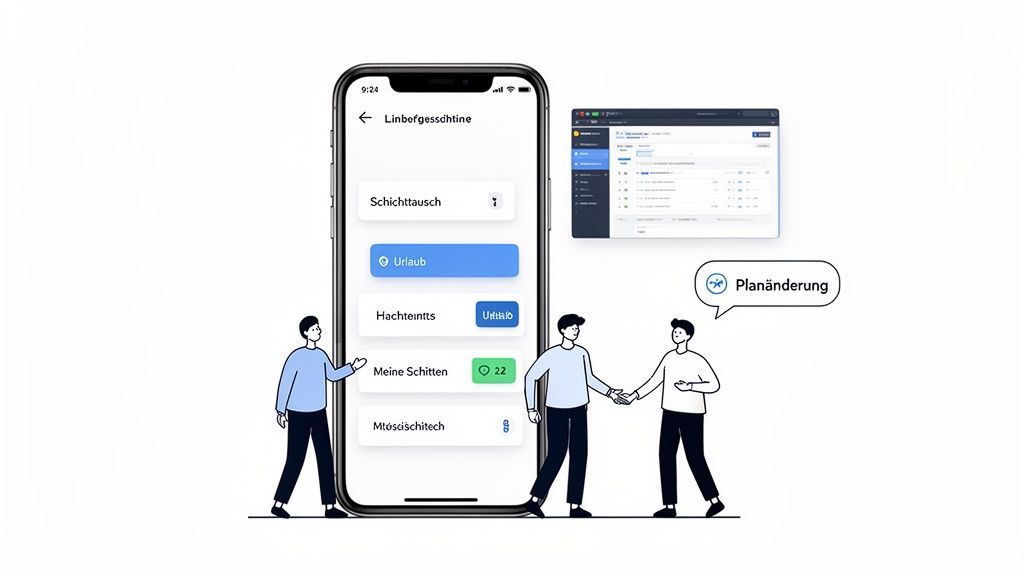
More flexibility through digital tools
The administrative effort surrounding shift planning can quickly get out of hand. Employee apps completely transform this process by giving your team direct opportunities to participate.
A few of the most important functions that immediately make everyday life easier:
- Digital shift exchanges: An employee unexpectedly cannot work? Instead of calling you, he simply makes his shift available in the app. Qualified colleagues see the offer and can take over the shift directly - often without any intervention on your part.
- Vacation and absence requests with a click: Your team can submit vacation requests directly in the app and immediately see how many days are still available. You approve it with one click and the plan is automatically updated. No more paperwork.
- Mobile time recording: Logging in and out via smartphone makes time recording precise and uncomplicated. This reduces errors and simplifies payroll enormously.
- Manage availabilities yourself: Your team independently enters their availability and preferences for upcoming planning periods. This gives you a much better and more realistic basis for creating rosters.
These tools lead to noticeably greater agility in your planning. Especially in Switzerland, where call centers operate on record days with up to 3,500 calls This flexibility is crucial. Modern mobile apps for self-service and shift swapping can improve organizational agility 20-30 percent increase and help to achieve the desired plan conformity 95 percent easier to reach. More about the Challenges and solutions in Swiss call center operations you can read about it here.
Transparency creates trust and avoids errors
Misunderstandings about working hours are one of the most common sources of frustration in a team. Who is on duty when? Was the change in plans from last week really communicated to everyone? Self-service portals solve this problem elegantly.
Everyone in the team has access to the latest roster at any time, directly on their own smartphone. This creates a clear and authoritative source of information for everyone.
Automatic notifications via push messages are a real advantage.
- A shift is changed? All affected employees will receive information immediately.
- A new shift is available? Interested colleagues will be notified.
- A shift starting soon? An automatic reminder helps ensure punctuality.
This transparency prevents double planning, missed shifts and the eternal "I didn't know about that". Everyone is on the same page, which noticeably improves collaboration. Like one Employee app for scheduling We'll show you exactly how it works in another article.
Practical example from the healthcare sector
A service provider that coordinates flexible part-time staff for medical hotlines faced a huge challenge. The manual coordination of hundreds of employees with different availability and qualifications was extremely time-consuming and error-prone.
After the introduction of a self-service portal, the situation changed fundamentally:
- Availabilities: Employees now maintain their availability independently in the app.
- Shift offers: Open shifts are sent via push notification to all qualified and available staff.
- Quick occupation: Interested employees can apply for the shift by clicking on it. The system awards the contract automatically according to predefined rules.
The result was impressive: the administrative effort for planners fell by almost half. At the same time, employee satisfaction increased because they can now organize their work in a much more flexible and self-determined manner. Compliance with plans improved significantly and short-term failures became a rare exception. A perfect example of how employee self-service works Operations planning in the call center accelerated and at the same time strengthen personal responsibility.
Meta description:
Would you like to relieve your scheduling in the call center? Discover how self-service tools like employee apps and digital shift exchanges reduce administrative effort, increase flexibility and make your team happier.
Ensure legal framework conditions and data protection
A perfectly coordinated one Operations planning in the call center It doesn't do you any good if it's legally on shaky ground. In Switzerland in particular, there are crystal-clear labor law requirements and strict data protection rules that you definitely need to keep on your radar. But don't see it as an obstacle, but rather as a fair and necessary framework for you and your team.
To be honest, ignoring these rules can quickly become very expensive - from severe fines to reputational damage that lasts for a long time. Your planning must therefore not only be clever and tailored to your needs, but also 100 % waterproof.
Keep an eye on Swiss labor law
The Swiss Labor Law (ArG) is not a toothless tiger. It sets clear boundaries to protect your employees from overload, and these rules are non-negotiable. Every individual shift plan must take them into account.
Here are the most important points you need to know for your planning:
- Maximum working hours: Depending on the industry, the maximum weekly working hours are: 45 or 50 hours. Overtime is the absolute exception and is only permitted under strict conditions - not the standard tool for dealing with spikes.
- Break regulations: The law prescribes breaks, quite clearly. Anyone who works more than seven and a half hours is entitled to 30 minutes. Important: These are unpaid rest periods that cannot simply be slapped on at the end or beginning of the shift.
- Daily rest time: Between two shifts there must be an uninterrupted break of at least 11 hours lie. So you can't put someone from the late shift straight back into the early shift. This is an absolute no-go.
- Night and Sunday work: These special shifts require approval and must be compensated for with wage or time surcharges. Particularly strict protective regulations apply here - find out more carefully before you plan something like this.
Data protection when processing employee data
As soon as you process your employees' data digitally - and you do this constantly when planning deployment - the Data Protection Act (DSG) comes into effect. This affects everything: availability, sick notes, performance data or vacation requests.
A deep understanding of relevant Privacy Policy is essential to work cleanly here. At the top is the principle of Data economy. So only collect the data that you really need for effective planning and not everything that would be technically possible.
Transparency is the key to trust. Your employees have the right to know what data you collect, for what purpose, and how you protect it.
Imagine if your software also collected performance data like average call time (AHT). Then you have to communicate crystal clear that this data is used to improve service and fair deployment planning - and not for complete monitoring. For tools like digital time tracking or an employee app, you need clear, informed consent from your team. It doesn't work without it.
Checklist to check your processes
Take a moment and go through your processes with this checklist. It helps you quickly identify weak points:
- Consent: Do you have written consent from your employees to process data for operational planning?
- Obligation to provide information: Do you know for sure that everyone on the team is aware of what data is being collected and what it is being used for?
- Data security: Is the data protected from unauthorized access? Are they stored securely and actually deleted after the legal deadlines have expired?
- Labor law: Does each individual shift schedule adhere to the requirements for breaks, rest periods and maximum working hours - even those that are changed at short notice?
- Contracts: Are regulations regarding overtime or weekend work clearly anchored in the employment contracts?
Case study from practice
An energy supplier's call center got into massive trouble because it repeatedly ignored labor law during planning. In order to cover short-term call peaks, employees were regularly assigned to double shifts. The statutory rest period was: 11 hours systematically undercut.
After an audit by the labor inspectorate, the company not only had to pay heavy fines, but also its entire fine Operations planning in the call center set up again. The damage to the team's image and loss of trust was enormous. The bitter thing about it: With modern planning software that automatically detects and blocks such rule violations, none of this would have happened.
The most burning questions from everyday planning
In everyday operational planning, the same tricky questions arise again and again. Here I have collected the most common ones for you and will give you tried-and-tested answers.
Unexpected call peaks – what now?
Peaks are the natural enemy of even the most perfect shift plan. You can't always predict them, but you can prepare yourself. A clever strategy consists of several building blocks:
- Flexible staff pools: Build a pool of part-time workers, students or freelancers. You can activate these people at short notice if necessary.
- Training skill overlap: Train your employees so that they can cover multiple topics. If the technology hotline is overloaded, colleagues from first-level support step in. This creates enormous buffers.
- Fast communication channels: Set up a direct line to your team, such as a chat group. Here you can offer free shifts at short notice if the queue explodes.
Imagine that a disruption in the online shop causes a flood of calls. Instead of panicking, send a push message to your temporary pool: “Urgent support for the next ones3Searched for hours!" This is how you catch the top without overloading your core team.
How do I take employee wishes into account fairly?
Anyone who ignores the needs of their team reaps frustration and high fluctuation. Fairness is the be-all and end-all here. Modern planning software is your best friend because it helps you to treat your wishes systematically and fairly.
A fair process is more important than the fulfillment of every individual wish. When your team sees that you are making an effort and acting transparently, acceptance of the finished plan increases enormously.
A practical tip: introduce a points system. Anyone who takes on an unpopular weekend shift will be credited with points that they can later redeem for a Friday of their choice. This creates a balance that is understandable for everyone.
The biggest mistake in shrinkage planning?
The most common mistake I see: planners assume a shrinkage value that is far too low - or don't take it into account at all. Many think a buffer of 10–15 % be generous. However, the reality in most call centers shows that the actual value is often 25–35 % lies.
Why? Because everything comes into play here: breaks, training, meetings, system failures and of course short-term sick leave. A value that is too low will inevitably lead to your service level collapsing at the slightest deviation. On paper you may have enough staff, but in practice there are far too few people actually on the phone.
How do I convince my team to use new planning software?
Change often triggers skepticism at first, that's normal. The key to acceptance is to clearly emphasize the benefits for employees - not just those for the company.
Emphasize the new freedoms and possibilities:
- More flexibility: "You'll soon be able to swap shifts with colleagues easily via the app."
- More transparency: "Your roster is available to you in real time, anytime, anywhere."
- More participation: "You can enter your holiday wishes yourself at any time and follow the status live."
My advice: get your team involved as early as possible. Form a small project team with a few experienced agents. When they experience the benefits themselves, they become the best ambassadors for the new system.
Operations planning in a call center is full of challenges. We have summarized the most frequently asked questions for you here.
| Question | Answer |
|---|---|
| How do I deal with sudden call peaks? | Ideally with a mix of flexible personnel pools (e.g. part-time workers), skill overlap in the existing team and fast communication channels for short-term assignments. |
| How can I treat employee requests fairly? | Transparency is key. Use tools that systematically record wishes and create fair rules, e.g. B. a points system for unpopular shifts. |
| What is the most common shrinkage planning mistake? | Setting a value that is too low. Realistic values are often included 25–35 %, not the ones that are often assumed 10–15 %. |
| How do I successfully introduce new software? | Focus on the benefits for employees (flexibility, transparency) and involve them in the process early on to create acceptance. |
These questions show how complex planning can be - but also that there is a suitable solution for every hurdle.
Are you looking for a solution that overcomes all these challenges and makes life easier for you and your team? job.rocks offers you an integrated platform for intelligent and legally compliant deployment planning. Discover how you can take your planning to the next level with automated processes and an intuitive employee app. Find out more at job.rocks.