
Practical guidelines for deployment planning for medical services
Well-thought-out deployment planning for medical services is the backbone of every successful deployment. It decides whether your team can act well and safely at a large festival or company event - or sink into chaos. Without a systematic approach, you risk overloading...
A well thought out one Operations planning for medical services is the backbone of every successful operation. It decides whether your team can act well and safely at a large festival or company event - or sink into chaos. Without a systematic approach, you risk overloaded staff, gaps in supply and, last but not least, legal problems.
Why good operational planning makes the difference
Imagine planning a three-day music festival. You juggle shift schedules, qualifications, vehicles and short-term cancellations. Anyone who still relies on Excel lists will quickly lose track and make mistakes. The result? Stress on site and a compromised quality of care.
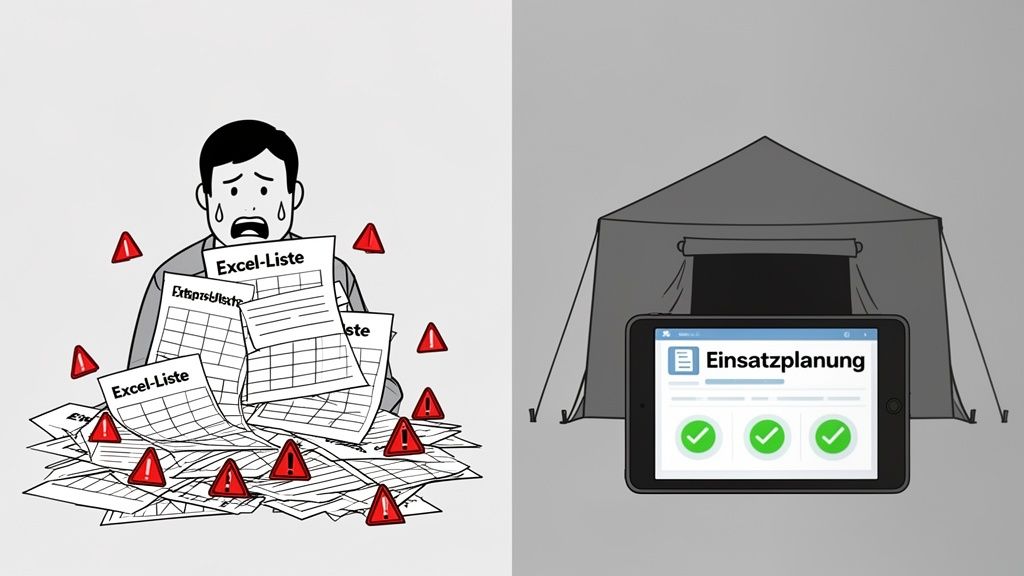
Switching from manual methods to specialized software is no longer a mere relief, but a strategic necessity for every professional medical service. It's about guaranteeing security without getting lost in administrative effort.
The limits of manual planning
In daily work, challenges lurk everywhere that push manual planning to its limits:
- Fluctuating personnel requirements: A sporting event needs a different team than a concert. Manual plans are rigid - every small adjustment becomes a Sisyphean task.
- Complex qualifications: You need to ensure that the right mix of paramedics, first responders and incident commanders are always on site. Who keeps track of things in a table?
- Short-term outages: A case of illness shortly before the start of a mission can bring an entire plan crashing down. Especially if you don’t have a quick overview of available and qualified replacement workers.
Inadequate planning is not just an organizational problem – it is a security risk. It creates gaps in the supply chain and increases the burden on the entire team.
The jump to a digital solution
Modern tools take this headache away by automating many steps. They help you keep an overview and react to changes quickly. This not only makes your deployment planning easier, but above all more precise and reliable. A look at how the use of Generative AI in healthcare Making processes more secure today shows the enormous potential.
The numbers speak for themselves: the Swiss rescue services carry out an enormous range of operations that can hardly be managed without smart planning. Until 2023 there were over 551,000 missions. In Zurich alone, Protection & Rescue will move forward in 2024 36.444-times out. Such volumes require tools that control flexible employee pools as needed and in compliance with GDPR - and reduce the administration effort by up to 50 % can reduce. You can find out more about this in the data from the Swiss Health Observatory their website.
The end result is a well thought out one Personnel scheduling the key to mastering these complex requirements while maintaining the quality of your services at the highest level.
Identify needs and manage qualifications correctly
The first and most important step for effective operational planning in the medical service is always a thorough analysis of the needs. Before you schedule a single helper, you need to understand exactly what to expect on site. Every event is unique – a city marathon has a completely different risk profile than the wine festival in the neighboring village.
A precise assessment of needs not only protects the health of the participants, but also protects your team from overload and chaotic conditions. Your goal must be to position exactly the right number of forces with the right skills exactly where they are needed in an emergency.
Event analysis as a basis
To get a clear picture, systematically break down the event into its individual parts. This is the only way you can realistically estimate how many paramedics with what training you really need.
It's best to start with these key questions:
- Type of event: Is it a sweaty sporting event, a loud concert, a dignified company party or a public meeting? Each format carries its own specific risks.
- Expected number of visitors: The size of the audience is a direct lever for staffing requirements. 10'000 Visitors in a confined space require completely different planning than 500 invited guests at a gala.
- Risk profile: Are there any particular sources of danger? Think about factors such as alcohol consumption, extreme weather conditions, the use of pyrotechnics or top sporting performances that can lead to circulatory problems.
- Venue and duration: A spacious open-air area calls for mobile teams, while a single hall might get by with a fixed post. A festival lasting several days also has completely different logistical requirements than a four-hour concert.
A classic mistake that I see again and again: the need is assessed too optimistically. Be sure to plan a buffer for unforeseen events. A sudden change in the weather or a small technical incident can change the situation on site in an instant.
To systematize this process, I developed a checklist. It helps you not to miss any important points.
Checklist for determining needs for medical services
This table helps you to systematically check all the important points for the personnel requirements analysis of an event.
| category | Aspects to be examined | Example (music festival, 10,000 visitors) |
|---|---|---|
| Event framework | Type of event, expected number of visitors, duration | Concert, rock/pop, 10,000 people, 8 hours |
| Risk factors | Alcohol consumption, weather forecast, special dangers | High alcohol consumption, summer heat expected |
| Terrain | Size, topography, accessibility, number of stages/areas | 20 acres, flat, multiple entrances/exits, 2 stages |
| Infrastructure | Medical rooms, water points, escape routes | 1 medical tent, 4 water points, clearly defined escape routes |
| Legal | Official requirements, requirements of the organizer | Cantonal regulation: 1 medical post per 5,000 visitors |
| Target group | Age, behavior (e.g. dancing, sitting) | Mostly 18-30 years old, standing, dancing |
With this systematic recording you have a solid basis for defining the appropriate roles and the necessary team strength in the next step.
Define roles and qualifications
As soon as the framework of the event is clear, it's time to get down to business: defining the specific roles. Each role is firmly linked to specific tasks and the necessary qualifications.
A typical team for a medium-sized event might look like this:
- Operations manager: Coordinates the entire team on site, is the central contact for the organizer and the emergency services organizations and makes strategic decisions in the chaos.
- Paramedic HF: Provides medical care in more complex emergencies and often leads smaller teams or medical posts.
- Transport Paramedic FA: Supports with care and is responsible for the safe transport of patients.
- First aider (IVR 2/3): Provides important first aid for minor injuries and immediately reports more serious cases to the qualified staff.
Filling these roles is becoming increasingly challenging, as the shortage of personnel in the Swiss healthcare system does not stop at the emergency services. stayed at the end of 2023 7,1 % of positions for qualified paramedics are vacant, while the capacity utilization of the services is increasing 79 % climbed. Forecasts indicate further growth in stakes 18 % until 2050. Razor-sharp planning is therefore not optional, but absolutely crucial in order to make the best possible use of scarce resources. You can find out more about the background in the report The Swiss rescue system in numbers.
Manage qualifications digitally
You not only have to know who has what training - you also have to be able to prove it completely and at any time. Expired certificates are not just a planning error, but also an enormous legal risk. Imagine that you are organizing the medical service for a large company marathon and have to prove to the organizer at short notice that all of the staff involved have the required qualifications. Paper chaos? Not a good idea.
This is where a digital solution comes into play. With software like job.rocks you can store all evidence, certificates and training centrally and digitally. The system automatically warns you when a qualification is about to expire. During the actual planning, it only suggests personnel who are actually qualified and available for the respective role. This way you avoid embarrassing mistakes and have all documents immediately to hand in the event of a check or query. This approach to digital administration can also be transferred to other personnel-intensive areas, as you can see in our article on Deployment planning in outpatient care you can read.
This systematic approach - from thorough analysis to clear role definition to digital management - forms the stable foundation on which your entire operational planning for medical services stands.
Create shift plans and communicate within the team
Okay, the needs have been identified and the qualifications have been defined. Now comes the operational core of yours Operations planning for medical services: creating shift plans. This is where you decide whether you have the right people in the right place at the right time - fairly, transparently and of course in accordance with the law.
A good shift plan is so much more than just a table with names. It has to reconcile break regulations, legal maximum working hours and, ideally, the wishes of your team. Without a clever system, it quickly becomes a frustrating puzzle game that costs you hours and ultimately only causes dissatisfaction.
Use templates for recurring assignments
Imagine running the same concert series every summer. The requirements are usually very similar: a certain number of medical posts, mobile teams, a permanent staff in the operations center. Instead of starting from scratch every time, you can save a lot of time here.
Using digital planning tools, you create a one-time template for this “standard deployment”. In it you define all shifts, the associated roles and the required qualifications. For the next concert, simply load the template, adjust the date and release the shifts to the cast.
A practical example of a concert series:
- Template "Rock Concert 10k":
- 1x operations manager (8-hour shift)
- 2x paramedic HF (2x 6-hour shifts each with overlap)
- 4x first aiders IVR 2 (2x 6-hour shifts each)
- You duplicate this template for each concert date. The structure is in place, you just have to assign the right people.
This approach drastically reduces administrative effort. At the same time, you ensure consistently high quality in your planning because no important positions are forgotten.
The key to quick planning is not reinventing the wheel every time. It lies in recognizing recurring patterns and converting them into standardized, reusable processes. This creates space for the really important tasks.
Rethink communication in the team
The biggest hurdle in shift planning is often not the plan itself, but everything surrounding it. Who can and when? Who missed the email with the change of plans? Who will step in at short notice? This manual query via phone, email or WhatsApp group is a guaranteed recipe for chaos.
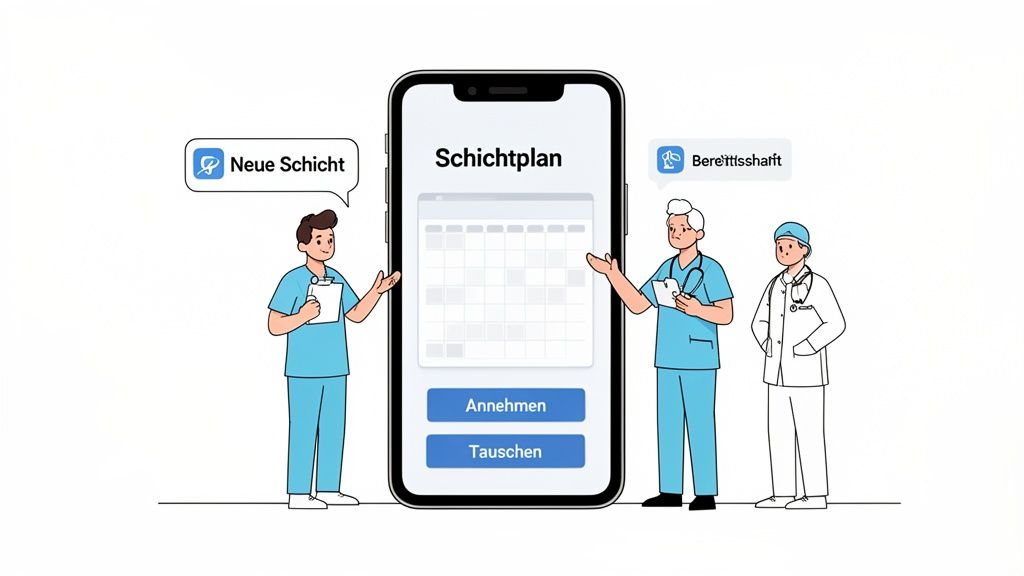
Here, a central, mobile solution completely changes the rules of the game. Let’s take the concert series example again. Instead of sending dozens of messages, the process suddenly works completely differently with an employee app:
- Post shifts: You publish the open shifts for the concert dates in the app. All qualified employees immediately receive a push notification on their cell phone.
- Report availability: Your team sees all open shifts and can apply for the shifts that fit their calendar directly in the app. You can see at a glance who is interested and available.
- Assign and confirm: You assign the layers with one click. Employees receive a definitive confirmation and the service automatically appears in their personal app calendar.
Misunderstandings caused by overlooked emails or outdated Excel lists are now a thing of the past. Everything is documented in a central location and can be clearly viewed by everyone involved at any time.
Flexibility through employee self-service
Life is unpredictable. An employee gets sick and an important private appointment comes up. In the past, this meant making phone calls, finding a replacement, changing the plan manually and informing everyone. Modern deployment planning software gives your team the tools to solve such situations largely independently.
A so-called Shift swapping function allows employees to swap their assigned services with each other. The process is simple and safe:
- A paramedic can't do his shift at the concert.
- He offers the shift for exchange directly in the app.
- A colleague with the same qualifications sees the offer, it suits her well and she accepts it.
- As a planner, you will receive a notification and just have to finally confirm the exchange.
This takes a lot of pressure off of you as the person responsible for planning, promotes personal responsibility in the team and ensures that shifts are quickly filled again even in the event of short-term cancellations. Your entire Operations planning for medical services This makes it more agile and resilient. You are no longer the bottleneck, but the moderator of a self-organizing system.
Make legal certainty and documentation GDPR-compliant
A clean one Operations planning for medical services doesn't stop with the finished shift plan. What happens in the background is at least as important: the legally compliant documentation. You are moving into an extremely sensitive area here, because it involves health data and the personal information of your employees. Mistakes can be really expensive – not just financially, but also in terms of the trust of your team.
The General Data Protection Regulation (GDPR) is not a bureaucratic monster, but rather your guide for the clean handling of data. Ultimately, it's about working transparently and only collecting the information that you really need to plan and carry out your operations.
What you need to know and remember
Essentially, you need to have three central data categories absolutely under control:
- Personal master data: Name, address, contact information – the basics for every personnel file.
- Proof of qualifications: Things get more exciting here. You not only have to record diplomas, certificates and training courses, but you also have to actively monitor their validity.
- Operational data: Working and break times, assigned roles and of course the associated operational protocols.
For medical services in particular, it is crucial to know the special requirements. They often act as part of the critical infrastructure (KRITIS), which underlines the social significance of their work. At the same time, this increases the pressure to ensure absolutely complete and understandable documentation.
The principle of data economy is your best friend. For every piece of information you request, ask yourself: “Do I really need this to plan and bill for the operation safely and legally?” Anything you answer “no” to is unnecessary and only increases your legal risk.
The complete change log as proof
Imagine the classic scenario: A paramedic calls in sick two hours before the start of his shift. You have to react quickly, organize a replacement and adjust the plan. Without a clean changelog, this can become a problem later. Who changed what and when? Why was the shift reassigned?
A digital solution automatically logs every single change with a time stamp. This Audit trail is worth its weight in gold in the event of a dispute. You can always provide complete evidence of who was informed, when and why which decision was made. This protects you from unjustified claims and creates the necessary clarity for everyone involved.
Manual vs. digital deployment planning in comparison
The direct comparison quickly shows where the pitfalls lie with traditional methods such as Excel lists and email traffic and how a specialized software solution can elegantly avoid them.
| aspect | Manual planning (Excel, email) | Digital planning (software like job.rocks) |
|---|---|---|
| Changelog | Not available, manual notes required | Automatic, seamless and tamper-proof |
| Data protection | High risk due to unsecured files | Central, access-protected storage |
| Time tracking | Manual, error-prone, difficult to detect | Digitally via app, legally secure and precise |
| communication | Confusing, no traceability | Centralized, documented and fast |
The table makes it clear: manual processes are not only more complex, but also a legal minefield.
Time recording as legal proof
How do you prove that your employees took their breaks? How do you calculate overtime correctly? Paper timesheets are not only cumbersome, but can also be easily disputed in case of doubt.
Mobile time recording via an app solves this problem in an elegant way. Your team members clock in and out directly at the location - simply via smartphone. The data flows into the system in real time and forms the basis for correct and punctual payroll. This not only saves you a huge amount of administrative effort, but also gives you the necessary legal security. You always have valid proof of the hours actually worked.
This form of digital communication is standard today, but there are legal frameworks here too. In our guide to SMS text messaging at work You will find further useful tips for legally compliant communication.
In the end, clean, digital documentation ensures that you can concentrate on what's important: providing first-class care for your patients.
The complete process from planning to billing
A good operational plan is just the beginning. The true strength of a professional Operations planning for medical services This only becomes apparent when all steps from the first inquiry to the final billing fit together seamlessly. Viewed in isolation, each process step is important in itself - but only when they are cleverly combined creates a consistent, error-free and, above all, fast process.
When planning, time recording and payroll accounting live in separate worlds, this opens the door to administrative idleness. Manual data transfers from timesheets to payroll programs are not only painfully slow, but also a notorious source of errors. The goal must be a closed loop in which information flows automatically from one step to the next.
From time recording directly to payroll accounting
Imagine a typical month-end closing: Your team consists of permanent employees, temporary workers on an hourly basis and external freelancers. Everyone has different contracts, different hourly rates and perhaps also different surcharges for night or weekend work.
Without a well-thought-out system, the paperwork starts now. You collect timesheets, painstakingly compare them with the original schedule, clarify any discrepancies over the phone and manually transfer the final data into a spreadsheet for payroll accounting. A nightmare.
A consistent digital process prevents precisely these media disruptions. The data is recorded once - mobile by the employee directly on site - and is then immediately and error-free available for all subsequent steps. This not only saves valuable time, but also reduces queries and correction loops to an absolute minimum.
An integrated solution completely transforms this process:
- Mobile time recording: Your team clocks in and out at the site directly via the app. The recorded times are therefore precise, accurate to the second and tamper-proof.
- Automatic validation: The system automatically compares the stamped times with the planned service. If there are deviations, they will be marked immediately and you can check them specifically and approve them with one click.
- Preparation for payroll accounting: The validated hours are automatically offset against the stored wage models and surcharges. The system prepares everything perfectly for billing.
- Interface to the payroll program: The prepared payroll data is transmitted directly to your payroll program via a clean interface. No typing, no copy-and-paste.
This procedure virtually completely eliminates manual input errors. Billing becomes noticeably faster, more transparent and crystal clear for everyone involved – from the paramedics to the accounting department.
A seamless data flow in practice
Let's take a look at this using the example of a freelance paramedic who was on duty at a major event.
Previously, he would have sent you an invoice after the deployment based on his own records. You would then have had to compare these with your planning documents, which often led to discussions. Today he checks in and out via the app. His working hours are recorded digitally and are immediately visible to you in the system.
At the end of the month, the system automatically generates a credit based on the validated hours. All you have to do is check it briefly and approve it. The freelancer receives his money on time and without the usual administrative hassle. This not only strengthens satisfaction, but also loyalty to your organization.
This infographic gets to the heart of a GDPR-compliant and fast data process.
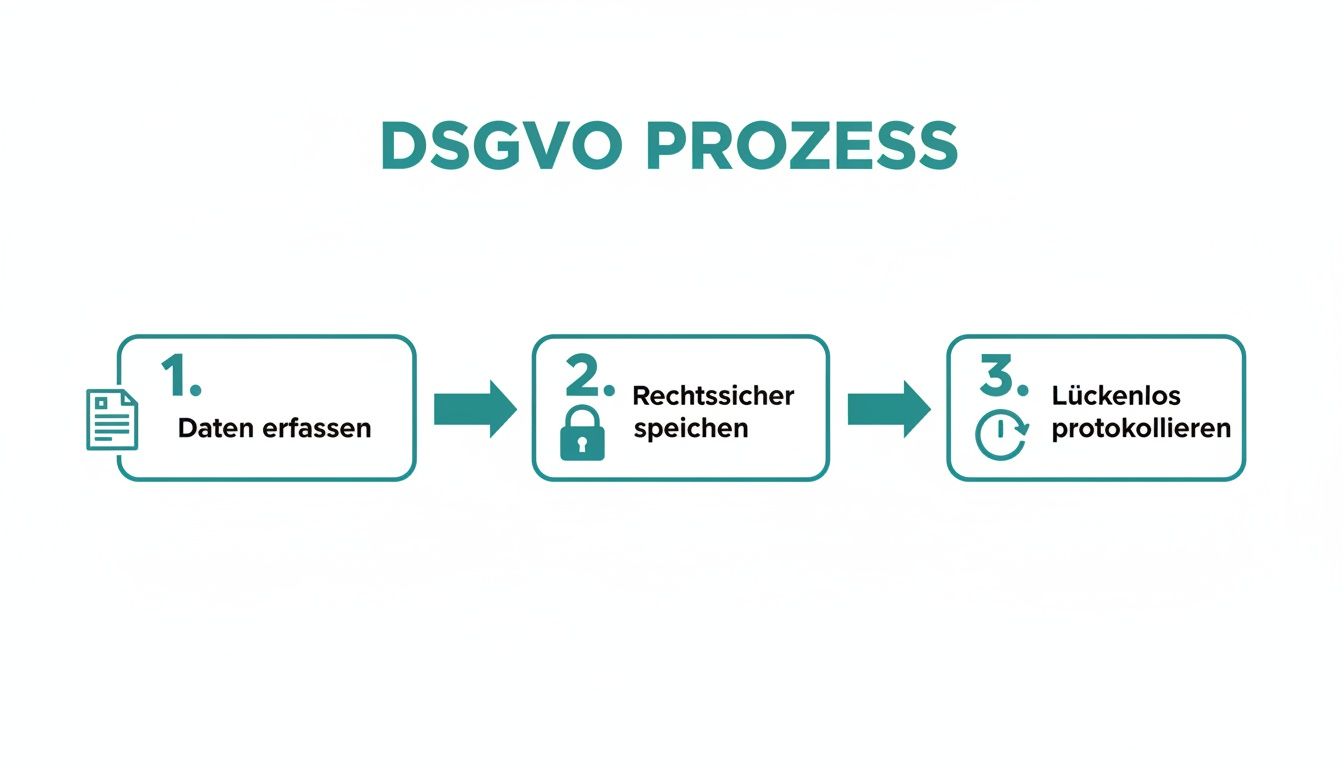
The visualization makes it clear: clean and secure data capture is the basis for legally compliant storage and complete logging. And that is exactly the basis for an automated billing process that you can rely on.
The advantages of an integrated system
The connection of all process steps from planning to billing brings with it tangible advantages that go far beyond mere time savings.
- Drastically reduced error rate: Automated data transfers minimize human errors when entering working hours and wage data to almost zero.
- Accelerated billing: Payroll for all employees – whether permanent, temporary or freelance – can be completed days or even weeks faster. This improves liquidity and the mood in the team.
- Maximum transparency: Everyone involved has access to their recorded hours and the current billing status at any time. That creates trust.
- Improved compliance: Complete documentation of working hours, breaks and changes ensures that you comply with legal requirements and contractual agreements at all times.
In the end the circle closes. A well thought out one Operations planning for medical services lays the foundation. But an integrated process from planning to billing makes it really effective. Not only will you gain speed, but you will also create a foundation of trust and professionalism with your entire team.
Frequently asked questions about deployment planning in the medical service
Here you will get answers to the questions we asked in the Operations planning for medical services meet again and again. They come directly from practice and help you avoid the typical pitfalls right from the start.
How do I deal with short-term outages?
Short-term failures are the absolute classic and the biggest stress factor in planning. The most important thing is not to react in the chaos, but to be prepared. Instead of panicking through the phone list, you need a digital pool of helpers.
Imagine: A paramedic calls in sick three hours before a big open-air concert. With software like job.rocks With one click you send a push message to all available and qualified paramedics in your pool. Whoever agrees first gets the shift. The whole thing often only takes a few minutes.
The trick isn't to prevent failures - that's impossible. The trick is to have a system in place that allows you to respond in minutes rather than hours. Build a pool of reliable freelancers and temporary workers that you can activate immediately in an emergency.
How do I plan staffing requirements for an unknown event?
Every planner knows this: a request for an event where the risk profile is completely unclear. Let's take a new type of art festival with interactive installations - there is simply no experience.
In such cases, you are always safest with more conservative planning. Proceed systematically:
- Ask the organizer questions: Inquire specifically about potential sources of danger, the expected audience and the exact conditions on site.
- Make up your own mind: A visit to the venue is worth its weight in gold. This allows you to identify bottlenecks, escape routes and the general infrastructure much better.
- Plan modular: Define a core primary care team. In addition, you plan flexible units, for example mobile teams of two, which you can quickly move to hot spots depending on the situation.
It has proven to be a good idea to start with a little more staff at the beginning. If after the first few hours it becomes apparent that the situation is calmer than expected, you can still reduce. But this only works if the communication structure is in place within the team.
How do I motivate volunteers in the long term?
Motivation in volunteer work is a delicate plant, especially when the missions are strenuous. It's rarely about money, but rather about appreciation, smooth processes and the feeling of making an important contribution.
From my experience, three points are crucial:
- Reliable planning: Nobody likes to sacrifice their free time only to sit around for hours because of poor organization. A clear operational plan that is communicated early on is a clear sign of respect.
- Useful training: Offer regular, high-quality training. This not only shows that you invest in your team, but also gives the helpers more security in their work.
- Transparent communication: Give your team an easy way to report requests and availability without pressure. An app in which everyone can enter their own preferences is often a relief compared to the chaos of a WhatsApp group.
An experienced operations manager, Sven Steinbeck, always says: "You have to meet people where they are and make them feel that their time is valuable."
What is the biggest mistake in operational planning?
By far the most common and costly mistake is assuming that the plan once created is set in stone. The reality on site is always dynamic. A sudden downpour at a festival can completely change the medical situation as thousands of people crowd into tents or slip on wet ground.
Your deployment planning therefore always needs a plan B. Specifically, this means:
- Plan reserve forces: Always have at least one person on call who you can call upon immediately if necessary.
- Clear communication channels: Set up a central channel through which you can quickly inform your entire team about changes to your plans - no confusing group chats.
- Defined escalation levels: Who makes which decision when things get hectic? These responsibilities must be crystal clear in advance.
Good operational planning is not a rigid corset. It is a flexible framework that gives your team the security to act professionally and calmly, even in unforeseen situations.
Are you ready to take your medical service planning to the next level? With job.rocks automate planning, communication and billing so you can focus on what really matters: safety on every mission. Discover now https://job.rockshow you can massively simplify your processes.