
Master deployment planning cleverly: your practical guide
Good operational planning is much more than just a calendar with names. It is the strategic heart that ensures that the right people with the right skills are in the right place at the right time to achieve your business goals. What good operational planning really means Imagine...
A good one Operations planningis much more than just a calendar with a name. It is the strategic heart that ensures that the right people with the right skills are in the right place at the right time to achieve your business goals.
What good operational planning really means
Imagine a busy restaurant on a Saturday night. Without a clear plan, chaos quickly breaks out. Orders are lost, guests wait angrily, and the staff is completely overwhelmed. Such a scenario not only frustrates your customers, but also demotivates your entire team.
With a strategic Operations planningthe picture looks completely different. You have analyzed in advance how many guests are to be expected and how many employees you need in the kitchen, in service and at the bar. Everyone knows their tasks, the processes mesh and the team works like clockwork.
More than just a roster
A well-made roster is only the visible result of much deeper planning. It is not a rigid document, but a flexible tool that helps you react confidently to the unexpected. If someone is unavailable at short notice, you immediately know who can step in with the necessary skills - without having to spend a lot of time searching and calling around.
Thoughtful operational planning transforms reactive chaos into proactive control. It's the difference between constantly putting out fires and deliberately steering your business to success.
This proactive approach pays off directly for your business. Not only do you avoid costly overtime, but you also create a working atmosphere in which your employees feel valued. If you take their availability and wishes into account, satisfaction and loyalty increase noticeably.
The direct benefit for you
A working one Operations planningbrings you very tangible advantages. You ensure that you always have the right staffing levels to deliver your quality standards and keep your customers happy. At the same time, you keep personnel costs firmly under control and easily comply with legal requirements such as working and rest times.
Here are the most important points at a glance:
- Satisfied customers:Smooth processes and optimally staffed shifts guarantee first-class service.
- Motivated employees:Fair and transparent planning increases morale and reduces fluctuation.
- Controlled costs:You avoid unnecessary overtime and deploy your staff exactly where they create the greatest value.
- Legal security:You adhere to all legal requirements and thus minimize business risks.
Ultimately, it's about finding the perfect balance: between the needs of your business and the needs of your employees. A good one Operations planningis the key to this. It is the foundation on which your success is built, ensuring that your most valuable asset - your team - is always used optimally.

The central processes and roles in planning
A working one Operations planningis not a product of chance. It is the result of a clear, structured process. Imagine building a house without a blueprint - the result would be shaky at best and in danger of collapsing at worst. It's exactly the same with personnel planning: Without defined processes and roles, you risk gaps in the company, overloaded employees and, in the end, pure frustration in the team.
A typical planning cycle runs in several phases that logically build on one another. Each of these steps is critical to overall success.
Phase 1: The needs assessment
Everything starts with the central question: How many people with what skills do I actually need, and when? Here you analyze past data, take seasonal fluctuations into account or plan for large, upcoming projects.
An example: A hotel manager takes a look at the booking figures for the next month. He immediately sees that there is a big conference coming up on a weekend. The signal is clear: on these days he needs significantly more staff at reception, in room service and in the kitchen than on a quiet Tuesday morning.
Phase 2: The concrete plan creation
Now it’s getting concrete. In this phase you put the individual pieces of the puzzle together to form the actual roster. You compare the identified needs with the availability, qualifications and wishes of your employees. Modern tools can save you an enormous amount of work here.
You have to think about everything:
- Qualifications:Does the person have the necessary certificates or skills for this shift? A paramedic without emergency certification cannot be scheduled for every mission.
- Availabilities:Who submitted leave? Who has fixed private appointments? Who simply can't or doesn't want to work on certain days?
- Legal requirements:Working and rest times are not recommendations. You must ensure that all legal regulations are strictly adhered to.
- Fairness:Nothing kills motivation faster than an unfair distribution of the unloved shifts. Make sure that the load is distributed fairly within the team.
A good operational plan is like a tailored suit. It fits the requirements of your company perfectly, takes into account the individual dimensions of your employees and ensures a professional, smooth appearance.
Phase 3: Communication and release
A perfectly crafted plan is worthless if no one knows or understands it. The next logical step is transparent communication to your team. Everyone must be able to view their plan in a timely manner and be informed immediately of any changes. A mobile app that allows employees to see their shifts directly on their smartphone is no longer an option, but rather a requirement.
Clear distribution of roles for smooth processes
In order for this entire process to run like clockwork, clearly defined roles are needed. Everyone in the team must know what their job is.
| Role | Primary responsibility | Example (hospital emergency room) |
|---|---|---|
| The planner | Creates and maintains the operational plan. He juggles all variables and is the central contact for planning questions. | The shift coordinator plans the doctors and nursing staff for the next few weeks and meticulously ensures that rest times are adhered to. |
| The team leader | Approves the plan, mediates conflicts and ensures that operational needs are actually met. | The station management reviews the plan and approves it after ensuring that all necessary specialists are available. |
| The employee | Reports his availabilities and absences, reviews the final schedule and is responsible for his assigned shifts. | A nursing specialist enters her training days into the system and checks her final shift schedule in the employee app. |
This clear structure prevents misunderstandings and ensures that everyone pulls together. Whether in a hectic emergency room, on a large construction site or at a huge event - a clear definition of processes and roles is the foundation for a successful one Operations planning.
If you want to dive deeper into the basics of workforce planning, check out our comprehensive guide to Operations planning and staff planningeven more valuable information.
Legal requirements and compliance in Switzerland
Yours Operations planningdoes not exist in a vacuum. In Switzerland in particular, there is a clear legal framework that you must be aware of and strictly adhere to. This not only protects your employees, but also gives you as a planning person the necessary security.
Legally compliant planning is not an obstacle, but a quality feature of your company. It shows that you take responsibility and treat your team fairly.
The foundation of your planning: the Swiss labor law
Your most important guide is the Swiss Labor Law (ArG). It sets the rules for the organization of working hours and ensures a fair balance between the interests of your company and the protection of employees.
There are three areas in particular for your daily life Operations planningof central importance:
- Maximum working hours:The law defines clear upper limits for weekly working hours. These may only be exceeded in absolutely exceptional cases and under strict conditions.
- Break regulations:Every employee is entitled to breaks. The duration depends on the daily working hours and is stipulated by law. These breaks are unpaid breaks and are intended for relaxation.
- Rest times:The uninterrupted time between two work assignments is also clearly regulated. In Switzerland there is a daily rest period of at least 11 hours. This rule ensures that your team can regenerate sufficiently.
Remember: Compliance with these requirements is non-negotiable. A violation can lead to severe fines and legal consequences. Good scheduling software will automatically alert you when you are about to violate any of these rules.
This infographic visualizes the basic process of structured operational planning - from needs analysis to communication with the team.
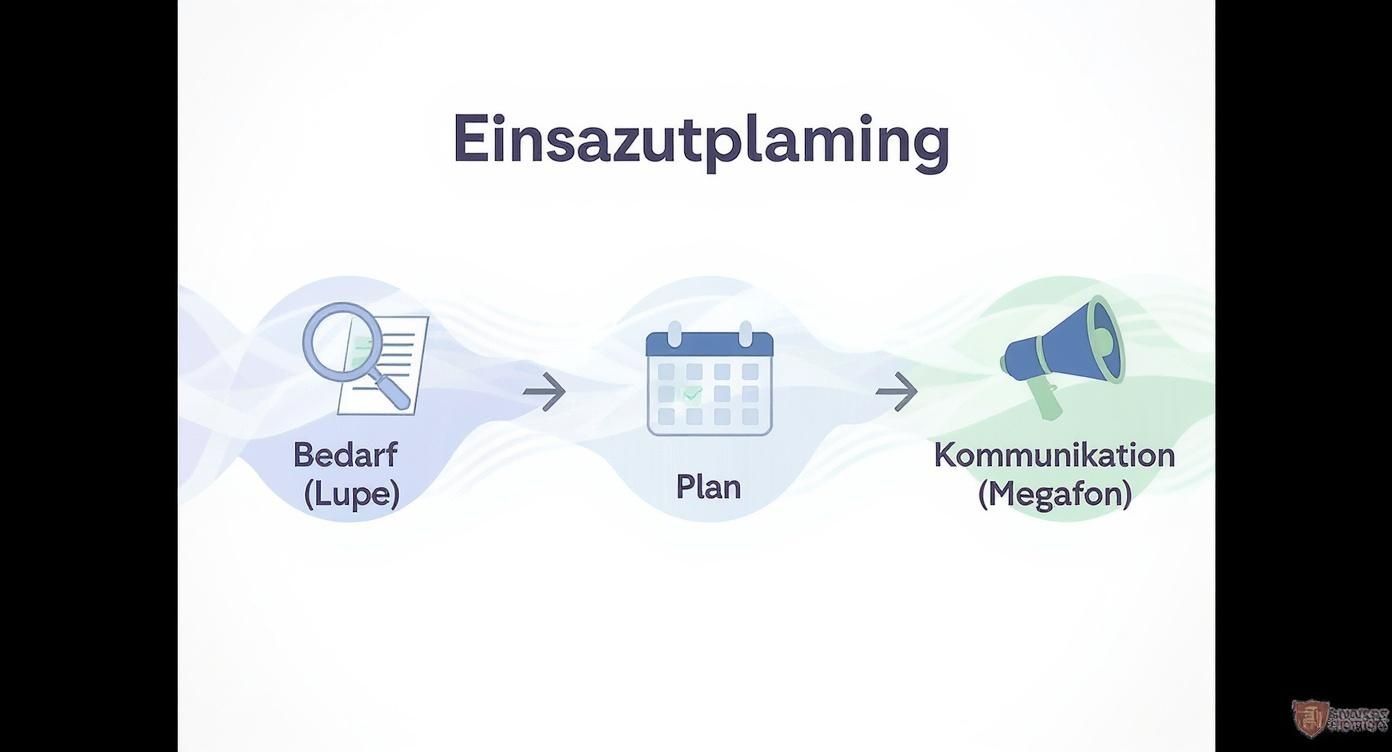
The presentation makes it clear that successful planning always begins with a careful analysis of needs before the actual plan is created and communicated.
An example from the retail trade
Imagine you are creating the shift schedule for your business in the run-up to Christmas. You know full well that you have longer opening hours and need more staff.
When planning, you have to pay close attention to ensuring that no one exceeds the statutory maximum working hours. Even more important: There must be a rest period of after each shift 11 hoursmust be guaranteed. If an employee works until 8:00 p.m., she may not start again until 7:00 a.m. the next day at the earliest. It's that simple.
Data protection in operational planning
Of course you need data from your employees for your planning - that's clear. But caution is advised here, because the Data Protection Act (DSG) sets strict limits.
You may only collect and process data that is necessary for Operations planningare directly necessary. These typically include:
- Name and contact details
- Qualifications and certificates
- Agreed working hours and availability
- Absences such as vacation or illness
Private information that has nothing to do with work is absolutely taboo. You must also ensure that this data is stored securely and can only be viewed by authorized people. A platform like job.rockshelps you to implement these requirements in a technically clean manner and to manage the data in a GDPR-compliant manner.
Communication and transparency are mandatory
You can't just tacitly assume a finished plan. The legal basis in Switzerland is clear here. According to Article 47 paragraph 1 of the Swiss Labor Law, you must announce the roster by posting or in another appropriate way.
The associated regulation specifies that employees must be informed about their deployment plan at least two weeks before the start. In addition, their inclusion in planning is required by law. Read more about the exact ones legal details on rosteringand how flexible you really have to be.
Short-term changes are only possible in emergencies or with the express consent of the person concerned. Open and fair communication is the key to avoiding legal problems from the outset.
Operations planning in various industries
Every industry has its own rules when it comes to a good one Operations planningworks. While the fundamental principles are often the same, the priorities and challenges couldn't be more different. Let’s dive into four typical industries and see what’s really important there.
What is essential for survival in a hospital may only play a secondary role in the event industry - and vice versa. It is precisely this understanding of the industry-specific characteristics that is the key to tailoring your planning and getting the best out of your team.
Event industry: organized chaos
Imagine you are planning the staff for a large music festival. This is not just about a simple shift in one place, but about a complex puzzle made up of countless teams that have to work together perfectly over several days.
Your plan must cover dozens of different roles:
- Security:Who secures which stage and which entrance at what time?
- Catering:How many people are needed at the food trucks during peak times between the main acts?
- Technology:Which team is responsible for the sound check of the main stage and who is responsible for lighting the smaller stages?
- Logistics:Who ensures that materials and personnel are in the right places on time?
The biggest challenge is this Dynamics. An artist is late, the technology fails or the weather changes - your plan must be flexible enough to immediately absorb such unforeseen events. Good software will help you quickly find replacements in the event of short-term failures by suggesting available employees with the right skills.
Hotel and catering industry: the art of flexibility
In a hotel or restaurant, the staffing requirement depends directly on the workload. On a fully booked weekend with a large wedding party, you obviously need significantly more staff than on a quiet Tuesday in November.
Yours Operations planninghas to be extremely adaptable here. You plan based on booking forecasts and have to be able to call people up or send them home at short notice. One of the core tasks is the smooth coordination of the various departments - from reception to housekeeping to the kitchen.
In the hotel industry, scheduling is like conducting an orchestra. Each department must know its role at the right moment to ensure a harmonious and perfect experience for the guest.
Here it is worth its weight in gold to maintain a pool of flexible part-time workers or temporary workers that you can quickly activate when needed. A good software for that Disposition of temporary workcan be of enormous help here.
Healthcare: precision and responsibility
In a clinic or a nursing home it is the case Operations planningis about much more than just efficiency - it's about human lives. Planning must not only meet demand, but above all ensure that the right qualifications are always in the right place at the right time.
A nurse with intensive care training cannot simply be replaced by a nursing assistant. The planner must know the exact qualifications of each employee and take them into account. At the same time, the legal requirements for working and rest times are particularly strict here in order to ensure the safety of patients and staff.
Security industry: seamless monitoring
In the security industry, the most important requirement is continuity. There should not be a gap for a second when guarding an object. The Operations planningmust therefore ensure seamless 24/7 operations, including weekends and public holidays.
The challenge is to create shift schedules that are fair and do not overload employees, while at the same time guaranteeing complete coverage. Documentation is also central: who was where and when? Especially for industries such as crafts, one can digital time recording in craftsmassively improve the accuracy of operational planning.
The high number of vacancies in Switzerland underlines the need for clever planning. In March 2025 there were around around 42,500 jobsis unstaffed, making it more difficult to find qualified personnel and increasing pressure on planners to make the best possible use of existing resources.
Comparison of deployment planning requirements by industry
This table shows the different focuses and challenges of operational planning in the four industries discussed at a glance.
| Industry | Main focus | Typical challenge | Solution approach with software |
|---|---|---|---|
| Event | Dynamics & flexibility | Unpredictable changes, complex role distribution | Fast rescheduling, skill-based matching in case of failures |
| Hotel/Gastronomy industry | Demand dependency | Strong fluctuations in workload, coordination of departments | Forecast-based planning, management of a flexible personnel pool |
| Healthcare | Qualifications & Compliance | Strict legal requirements, ensuring professional skills | Detailed qualification management, automatic rule checking |
| Security | Complete coverage | 24/7 operation, fair shift rotation, accurate documentation | Seamless shift transitions, seamless logging |
As you can see, there is no “one-size-fits-all” solution. The key to success is understanding the specific needs of your industry and aligning your planning processes and tools accordingly.
Digital tools for your modern operational planning

To be honest: the time of Excel lists is over. Anyone today who wants a flexible and precise Operations planning If you want to get [[[JR186]]] off the ground, you can no longer avoid modern digital tools. These tools not only relieve you of dull, repetitive tasks, but also become your strategic partner, avoiding mistakes and making team communication crystal clear.If you want to get going, you can no longer avoid modern digital tools. These tools not only relieve you of dull, repetitive tasks, but also become your strategic partner, avoiding mistakes and making team communication crystal clear.
Imagine you are planning the deployment of staff for a large event. Instead of laboriously digging through tables to see who has what qualifications or when they are available, the software does it for you. With just a few clicks, you can create a plan that automatically takes all rules, wishes and legal requirements into account.
What distinguishes good planning software
Modern software is so much more than just a digital calendar. It is the command center that runs all the strings of your Operations planningmerges.
What really matters:
- A mobile app for your team:Employees report their availability, view their shifts, apply for open assignments or even exchange services with each other - all directly and easily from their own smartphone.
- Automatic notifications:Will the plan change in the short term? No problem. Everyone affected will immediately receive a push message or email. Misunderstandings and no-shows are now a thing of the past.
- Integrated time recording:Your team clocks in and out directly via the app. This creates an absolutely accurate basis for payroll accounting and eliminates the need for manual timesheets.
- Interfaces to payroll accounting:The recorded hours flow into your payroll program at the push of a button. This not only saves a lot of time in administration, but also dramatically reduces the error rate.
Good software gives you full control back. You can see in real time who is currently working, what costs are incurred and where there are potential bottlenecks. This means you can react quickly and in a well-founded manner instead of flying blind.
From simple tools to comprehensive systems
The market for planning tools is huge and confusing. The right choice depends solely on your specific needs.
Simple planning toolsare often a good start for small teams with manageable requirements. They provide basic calendar functions and help organize shifts. But as soon as things get more complex - different qualifications, strict rest time regulations or multiple locations - they quickly reach their limits.
Comprehensive systemslike job.rocks are built for exactly that. You can master even highly complex scenarios with ease. The software automatically checks whether rest times are adhered to, compares the needs with the skills of your employees and provides you with insightful reports. With a platform like this, you can seamlessly map the entire process from the initial needs assessment to the final payroll. An important aspect when using digital tools is that Link security reviewto ensure the confidentiality of your planning data.
Find the right software for your Swiss SME
The average working time in Switzerland is 35 hours and 45 minutesper week, which reflects the high proportion of part-time workers. A flexible one Operations planningis therefore absolutely crucial in order to maintain the high employment rate of around 80 percentto be managed efficiently.
To find the right system for your company, you should take a close look at the various options. In ours Personnel deployment planning software comparison for Swiss SMEswe have prepared a detailed comparison that will help you make your decision. Above all, make sure that the tool covers your industry-specific requirements and can be seamlessly integrated into your existing processes.
FAQ operational planning: Clear answers to your questions
The same questions keep coming up in everyday planning. We have collected the most common ones and will give you tried-and-tested, clear answers here. This is how you navigate safely through the typical hurdles Operations planning.
How quickly can I actually change a roster?
Basically, one applies in Switzerland Two weeks notice period. This is not a guideline, but an important basis that gives your team the security they need to plan their private lives.
Short-term changes are and remain the absolute exception. They are only permitted if both sides – you and the employee – agree. Another exception are real, unforeseeable emergencies that would otherwise bring operations to a standstill. What is always important is that the interests of your team must be taken into account fairly.
Do I have to take the wishes of my employees into account?
A resounding yes. This is not just a question of good style, but is also anchored in Swiss labor law. The law stipulates that the wishes of employees must be taken into account as much as possible. In practice it shows again and again: One Operations planning, which actively plans wishes, leads to significantly happier and more motivated teams.
Fair planning is a two-way street. It brings the needs of the company into line with those of the employees. The result is a working atmosphere characterized by mutual respect - and this noticeably reduces fluctuation.
Software or Excel – what does the switch really do for me?
The leap from Excel to professional software is huge. Software takes the most tedious steps away from you Operations planningjust off. It automatically checks in the background who has what qualifications and ensures that all statutory rest periods are adhered to. A complex Excel spreadsheet, on the other hand, is a ticking time bomb - extremely error-prone and incredibly cumbersome when changes are made.
The biggest advantages of software are obvious:
- Huge time savings:Planning no longer becomes a puzzle game. Automatic checks and suggestions do most of the work.
- No more errors:The system immediately warns you about rule violations such as too short a rest period, even before the plan is published.
- Clear communication:Changes are immediately visible to everyone in the app. This puts an end to the time of misunderstandings and outdated plan versions.
What do I do if there are short-term staff absences?
A good plan doesn't collapse just because the unexpected happens. If someone is unavailable at short notice, quick and targeted action is required to keep operations running.
This is exactly where modern software comes into play for your Operations planningshows off its strengths. Instead of making tedious calls, it shows you a list of all available employees who have exactly the right skills for the open shift at the touch of a button. With one click you can request them directly via the app. A well-maintained list of jumpers or clear substitution rules in the system also help to fill such gaps quickly and without stress.
Are you ready to get yours Operations planningto finally design it the way it should be – simple, fast and fair? With job.rocksyou automate your planning processes, regain valuable time and ensure satisfied teams.
Discover now https://job.rockshow uncomplicated clever planning can be.