
Event catering roster: How to create efficient shift schedules and reduce costs
A well-thought-out roster in event catering is much more than just a list of names and times. It is the strategic backbone that ensures everything runs smoothly. Essentially, it ensures that you have the right people with the right skills exactly when you need them...
A well thought out one Duty roster in event catering is much more than just a list of names and times. It is the strategic backbone that ensures everything runs smoothly. Essentially, it ensures that you have the right people with the right skills right when you need them most.
Why your roster makes the difference between success and chaos
Imagine a big summer festival. Thousands of guests flock to the food and drink stands at the same time. Without a precise one Roster for event catering Pure chaos quickly breaks out here. Long queues annoy visitors, staff are completely overwhelmed and revenue collapses. A smart plan prevents exactly that.

It's not just about filling any layers. It's about acting with foresight. You need to know the peak times and make sure there are enough experienced bartenders behind the bar, while during quieter times a smaller crew may be sufficient.
A responsive roster is your most important tool for preparing for the unpredictable dynamics of events. It turns potential problems into manageable tasks.
The typical stumbling blocks in everyday event life
In event catering, the unexpected is the norm. Your planning must reflect this. The biggest challenges that everyone knows from practice include:
- Unpredictable guest numbers: The weather changes, an act is more popular than expected - and suddenly there are twice as many people in front of your stand.
- Short-term changes: The event schedule changes or an artist cancels. Your staffing needs change instantly.
- Absences due to illness: An important employee calls in sick shortly before the start of the shift. Now you need a qualified replacement quickly.
A static plan from a Excel table simply cannot keep up here. You need a flexible system that allows you to react quickly, redeploy staff and close gaps - without sacrificing service quality.
More than just satisfied guests
Well-thought-out personnel planning has effects that go far beyond pure service. A well-staffed team is less stressed, makes fewer mistakes and is noticeably more motivated. Not only do guests notice this, it also has a direct impact on your sales. Satisfied employees also remain loyal to you for longer, which saves you recruitment costs in the long run.
At the same time, you keep personnel costs firmly under control. Event catering in Switzerland is an important economic factor, and studies show that often up to 20% of staff deployment times must be planned flexibly in order to be able to react to fluctuations. Digital planning tools help you precisely control demand and avoid expensive over- or understaffing. More insights into the Gastronomy in Switzerland delivers Statista.
Ultimately, your roster is the foundation on which the success of your event rests. He ensures happy guests, a motivated team and a healthy balance sheet.
Lay the foundation for your roster
Before even a single shift ends up on the calendar, you need a solid foundation. A really good one Duty roster in event catering doesn’t just fall from the sky – it’s the result of clearly defined requirements and reliable data. Everything else is purely gut feeling and usually ends in chaos.
Imagine an exclusive wedding in a top location. The bride and groom expect perfection, not compromises. Your mission is to ensure your team delivers exactly that. And that only works if you know crystal clear from the start which personnel puzzle pieces you have to put together.
What roles do you really need for this event?
First of all: define the roles for this one event are needed. It's not about general job titles from a list, but about the specific tasks on site. For the wedding in question it could look like this:
- 1x operations management: Holds all the strings on site, is the direct contact for the bride and groom and puts out small fires before they become a fire.
- 4x service staff (higher service): Take care of serving the courses, refilling and looking after the tables - with the necessary tact.
- 2x bartenders (with cocktail experience): Mix the drinks at the main bar, including the previously agreed signature cocktails. It takes more than just pouring beer here.
- 1x logistician/Runner: The invisible hero who keeps supplies at the bars, clears away empty glasses and keeps the kitchen safe.
- 1x cloakroom worker: Greets guests with a smile, accepts their coats and ensures everything runs smoothly at the end.
This attention to detail is not an end in itself. It helps you to calculate your personnel requirements precisely and not to overlook any crucial function. Every event works differently: a festival might need ten bartenders, but hardly any upscale service. A company gala, on the other hand, may require a trained sommelier.
Qualifications: Who can really do what?
The roles are set, each position has a clear requirements profile. This is your protective shield against later disappointments and expensive wrong appointments, which not only cost money but also damage your reputation.
For the wedding bartender, the profile might look like this:
- Must-have criteria: At least 2 years Experience in mixing classic cocktails, confident dealing with demanding guests, fluent German.
- Target criteria: Has already worked at weddings, is familiar with non-alcoholic signature drinks, and has a well-groomed demeanor.
A precise qualification profile is your best filter. You only get requests from people who really have the job. This saves you an incredible amount of time when making your selection.
How to check availability without losing your mind
Manually juggling availability via email, WhatsApp group, or Excel lists is a nightmare. Who answered? Who ignored the message? This is pure chaos management.
Modern tools take this Sisyphean task off your hands. You only send shift requests to employees who match your defined qualification profile. They get a push notification on their cell phone, click on “Accept” or “Cancel,” and that’s it. You can see who is available in real time and fill open gaps in no time. The whole process becomes noticeably easier and more transparent for all parties.
Legal rules of the game in Switzerland: What you need to know
Despite all the necessary flexibility, you must never lose sight of the legal framework. In Switzerland, the labor law (ArG) is not negotiable. There are clear regulations regarding maximum working hours and, above all, mandatory rest periods.
This is a hot potato, especially in the event industry, where operations often take place in the evenings or on weekends. It is your responsibility to ensure that your staff has enough time to recover between shifts. Good duty scheduling software is worth its weight in gold here: it automatically warns you if you are in danger of violating a legal rule. This way you protect your team from exploitation and your company from hefty fines.
With this careful preparation you will create a reliable basis. Your Roster for event catering Not only is it easier to create, but above all it is robust enough to withstand the typical surprises that the industry brings with it.
Put intelligent shift planning into practice
Okay, the preparation is complete. Now it gets concrete: you create the roster. At this moment, all the collected data, wishes and requirements are transformed into a tangible plan that supports your event and at the same time ensures a good atmosphere in the team.
A smart plan thrives on data. Take a close look at past, comparable events. How many guests were really there? When did the mood – and therefore the business – reach its peak? Where did you plan too many or too few people? These empirical values are worth their weight in gold because they help you to calculate the personnel requirements for the next event much more precisely.
Plan according to your needs based on experience
Let's imagine a three-day street food festival by the lake. You have last year's numbers ready:
- Friday evening: Big rush right after work, especially at the drinks stands.
- Saturday afternoon: Families and tourists stream in, the focus is clearly on the food stalls and the ice cream counter.
- Sunday: Everything is more relaxed and you need significantly less staff.
With this knowledge, you don't just schedule the same team for three days. You design the layers dynamically. On Friday evening the main bar needs four people, on Saturday afternoon two are enough. To do this, you have to staff the crepe stand twice. This means you can invest your budget exactly where it will have the greatest impact.
Divide the team fairly and transparently
A roster is more than just a Excel table; it is a social structure. A fair distribution of shifts is the be-all and end-all for a motivated team. Nobody wants to constantly have to work the unpopular late shift on Saturday evenings.
So make sure you have a balanced rotation. Also try to take your employees’ wishes into account wherever possible. Does anyone have a long commute and therefore prefers longer shifts on fewer days? Or do you have students in your team who can only work on weekends?
Transparency is your strongest ally here. Communicate openly the criteria you use to create the plan. If everyone in the team can understand why the plan looks the way it does, acceptance increases enormously.
Seasonal fluctuations play a huge role, especially in event catering. The average working time in the Swiss hospitality industry was around 2023 42 hours per week, but at events this need can literally explode. Seasonal peaks often require up to 30% more staff than the annual average. With a part-time share of approx 40% planning becomes even more complex. Detailed data on the You can find out about the economic importance of the hospitality industry at GastroSuisse.
Learn to deal with the unexpected
Every event professional knows: No plan survives the first contact with reality. One employee gets sick, another gets stuck in a traffic jam. What now? The key is to prepare for exactly such scenarios.
Plan buffers and knights:
For the street food festival you don't plan on sewing on edge. You define a “jumper” from the start. This is an experienced all-round force without a permanently assigned station. This person flexibly steps in wherever the need arises: at an overrun checkout, when refilling drinks or when a colleague needs a short break.
Clear processes for changing shifts:
If someone is absent or wants to swap shifts, you need a simple, clear process. Instead of dozens of calls and messages, you establish a fixed path.
- Promote personal responsibility: The employee is initially responsible for finding a qualified replacement from the team.
- Authorization by you: The exchange will only become valid once you officially confirm it. This way you stay in control and ensure that the qualifications for the shift are right.
The following graphic summarizes the three pillars on which a stable and fair roster must stand.
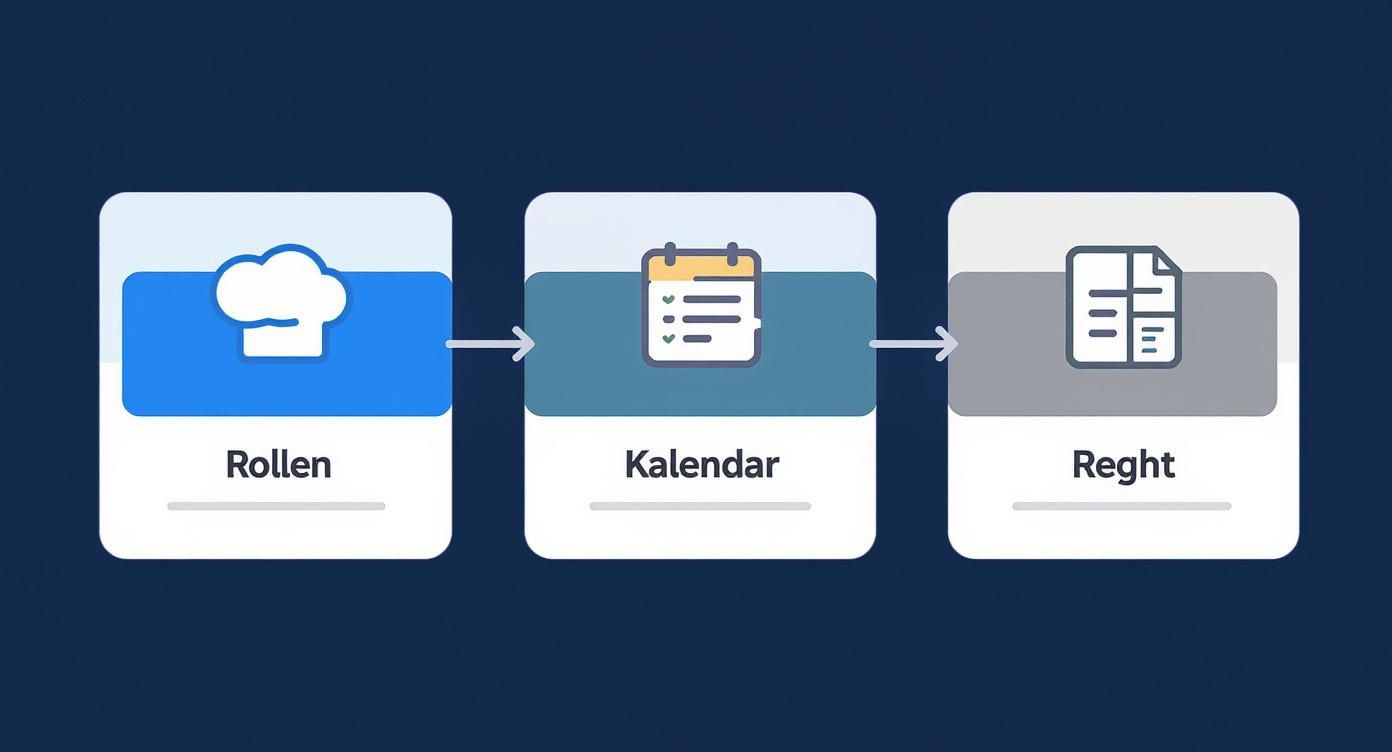
These three elements – clearly defined roles, current availability and compliance with legal requirements – form the foundation for every functioning roster.
Modern tools can be a huge help to you here. They allow employees to make exchange requests directly in an app, and all you have to do is approve them. A more detailed guide on the topic Shift planning and how to master it, you can also find it in our further article.
This mix of data-driven forecasting, fair staffing and a solid emergency plan is how you build one Roster for event catering, which not only works, but creates the basis for a successful event and a satisfied team.
Smart tools that make your work easier
You don't have to reinvent the wheel every week to get one that works Roster for event catering to create. Clever tools take a lot of the repetitive work off your hands, minimize errors and give you more time for what's important: your event and your team.

The easiest way to get started is with well-thought-out templates and checklists. They help you not to forget anything important and to standardize your planning. Especially if you are starting out or only manage small events, a well-structured Excel template can work wonders. It provides a basic structure and overview.
Beyond Excel: Ignite the next stage
But as your events become more complex and your employee pool grows, manual lists quickly reach their limits. This is where digital roster tools come into play. They are much more than just a digital calendar. They are your command center for all personnel planning.
A good software solution for event catering should relieve you of the following tasks:
- Automatic shift suggestions: The system suggests suitable employees for open shifts based on availability and qualifications.
- Integrated time tracking: Your team clocks in and out via the app. The times are recorded automatically, which massively simplifies payroll accounting.
- Direct communication: All information about the deployment, including briefings and changes, goes directly to employees via the app.
- Interface to payroll accounting: The recorded hours can be exported with just a few clicks and transferred to your payroll program.
What you should pay attention to when choosing software
Not every tool is suitable for every company. When choosing software for your Duty roster in event catering There are a few key features you should pay attention to. What is crucial is a mobile app for your employees, which they can use to report availability, accept shifts and record their working hours. A smart skills filter is also essential so that when you request a cocktail bartender, you don't have to write to your entire staff pool.
The professionalization of rostering has accelerated significantly in Switzerland. Software-supported systems now make it possible to change rosters on average 25-30% to create faster. At the same time, the personnel cost ratio was able to increase by an average of 5-7% be lowered. The digital helpers also support you in complying with labor law regulations. By the way, you can find more background information on this change in the industry at G-wie-Gastro.
A caterer who switched from Excel to software reported that he saved around four hours of pure administration time per event just through the automated availability query. This is time that he now invests in looking after his customers.
The leap to automation pays off
Imagine a customer books an additional event for the coming weekend at short notice. In the past that would have meant countless calls, emails and a huge mess in your Excel list.
Using a digital tool, you create the event, define the required roles and send the request to all available and qualified employees with one click. Your shifts will be filled within a few hours - without a single phone call. This agility gained is an invaluable advantage in the fast-moving event industry. Not only will you become more efficient, but you will also be significantly more stress-resistant.
The right technology is not a cost factor, but an investment in the scalability and professionalism of your operation. If you would like to delve deeper into the subject, you can find it in our guide suitable deployment planning software further valuable tips.
Optimize rosters and avoid legal pitfalls
Creating a roster is one thing. But designing it in such a way that it becomes a little better, more efficient and more legally secure after each event - that is the real art in the world Event catering. Now we get down to business: You'll see how you can analyze your planning, improve it sustainably and protect yourself from expensive legal mistakes.
Your gut feeling is a valuable guide, no question. But to really take your planning to the next level, you need hard numbers. Only by measuring what works and what doesn't will you make decisions based on facts - not just vague assumptions.
The most important metrics you need to know
Get into the habit of collecting a few simple but extremely meaningful key performance indicators (KPIs) after every event. They are your compass and show you in black and white how good your planning really was. To start, focus on these three values:
- Personnel cost ratio (PKQ): How high were your personnel costs in relation to the turnover of the event? In the catering industry, a PKQ of 25-35% a common guideline, but of course this can vary greatly at events.
- Productivity per employee: What sales did each individual employee generate per hour? This value immediately reveals whether your casting was on point or whether you paid too many people who were bored.
- Employee satisfaction: How did the team feel about the effort? A simple, anonymous survey after the event can work wonders here. You get invaluable feedback on the planning quality directly from the front.
Imagine comparing two similar company parties. For Event A you had a PKQ of 28%, at Event B she shot up 42% high. A quick look at the numbers shows: In Event B you let your team compete far too early. For the first hour, many people just stood around. This is a crystal clear insight that will immediately make your planning for the next time sharper.
A good roster is never really “finished.” See it as a living process that you improve a little bit after each use. Your KPIs are your compass.
Legal certainty in the roster – a big issue
One point that is often lost in the heat of the moment, but can have massive consequences, is legal certainty. There are pitfalls lurking, especially when dealing with employee data, that can be really expensive. The General Data Protection Regulation (DSGVO) and the Swiss Data Protection Act (DSG) set very clear rules here.
You need to know exactly what data you collect from your employees, store and - very importantly - make visible to others in the roster. Health data, private notes or the reason for an absence have absolutely no place there.
Your roster and the DSGVO
The DSGVO is anything but a paper tiger. Violations can lead to severe fines. A classic horror: the publicly displayed roster in the break room, packed with full names, phone numbers and maybe even handwritten notes about sick leave. An absolute no-go.
What you need to pay attention to:
- Data minimization: Show only the data that is essential to complete the shift. Often the last name and the first letter of the first name are sufficient.
- Access restriction: Make sure that only the people who really need it for their work can see the complete roster. The notice in the break room is almost always a data protection issue.
- Transparency: Your team needs to know which of their data you use for planning and where it is stored.
A digital solution relieves you of an enormous amount of work and risk. Modern systems ensure that each employee only sees their own shifts and perhaps those of their direct colleagues. Private data such as telephone numbers remain protected and can only be viewed by you as the planner. If you want to go deeper, like a professional Operations planning also masters these legal hurdles confidently, You can find further information here.
To quickly put your current processes to the test, use a simple checklist. It helps you find and close the most common sources of errors.
| Checkpoint | Yes No | Action if “No” |
|---|---|---|
| Is private contact information visible to everyone in the plan? | Restrict access or anonymize data (e.g. abbreviations). | |
| Are sick notes or reasons for absence noted? | Remove this information from the public plan immediately! | |
| Can unauthorized people have access to the full roster? | Introduce access controls (e.g. password-protected files). | |
| Are old rosters securely archived or deleted? | Define a clear process for retention and deletion. |
This systematic approach not only protects your company from fines. It also signals to your team that you take their privacy seriously - a crucial building block for trust and good collaboration. This will be yours Roster for event catering from a pure organizational list to a robust tool that elegantly combines performance and legal certainty.
Frequently asked questions about duty scheduling in the event sector
Even the best plan is only good until reality intervenes. In the hectic everyday life of event catering, the same stumbling blocks arise again and again that require a quick and clear answer. Here you will find tried-and-tested solutions for the issues that matter to you.
How do you deal fairly with overtime?
Overtime is almost de rigueur in the event industry. An event just takes longer, the dismantling takes a long time, the guest simply doesn't want to leave - you know that. Dealing with it fairly is not a nice extra, but absolutely crucial for the mood in the team.
The golden rule here is very simple: Transparency from the start. Make it crystal clear in your employment contract or in a company agreement how you will handle overtime. The most common models are known:
- Free time compensation: For every overtime worked, you get one hour of free time. This is usually the most popular option because it has a direct impact on the work-life balance.
- Payout: Every overtime hour is paid, ideally with a supplement. This is often required by law if compensation does not work.
The most important thing is complete and honest time recording. This is the only way you and your team can understand what's going on at any time. Modern digital tools, where employees clock in and out via app, create an incorruptible and fair basis for everyone.
A transparent and reliable overtime process is not a “nice-to-have”, but a clear sign of respect. It shows your team that you really value their extra mile.
What is the best way to integrate new employees?
Throwing new people into an ongoing business while the next major event is already in the starting blocks is a real art. A clean process helps get them ready to go quickly without burning them on the first day.
Please do yourself and them a favor and don't immediately throw newbies into the most complex layers. It's better to let them start with simpler tasks or look over the shoulder of an experienced colleague as a "shadow". This way they get to know the processes, the location and the expectations without being directly exposed to the full pressure.
A digital tool can be worth its weight in gold here. If all important information such as briefings, contact persons and precise task descriptions are stored directly in the app for the shift, new employees will find their way around much more quickly. This gives them security and takes a huge burden off your shoulders as a planner.
Which tools are suitable for small teams or just starting out?
You don't have to shoot sparrows with cannons. If you're just starting out or have a small, manageable team, you don't need the big enterprise solution right away.
A clean one Excel or Google Sheets template is often the first, logical step. Create a simple table with columns for date, shift time, position, name and notes. A few color codings help enormously to keep track.
But the point at which you should rethink quickly comes. As soon as you notice that manually maintaining it, asking about availability via WhatsApp and constantly updating the list is taking up more time than the actual planning, it's time for the next step. There has long been scalable software that is affordable even for small teams and grows with your business.
Some providers even have free basic versions that allow you to have digital availability queries and simple shift planning via app. The jump from the manual list to a tool like this is often the biggest efficiency booster you can give your planning.
Are you ready to leave the chaos behind and take your workforce planning to the next level? job.rocks offers you the tools to design your event catering roster precisely, fairly and DSGVO-compliant. Automate your processes, save valuable time and ensure a motivated team. Discover now how easy good planning can be: https://job.rocks