
Study on automating staff planning: insights and practical tips
A recent study on automating staff planning makes the point clearly: companies that put workforce planning on autopilot save up to 70% of their planning time while reducing related costs.
A current one Study on the automation of deployment planning gets to the point: companies that put their personnel planning on autopilot save up to 70% of their planning time. At the same time, the associated costs decrease. Instead of getting lost in endless Excel lists, you can focus on what really counts: your strategic tasks. An intelligent system works in the background to ensure perfect shift staffing.
What automated deployment planning means for you
You may now be wondering what the term “automated deployment planning” really means? Imagine you are organizing a big festival. In the past, you would have spent hours on the phone and sent countless emails to find technicians, security personnel and temporary workers.
Today you simply send your request to a smart system. It immediately checks who is available, has the necessary qualifications and whether all statutory break times are being adhered to. Your team is ready within minutes. That's exactly the core of automation: It completely relieves you of the repetitive, time-consuming tasks such as availability queries and shift assignments.
From manual chaos to smart planning
Instead of getting bogged down in confusing lists and endless email chains, you gain valuable time, reduce your costs and avoid annoying human errors. The advantages go far beyond pure planning. A good example from another area of life is this automated apartment search, which speeds up the process by finding suitable offers much faster.
The essence of automation is not to replace people, but to empower them. You get a tool that takes the routine work off your hands so you can concentrate on the complex decisions and supporting your team.
This change not only makes your everyday work easier, but above all more strategic. You suddenly have the capacity to focus on the further development of your employees or improving work processes. If you want to delve deeper into the basics, check out our guide Operations planning lots of other valuable information.
A direct comparison: manual vs. automated
In order to make the differences really tangible, we compare the two approaches directly. The table shows you at a glance where the key advantages of modern, automated planning lie.
Comparison between manual and automated deployment planning
The table shows you at a glance the differences between classic manual planning and a modern, automated approach.
| aspect | Manual planning | Automated planning |
|---|---|---|
| Time expenditure | High (hours to days) | Small amount (minutes) |
| Error rate | High (e.g. double bookings, incorrect qualifications) | Minimal (thanks to automatic system checks) |
| flexibility | Small amount (Changes are extremely complex) | High (lightening-fast response to failures) |
| Compliance | Laborious (manual checking of labor laws) | Automatically (integrated rules and specifications) |
The comparison makes it clear how the planning process is changing. Instead of a reactive and error-prone method, you get a proactive, reliable system that has your back.
The most important results of the study at a glance
Now it's time to get down to business. What does automating deployment planning really bring when you look at the numbers? The study provides clear answers and shows measurable successes in three areas: productivity, costs and legal certainty.
This infographic breaks down the impressive results and shows how automation translates into hard time and cost savings, as well as fewer errors.
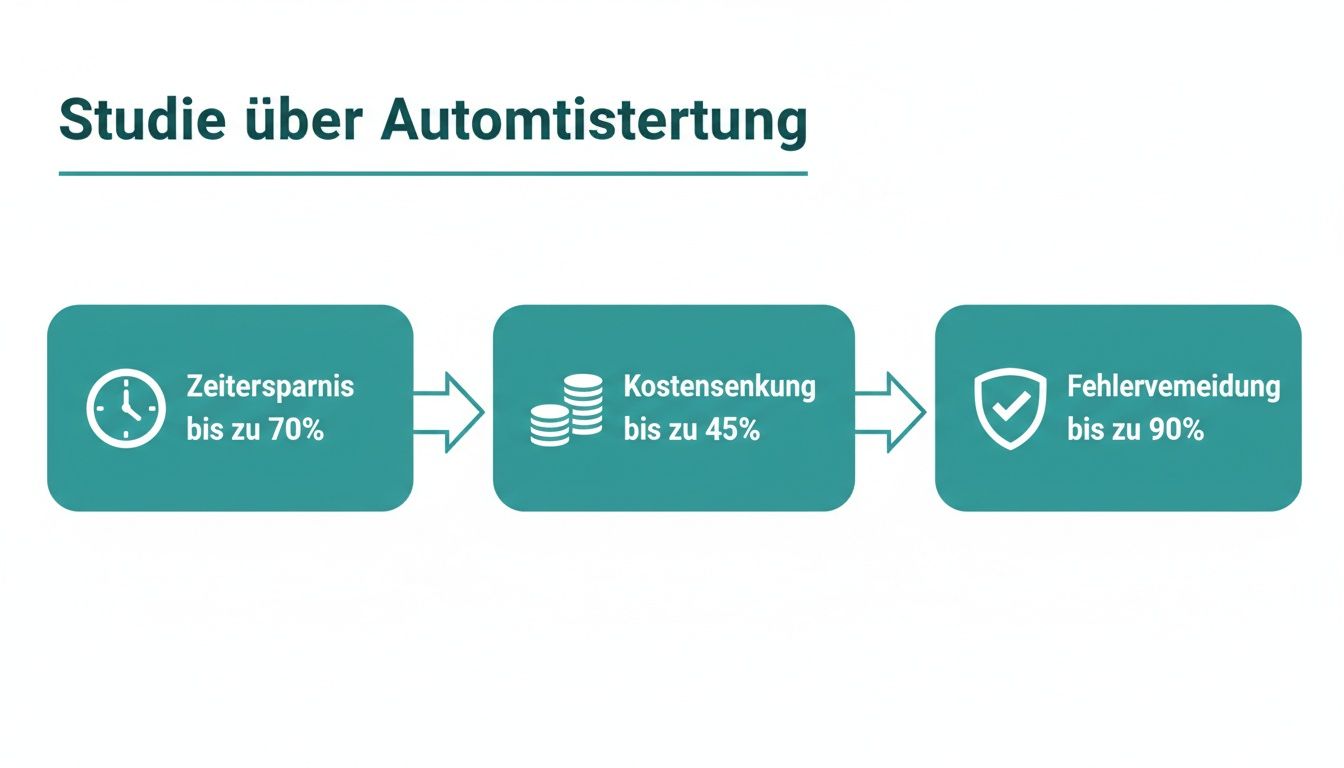
The numbers make it clear how much automated processes have an impact on performance and help companies manage their resources much more intelligently.
Increase in productivity through less routine
Imagine if your planning team no longer spends most of their day on endless phone calls, emails and manually comparing Excel lists. This is exactly where automation comes into play. The study shows that companies can reduce the administrative effort for planning by up to Reduce 70% can.
This freed up time is a direct benefit for value-adding tasks. Your planners can finally focus on what really matters:
- Predictive problem solving: Instead of just reacting to short-term failures, you can plan ahead and identify bottlenecks early on.
- Employee retention: You have more time for personal support of the team, which increases satisfaction and loyalty enormously.
- Quality management: Focusing on the right qualifications for each shift noticeably improves your company's service quality.
A catering business that took part in the study was able to reduce the time it took to create the weekly roster from six hours to under one hour. The operations manager used the time gained to develop new training programs for service personnel.
Noticeable cost reduction and financial benefits
The financial impact is often the most compelling factor. Automation is an investment that pays off surprisingly quickly. The study shows several levers that you can use to save money directly.
Firstly, you avoid expensive planning errors. Double bookings, assigning unqualified staff or not adhering to break times lead to direct costs - be it through inefficient work or even fines.
By automating deployment planning, the companies examined were able to reduce their operating costs in the planning area on average Reduce 45%. This is mainly due to less overtime, faster filling of open shifts and the avoidance of idle time.
Secondly, you massively accelerate the filling of open shifts. If an employee is absent at short notice, the system automatically sends requests to all available and qualified staff. What once took hours can now be done in minutes - without costly downtime.
More legal certainty and compliance
Compliance with working time laws, rest periods and data protection regulations (GDPR) is a major responsibility. Manual errors can quickly lead to legal problems and severe penalties. An automated system is your digital shield.
It continuously monitors compliance with all relevant rules. This way you can be sure that your company acts in accordance with the law at all times.
An example from the security industry:
A security service must ensure that its employees adhere to the legally required rest periods between operations. With hundreds of employees, it is difficult to keep track of this manually without errors.
An automated system automatically blocks the scheduling of an employee if the rest time is not reached. This reduces the risk of legal consequences to almost zero. This aspect is also a central point when you deal with the AI-based deployment planning busy.
This potential is particularly great in Switzerland. A study by Exxas and the LINK Institute shows that up to 11% of working time could be saved in office jobs through automation. Nevertheless, around half of the SMEs surveyed rate their own level of automation as backwards.
How automated planning works in your industry
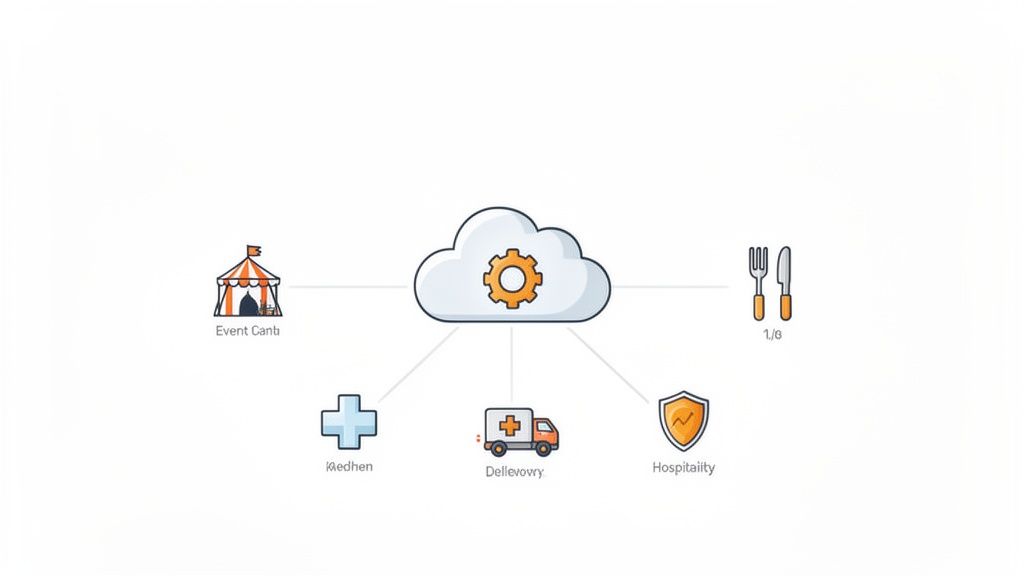
Every industry works differently, each has its own rules and rhythms in operational planning. There is simply no patent recipe. But this is exactly where the strength of a really good, automated system lies: It is flexible and adapts to the very specific challenges of your business area, instead of forcing you into a rigid corset.
Let's take a look at how automation solves specific, everyday problems in various industries. You'll quickly notice: It's about much more than just saving a few hours a week.
Event management and promotion
In the event sector, flexibility is the currency with which you pay. Large pools of freelancers, constantly changing requirements and the pressure to react at short notice - managing this manually is a nightmare.
This is where automation really comes into its own. Imagine you need something spontaneous for a weekend festival 20 additional helpers with medical training. Instead of making dozens of phone calls or hoping in WhatsApp groups, you send a single request via your system.
The software immediately filters according to the criteria “available” and “medical training” and only notifies the appropriate people. The first confirmations often land in your inbox after just a few minutes. Your team is in place and you can focus on the essentials.
Gastronomy and hotel industry
Anyone who works in the catering or hotel industry knows the daily struggle with fluctuating guest numbers. A single sunny afternoon can cause the demand for servers on the terrace to explode - or not.
An automated system is your wildcard for such unpredictable spikes. You can create shift templates for different scenarios. If the unexpected rush comes, you can activate the template for “peak activity” with just a few clicks.
The system immediately suggests available employees or sends open shifts to your personnel pool. This way you can ensure that your guests always receive the best service without constantly being over- or understaffed.
Healthcare and care
Healthcare is about much more than just attendance. The right qualification at the right time in the right place is crucial for the safety and well-being of patients. Here the planning does not forgive any mistakes.
Skills-based planning is at the heart of automation in this sector. The system ensures that the prescribed number of qualified nursing staff, nursing assistants and specialists are scheduled for each shift.
Imagine that an intensive care specialist is unavailable at short notice. The system immediately recognizes this bottleneck, sounds the alarm and specifically looks for a replacement with exactly this qualification. This practically eliminates manual errors that could have serious consequences.
Security and logistics
In the security industry and logistics, the requirements are often location- and object-related. It's not just about who works, but also where and on which route.
- For security services: An automated system can manage the occupation of hundreds of objects at the same time. It knows the specific requirements of each location, such as a firearms license or certain first aid certificates. If someone fails, the replacement is specifically sought from a pool of people who are approved for exactly that object.
- For logistics: When planning drivers, compliance with statutory driving and rest times is the be-all and end-all. Automation helps to optimize routes and seamlessly monitor these regulations. The system can even automatically suggest drivers for new trips based on their current location and remaining driving time. This noticeably improves the utilization of your fleet.
Cleaning industry
In the cleaning industry, you often juggle a large number of employees spread across countless properties. The biggest challenge: maintaining an overview and being able to react immediately to customer requests or short-term failures.
With an automated system, you can see at a glance which team is assigned to which object. You can easily organize replacements by using the software to suggest available employees in the immediate vicinity of the location.
These examples from everyday life show that automated deployment planning is much more than just a technical toy. It is a strategic response to the real, daily challenges that make every industry unique.
This is how you introduce automated deployment planning
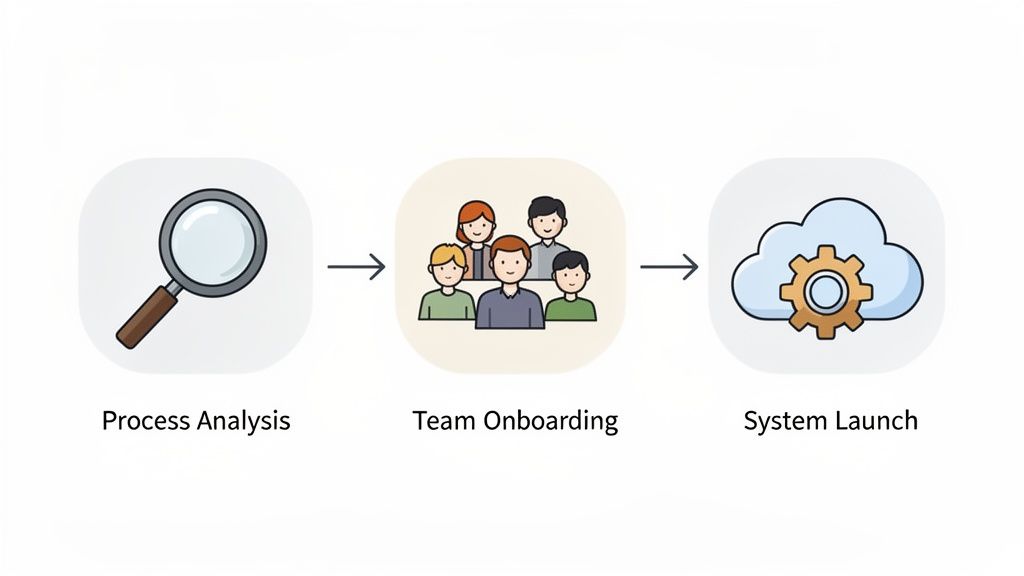
The decision to purchase new software has been made, and now you're wondering: What's next? Don't worry, introducing automated deployment planning isn't rocket science. This guide will walk you through the process step by step - without any technical gobbledygook.
It all starts with an honest inventory of your current operations. Take a moment and look closely at where the problem really is.
Step 1: Create the basis – understand your processes
Before you pick up any tool, you need to know exactly what you want to repair. Ask yourself and your team a few critical questions to uncover the biggest time wasters and sources of error.
- Where is the most time lost? Is it the tedious search for available staff for short-term absences? Or the endless coordination of vacation requests with the roster?
- What mistakes keep happening? Are you accidentally scheduling employees twice? Are you perhaps using someone without the necessary qualifications for a specific assignment?
- How complex is your communication? Are you losing track of countless emails, calls and messenger messages just to communicate shift changes?
This analysis is your foundation. It not only helps you choose the right software, but also makes the success of the change measurable later.
Step 2: Convince your team right from the start
The best software is of no use if your team doesn't accept it. Your employees are the key to success, so you have to get them on board from the start. Open communication is the be-all and end-all here.
Explain clearly and understandably what advantages the new solution brings to each individual. It's not about replacing anyone, but about making everyday working life noticeably easier for everyone.
Make it clear that it's about relief: less administrative routine means more time for more exciting tasks. More transparent planning and fairer shift distribution improve the balance between work and private life.
Organize training tailored to different roles. Ultimately, a dispatcher needs different knowledge than an employee who reports their availability via an app. Give your team time to get to know the new system in a test phase and actively collect feedback.
Step 3: Prepare data and system settings
Now it gets practical. The quality of your automated planning depends directly on the quality of your data. So make sure that all of your employees’ master data is clean and complete.
Checklist for your data preparation:
- Employee master data: Are all contact details, contracts and working time models stored correctly?
- Qualifications: Have you recorded all relevant skills and certificates (e.g. driving license, language skills, safety certificates)?
- Locations and objects: Are all locations with their specific requirements created in the system?
As soon as the database is available, you configure the system according to your rules. Determine which legal requirements or internal guidelines the software should automatically take into account. At the Use of AI and automated technologies Clean processes and good quality control are crucial. If you are looking for a suitable solution, take a look at the possibilities of modern ones Operations planning software.
By the way, Swiss organizations are leaders in automation. An investigation shows that 52% of Swiss companies use AI agentsto automate processes – significantly higher than the global average of 46%. There 80% of Swiss managers As consumers see the coming year as crucial for re-aligning their business strategies with AI, this trend will continue to grow.
Common risks – and how to avoid them
Honestly, introducing a new technology often feels like jumping into the deep end. In addition to all the opportunities, there are of course also possible hurdles. So let's talk openly about the typical stumbling blocks - and show you how you can cleverly avoid them right from the start.
Experience shows that the biggest obstacle is rarely the technology itself. It is the people who ultimately have to work with it. A lack of acceptance within the team can slow down any project, no matter how good it is, before it even gets off the ground.
Proactively address fears in the team
Employees often react to new systems with a mixture of curiosity and concern. The most common concerns are the fear of total surveillance or the fear that your own workplace will become redundant due to automation. These concerns are real and you must take them absolutely seriously.
Your most important tool here is transparency, from day one. Explain crystal clear Why You automate deployment planning and what specific advantages this has for each individual in the team. Emphasize that the aim is to get rid of annoying routine tasks so that there is more time for the really important and exciting activities.
Fortunately, the risk of being replaced by automation in Switzerland is negligible compared to other European countries. According to a study by the Federal Statistical Office (BfS), only one percent of employees have a job that combines a high proportion of routine with little autonomy - exactly the mix that is considered the main risk factor. You can find more details about this in the Analysis on 20min.ch.
Your goal must be to position technology as a supporting tool, not a replacement for human skills. Make it clear how fair, transparent and error-free planning improves everyday work for everyone.
Organize workshops and offer straightforward training courses. Give your team the chance to ask questions and try out the system for themselves. This is how you build trust and turn skeptical employees into convinced supporters.
Data quality as a crucial success factor
Another, often underestimated risk: poorly maintained data. An automated system is only as good as the information you feed it. Incorrect or outdated employee data inevitably leads to chaotic planning.
Just imagine that an employee's qualifications are not stored correctly. The system may then schedule him for a task for which he is not certified. Or outdated contact details mean that important shift information is lost.
How to ensure high data quality:
- Clear responsibilities: Designate one person or a small team to be responsible for maintaining the master data.
- Regular checks: Check the data at regular intervals. Are all certificates still valid? Are the contact details still correct?
- Involve employees: The smartest solution is to give your employees the opportunity to maintain their own data via an app. This reduces your administrative effort and massively increases accuracy.
At the beginning, invest the necessary time to build a clean and complete database. This effort may seem tedious at first, but it will pay off a thousandfold in the long run because it ensures the reliability of your entire planning.
Finding the right balance between man and machine
A final danger is blind dependence on technology. Automation is a powerful tool, but it never replaces common sense and human intuition. No algorithm in the world can take into account every unforeseen event or interpersonal intricacy.
Always stay in control. The final decision should always rest with your dispatchers. The system provides intelligent suggestions and takes away the grunt work, but human supervision remains essential.
It's about creating a smart partnership where technology serves and people retain strategic leadership. This is exactly how you use the strengths of both worlds and avoid the typical pitfalls Study about: Automating deployment planning.
Frequently asked questions about automated deployment planning
When it comes to a topic as important as automating deployment planning, questions naturally arise. We have collected the most common ones and will give you clear, practical answers here - without marketing blah blah, so that you know exactly where you stand.
How long does it take to introduce deployment planning software?
The duration depends largely on the size of your company and the complexity of your processes. With a solution like job.rocks but you can often do it within a few weeks get off to a full start.
The key is preparation. If you prepare your employee data cleanly, clearly define qualifications and know exactly what you want to achieve, everything goes much faster. The starting signal usually sounds earlier than expected.
Is automated planning also worthwhile for small companies?
Yes, absolutely. Especially in smaller teams, manual planning eats up a disproportionate amount of time - time that could be better invested in your core business and supporting your customers. The administrative effort is often just as high as in large companies, only it falls on fewer shoulders.
Modern software solutions are now scalable and absolutely affordable even for small teams. You immediately gain structure, make significantly fewer mistakes and appear much more professional to your staff.
Many small companies experience the greatest relative profit because every planning effort saved flows directly into growth and quality.
Will my dispatchers lose control due to automation?
No, quite the opposite – your dispatchers gain real control and overview. The software is a tool that relieves you of the time-consuming and monotonous routine tasks. This finally leaves more time for what really counts: personal support for employees and solving tricky problems.
They control the system, set the rules and only intervene when it is really necessary or a special situation requires human sensitivity. The final decision always remains in the hands of people; the technology simply provides the best possible basis for this.
Are you ready to simplify your operational planning and gain valuable time? Find out how job.rocks can help your business. Discover the possibilities on job.rocks now.