
Working Days per Year: Your Simple Guide to Calculation
Of course, it's not rocket science. How many days do you really work in a year? The quick answer is not 365 minus a few weekends. If you calculate honestly and subtract holidays, vacations, and usual absences, you often end up with around 200 to 220 effective working days. What are…
Of course, it's not rocket science. How many days do you really work in a year? The quick answer is not 365 minus a few weekends. If you calculate honestly and subtract holidays, vacations, and usual absences, you often end up with around 200 to 220 effective working days.
What Are Working Days per Year Really?
Working days per year are the days when you are actually productive for your company. Think of it as a net number: you take all the calendar days of a year and subtract everything that is not working time. This figure is the hard foundation for any realistic planning – whether for you personally or for the entire company.
A normal year has 365 days. A large chunk is first taken away for:
- Weekends: Usually 104 Saturdays and Sundays.
- Public holidays: These vary significantly depending on the canton.
- Your personal vacation entitlement: At least four weeks are legally required.
- Other absences: Illness, further training, or unpaid leave reduce the number even more.
Practical Significance
This number is much more than just a nice statistic. For industries like events or gastronomy, but also in security services, it is the be-all and end-all of workforce planning. A wrong calculation inevitably leads to staff shortages, overburdened teams, and budget calculations that don't add up.
A year theoretically has around 251 working days (excluding holidays), but the actually productive time is significantly less. Knowing this difference is the key to functioning personnel planning.
Statistics show it clearly: the effective annual working time in Switzerland is decreasing. The Federal Statistical Office (FSO) reports that the actual weekly working hours for full-time positions have declined. When you extrapolate this to a whole year, realistically there are rather 190 to 200 productively usable days per employee. This is a crucial figure that modern planning tools like job.rocks automatically take into account. You can find more about these developments in the FSO's Work Volume Statistics.
Knowing the exact number of working days per year helps you realistically assess your own time and ensures companies deploy their people exactly when they are really needed.
The Formula to Calculate Your Working Days per Year
To find out how many days you actually work in a year, you need a simple but absolutely reliable formula. Think of it like a funnel: at the top, you throw in all the calendar days of the year and then filter out step by step everything that is not a working day.
The basic formula is very simple and forms the basis for any serious personnel planning:
Calendar days – weekends – holidays – vacation days = your net working days
This simple calculation is the key to realistically planning your time and projects. Let's take a closer look at the individual steps.
Step 1: Calendar Days Minus Weekends
Everything starts with the total number of days in the year. A normal year has 365 days, a leap year like 2024 even 366. The first and biggest chunk we subtract is the weekends. In a classic 5-day workweek, this is exactly 104 Saturdays and Sundays in most years.
- A practical example for 2024 (leap year):
366 calendar days – 104 weekend days = 262 days
This intermediate value is our starting point. From these 262 days, we now go into detail.
Step 2: Subtract Public Holidays
Next come the holidays – and here it gets regional. The number depends heavily on your canton. For example, the canton of Zurich has 9 public holidays that can fall on a weekday, while in the canton of Fribourg you can enjoy significantly more days off. You can usually find an up-to-date list on your canton's official website.
- A practical example for 2024 in the canton of Zurich (9 holidays):
262 days – 9 holidays = 253 days
See? With each step, we get much closer to reality.
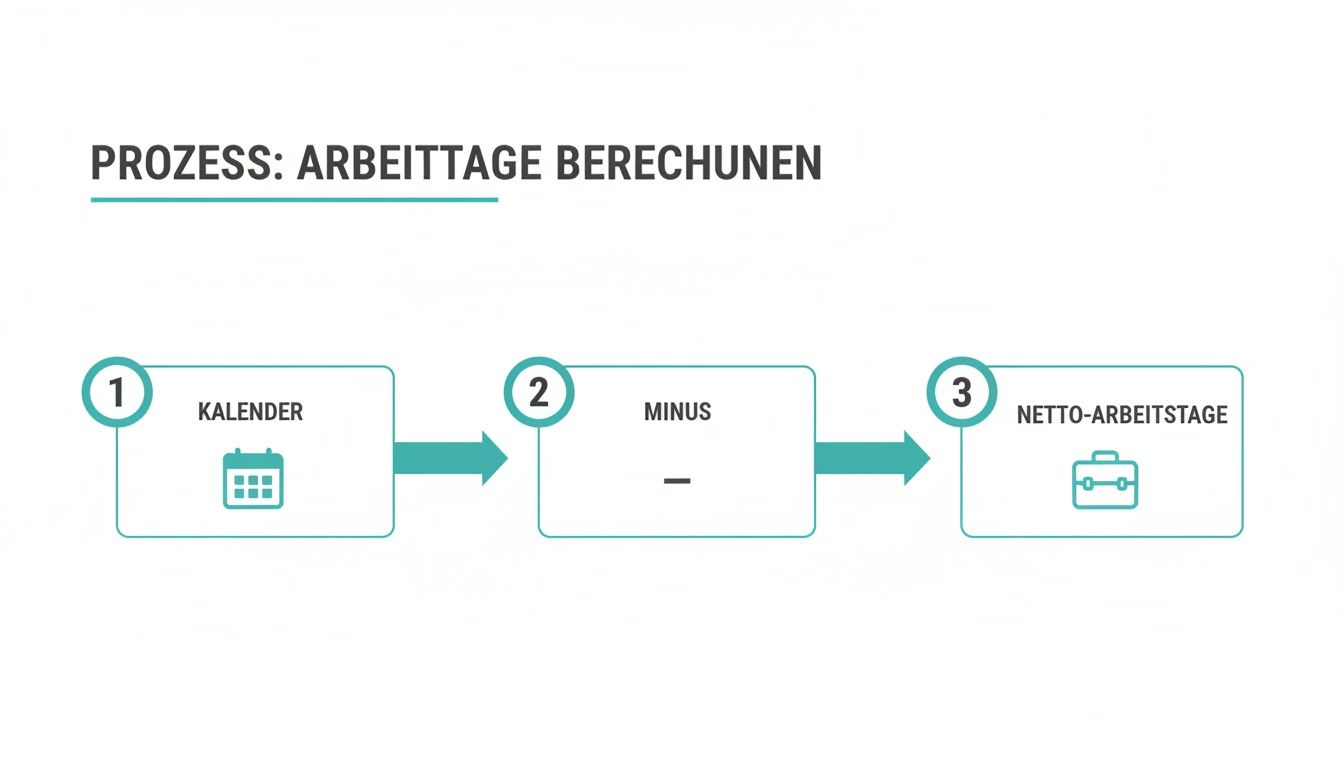
The diagram makes it clear: the calculation is a logical deduction process from large to small, from gross to net.
Step 3: Include Your Personal Vacation Entitlement
The last big item to subtract is your personal vacation entitlement. The legal minimum in Switzerland is four weeks, which corresponds to 20 working days in a 5-day week. However, many modern employment contracts include five weeks (25 days) or even more.
- A practical example with 5 weeks of vacation:
253 days – 25 vacation days = 228 net working days for 2024 in Zurich
The result is often eye-opening: Of the 366 days of a leap year, after subtracting weekends, holidays, and a solid vacation entitlement, only 228 days remain on which work is actually done.
This number is not just a nice statistic for the annual overview but a hard foundation for capacity planning. If you want to know how to convert these working days into hours, continue reading our article on how to calculate your daily working time. This gives you a complete picture of your available work capacity.
Cantonal Differences in Holidays and Working Time
Switzerland would not be Switzerland without its cantonal peculiarities – and this applies especially to working days per year. There is simply no nationwide valid number because the number of holidays is a mosaic of regional traditions and legal requirements.
In practice, this means: your place of work largely determines how many days you are effectively in the office or on assignment.
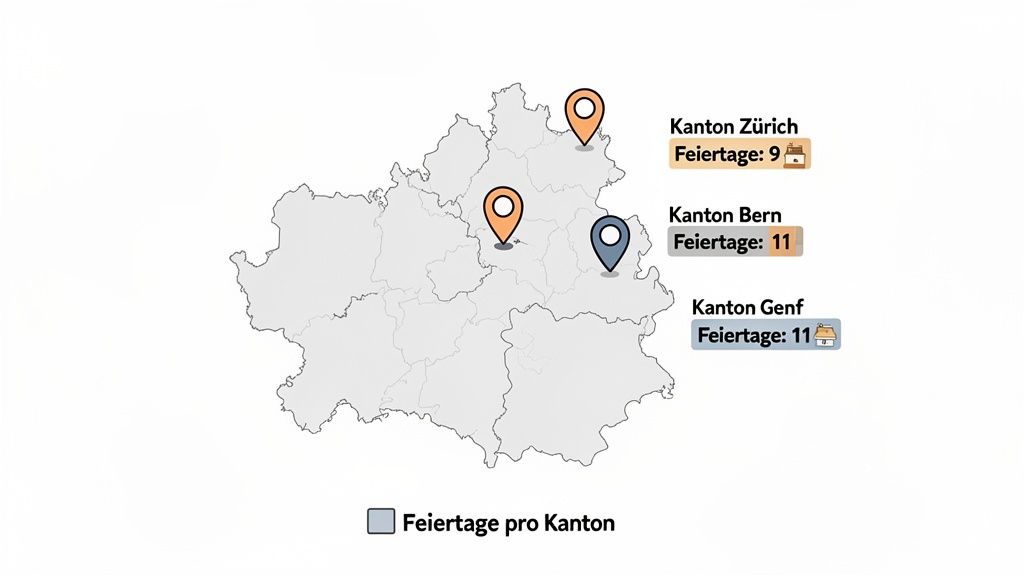
A Look at Cantonal Holidays
The differences are sometimes significant. While August 1st is the only nationwide recognized holiday, each canton adds more.
A few practical examples illustrate this:
- Canton of Zurich: Usually has 9 public holidays, which is rather few compared to the rest of Switzerland.
- Canton of Bern: Bern is a bit more generous and usually grants its employees 10 holidays.
- Canton of Fribourg: As a strongly Catholic canton, Fribourg has one of the highest numbers of holidays – often 14 or more.
An employee in Fribourg potentially has five or more days off per year compared to someone working in Zurich. This directly affects the total number of net working days and must be coldly considered in personnel planning.
Annual Working Time and Its Regional Definition
This topic becomes particularly clear when looking at cantonal regulations. The canton of Zurich sets a gross annual working time of 2,184 hours for a full-time position. Subtracting vacations, the 9 cantonal holidays, and usual absences quickly reduces the number of effectively available working days to around 215–220.
For industries with irregular demand, such as gastronomy or security services, this means that planning working days per year is extremely location-dependent. You can find more details on this calculation directly from the canton of Zurich.
For companies with staff at various locations, it is therefore crucial to know these regional conditions. A uniform calculation for the whole of Switzerland inevitably leads to planning errors.
These cantonal differences are also relevant for payroll. Correct recording of working time according to the collective labor agreement (GAV) is a complex task that requires precise knowledge of local rules. In our article on working time recording according to L-GAV, you can learn more about how to proceed legally safely here.
Calculating working days is also important for determining fair wages and understanding cantonal peculiarities in working time. Here you find a detailed overview of fair hourly wages and cantonal differences for cleaning staff. These differences make clear why automated and location-based planning, as enabled by job.rocks, is indispensable for companies with flexible teams.
Why the Exact Number of Working Days Is So Important
Calculating working days per year may sound like dry bookkeeping, but in truth, it is the foundation for every functioning personnel and deployment planning. Especially in dynamic industries like gastronomy, events, or logistics, this number decides success or failure.
Imagine you are planning a large music festival in summer. Your calculation is based on the assumption that every employee is available around 250 days a year. A fatal mistake if you forget to subtract individual vacation entitlements and a realistic quota for sick leave.
The Consequences of Inaccurate Planning
What happens? In the critical phase, when you need every head, suddenly far fewer people show up than expected. The result is a nightmare: remaining employees work endless overtime, service quality collapses, and in the worst case, entire areas can no longer be covered.
Such staff shortages are not only pure stress but also an expensive affair. They drive wage costs up through overtime premiums and can jeopardize the profitability of your entire project. Knowing the effective, i.e., actually available working days per employee is therefore not a "nice-to-have" but absolutely crucial.
The difference between the theoretical number of working days and the actually available net working days is no small matter. It can quickly amount to 30 to 40 days per employee – almost two full working months!
More Than Just Shift Planning
The practical use of this figure goes far beyond pure shift distribution. Smart companies use net working days as a hard basis for many central business processes:
- Budgeting: Personnel costs are calculated based on realistically available working hours, not theoretical desired values.
- Personnel demand forecasting: You can predict for the whole year how many employees you really need for seasonal peaks or large projects.
- Accurate payroll: Especially for hourly wage earners, the exact number of days worked is the basis for error-free billing.
- Fair work distribution: Realistic planning helps avoid overloading individual employees and distributes work fairly across the entire team.
Ultimately, precise calculation of working days per year not only secures the profitability of your projects but also the satisfaction and resilience of your team. It turns a seemingly simple number into a powerful tool for forward-looking and fair management.
How the Number of Working Days per Year Changes
The number of working days per year is anything but fixed – it is constantly changing. Trends like the desire for more flexibility, the massive increase in part-time work, and longer vacation entitlements are fundamentally reshaping the working world. What does this mean in practice? Available working time per employee is gradually but noticeably decreasing.
For companies, this means concretely: to deliver the same work performance as before, they often have to increase their personnel pools or design their deployment planning much smarter. The traditional full-time position as the sole benchmark for personnel planning is losing significance.
The Trend Toward Fewer Hours per Capita
This change can be clearly quantified. A look at the development of annual working time in Switzerland shows how the number of working days per year is slowly but surely moving downward – with direct consequences for deployment planning. According to industry associations, the annual working time has dropped from 1,610 to 1,495 hours within just ten years.
That is a hefty minus of around 115 hours, which in practice corresponds to almost 14 full working days per year! At the same time, the weekly working time of full-time employees has decreased to around 40 hours. Dividing the 1,495 hours by a classic 8-hour day statistically leaves only about 187 effective working days. You can read the exact background of this development in detail at papershift.com.
However, this reduction does not mean that less work is done overall. The total work volume in Switzerland has even increased. It is just distributed among more people, higher part-time rates, and more absence days.
Especially for industries with high demand for temporary assignments – such as events, logistics, or cleaning – this is a real challenge. Per employee, fewer full working days are available over the year, while demand remains unpredictable and often short-term.
Modern systems like job.rocks must factor in this structural shortening of available time from the start. Only then can personnel pools be dimensioned large enough, shifts realistically staffed, and looming bottlenecks detected early before they become a problem.
Simplify Workforce Planning with Automated Calculation
Honestly: manually calculating the working days per year for each individual employee is a tedious and error-prone task. Especially with large teams and flexible work models, this quickly becomes an ungrateful task that no one wants to do. This is exactly where digital helpers come into play, simplifying this process or even doing it completely for you.
Modern software solutions take this burden off your shoulders. They automatically consider all the small but important details: cantonal holidays, individual vacation entitlements, or planned absences like training or sick leave. The result? A constantly up-to-date and crystal-clear overview of your available personnel capacities.
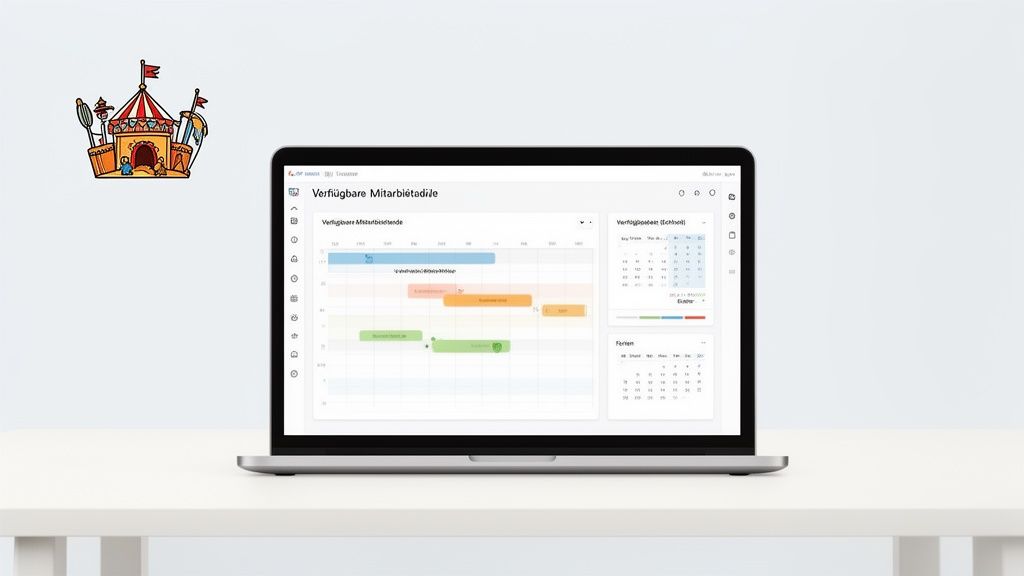
Planning Security in Real Time
Imagine you are planning a large music festival. The schedule must be perfect because every short-term absence can shake the entire process. Instead of struggling through endless Excel tables, an intelligent system shows you at a glance who is really available.
A good dashboard visualizes your capacities and immediately makes potential bottlenecks visible. You see exactly how many people are scheduled for the main stage, gastronomy, or security service – and where gaps still exist. This way, you can act proactively instead of just reacting and optimally manage your team.
An automated system not only calculates the working days per year but turns these bare numbers into a reliable decision-making basis. This saves a lot of time and massively improves the quality of your planning.
With the right workforce planning software, you can finally focus on what really matters: the smooth running of your business. The software ensures in the background that the numbers are correct and your team is always optimally positioned.
Especially in complex areas like care, exact planning is vital. To see how these principles work in practice, you can read in a further guide how professionals create a duty roster for care. The approaches shown there can be wonderfully transferred to many other industries and underline how crucial structured and fair planning is for success.
Any Questions? Here Are the Answers.
Great, the basics for calculating working days per year are set. But in everyday life, a few detailed questions often arise. Let's clear up the most common uncertainties so you are prepared for every situation.
Do Saturdays Count as Working Days?
In the classic 5-day week from Monday to Friday, the answer is a clear no. Saturdays and Sundays are considered weekends and are subtracted flatly when calculating net working days.
Of course, the situation often looks different in retail, gastronomy, or logistics. If your employment contract provides for a 6-day week, then Saturday is naturally a normal working day for you and must be included in your calculation.
How Do I Handle Sick Days in the Calculation?
Sick days are by definition unpredictable – therefore, they do not appear in the basic formula at first. However, for realistic planning, it is absolutely clever to build in a buffer for illness-related absences. Planning with 100% capacity means planning past everyday reality.
Many companies calculate with an average sickness rate of 3–5% of annual working time. This corresponds to roughly 7 to 12 days per employee per year. Subtract these days from your net working days, and you already have a much more realistic number for your capacity planning.
A quick practical example: you calculated 228 net working days. A smart planner rather calculates with about 218 actually productive days. This leaves room for the unforeseen without the whole project shaking.
What Is the Difference Between Working Days and Business Days?
These two terms are constantly confused, although they mean something completely different. Let's keep it simple:
- Business days: These are all days from Monday to Saturday, as long as they are not public holidays. A year therefore has many more business days than working days. This term is mainly relevant for legal deadlines.
- Working days: These are the days you actually work according to your contract – mostly Monday to Friday.
For your workforce planning, project calculation, and payroll, only one number counts in the end: the working days per year. It reflects the real, available work performance.
Do I Need to Adjust the Formula for Part-Time?
Yes, absolutely! The standard formula assumes a 100% position. For part-time, you have to adjust it to your individual workload.
Suppose you work three fixed days a week. Then you don't calculate with 52 x 5 but start your calculation with 52 x 3 days as the basis.
Alternatively, and often easier, you take the full-time result and multiply it by your part-time factor. For a 60% workload, this would be: 228 working days x 0.60 = around 137 working days. This way, you quickly and easily get an accurate number for your situation.
Want to finally leave the calculation and management of your working days per year behind? job.rocks automates your entire workforce planning, considers all absences, and gives you a crystal-clear overview of your available capacities at any time. Discover the benefits now on job.rocks