
30-Hour Week: What Percentage Is That? Table and Calculator Switzerland
30 hours per week correspond to 75% for 40h, 73.2% for 41h, and 71.4% for 42h. Includes table, formula, and Swiss practical examples.
30-Hour Week: What Percentage Is That? The quick answer: For a 40-hour week, 30 hours are 75%. For a 41-hour week, it is 73.2%. For a 42-hour week, common in Switzerland, 30 hours correspond to 71.4%.
Key Points in Brief
- Formula: Weekly hours ÷ full-time hours × 100 = percentage workload.
- 30h with 40h full-time: 75%.
- 30h with 41h full-time: 73.2%.
- 30h with 42h full-time: 71.4%.
- Swiss practice: Always check your employment contract, collective labour agreement (GAV), or company full-time basis before deriving salary, vacation, or scheduling from it.
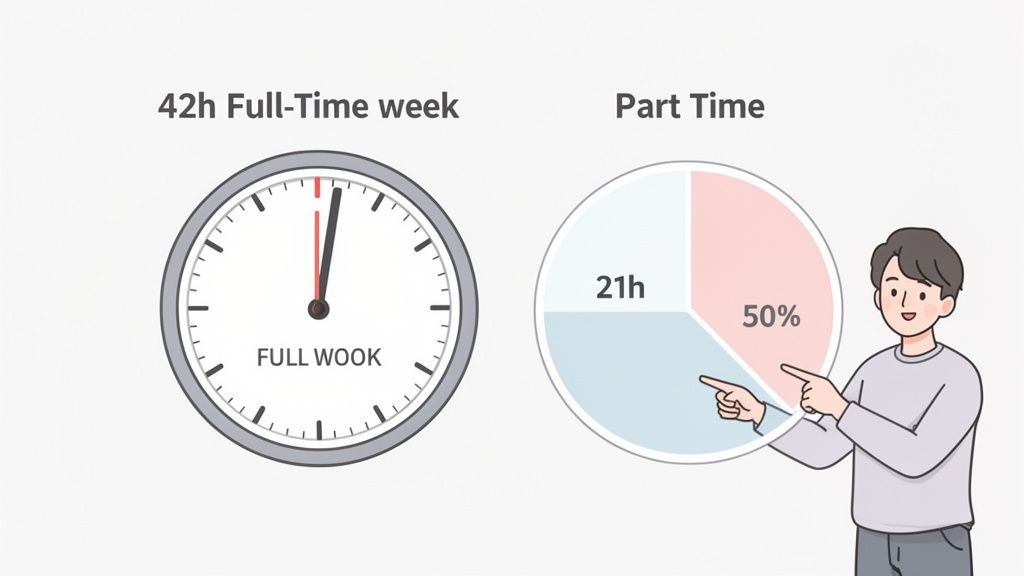
If you want to quickly and correctly convert your working hours into a percentage workload, you only need two values: your agreed or actual hours and the full-time basis at your company. A practical example: You work 21 hours per week and the full-time basis is 42 hours. The calculation is: (21 ÷ 42) × 100 = 50%.
⏱️ Interactive Workload Calculator
Why Converting Your Workload Percentage Is So Important
Expressing your workload as a percentage is much more than just a number in your employment contract. It directly affects many areas of your working life. Without a clear understanding of how your hours convert into percentages, misunderstandings or even errors can quickly arise in important matters.
A correctly calculated workload primarily creates clarity and fairness. It ensures that your salary, social benefits, and vacation entitlement are exactly based on your contractual agreement. Especially in Switzerland, where weekly full-time hours can vary by industry and canton, an accurate conversion is essential.
A common misunderstanding is that a 50% workload always means 20 hours per week. This is only true for a 40-hour week. In many Swiss industries with a 42-hour week, a 50% workload already corresponds to 21 working hours.
This percentage is the basis for many administrative processes in your company. It helps HR to plan resources correctly and gives you the assurance that your work performance is fairly accounted for.
Before we look at more complex cases, the following table gives you a quick overview of common workloads for a widely used 42-hour full-time week in Switzerland.
Common Part-Time Workloads and Their Hours for a 42-Hour Week
This table shows at a glance how many working hours per week common part-time percentages mean for a typical Swiss full-time week of 42 hours.
| Workload in Percent | Weekly Working Hours | Typical Industries |
|---|---|---|
| 100 % | 42.0 hours | All industries |
| 90 % | 37.8 hours | Office, administration |
| 80 % | 33.6 hours | Office, IT, healthcare |
| 70 % | 29.4 hours | Parental part-time, care professions |
| 60 % | 25.2 hours | Sales, consulting |
| 50 % | 21.0 hours | Gastronomy, retail |
| 40 % | 16.8 hours | Side jobs, student work |
| 30 % | 12.6 hours | Mini-jobs, temporary help |
| 20 % | 8.4 hours | Marginal employment |
With this overview, you already have a solid basis for the most common part-time models. This way, you can quickly estimate what a certain workload means in practice.
30-Hour Week: What Exactly Is the Percentage?
The search query "30 hours week what percentage" sounds simple but often leads to wrong answers because the percentage does not depend on the 30 hours alone. The decisive factor is always how many hours are considered 100% full-time in your company.
| Full-Time Basis per Week | Calculation | 30 hours correspond to | Typical Use |
|---|---|---|---|
| 40 hours | 30 ÷ 40 × 100 | 75.0 % | Common in office, administration, many modern contracts |
| 41 hours | 30 ÷ 41 × 100 | 73.2 % | Intermediate model depending on company or GAV |
| 42 hours | 30 ÷ 42 × 100 | 71.4 % | Common reference in many Swiss industries |
| 38.5 hours | 30 ÷ 38.5 × 100 | 77.9 % | Some companies, tariff/GAV models, international groups |
For most Swiss HR and planning cases, "30 hours = 75%" is therefore not automatically correct. Correct is: 30 hours are 75% only if 40 hours are considered full-time. With 42 hours full-time, the same weekly workload is 71.4%. This difference is important when vacation entitlement, target hours, monthly salary, scheduling, or time tracking are based on it.
Example for a Swiss Company with a 42-Hour Week
An event company plans flexible employees with a 42-hour full-time basis. An employee now works 30 hours per week. For scheduling, this means:
- 30 weekly hours correspond to a 71.4% workload.
- With 4 working weeks, this is about 120 target hours per month.
- For vacation, holidays, or irregular assignments, the target time must be accurately broken down for the specific period.
Especially for teams with part-time, temporary staff, or changing assignments, a rough percentage is often not enough. You need a clear basis documented in the employment contract, GAV, or internal HR regulation.
Work Time in Percent Table: 30, 32, 35, and 36 Hours Compared
Many users search not only for 30 hours but compare several part-time models. The following table helps you quickly classify common weekly hours. It is especially useful when preparing job percentages, target hours, or duty rosters.
| Weekly Hours | at 40h Full-Time | at 41h Full-Time | at 42h Full-Time |
|---|---|---|---|
| 20 h | 50.0 % | 48.8 % | 47.6 % |
| 24 h | 60.0 % | 58.5 % | 57.1 % |
| 28 h | 70.0 % | 68.3 % | 66.7 % |
| 30 h | 75.0 % | 73.2 % | 71.4 % |
| 32 h | 80.0 % | 78.0 % | 76.2 % |
| 35 h | 87.5 % | 85.4 % | 83.3 % |
| 36 h | 90.0 % | 87.8 % | 85.7 % |
The table is deliberately intended as guidance. For binding HR decisions, the agreed full-time basis always counts. The SECO explains the principles of working and rest times; concrete target hours result from contract, GAV, and company practice. For statistical classification of Swiss working hours, the Federal Statistical Office is also a reliable source.
When a Table Is Enough – and When You Need Software
For a single person, a simple formula or table is usually sufficient. But as soon as you plan multiple employees with different workloads, changing shifts, vacations, absences, and short-term assignments, percentage calculation quickly becomes part of a larger process.
| Situation | Table Suffices | Software Is Useful |
|---|---|---|
| A single fixed part-time workload | Yes, formula is enough | Not necessarily |
| Multiple part-time models in a team | Only with careful maintenance | Yes, for overview and fewer errors |
| Flexible assignments per week | Risky | Yes, especially with mobile time tracking |
| Temporary staff, events, gastronomy or care | Only as auxiliary calculation | Yes, because planning, communication, and hours are linked |
| Month-end closing and payroll preparation | Error-prone | Yes, if target/actual hours must be traceable |
job.rocks does not replace legal labour advice or payroll specialist software. However, the platform helps you to combine assignments, availabilities, mobile feedback, and time tracking more cleanly. For flexible teams in Switzerland, you can work much more structured with the assignment planning software, the personnel planning tool, the time tracking app, and the employee app than with individual Excel files. Entry is possible via Forever Free; with growing needs, pay-per-use starts at 1.20 CHF / assignment. If you want to check whether this fits your team, find the prices here or book a demo directly.
The Formula in Detail: How to Calculate Your Workload (with Practical Examples)
Fortunately, calculating your workload in percent is not rocket science. Basically, you only need two numbers: your actual hours worked and the hours considered 100% full-time at your company.
The formula you need is very simple:
(Your hours worked ÷ hours of a full-time position) × 100 = Your workload in percent
This simple tool is flexible. You can apply it for single days, entire weeks, or even months – depending on what is most relevant for you.
Calculation for a Single Workday
Imagine you work as an event technician at a festival. A normal working day there lasts 10 hours. On a quieter setup day, you only work 6 hours.
Your calculation looks like this:
(6 hours worked ÷ 10 full-time hours) × 100 = 60%
For this day, you have fulfilled a workload of 60%. This daily view is useful especially for project-based jobs or very flexible assignments.
Calculation for a Workweek
Now let's take another scenario: a service employee in gastronomy. Weekly schedules are often irregular here. The company full-time is set at 42 hours per week. In a somewhat quieter week, you work 35 hours.
The calculation for this week is:
(35 hours worked ÷ 42 full-time hours) × 100 ≈ 83.3%
Your workload for this specific week is thus about 83.3%.
Calculation on a Monthly Basis
Especially in industries with strongly fluctuating weekly hours, such as security services, monthly accounting really makes sense. Suppose the company full-time for the month is 168 hours. You worked a total of 120 hours in this period.
The monthly formula applies here:
(120 hours worked ÷ 168 full-time hours) × 100 ≈ 71.4%
Your workload for the month is thus about 71.4%. How you determine the correct working hours per month for your calculation can vary from company to company and is often regulated in the employment contract or GAV.
With these concrete practical examples, you have the tools to quickly and safely determine your own workload. It is a simple step to gain full transparency about your employment level.
What to Do in Special Cases Like Irregular Working Hours?
Reality at work is rarely as straightforward as a fixed number of weekly hours. What do you do if your working hours fluctuate strongly, as is often the case in hospitality or project work? We now take a closer look at these tricky cases so that you can also correctly determine your workload here.
A classic scenario is seasonal work, where you work significantly more in one month than in the next. Instead of looking at each week individually, it makes more sense here to calculate an average over a longer period.
Calculating Average Workload with Fluctuating Hours
If your working hours vary from month to month, calculating an average workload gives the fairest and most accurate picture. Simply add up the hours worked over a meaningful period – for example, a quarter – and divide by the corresponding target hours for the same period.
A practical example from the event industry:
An employee works different hours over three months. The full-time basis in the company for this period is 504 hours (3 months × 168 hours).
- Month 1: 180 hours
- Month 2: 140 hours
- Month 3: 165 hours
First, add the total hours: 180 + 140 + 165 = 485 hours.
Then apply the known formula:
(485 hours worked ÷ 504 full-time hours) × 100 ≈ 96.2%
His average workload for this quarter is thus about 96.2%. This value reflects his actual utilization much better than a single week or month view ever could.
This infographic shows you a simple decision path on how to best proceed when calculating your workload.
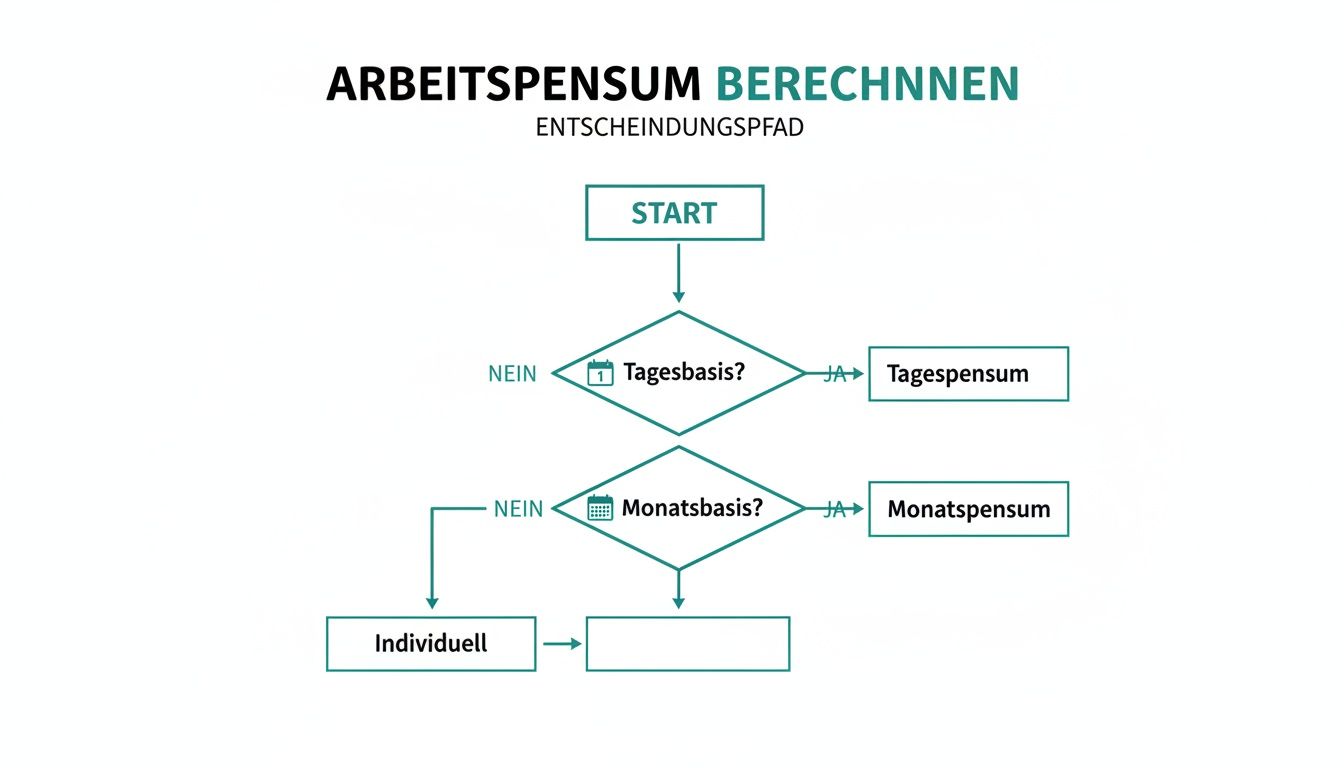
The graphic makes clear: The first step is always choosing the correct calculation basis, whether per day, month, or over an individual period.
Holidays and Special Features for Freelancers
Another point is paid holidays. If they fall on one of your regular working days, the hours allocated count normally as your working time. They are simply included in your calculation and do not distort the result. In our guide on calculating daily working hours, you will find more details.
For freelancers, things are often even more flexible. There is rarely a fixed full-time reference here. Many self-employed define their own "full-time", for example 40 hours per week, to measure their utilization. If you work 30 hours in a week, your utilization is 75%.
This percentage helps you not only with internal planning but also to transparently communicate to clients how much capacity you dedicate to their project.
The working culture in Switzerland is characterized by high labour market participation. A total of 8.117 billion working hours were performed, highlighting the importance of exact recording. More facts about the work volume in Switzerland can be found on the Federal Statistical Office's website.
Why the Exact Percentage Is So Important for You and Your Team
Converting your working time into a percentage is much more than just a dry number in the employment contract. It is the foundation for crucial areas of your job – from payroll to vacation planning to your social benefits. An exact calculation creates transparency and above all fairness.
Imagine your workload is calculated as 71.4% when it should actually be 75%. At first glance, the difference may seem small. But over months or even years, this adds up to a noticeable financial disadvantage. Only if the percentage is correct can the salary at the end of the month also be correct.
Fair Pay and Clear Entitlements
An exact percentage is the prerequisite for fair pay. It ensures that your salary exactly corresponds to the workload you have contractually agreed upon. At the same time, it is the basis for the correct calculation of your vacation days.
Simply put: With an 80% workload, you are entitled to 80% of the vacation days of a full-time position. If the percentage is wrong, your vacation entitlement is also incorrect.
Furthermore, a clean calculation helps avoid errors in recording and compensating overtime. Your workload defines your target working time – everything beyond that must be clearly recognizable and billable as overtime.
The Basis for Smart Personnel Planning
For team scheduling, the workload in percent is also crucial. It helps supervisors realistically assess available resources and distribute tasks fairly. This way, personnel bottlenecks can be avoided and a balanced workload for all ensured.
For a stable classification, it is worth looking at official sources: The Federal Statistical Office regularly publishes data on employment and working hours in Switzerland. For your concrete percentage calculation, however, the company full-time basis remains decisive, not an average value from statistics.
When you understand the connections, you are much more aware of your rights and obligations. A correct value provided by a workload-in-percent calculator gives you the assurance that everything is fair and correct.
End Excel Chaos: How Tools Automate Your Working Time Calculation
Do you know this? Manual calculations in Excel are not only time-consuming but also a source of errors. Especially when flexible working models, holidays, or variable weekly hours come into play, manual maintenance becomes complicated.
Modern systems take this work off your hands. Instead of tediously typing formulas into spreadsheets, you or your employees record working times digitally, often simply via smartphone app. The conversion into percent is then done by the software in the background – automatically and in real time.
From Manual Effort to Strategic Overview
Digital helpers like job.rocks are designed to consider individual contract details and fluctuating working hours from the start. For you as a planner, this means less administrative effort and significantly higher accuracy in payroll.
This image illustrates how a modern platform connects time tracking and planning.

The days when data had to be laboriously transferred from one system to another are over. All information flows into a central database, which not only saves time but also eliminates typical transfer errors.
The real advantage, however, is the reporting function. With a few clicks, you create reports that clearly show the workload per person or for entire teams in percent. This way, you always keep an overview and create an absolutely reliable basis for payroll. Automating these routine tasks is a building block for efficient personnel planning.
Do not see such tools only as a simple workload-in-percent calculator. They are rather a complete solution that secures and noticeably simplifies the entire process from recording to payroll preparation.
Frequently Asked Questions About Working Time in Percent
❓ 30-Hour Week: What Percentage Is That?
30 hours per week correspond to 75% for a 40-hour week, 73.2% for a 41-hour week, and 71.4% for a 42-hour week. The formula is: 30 ÷ full-time hours × 100.
❓ Are 30 Hours Always 75 Percent in Switzerland?
No. 75% is only correct if 40 hours are considered full-time. For a 42-hour week, common in Switzerland, 30 hours are about 71.4%. Always check your employment contract, GAV, or internal HR regulation.
❓ How Do I Plan 30-Hour Workloads in a Flexible Team?
First, set the full-time basis, calculate the target hours from it, and plan assignments, vacations, and absences against this target time. For multiple employees, digital assignment planning with time tracking is useful to keep target/actual deviations visible.
❓ How Do I Calculate My Workload for a 40-Hour Week?
The logic remains the same; only the full-time basis changes. Suppose you work 30 hours per week in a company with a 40-hour week.
The calculation is simple: (30 hours ÷ 40 hours) × 100 = 75%.
Your workload is thus 75%. It is always important to use the correct full-time hours of your company as the basis – a quick look at the employment contract provides certainty.
❓ What Counts as Full-Time in Switzerland?
There is a peculiarity here: Switzerland has no nationwide law prescribing a fixed number of hours for full-time. The usual weekly working time can vary greatly depending on industry and collective labour agreement (GAV).
In practice, most full-time positions range between 40 and 42 hours per week. To have the exact value for your calculations, your personal employment contract or the applicable GAV is the most reliable source.
❓ Do Overtime Hours Count Toward My Percentage Workload?
No, and this is an important point. Your percentage workload always reflects only your contractually agreed target working time.
Overtime is by definition a deviation from this norm. It is recorded separately, either compensated with pay or time off, but it does not change your contractually fixed base workload.
Your workload describes your contractual obligation. Overtime is a temporary exceedance of this obligation and is treated separately.
❓ How Do I Handle Unpaid Leave in Monthly Calculations?
Unpaid leave is a special case that requires adjusting the calculation basis. To fairly calculate the workload for a month with unpaid leave, both target hours and actual hours must be adjusted.
In most companies, the days of unpaid leave are simply deducted from the monthly target working time. This creates a new, reduced calculation basis for that specific month. Since the exact handling depends on internal guidelines, it is best to clarify this briefly with HR. This avoids misunderstandings and ensures correct accounting.
❓ How Do I Calculate My Workload with Fluctuating Working Hours?
For strongly fluctuating working hours (e.g., seasonal work, event industry), averaging over a longer period is fairest:
- Add all hours worked in the period (e.g., quarter)
- Determine the target full-time hours for the same period
- Apply the formula: (Total hours ÷ target hours) × 100
Example: 485 hours in 3 months with 504 target hours = (485 ÷ 504) × 100 = 96.2%
❓ What Role Do Holidays Play in the Calculation?
Paid holidays that fall on your regular working days count normally as working time. You do not have to deduct or treat them differently – they simply flow as regular working hours into the calculation.
❓ How Does a Digital Working Time Calculator Help Me Specifically?
Modern tools like job.rocks offer you several advantages:
- Automatic calculation in real time without manual formulas
- Traceable payroll through a central data basis
- Clear reports at the push of a button for individuals or teams
- Consideration of holidays, vacation, and special cases
- Mobile time tracking via smartphone app
This not only saves time but also gives you the assurance that all calculations are correct and traceable.
🚀 End Excel Chaos!
job.rocks connects assignment planning, mobile feedback, and time tracking so that working hours and workloads remain transparent – especially for flexible teams.