
Create a requirements profile: 5 steps & template for HR planning
A faulty requirements profile is a leading cause of expensive bad hires. It is not enough to list the tasks of a role; you need to define which competencies the ideal employee needs to achieve the role objectives. This how-to guides you through the 5 steps…
A faulty requirements profile is a leading cause of expensive bad hires. It is not enough to list the tasks of a role (job description); you need to define which competencies the ideal employee must bring in order to achieve the role objectives. This how-to guides you through the 5 steps for creating a realistic, future-proof requirements profile.
1. From role objective to target profile (how it differs from a job description)
The first step is to clearly define the target profile for the future role. Do not confuse the requirements profile with the job description.
- Job description: Lists the tasks and the role’s position in the hierarchy (e.g. preparing monthly reports, supporting management).
- Requirements profile: Defines the qualifications and skills needed to perform these tasks successfully (e.g. very good SAP knowledge, analytical thinking).
Tip: Define the role objectives first. What does the person need to achieve in the first 12 months? The required competencies are derived from that.
Example:
- Role objective: Reduce the error rate in production by 15% within the first year.
- Derived target profile (competencies): Ability in process analysis (methodological competence) and openness to criticism (personal competence) in order to communicate optimisation needs transparently.
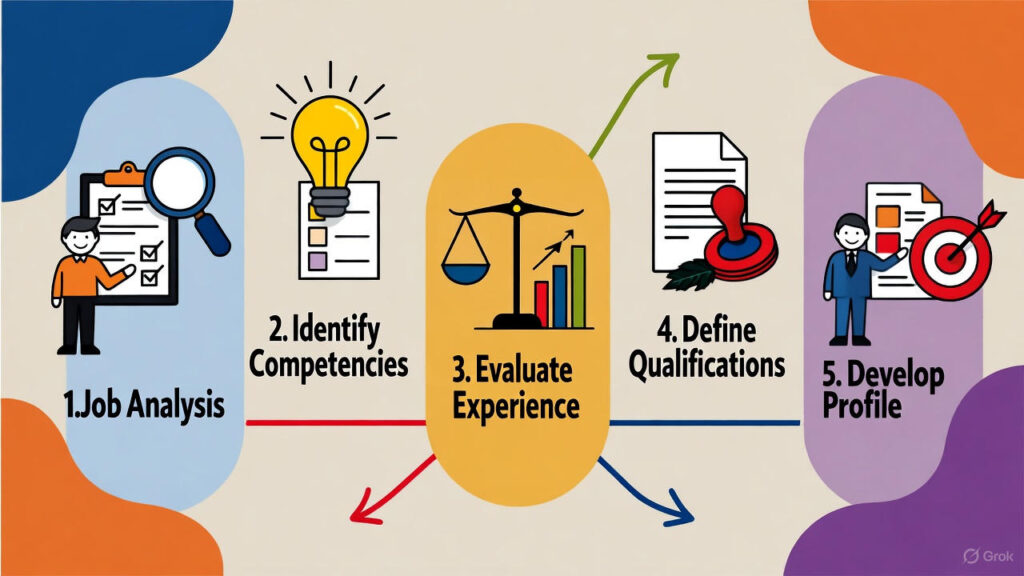
2. Competency split: hard skills, soft skills and methodological competence
At the core of the requirements profile is the breakdown of required competencies into measurable categories:
- Hard skills (technical competence): Measurable, learned knowledge (e.g. language skills, certificates, programming skills).
- Soft skills (social competence): Personal and social abilities (e.g. teamwork, communication skills, adaptability).
- Methodological competence: Skills used for problem-solving and in work processes (e.g. analytical thinking, project management methods).
Only when you cover all three areas do you get a complete competency profile.
Example for a «Senior Account Manager»:
- Hard skill: Business-fluent English, CRM system expertise.
- Soft skill: Empathy and conflict-resolution ability.
- Methodological competence: Strategic planning (developing sales strategies).
3. Requirements matrix: knockout criteria and weighting
A common mistake is to weight all requirements equally. A realistic profile must distinguish between must-haves and nice-to-haves. Use a requirements matrix to prioritise criteria:
- Mandatory criteria (knockout criteria): Without this qualification, the role cannot be performed (e.g. completed vocational training).
- Target criteria: Desirable competencies that accelerate success (e.g. 3 years of professional experience).
- Optional criteria: Additional qualifications that are helpful but not essential (e.g. additional degree).
This matrix is essential for qualitative workforce planning, because it enables objective preselection in recruiting and prevents you from setting unrealistically high requirements.
Example (weighting 1 to 5, 5=knockout): | Requirement | Weighting | Category | | :— | :— | :— | | Experience with SAP FI/CO | 5 (must) | Hard skill | | Teamwork | 4 (target) | Soft skill | | Experience in the solar industry | 2 (optional) | Hard skill |

4. Target-actual comparison and the role of HR tools
Before you start recruiting, you need a target-actual comparison: are the required competencies already available in the company?
Many companies use standard HR systems such as Teamhero, Personio or specialised tools such as Staffcloud to manage employee data, holiday planning and broad qualification profiles. These tools are excellent for purely quantitative inventory management and short-term shift and workforce planning.
But when it comes to dynamic, future-oriented competency development, these tools are often limited:
- Personio and Teamhero do offer qualification dashboards, but their focus is on documented (historical) qualifications and the administration of absences and training.
- Staffcloud is often specialised in managing flexible work teams and quickly assigning roles, but rarely offers in-depth, forward-looking competency gap analysis for strategic workforce development.
Here is the direct comparison of Staffcloud vs job.rocks: https://job.rocks/staff-cloud-alternative/
job.rocks goes beyond simple administration and focuses on the strategic competency model of qualitative workforce planning. Unlike the rigid structures of competitors, job.rocks gives you an intelligent requirements matrix that compares the role’s target profile with the future potential of your existing employees. We use AI-supported analyses to:
- Compare the target profile directly with the competencies of the entire workforce.
- Automatically identify competency gaps (target-actual analysis).
- Suggest concrete internal development measures (reskilling) before you start expensive external recruiting.
Example:
- Result in Teamhero/Personio/Staffcloud: «3 employees have knowledge of ‹English›.»
- Result in job.rocks: «3 employees have the hard skill ‹English›. But only 1 employee shows the personal competence ‹high resilience› required in the target profile for challenging customer support in the Swiss market. We suggest targeted reskilling for employees X and Y to strengthen resilience, because a new hire would be 30% more expensive.»
With job.rocks, you turn the requirements profile from a static document into a dynamic steering instrument for strategic workforce development.
5. The requirements profile as a dynamic tool
Your requirements profile is not a rigid document; it must be dynamic and future-oriented. As part of qualitative workforce planning, regular review and adjustment are required, especially in fast-moving areas such as IT or AI.
- Future orientation: Are you creating a profile for a role as it is today, or for the role in three years? Make sure you integrate future skills (e.g. working with LLMs or data analysis) early on.
- Regular assessment: Use feedback discussions and performance evaluations to check whether the competencies actually shown match the profile.
This ensures that your requirements profile is not just a hiring checklist, but a strategic instrument for securing your entire company’s expertise (E) over the long term.
Further reading: The requirements profile is a central pillar of qualitative workforce planning. As a next step, learn how to use these profiles strategically to plan your overall staffing needs in a future-proof way: